
BuddhistCatholicContemplativeEvangelicalGeneral ChristianHinduJewishLatter-day SaintMuslimNew VisionsProgressive Christian
Beliefs
- Buddhist
- Catholic
- Contemplative
- Evangelical
- General Christian
- Hindu
- Jewish
- Latter-day Saint
- More Voices
- Muslim
- New Visions
- Pagan
- Progressive Christian
Topics
- Religion News
- Food and Religion
- Sports and Religion
- Religious Art
- Religious Music and Entertainment
- Religious Events
- History and Religion
- Style and Religion
- Politics and Religion
- Women in Religion
- Recreation Outdoors and Religion
- Business Finance and Religion
- Careers Workplace and Religion
- Education and Religion
- Family Parenting and Religion
- Health Fitness and Religion
- Home and Religion
- Relationships and Religion
- Technology and Religion
- Travel and Religion
Columnists
- Buddhist Columnists
- Business Finance and Religion Columnists
- Careers Workplace and Religion Columnists
- Catholic Columnists
- Contemplative Columnists
- Education and Religion Columnists
- Evangelists Columnists
- Family Parenting and Religion Columnists
- General Christian Columnists
- Health Fitness and Religion Columnists
- Hindu Columnists
- History and Religion Columnists
- Home and Religion Columnists
- Jewish Columnists
- More Voices Columnists
- Latter Day Columnists
- Muslim Columnists
- New Visions Columnists
- Nonreligious Columnists
- Pagan Columnists
- Politics and Religion Columnists
- Progressive Columnists
- Recreation Outdoors and Religion Columnists
- Relationships and Religion Columnists
- Religion News Columnists
- Religious Art Columnists
- Religious Events Columnists
- Religious Music and Entertainment Columnists
- Sports and Religion Columnists
- Style and Religion Columnists
- Technology and Religion Columnists
- Travel and Religion Columnists
- Women in Religion Columnists
Resource Library
- 2026 Calendar
- Library of World Religions
- The 100 Most Holy Places on Earth
- Patheos Answers
- Podcasts
- Videos
- Faith Leaders Database
- Anglican Episcopalian
- Bahai
- Baptist
- Buddhism
- Christianity
- Confucianism
- Eastern Orthodoxy
- Hinduism
- Holiness and Pentecostal
- ISKCON
- Islam
- Judaism
- Lutheran
- Methodist
- The Church of Jesus Christ of Latter-day Saints
- New Age
- Paganism
- Presbytarian and Reformed
- Protestantism
- Religion Behind the Scenes
- Roman Catholic
- Scientology
- Shia Islam
- Sikhism
- Sufism
- Sunni Islam
- Taoism
- Zen
- See all religions
Research Tools
 Ad-Free & Subscriber Log-In Subscription Support
Ad-Free & Subscriber Log-In Subscription Support
Follow Patheos 

- Trending:
- Forgiveness
- |
- Marriage
- |
- Consciousness
- |
- Death Penalty
- |
- Election
- |
- Halloween
 Good Letters
-
Contributors
- Home
- Catholic
- The Thing Itself: Art and Poverty, Part 1
The Thing Itself: Art and Poverty, Part 1
Last updated on: June 8, 2015 at 1:00 am by Gregory Wolfe
The Thing Itself: Art and Poverty, Part 1 2015-06-02T15:12:41-07:00 Gregory Wolfe
Patheos Explore the world's faith through different perspectives on religion and spirituality! Patheos has the views of the prevalent religions and spiritualities of the world.
The following is adapted from a presentation given at the Dominican School of Philosophy and Theology in Berkeley in January 2015 during a convocation on the topic “Blessed Are You Poor: What Does It Mean to Be a Poor Church for the Poor?”
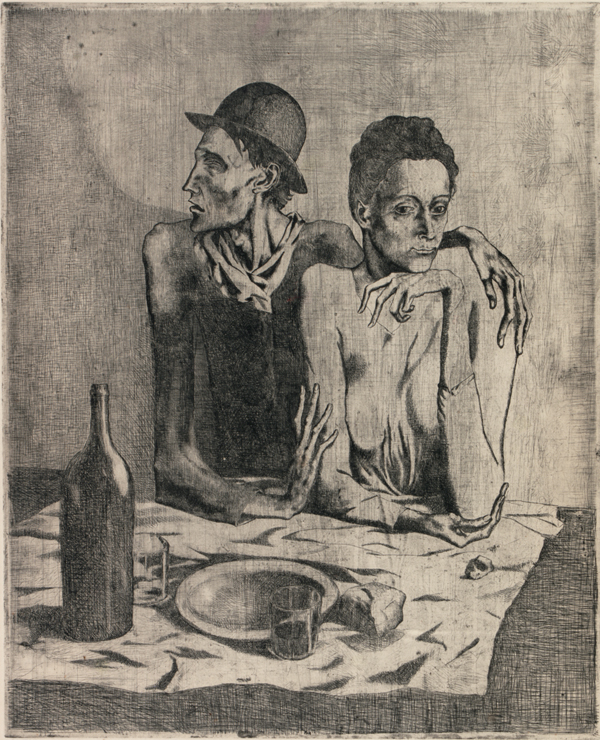 I am profoundly grateful that the witness of Pope Francis has spurred so many of us to rethink our relationship to the poor and marginalized. There are a dozen directions to take this topic, depending on how we define poverty. We have spoken of it as an evil—a condition to be ameliorated whenever possible—and we have spoken of it as a virtue—a habit that embraces simplicity, freedom, and sacrifice.
It is, of course, both.
Poverty is the kind of topic that makes someone like me uncomfortable. After all, my bailiwick is the world of high art—literature, painting, sculpture, classical music, and so on. I inhabit a world where the production and certainly the consumption of art largely exist in a culture of privilege.
Some might say that I am entirely cut off from the poor—that their natural habitat is in an altogether different neighborhood, that of popular culture. But here we immediately bump into other complications and ambiguities. What we call popular culture today bears little relationship to its past incarnations. If you want to describe art that arises from the life of real communities bound together by history and shared experience, the better term would be folk culture.
By way of contrast, I don’t think it’s an exaggeration to say that much of what we call pop culture today has its origins in conference rooms at Sony Corporation. Contemporary pop culture is a commodified substance, generic and syncretistic—so much “product” to be moved. And much of it is devoted to celebrating what the poor lack: money, power, and fame. The ironies here would be delicious if they were not so tragic.
This is the sort of thought that makes me occasionally wonder if I need to get in touch with my inner Marxist. The real difference between folk culture and pop culture is that one is made in the plaza or town square from a rich matrix of religious, ethnic, and historical experience, and the other is downloaded. I’m reminded of a line of Andrew Lytle’s written nearly one hundred years ago in an essay protesting the effects of modern industrialism on culture: “Throw out the radio,” Lytle wrote, “and take down the fiddle from the wall.”
Call that a utopian sentiment if you will, but if we are not haunted by that summons to make—rather than merely consume—culture, we’re going to suffer from one of the bleaker forms of human poverty.
The tension between art and poverty is an old one. Consider the famous words of Christ: “For ye have the poor with you always.” It’s worth recalling the context of that phrase: the moment when the woman anoints Christ’s feet with expensive oil. The disciples, do-gooders that they are, immediately object that the money spent on the oil would be better spent on the poor.
But Christ blesses the act. The oil not only cleanses, but also has a rich fragrance, honoring the humanity of Christ with beauty beyond utility. The anointing is wholly gratuitous, which also happens to be one of the fundamental characteristics of art. If art is a free act, not done for utility or gain—if it is truly useless—then its relationship to the world of valuation and the market will always be troubled and unclear. (The classic text on this is Lewis Hyde’s The Gift.)
Our cultural programming, at least in North America, leads us to think of art either as useless or—what amounts to the same thing—as a luxury. But if we really want to care for the poor, the question we should ask ourselves is: what have the poor done with regard to art? Pope Francis speaks constantly about the “santo pueblo fiel de Dios,” God’s faithful holy people. How have they voted with their feet?
The historical record is clear. We would not have the great cathedrals if not for the countless, nameless poor who contributed widow’s mites to their construction. And where there are no cathedrals there are household shrines, murals, depictions of Our Lady of Guadalupe spray-painted on lowriders and tattooed on forearms.
And let’s not have any condescending nonsense about the groundlings at the Rose Theatre coming only for Shakespeare’s bawdy jokes. The climactic scene of Shakespeare in Love had it just right when it depicted the entire audience, from pauper to Queen Elizabeth, as equally riveted by the drama of Romeo and Juliet.
When the privileged think about art we tend to either forget the poor altogether or, if they come to mind, to fall into moralism. We fret that art may be a distraction from justice. But as Elaine Scarry has argued in her book On Beauty and Being Just, the truth is the other way around. Beauty, whether manmade or natural, evokes in us the desire to protect what is both precious and vulnerable.
The problem for religious believers is that we confuse the virtues of piety and asceticism with mere pragmatism. We wring our hands in high-minded angst, focusing guiltily on the dollar value of the art in the Vatican. The faithful poor don’t ask how much art costs but what we have given back to God.
As David Griffith has written, “when we encounter the poor and indigent we project onto them our own deficiencies,” including our obsessions with money, utility, and success—things that have little purchase on the poor. When school budgets have to be cut, the first programs to go are arts-related. Words like global, competition, markets, and technology are given ritual obeisance while words like wonder, attention, and imagination are rarely heard.
Throw out the iPad and grab the fiddle.
To be continued tomorrow.
Gregory Wolfe is the founder of Image and serves as Writer in Residence and Director of the MFA in Creative Writing program at Seattle Pacific University. His books include Beauty Will Save the World and Intruding Upon the Timeless. Follow him on Twitter: @Gregory_Wolfe.
Etching above: Le repas frugal, (The Frugal Repast), Pablo Picasso, 1904.
Previous Post

June 5, 2015
Hello, Insomnia, My Old Friend
Next Post
June 9, 2015 The Thing Itself: Art and Poverty, Part 2
Browse Our Archives
Select a Category A. G. Harmon Alissa Wilkinson Allison Backous Art Authors Brad Fruhauff Bradford Winters Bryan Bliss Caroline Langston Chad Thomas Johnston Chris Hoke Christiana N. Peterson Culture D.G. Myers D.L. Mayfield Daniel Bowman Jr. David Griffith Elizabeth Duffy Faith Film Greg Wolfe Guest Contributor Interview Jan Vallone Jeffrey Overstreet Jessica Eddings-Roeser Jessica Mesman Griffith Kelly Foster Lindsey Crittenden Morgan Meis music Natalie Vestin Nick Olson Peggy Rosenthal Personal Reflection Poetry Friday Reflection Relationships Review Richard Chess Richard Cole Sara Zarr Shannon Huffman Polson Sonya Bilocerkowycz Tania Runyan Tony Woodlief Topical Categories Uncategorized Vic Sizemore Writing
Select a Month October 2018 September 2018 August 2018 July 2018 June 2018 May 2018 April 2018 March 2018 February 2018 January 2018 December 2017 November 2017 October 2017 September 2017 August 2017 July 2017 June 2017 May 2017 April 2017 March 2017 February 2017 January 2017 December 2016 November 2016 October 2016 September 2016 August 2016 July 2016 June 2016 May 2016 April 2016 March 2016 February 2016 January 2016 December 2015 November 2015 October 2015 September 2015 August 2015 July 2015 June 2015 May 2015 April 2015 March 2015 February 2015 January 2015 December 2014 November 2014 October 2014 September 2014 August 2014 July 2014 June 2014 May 2014 April 2014 March 2014 February 2014 January 2014 December 2013 November 2013 October 2013 September 2013 August 2013 July 2013 June 2013 May 2013 April 2013 March 2013 February 2013 January 2013 December 2012 November 2012 October 2012 September 2012 August 2012 July 2012 June 2012 May 2012 February 2008
Follow Us!
TAKE THE
Religious Wisdom Quiz
Proverbs warns against what kind of woman as a symbol of temptation?
Select your answer to see how you score.
Widow Queen Adulterous woman Mother-in-law
Related posts from Good Letters




Can a Racist Drive a Prius? Stereotypes and...
TRENDING AT PATHEOS Catholic

Rejecting Doom: Christian Hope And Human Action
Christianity is a religion of hope. We are to have hope and...

It’s What Comes From Within Which Matters
One of the most difficult things for us to understand is why...

Why I Choose the Eucharist Over the Sermon
Choose the Eucharist, Not the Sermon What are we supposed to get...

5 Design Elements Found in Spiritually Rooted Homes
Putting Spirituality Into Home Decor Our homes are more than our living...

Credo: A Story of God Told with the...
About 10 years ago, I began to imagine a personal "Credo" that...

The Anatomy of Divine Revelation in Catholic Thought
The claim that God has made Himself known to human beings is...
view all Catholic blogs
Ad-Free & Subscriber Log-In Subscription Support
- About Us
- 2026 Calendar
- Videos
- Podcasts
- Library of World Religions
- Faith In Media Tracker
- Advertise With Us
- Write for Us
- Privacy Policy
- Terms of Service
- Do Not Sell My Data
- Contact Us
- Radiant Digital
- Manage Newsletter Subscriptions
- Unsubscribe From Notifications
- Sitemap
Copyright 2008-2026, Patheos. All rights reserved.
Subscription Support Ad-Free & Subscriber Log-In
Follow Patheos