
BuddhistCatholicContemplativeEvangelicalGeneral ChristianHinduJewishLatter-day SaintMuslimNew VisionsProgressive Christian
Beliefs
- Buddhist
- Catholic
- Contemplative
- Evangelical
- General Christian
- Hindu
- Jewish
- Latter-day Saint
- More Voices
- Muslim
- New Visions
- Pagan
- Progressive Christian
Topics
- Religion News
- Food and Religion
- Sports and Religion
- Religious Art
- Religious Music and Entertainment
- Religious Events
- History and Religion
- Style and Religion
- Politics and Religion
- Women in Religion
- Recreation Outdoors and Religion
- Business Finance and Religion
- Careers Workplace and Religion
- Education and Religion
- Family Parenting and Religion
- Health Fitness and Religion
- Home and Religion
- Relationships and Religion
- Technology and Religion
- Travel and Religion
Columnists
- Buddhist Columnists
- Business Finance and Religion Columnists
- Careers Workplace and Religion Columnists
- Catholic Columnists
- Contemplative Columnists
- Education and Religion Columnists
- Evangelists Columnists
- Family Parenting and Religion Columnists
- General Christian Columnists
- Health Fitness and Religion Columnists
- Hindu Columnists
- History and Religion Columnists
- Home and Religion Columnists
- Jewish Columnists
- More Voices Columnists
- Latter Day Columnists
- Muslim Columnists
- New Visions Columnists
- Nonreligious Columnists
- Pagan Columnists
- Politics and Religion Columnists
- Progressive Columnists
- Recreation Outdoors and Religion Columnists
- Relationships and Religion Columnists
- Religion News Columnists
- Religious Art Columnists
- Religious Events Columnists
- Religious Music and Entertainment Columnists
- Sports and Religion Columnists
- Style and Religion Columnists
- Technology and Religion Columnists
- Travel and Religion Columnists
- Women in Religion Columnists
Resource Library
- 2026 Calendar
- Library of World Religions
- The 100 Most Holy Places on Earth
- Patheos Answers
- Podcasts
- Videos
- Faith Leaders Database
- Anglican Episcopalian
- Bahai
- Baptist
- Buddhism
- Christianity
- Confucianism
- Eastern Orthodoxy
- Hinduism
- Holiness and Pentecostal
- ISKCON
- Islam
- Judaism
- Lutheran
- Methodist
- The Church of Jesus Christ of Latter-day Saints
- New Age
- Paganism
- Presbytarian and Reformed
- Protestantism
- Religion Behind the Scenes
- Roman Catholic
- Scientology
- Shia Islam
- Sikhism
- Sufism
- Sunni Islam
- Taoism
- Zen
- See all religions
Research Tools
 Ad-Free & Subscriber Log-In Subscription Support
Ad-Free & Subscriber Log-In Subscription Support
Follow Patheos 

- Trending:
- Forgiveness
- |
- Marriage
- |
- Consciousness
- |
- Death Penalty
- |
- Election
- |
- Halloween
 Good Letters
-
Contributors
- Home
- Catholic
- The Eucharist: Eat, Eat!
The Eucharist: Eat, Eat!
Last updated on: June 10, 2015 at 1:24 am by Guest Contributor
The Eucharist: Eat, Eat! 2015-06-08T15:11:55-07:00 Guest Contributor
Patheos Explore the world's faith through different perspectives on religion and spirituality! Patheos has the views of the prevalent religions and spiritualities of the world.
By Shannon Huffman Polson
We sit in the back pew at church with intention; there’s an easy exit if our two-year-old’s patience has run out, or if ours has. Bible stories shine down on us hopefully from brightly colored stained glass windows on either side of the church.
Earlier I made spelt French toast for breakfast and my son ate three pieces, but halfway through the service he’s hungry again. He’s played with the hymnals and retrieved every stuffed animal from the basket at the rear of the church. We work on silent diversions when he tries to use the visitor card pen on the pews themselves.
Then he has another idea. “Eat, eat!” he says, with sudden and sincere desperation in his eyes, just as the congregation says “the Lord Jesus Christ took bread, and gave it to his disciples, and said ‘take, eat, this is my body…’”
My son makes the sign he learned before he could say his first words, fingers and thumb together at the side of his mouth. He’s hungry. He’s asking.
“Just a minute, sweetheart,” I whisper, hoping he will find the patience of a few more minutes. We have raisins in the diaper bag, but my husband was mortified the last time we walked up to the communion rail trailing graham cracker crumbs.
“Eat,” my son says again, thankfully sotto voce, though my anxiety is increasing with his determination. We’re making a small commotion and the parishioners just in front of us turn and smile at me and voice the words: “How cute.” Do they really think that?
“One minute sweetie, and we go to communion,” I whisper in his ear. “”Remember? We go up to the front and we eat.”
I feel momentarily sacrilegious and overly simplistic. We don’t just eat. We go to share the table with the communion of saints.
We have one precious moment when we kneel with the Papa and Nana he will never meet, with my Grandma who died before he was born, with the Grandma who just died, all of us at the table together, taking God into our bodies, honoring God’s indwelling in us, in our physical bodies, in our everyday lives.
My son simply wants a snack, and I just told him “Just a minute, and we’ll eat”?
When he started solid foods, I wasn’t even sure he should take communion right away. I liked the idea of ritual around the sacrament, a First Communion, new clothes and a specific day with the chance to talk about the sacrament that would require the budding genius of a five-year-old.
Twenty-first century Episcopalians don’t typically make a big deal of First Communion, but I figured our family could adopt the tradition. We could make Sam’s first experience of the Eucharist meaningful, because the Eucharist was meaningful for me in a way I had never expected.
I had known it was a sacrament, and known that it was supposed to be a big deal when I grew up in the church. But until I experienced real loss, I didn’t understand.
I came back to the Episcopal Church from a several year foray with the Presbyterians, missing the liturgy, missing the Eucharist. I came back and the liturgy didn’t just speak to me, it fairly shouted.
I came back and recognized a spiritual need for the Eucharist so much deeper than any possible physical hunger that I blinked in amazement and came to it like a woman starving.
The word eucharist comes from the Greek eucharistos, meaning grateful. At first I did not know enough to be grateful. I came to the table to be reminded that God was in me, that maybe this meant I was still alive. Then I came to be grateful for God in my life, even if some people no longer were.
So I wanted my son to understand this sacrament, understand its mystery and its power before he went to it. I wanted him to understand how it can curl over and around and through each part of us like water, filling up the empty places.
Our bishop came last autumn for his annual visit to our parish. As we left the service and stood in line to shake his hand, I held our son on my shoulder.
“What do you think about young children taking communion?” I asked him when our turn came to say hello. “Should we wait and make it more of a special occasion?” He seemed to me a man of wisdom and faith and pragmatism. I wanted his guidance.
“I think children should only have memories of coming to the table as part of Christ’s body,” he said.
That sealed it.
It may have taken until my thirties to have the Eucharist come upon me, but it was hardly fair to expect my future five-year-old to internalize my awkward explanations and attain precocious enlightenment. And yet, innocence might understand far more than I could hope to impart.
Perhaps the greatest experience of sacrament is understanding its presence in the quotidian. Perhaps it was I who needed to understand the mystery. My son was a part of the body of Christ. It was his table, too.
So when he looked at me with plaintive eyes wavering with despair, I whispered, “Just a minute, and we’ll eat!” For all of its mystery, that’s what we would do. That’s what we are meant to do.
We walked to the front of the church, and knelt on the kneeler, and he took a wafer in his soft mouth without hesitation. We ate.
I was hungry, and you gave me food…
Thank you Lord, for feeding us.
Originally published in Good Letters on April 19, 2013.
Shannon Huffman Polson is the author of North of Hope: A Daughter’s Arctic Journey. Her essays and articles have appeared in a number of literary and commercial magazines including High Country News, Huffington Post, Cirque Journal and Alaska and Seattle Magazines. She can be found writing or with her family in Washington State or Alaska, and always at her website, Facebook, and Twitter.
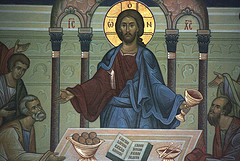
Photo above is Communion of the Apostles of St. Paul Chruch.
Previous Post

June 9, 2015
The Thing Itself: Art and Poverty, Part 2
Next Post
June 11, 2015 Prayers in the River
Browse Our Archives
Select a Category A. G. Harmon Alissa Wilkinson Allison Backous Art Authors Brad Fruhauff Bradford Winters Bryan Bliss Caroline Langston Chad Thomas Johnston Chris Hoke Christiana N. Peterson Culture D.G. Myers D.L. Mayfield Daniel Bowman Jr. David Griffith Elizabeth Duffy Faith Film Greg Wolfe Guest Contributor Interview Jan Vallone Jeffrey Overstreet Jessica Eddings-Roeser Jessica Mesman Griffith Kelly Foster Lindsey Crittenden Morgan Meis music Natalie Vestin Nick Olson Peggy Rosenthal Personal Reflection Poetry Friday Reflection Relationships Review Richard Chess Richard Cole Sara Zarr Shannon Huffman Polson Sonya Bilocerkowycz Tania Runyan Tony Woodlief Topical Categories Uncategorized Vic Sizemore Writing
Select a Month October 2018 September 2018 August 2018 July 2018 June 2018 May 2018 April 2018 March 2018 February 2018 January 2018 December 2017 November 2017 October 2017 September 2017 August 2017 July 2017 June 2017 May 2017 April 2017 March 2017 February 2017 January 2017 December 2016 November 2016 October 2016 September 2016 August 2016 July 2016 June 2016 May 2016 April 2016 March 2016 February 2016 January 2016 December 2015 November 2015 October 2015 September 2015 August 2015 July 2015 June 2015 May 2015 April 2015 March 2015 February 2015 January 2015 December 2014 November 2014 October 2014 September 2014 August 2014 July 2014 June 2014 May 2014 April 2014 March 2014 February 2014 January 2014 December 2013 November 2013 October 2013 September 2013 August 2013 July 2013 June 2013 May 2013 April 2013 March 2013 February 2013 January 2013 December 2012 November 2012 October 2012 September 2012 August 2012 July 2012 June 2012 May 2012 February 2008
Follow Us!
TAKE THE
Religious Wisdom Quiz
Which religious tradition sees the Genesis flood story as parallel to the Epic of Gilgamesh?
Select your answer to see how you score.
Ancient Mesopotamian religion Zoroastrianism Greek mythology Hinduism
Related posts from Good Letters

Poetry Friday: "The Burned Butterfly"


The Stars of the Earth Cry Out

TRENDING AT PATHEOS Catholic

Rejecting Doom: Christian Hope And Human Action
Christianity is a religion of hope. We are to have hope and...

It’s What Comes From Within Which Matters
One of the most difficult things for us to understand is why...

Why I Choose the Eucharist Over the Sermon
Choose the Eucharist, Not the Sermon What are we supposed to get...

5 Design Elements Found in Spiritually Rooted Homes
Putting Spirituality Into Home Decor Our homes are more than our living...

Credo: A Story of God Told with the...
About 10 years ago, I began to imagine a personal "Credo" that...

The Anatomy of Divine Revelation in Catholic Thought
The claim that God has made Himself known to human beings is...
view all Catholic blogs
Ad-Free & Subscriber Log-In Subscription Support
- About Us
- 2026 Calendar
- Videos
- Podcasts
- Library of World Religions
- Faith In Media Tracker
- Advertise With Us
- Write for Us
- Privacy Policy
- Terms of Service
- Do Not Sell My Data
- Contact Us
- Radiant Digital
- Manage Newsletter Subscriptions
- Unsubscribe From Notifications
- Sitemap
Copyright 2008-2026, Patheos. All rights reserved.
Subscription Support Ad-Free & Subscriber Log-In
Follow Patheos