
BuddhistCatholicContemplativeEvangelicalGeneral ChristianHinduJewishLatter-day SaintMuslimNew VisionsProgressive Christian
Beliefs
- Buddhist
- Catholic
- Contemplative
- Evangelical
- General Christian
- Hindu
- Jewish
- Latter-day Saint
- More Voices
- Muslim
- New Visions
- Pagan
- Progressive Christian
Topics
- Religion News
- Food and Religion
- Sports and Religion
- Religious Art
- Religious Music and Entertainment
- Religious Events
- History and Religion
- Style and Religion
- Politics and Religion
- Women in Religion
- Recreation Outdoors and Religion
- Business Finance and Religion
- Careers Workplace and Religion
- Education and Religion
- Family Parenting and Religion
- Health Fitness and Religion
- Home and Religion
- Relationships and Religion
- Technology and Religion
- Travel and Religion
Columnists
- Buddhist Columnists
- Business Finance and Religion Columnists
- Careers Workplace and Religion Columnists
- Catholic Columnists
- Contemplative Columnists
- Education and Religion Columnists
- Evangelists Columnists
- Family Parenting and Religion Columnists
- General Christian Columnists
- Health Fitness and Religion Columnists
- Hindu Columnists
- History and Religion Columnists
- Home and Religion Columnists
- Jewish Columnists
- More Voices Columnists
- Latter Day Columnists
- Muslim Columnists
- New Visions Columnists
- Nonreligious Columnists
- Pagan Columnists
- Politics and Religion Columnists
- Progressive Columnists
- Recreation Outdoors and Religion Columnists
- Relationships and Religion Columnists
- Religion News Columnists
- Religious Art Columnists
- Religious Events Columnists
- Religious Music and Entertainment Columnists
- Sports and Religion Columnists
- Style and Religion Columnists
- Technology and Religion Columnists
- Travel and Religion Columnists
- Women in Religion Columnists
Resource Library
- 2026 Calendar
- Library of World Religions
- The 100 Most Holy Places on Earth
- Patheos Answers
- Podcasts
- Videos
- Faith Leaders Database
- Anglican Episcopalian
- Bahai
- Baptist
- Buddhism
- Christianity
- Confucianism
- Eastern Orthodoxy
- Hinduism
- Holiness and Pentecostal
- ISKCON
- Islam
- Judaism
- Lutheran
- Methodist
- The Church of Jesus Christ of Latter-day Saints
- New Age
- Paganism
- Presbytarian and Reformed
- Protestantism
- Religion Behind the Scenes
- Roman Catholic
- Scientology
- Shia Islam
- Sikhism
- Sufism
- Sunni Islam
- Taoism
- Zen
- See all religions
Research Tools
 Ad-Free & Subscriber Log-In Subscription Support
Ad-Free & Subscriber Log-In Subscription Support
Follow Patheos 

- Trending:
- Forgiveness
- |
- Marriage
- |
- Consciousness
- |
- Death Penalty
- |
- Election
- |
- Halloween
 Good Letters
-
Contributors
- Home
- Catholic
- The Dissonant Note
The Dissonant Note
Last updated on: July 20, 2015 at 12:35 pm by Guest Contributor
The Dissonant Note 2015-07-20T12:35:43-07:00 Guest Contributor
Patheos Explore the world's faith through different perspectives on religion and spirituality! Patheos has the views of the prevalent religions and spiritualities of the world.
This post was made possible through the support of a grant from The BioLogos Foundation’s Evolution and Christian Faith program. The opinions expressed are those of the author and do not necessarily reflect the views of BioLogos.
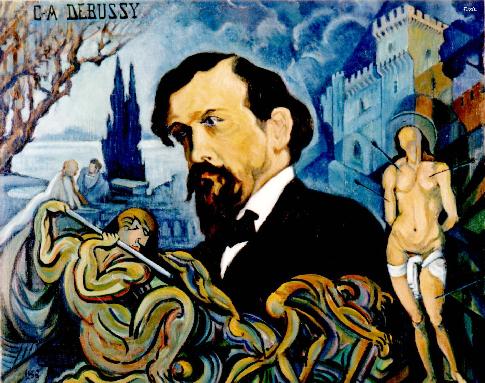 I have a heart arrhythmia that, though benign, is frustrating and feels like death despite its clinical insignificance. It has no cause and no effect; cardiologists call it capricious. It’s meaningless and unreasonable and irregular, and I hate it.
After a night of insomnia and errant heartbeats, I spend a comforting morning on the piano with Claude Debussy’s First Arabesque. Its rhythm is purposefully unpredictable, notes falling all over themselves.
I played the piano all the time when the arrhythmia was first monitored and diagnosed, drifting toward arrhythmic music I hated learning as a child. All those misplaced beats and skittering hands and attempts to hold multiple melodies in my head at the same time. It felt wrong, but my piano teacher knew: This one, she will never befriend the metronome.
The arabesque is a problem that never gets solved, an unanswered question. Playing it is like endlessly falling with nothing to right the body. It is all sky and no ground.
Arrhythmia is distressing in any form. Debussy’s use of arrhythmic structure—bitonality—got his music shunned by the artistic thought leaders of the day. In nineteenth-century Europe, tone was integral to composing music, tone being a steady sound in one key that predicts and guides the composition. Haydn and Bach were the greats, the ones to be emulated: repetition leading to rhythm, a diversionary tactic here to indicate that something is happening, a return to the source soon after. Set the metronome; do not deviate.
In a bitonal musical structure, different melodies climb on top of each other, and there’s no true harmony to act as home base. It must have been a compositional trip for Debussy, but it’s a special kind of hell for a musician taught to follow certain musical rules. And one effect of flouting the rules, throwing a piece entirely out of stability, is that any small shift can change everything.
Enter dissonance, the small shift that changes everything. In a system thrown out of balance, all it takes is one note. A dissonant note is the note that demands a musician move on to a stable chord, the confused note that hangs in mid-air and demands resolution, creating tension and drama and a singular feeling of wrong and bad and wrong.
It is the beat that feels and sounds like fear.
Cognitive dissonance—our ability to believe two contradicting truths or at least sit with the discomfort of allowing them to face each other—is a bit of an evolutionary puzzle. It requires backing away from certainty to argue within oneself, or somehow learning to carry a friendly argument, and living with questions that can’t be answered.
It’s a puzzle, because our survivalist brains should be accumulating knowledge and discarding that which is uncomfortable. Instead, we ponder. And we don’t just ponder: We make art to welcome and celebrate the dissonant. We have fun.
In Image’s most recent issue,“Evolution and the Imago Dei,” I was surprised to find that none of the authors advocated compromise between belief in God and the mechanism of evolution.
Compromise is a little silly to me: Why can’t things be entirely themselves and still refrain from obliterating each other? Whether the authors wrote of the two concepts—that of God and evolution—as friends or parts of a symphonic whole, the impression is of a question whose answer is never promised, a question to tuck away and carry and live. But how to live a question?
As someone who, until recently, disdained the idea of mystery as a deliberate eschewing of knowledge, I was intrigued by Toby Twining’s essay “The Evolving Song.” Twining talks of mystery as humility before creatures and processes whose lives and journeys are not ours. He is writing of what we don’t own, and by default, highlighting our wish to regulate and control and organize and—horrible idea when applied to other beings—possess.
Mystery is, in part, acceptance that we can know a little and believe and imagine, but we can’t pretend to use knowledge to have what isn’t ours. And precious little is fully ours.
Arrhythmia is a question held in the body. Mine is not dangerous, but simply in error, though the idea of error without risk seems anathema. When I’m feeling forgiving toward it, I think of it as variation, and bodily variation is adaptive, yes, but also courageous: Aren’t we always so disappointed when we fall out of line with how we’re measured? Courageous, because we have to build humility to stop controlling things that are entirely themselves, things that are closer friends with mistake than with control.
A well-known example of dissonance in classical music is D minor, the devil’s chord. D minor was used frequently in opera to denote that something terrible was about to happen, a trick of the scales and the ear to represent the presence of evil. In other words, it conveyed a feeling of wrong and bad and wrong. It made its listeners wish intensely for the piece to move on, quickly if possible.
Dissonance sounds like pain, like grief, like dread and chaos and death.
These qualities made dissonance perfect for one of its original musical uses. Debussy flouted the rules, but he was by no means original. The rules had been broken before they were written, arrhythmia existing before the metronome could call it out. Early religious music used it almost exclusively, because dissonance was how one talked to God.
Early prayerful music—the droning chants of Catholic monks, the Sikh songs comprising sacred sounds to draw the divine out of its hiding place in the cells—was dissonant purposefully, because people got lost in it, caught in a problem that vibrated in the muscles.
Faith wasn’t always without question. Faith wasn’t always so accepting, so joyful in its major key, its seven-note intervals. Once, doubt was desired, not just as a frame of mind but also as a bodily state. Prayer was an uncertain call to a God who might live anywhere, whose existence didn’t matter so much as the question that reverberated through flesh. Prayer was communication without resolution, felt only in the dropped notes flickering through the body.
The first heart must have felt like holding a bomb. All those beats, like the early church bells whose clanging was intended to slice room in the air for God. And in reading the “Evolution and the Imago Dei” issue, I have so many questions: If God can be anything, can God be an uncertainty, an absence, a mistake?
I saw a photo last year of a teen boy’s heart, a bullet hole in the left ventricle, and the hole cried out. If each beat carves room for God, then stopping each beat abolishes a slice of him. There is such a thing as no more room.
There is such a thing as our hearts beating now, and now, and now, and….
Join in the conversation about evolution and Christian faith by visiting the BioLogos symposium at Patheos.
Natalie Vestin is a health scientist and writer from Saint Paul. Her essays have appeared inThe Normal School, Iowa Review, Prairie Schooner, and elsewhere. Her chapbookShine a Light, the Light Won’t Pass is forthcoming from Miel Books.
Previous Post

June 29, 2015
Learning to Pray
Next Post
July 1, 2015 Dancing for My Life, Part 1
Browse Our Archives
Select a Category A. G. Harmon Alissa Wilkinson Allison Backous Art Authors Brad Fruhauff Bradford Winters Bryan Bliss Caroline Langston Chad Thomas Johnston Chris Hoke Christiana N. Peterson Culture D.G. Myers D.L. Mayfield Daniel Bowman Jr. David Griffith Elizabeth Duffy Faith Film Greg Wolfe Guest Contributor Interview Jan Vallone Jeffrey Overstreet Jessica Eddings-Roeser Jessica Mesman Griffith Kelly Foster Lindsey Crittenden Morgan Meis music Natalie Vestin Nick Olson Peggy Rosenthal Personal Reflection Poetry Friday Reflection Relationships Review Richard Chess Richard Cole Sara Zarr Shannon Huffman Polson Sonya Bilocerkowycz Tania Runyan Tony Woodlief Topical Categories Uncategorized Vic Sizemore Writing
Select a Month October 2018 September 2018 August 2018 July 2018 June 2018 May 2018 April 2018 March 2018 February 2018 January 2018 December 2017 November 2017 October 2017 September 2017 August 2017 July 2017 June 2017 May 2017 April 2017 March 2017 February 2017 January 2017 December 2016 November 2016 October 2016 September 2016 August 2016 July 2016 June 2016 May 2016 April 2016 March 2016 February 2016 January 2016 December 2015 November 2015 October 2015 September 2015 August 2015 July 2015 June 2015 May 2015 April 2015 March 2015 February 2015 January 2015 December 2014 November 2014 October 2014 September 2014 August 2014 July 2014 June 2014 May 2014 April 2014 March 2014 February 2014 January 2014 December 2013 November 2013 October 2013 September 2013 August 2013 July 2013 June 2013 May 2013 April 2013 March 2013 February 2013 January 2013 December 2012 November 2012 October 2012 September 2012 August 2012 July 2012 June 2012 May 2012 February 2008
Follow Us!
TAKE THE
Religious Wisdom Quiz
What does the Hebrew word 'El Shaddai' mean?
Select your answer to see how you score.
Everlasting Father God The Lord is my Shepherd Holy One
Related posts from Good Letters

The Stars of the Earth Cry Out


Poetry Friday: “The Ordinary Time”
TRENDING AT PATHEOS Catholic

Rejecting Doom: Christian Hope And Human Action
Christianity is a religion of hope. We are to have hope and...

It’s What Comes From Within Which Matters
One of the most difficult things for us to understand is why...

Why I Choose the Eucharist Over the Sermon
Choose the Eucharist, Not the Sermon What are we supposed to get...

5 Design Elements Found in Spiritually Rooted Homes
Putting Spirituality Into Home Decor Our homes are more than our living...

Credo: A Story of God Told with the...
About 10 years ago, I began to imagine a personal "Credo" that...

The Anatomy of Divine Revelation in Catholic Thought
The claim that God has made Himself known to human beings is...
view all Catholic blogs
Ad-Free & Subscriber Log-In Subscription Support
- About Us
- 2026 Calendar
- Videos
- Podcasts
- Library of World Religions
- Faith In Media Tracker
- Advertise With Us
- Write for Us
- Privacy Policy
- Terms of Service
- Do Not Sell My Data
- Contact Us
- Radiant Digital
- Manage Newsletter Subscriptions
- Unsubscribe From Notifications
- Sitemap
Copyright 2008-2026, Patheos. All rights reserved.
Subscription Support Ad-Free & Subscriber Log-In
Follow Patheos