
BuddhistCatholicContemplativeEvangelicalGeneral ChristianHinduJewishLatter-day SaintMuslimNew VisionsProgressive Christian
Beliefs
- Buddhist
- Catholic
- Contemplative
- Evangelical
- General Christian
- Hindu
- Jewish
- Latter-day Saint
- More Voices
- Muslim
- New Visions
- Pagan
- Progressive Christian
Topics
- Religion News
- Food and Religion
- Sports and Religion
- Religious Art
- Religious Music and Entertainment
- Religious Events
- History and Religion
- Style and Religion
- Politics and Religion
- Women in Religion
- Recreation Outdoors and Religion
- Business Finance and Religion
- Careers Workplace and Religion
- Education and Religion
- Family Parenting and Religion
- Health Fitness and Religion
- Home and Religion
- Relationships and Religion
- Technology and Religion
- Travel and Religion
Columnists
- Buddhist Columnists
- Business Finance and Religion Columnists
- Careers Workplace and Religion Columnists
- Catholic Columnists
- Contemplative Columnists
- Education and Religion Columnists
- Evangelists Columnists
- Family Parenting and Religion Columnists
- General Christian Columnists
- Health Fitness and Religion Columnists
- Hindu Columnists
- History and Religion Columnists
- Home and Religion Columnists
- Jewish Columnists
- More Voices Columnists
- Latter Day Columnists
- Muslim Columnists
- New Visions Columnists
- Nonreligious Columnists
- Pagan Columnists
- Politics and Religion Columnists
- Progressive Columnists
- Recreation Outdoors and Religion Columnists
- Relationships and Religion Columnists
- Religion News Columnists
- Religious Art Columnists
- Religious Events Columnists
- Religious Music and Entertainment Columnists
- Sports and Religion Columnists
- Style and Religion Columnists
- Technology and Religion Columnists
- Travel and Religion Columnists
- Women in Religion Columnists
Resource Library
- 2026 Calendar
- Library of World Religions
- The 100 Most Holy Places on Earth
- Patheos Answers
- Podcasts
- Videos
- Faith Leaders Database
- Anglican Episcopalian
- Bahai
- Baptist
- Buddhism
- Christianity
- Confucianism
- Eastern Orthodoxy
- Hinduism
- Holiness and Pentecostal
- ISKCON
- Islam
- Judaism
- Lutheran
- Methodist
- The Church of Jesus Christ of Latter-day Saints
- New Age
- Paganism
- Presbytarian and Reformed
- Protestantism
- Religion Behind the Scenes
- Roman Catholic
- Scientology
- Shia Islam
- Sikhism
- Sufism
- Sunni Islam
- Taoism
- Zen
- See all religions
Research Tools
 Ad-Free & Subscriber Log-In Subscription Support
Ad-Free & Subscriber Log-In Subscription Support
Follow Patheos 

- Trending:
- Forgiveness
- |
- Marriage
- |
- Consciousness
- |
- Death Penalty
- |
- Election
- |
- Halloween
 Good Letters
-
Contributors
- Home
- Catholic
- The Beautiful Attitudes
The Beautiful Attitudes
Last updated on: June 2, 2015 at 1:10 am by Guest Contributor
The Beautiful Attitudes 2015-05-27T13:04:23-07:00 Guest Contributor
Patheos Explore the world's faith through different perspectives on religion and spirituality! Patheos has the views of the prevalent religions and spiritualities of the world.
By Dyana Herron
 I clearly remember the last day of being nine. I stood in front of my house on the porch, its cement stained from summer, when my brother and I felt through the thick fur of our chow chows for fat ticks that we plucked, shook off, then smashed with rocks.
On the last day of being nine, I stood on the stained cement crying. I was upset because although the next day was my birthday and would bring all the extravagances of a birthday, I would be turning ten.
As in, going from a one-digit age number to a two-digit age number. And I realized I wasn’t likely to reach the three-digits.
Standing on the edge of our porch, it was as if I were standing on the edge of my grave.
Yes, I was a sensitive kid.
Luckily, as I grew older, my preoccupation with death diminished somewhat, and I began to assume a relatively normal outlook on things like birthdays. I now love birthdays. As I write this, I am two days away from turning twenty-nine, and I feel great about that.
But predisposition toward the morbid or no, birthdays invite self-reflection. They are a natural time for gauging one’s progress, for taking stock.
On the threshold of my third decade, this self-reflection takes the form of a question:
What would Juanita think of me now?
Juanita was my great-aunt, my maternal grandfather’s sister, and until I was a teen my family lived in a trailer on her land in Southeast Tennessee. The land had belonged to her husband, Earnest, who was a cook in World War II and died before I was born of a complication from diabetes.
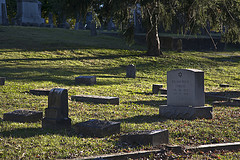
I felt a bond with Earnest because his birthday was the day after mine. I knew this because I read the date a million times on his tombstone, which was in a small family cemetery a field away from my house.
(I know what you’re thinking. Perhaps hanging out in graveyards contributed to my nine-year-old meltdown? Okay, maybe. But to us, the small plot of land was as commonplace as the vegetable garden.)
Juanita’s tombstone was already in place beside her husband’s, and it made me sad to think how she’d lie there beside him someday. She was in many ways closer to my brother and me than our own grandmothers because she was ever-present in her large white house just across the road—a road that soon dead-ended in the woods, and on which no others lived.
She was old-fashioned, even more so than my grandparents. There was a coal-burning stove in her kitchen, and a big black coal pile outside beside the well house. She stitched quilts by hand.
She insisted my brother and I squat over a porcelain chamber pot in her bathroom if we only had to pee, even though she had working indoor plumbing. I rarely saw her eat anything richer than cornbread soaked in buttermilk. Instead of “chimney,” she said “chimley.”
One evening, during a thunderstorm, I played in front of the stove and she read to me from her Bible. “The Beatitudes,” she called the passage, although I wasn’t sure what that meant. It sounded like “the beautiful attitudes.”
Blessed are the poor in spirit, for theirs is the kingdom of heaven. Blessed are the meek, for they will inherit the earth. Blessed are the pure in heart, for they will see God.
But rest assured, Juanita had her faults, and quirks that came from a solitary life.
She once recommended that my parents build a wooden box to physically restrain my brother, a spirited-but-normal little boy.
Sitting on her screened-in porch one stifling afternoon, she said she hoped the wind would begin to blow soon, or else we would all suffocate and die—a remark that left me hyperventilating in my bedroom later, eyes glued to the trees outside, praying they would move.
Her mind left her slowly, like a forgotten piece of fruit becomes soft then loses its shape. She sold her land without telling my parents, who bought a few acres of their own a couple miles away and moved us there. Juanita lived with other relatives who cared for her until her death.
What would she think of me now, so far removed from that home where my life began and hers finished? What would she think of the choices I make, living in a large city, any manner of thing I could want at my fingertips, and so extravagant in my want, often wasteful with what I have?
And why does it matter? What indelible mark has she left on me?
In the one photograph I have of Juanita, she is walking straight toward the camera, her hair an arc of cotton. I am in the background on my bike, brown feet digging into the pedals, riding away. Her long arm stretches straight forward, and her eyes are like coal, she is so focused on what she is reaching toward.
In my dreams, we are again in the white house together, but it is empty and dark. She is speaking to me in whispers. She is reading to me from texts I’m not yet able to decipher.
Originally published in Good Letters on February 3, 2011.
Dyana Herron is a writer and teacher originally from Cleveland, TN, who currently lives in Seattle. She is a graduate of SPU’s MFA Program in Creative Writing.
Photo above credited to Dieter Weinelt and used under a Creative Commons license.
Previous Post

June 1, 2015
Charlie Hebdo and the Inner Soul of Humor
Next Post
June 3, 2015 The Science and Sundayness of Play
Browse Our Archives
Select a Category A. G. Harmon Alissa Wilkinson Allison Backous Art Authors Brad Fruhauff Bradford Winters Bryan Bliss Caroline Langston Chad Thomas Johnston Chris Hoke Christiana N. Peterson Culture D.G. Myers D.L. Mayfield Daniel Bowman Jr. David Griffith Elizabeth Duffy Faith Film Greg Wolfe Guest Contributor Interview Jan Vallone Jeffrey Overstreet Jessica Eddings-Roeser Jessica Mesman Griffith Kelly Foster Lindsey Crittenden Morgan Meis music Natalie Vestin Nick Olson Peggy Rosenthal Personal Reflection Poetry Friday Reflection Relationships Review Richard Chess Richard Cole Sara Zarr Shannon Huffman Polson Sonya Bilocerkowycz Tania Runyan Tony Woodlief Topical Categories Uncategorized Vic Sizemore Writing
Select a Month October 2018 September 2018 August 2018 July 2018 June 2018 May 2018 April 2018 March 2018 February 2018 January 2018 December 2017 November 2017 October 2017 September 2017 August 2017 July 2017 June 2017 May 2017 April 2017 March 2017 February 2017 January 2017 December 2016 November 2016 October 2016 September 2016 August 2016 July 2016 June 2016 May 2016 April 2016 March 2016 February 2016 January 2016 December 2015 November 2015 October 2015 September 2015 August 2015 July 2015 June 2015 May 2015 April 2015 March 2015 February 2015 January 2015 December 2014 November 2014 October 2014 September 2014 August 2014 July 2014 June 2014 May 2014 April 2014 March 2014 February 2014 January 2014 December 2013 November 2013 October 2013 September 2013 August 2013 July 2013 June 2013 May 2013 April 2013 March 2013 February 2013 January 2013 December 2012 November 2012 October 2012 September 2012 August 2012 July 2012 June 2012 May 2012 February 2008
Follow Us!
TAKE THE
Religious Wisdom Quiz
Who was the youngest friend who rebuked Job and the other friends?
Select your answer to see how you score.
Bildad Eliphaz Elihu Zophar
Related posts from Good Letters


The Stars of the Earth Cry Out


TRENDING AT PATHEOS Catholic

Rejecting Doom: Christian Hope And Human Action
Christianity is a religion of hope. We are to have hope and...

It’s What Comes From Within Which Matters
One of the most difficult things for us to understand is why...

Why I Choose the Eucharist Over the Sermon
Choose the Eucharist, Not the Sermon What are we supposed to get...

5 Design Elements Found in Spiritually Rooted Homes
Putting Spirituality Into Home Decor Our homes are more than our living...

Credo: A Story of God Told with the...
About 10 years ago, I began to imagine a personal "Credo" that...

The Anatomy of Divine Revelation in Catholic Thought
The claim that God has made Himself known to human beings is...
view all Catholic blogs
Ad-Free & Subscriber Log-In Subscription Support
- About Us
- 2026 Calendar
- Videos
- Podcasts
- Library of World Religions
- Faith In Media Tracker
- Advertise With Us
- Write for Us
- Privacy Policy
- Terms of Service
- Do Not Sell My Data
- Contact Us
- Radiant Digital
- Manage Newsletter Subscriptions
- Unsubscribe From Notifications
- Sitemap
Copyright 2008-2026, Patheos. All rights reserved.
Subscription Support Ad-Free & Subscriber Log-In
Follow Patheos