
BuddhistCatholicContemplativeEvangelicalGeneral ChristianHinduJewishLatter-day SaintMuslimNew VisionsProgressive Christian
Beliefs
- Buddhist
- Catholic
- Contemplative
- Evangelical
- General Christian
- Hindu
- Jewish
- Latter-day Saint
- More Voices
- Muslim
- New Visions
- Pagan
- Progressive Christian
Topics
- Religion News
- Food and Religion
- Sports and Religion
- Religious Art
- Religious Music and Entertainment
- Religious Events
- History and Religion
- Style and Religion
- Politics and Religion
- Women in Religion
- Recreation Outdoors and Religion
- Business Finance and Religion
- Careers Workplace and Religion
- Education and Religion
- Family Parenting and Religion
- Health Fitness and Religion
- Home and Religion
- Relationships and Religion
- Technology and Religion
- Travel and Religion
Columnists
- Buddhist Columnists
- Business Finance and Religion Columnists
- Careers Workplace and Religion Columnists
- Catholic Columnists
- Contemplative Columnists
- Education and Religion Columnists
- Evangelists Columnists
- Family Parenting and Religion Columnists
- General Christian Columnists
- Health Fitness and Religion Columnists
- Hindu Columnists
- History and Religion Columnists
- Home and Religion Columnists
- Jewish Columnists
- More Voices Columnists
- Latter Day Columnists
- Muslim Columnists
- New Visions Columnists
- Nonreligious Columnists
- Pagan Columnists
- Politics and Religion Columnists
- Progressive Columnists
- Recreation Outdoors and Religion Columnists
- Relationships and Religion Columnists
- Religion News Columnists
- Religious Art Columnists
- Religious Events Columnists
- Religious Music and Entertainment Columnists
- Sports and Religion Columnists
- Style and Religion Columnists
- Technology and Religion Columnists
- Travel and Religion Columnists
- Women in Religion Columnists
Resource Library
- 2026 Calendar
- Library of World Religions
- The 100 Most Holy Places on Earth
- Patheos Answers
- Podcasts
- Videos
- Faith Leaders Database
- Anglican Episcopalian
- Bahai
- Baptist
- Buddhism
- Christianity
- Confucianism
- Eastern Orthodoxy
- Hinduism
- Holiness and Pentecostal
- ISKCON
- Islam
- Judaism
- Lutheran
- Methodist
- The Church of Jesus Christ of Latter-day Saints
- New Age
- Paganism
- Presbytarian and Reformed
- Protestantism
- Religion Behind the Scenes
- Roman Catholic
- Scientology
- Shia Islam
- Sikhism
- Sufism
- Sunni Islam
- Taoism
- Zen
- See all religions
Research Tools
 Ad-Free & Subscriber Log-In Subscription Support
Ad-Free & Subscriber Log-In Subscription Support
Follow Patheos 

- Trending:
- Forgiveness
- |
- Marriage
- |
- Consciousness
- |
- Death Penalty
- |
- Election
- |
- Halloween
 Good Letters
-
Contributors
- Home
- Catholic
- Before the Fall of Baseball
Before the Fall of Baseball
Last updated on: June 16, 2015 at 1:31 am by Guest Contributor
Before the Fall of Baseball 2015-06-08T15:19:52-07:00 Guest Contributor
Patheos Explore the world's faith through different perspectives on religion and spirituality! Patheos has the views of the prevalent religions and spiritualities of the world.
By Chad Thomas Johnston
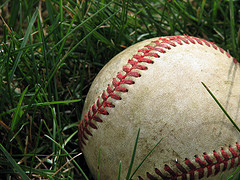
When I was a child, school did not rank high on my priority list, which meant my report cards led my parents to believe that, intellectually, I was probably about as dense as a baseball.
While watching a Kansas City Royals game on TV with my father one day, however, I made the mistake of reciting the batting averages of a few players from memory. After verifying the statistics using the career information on my baseball cards, my parents realized—much to their consternation—that I lacked not smarts, but the will to apply myself in school.
I could never coast through class again. But the experience did confirm something for my parents, and somewhat paradoxically: While I was not as thickheaded as they thought, I did have a baseball for a brain. I thought of little besides America’s favorite pastime in those days.
Insofar as one worships what one thinks about most, I bowed before that sport as a boy. Much as the Greeks lived in close proximity to their gods, who dwelled on Mt. Olympus, my family lived in Odessa, Missouri, only a half-hour’s drive from Kansas City, where the Royals loomed larger than life for me.
I even met a few of those baseball diamond deities with my friend Jeff, a fellow devotee who lived down the street from me, when his parents took us to a baseball card expo. Jeff and I traded cards, listened to Royals games on the radio, and occasionally witnessed our heroes in action at Royals Stadium before it became Kauffman Stadium in 1993.
In hopes of someday becoming like George Brett or Bo Jackson, we also swung bats and slung balls behind the parsonage where my family lived. Our backyard ended at the beginning of a grassy expanse that might have been comparable in size to a major league field. Almost as often as we belted the ball into that field, however, we fouled it over the crabapple tree, over my neighbors’ fence, and into their pool.
I sent letters to my favorite players—some promising rookies, others venerable veterans—and enclosed baseball cards for them to autograph, along with self-addressed stamped envelopes. To ensure that my mail would stand out, I took painstaking care to pencil portraits of the players on the mailing envelopes. A few players signed the cards and returned them: San Francisco Giants walloper Will Clark, Chicago Cubs center fielder Jerome Walton, and Royals pitcher Kevin Appier.
But my card collecting, ball playing, and letter writing ceased with the strike of 1994, which lasted 232 days and resulted in the first cancellation of the World Series since 1904. At sixteen, I turned my back on baseball, and I returned to it only recently.
The strike began when team owners and players reached an impasse about financial matters my teenage mind could not comprehend. I understood only that the purity of the sport, at least as I knew it, had been sullied by greed. Apparently, I was not the only one who felt this way. When play resumed in 1995, game attendance dropped by almost twenty percent.
After discovering Baseball, Ken Burns’s eighteen-and-a-half-hour documentary series, however, I am beginning to see baseball with new eyes. While I once saw the strike of 1994 as an expulsion from the sporting equivalent of Eden, with angels swinging Spalding bats at the gates of the stadium to keep the players out of Paradise, I now realize my perspective was wrong all along.
In Burns’s documentary, I saw a sport no purer than any other human endeavor. Baseball fell from grace long before 1994, and perhaps no more so than when eight members of the Chicago White Sox conspired with gamblers to fix the 1919 World Series. After the team handed victory to the Cincinnati Reds, Commissioner of Baseball Kenesaw Mountain Landis banned the players who participated in the “Black Sox Scandal” from Major League Baseball.
As I watched the documentary, I wondered how many boys had given up on baseball after the Black Sox Scandal. How many more had abandoned the sport during the Steroid Era?
In idealizing the sport as I did as a boy, I came to see it as a remnant of prelapsarian humanity. When I think of my misguided perception of baseball, Woody Allen’s Midnight in Paris comes to mind. In the film, Owen Wilson plays Gil Pender, a writer who visits Paris with his fiancé and finds himself magically transported to the 1920s—the city’s Golden Age, in his estimate—every night at the stroke of midnight.
Pender whiles away the hours with literary luminaries like Ernest Hemingway, F. Scott Fitzgerald, and Gertrude Stein, and falls for an inhabitant of the era named Adriana, who sees 1890s France—the Belle Époque period—as the city’s Golden Age. Much like Pender, I romanticized baseball’s past and perceived the present as a polluted version of a once pure thing, but I failed to realize that those who came before me probably did the same.
The only people in human history who might have rightfully dreamed of a purer past were Adam and Eve. We who have followed in their footsteps would do well to learn that loving anything in this world means loving a fallen version of that thing. It is far better, at least for me, to embrace baseball in all of its brokenness than to live in endless disappointment with the sport that set my childhood afire.
If I am really honest, in fact, I know that even as a child, I corrupted baseball in my own backyard.
“If you hit the ball into that crabapple tree again,” I once said to my friend Jeff, “I’ll sock you in the nose!”
I never socked Jeff (or anyone else for that matter) in the schnoz, but a world where one friend would threaten to strike another over something so trivial is no Eden at all.
Originally published on Good Letters on May 22, 2013.
Chad Thomas Johnston is a slayer of word dragons who resides in Lawrence, Kansas, with his wife Rebekah, their daughter Evangeline, and five felines. He has written for Image Journal’s Good Letters blog, In Touch magazine, The Baylor Lariat, and CollapseBoard.com. Johnston’s first book, the whimsical memoir Nightmarriage, was a finalist for a 2013 Shirley You Jest! Book Award in nonfiction writing.
Photo above credited to Matt McGee and used under a Creative Commons license.
Previous Post

June 15, 2015
His Murderer and His Keeper
Next Post
June 17, 2015 Wanted: God—Dead or Alive?
Browse Our Archives
Select a Category A. G. Harmon Alissa Wilkinson Allison Backous Art Authors Brad Fruhauff Bradford Winters Bryan Bliss Caroline Langston Chad Thomas Johnston Chris Hoke Christiana N. Peterson Culture D.G. Myers D.L. Mayfield Daniel Bowman Jr. David Griffith Elizabeth Duffy Faith Film Greg Wolfe Guest Contributor Interview Jan Vallone Jeffrey Overstreet Jessica Eddings-Roeser Jessica Mesman Griffith Kelly Foster Lindsey Crittenden Morgan Meis music Natalie Vestin Nick Olson Peggy Rosenthal Personal Reflection Poetry Friday Reflection Relationships Review Richard Chess Richard Cole Sara Zarr Shannon Huffman Polson Sonya Bilocerkowycz Tania Runyan Tony Woodlief Topical Categories Uncategorized Vic Sizemore Writing
Select a Month October 2018 September 2018 August 2018 July 2018 June 2018 May 2018 April 2018 March 2018 February 2018 January 2018 December 2017 November 2017 October 2017 September 2017 August 2017 July 2017 June 2017 May 2017 April 2017 March 2017 February 2017 January 2017 December 2016 November 2016 October 2016 September 2016 August 2016 July 2016 June 2016 May 2016 April 2016 March 2016 February 2016 January 2016 December 2015 November 2015 October 2015 September 2015 August 2015 July 2015 June 2015 May 2015 April 2015 March 2015 February 2015 January 2015 December 2014 November 2014 October 2014 September 2014 August 2014 July 2014 June 2014 May 2014 April 2014 March 2014 February 2014 January 2014 December 2013 November 2013 October 2013 September 2013 August 2013 July 2013 June 2013 May 2013 April 2013 March 2013 February 2013 January 2013 December 2012 November 2012 October 2012 September 2012 August 2012 July 2012 June 2012 May 2012 February 2008
Follow Us!
TAKE THE
Religious Wisdom Quiz
What did King Nebuchadnezzar order everyone to worship?
Select your answer to see how you score.
His crown A golden statue The sun A lion
Related posts from Good Letters

The Stars of the Earth Cry Out



Poetry Friday: “The Ordinary Time”
TRENDING AT PATHEOS Catholic

Rejecting Doom: Christian Hope And Human Action
Christianity is a religion of hope. We are to have hope and...

It’s What Comes From Within Which Matters
One of the most difficult things for us to understand is why...

Why I Choose the Eucharist Over the Sermon
Choose the Eucharist, Not the Sermon What are we supposed to get...

5 Design Elements Found in Spiritually Rooted Homes
Putting Spirituality Into Home Decor Our homes are more than our living...

Credo: A Story of God Told with the...
About 10 years ago, I began to imagine a personal "Credo" that...

The Anatomy of Divine Revelation in Catholic Thought
The claim that God has made Himself known to human beings is...
view all Catholic blogs
Ad-Free & Subscriber Log-In Subscription Support
- About Us
- 2026 Calendar
- Videos
- Podcasts
- Library of World Religions
- Faith In Media Tracker
- Advertise With Us
- Write for Us
- Privacy Policy
- Terms of Service
- Do Not Sell My Data
- Contact Us
- Radiant Digital
- Manage Newsletter Subscriptions
- Unsubscribe From Notifications
- Sitemap
Copyright 2008-2026, Patheos. All rights reserved.
Subscription Support Ad-Free & Subscriber Log-In
Follow Patheos