
BuddhistCatholicContemplativeEvangelicalGeneral ChristianHinduJewishLatter-day SaintMuslimNew VisionsProgressive Christian
Beliefs
- Buddhist
- Catholic
- Contemplative
- Evangelical
- General Christian
- Hindu
- Jewish
- Latter-day Saint
- More Voices
- Muslim
- New Visions
- Pagan
- Progressive Christian
Topics
- Religion News
- Food and Religion
- Sports and Religion
- Religious Art
- Religious Music and Entertainment
- Religious Events
- History and Religion
- Style and Religion
- Politics and Religion
- Women in Religion
- Recreation Outdoors and Religion
- Business Finance and Religion
- Careers Workplace and Religion
- Education and Religion
- Family Parenting and Religion
- Health Fitness and Religion
- Home and Religion
- Relationships and Religion
- Technology and Religion
- Travel and Religion
Columnists
- Buddhist Columnists
- Business Finance and Religion Columnists
- Careers Workplace and Religion Columnists
- Catholic Columnists
- Contemplative Columnists
- Education and Religion Columnists
- Evangelists Columnists
- Family Parenting and Religion Columnists
- General Christian Columnists
- Health Fitness and Religion Columnists
- Hindu Columnists
- History and Religion Columnists
- Home and Religion Columnists
- Jewish Columnists
- More Voices Columnists
- Latter Day Columnists
- Muslim Columnists
- New Visions Columnists
- Nonreligious Columnists
- Pagan Columnists
- Politics and Religion Columnists
- Progressive Columnists
- Recreation Outdoors and Religion Columnists
- Relationships and Religion Columnists
- Religion News Columnists
- Religious Art Columnists
- Religious Events Columnists
- Religious Music and Entertainment Columnists
- Sports and Religion Columnists
- Style and Religion Columnists
- Technology and Religion Columnists
- Travel and Religion Columnists
- Women in Religion Columnists
Resource Library
- 2026 Calendar
- Library of World Religions
- The 100 Most Holy Places on Earth
- Patheos Answers
- Podcasts
- Videos
- Faith Leaders Database
- Anglican Episcopalian
- Bahai
- Baptist
- Buddhism
- Christianity
- Confucianism
- Eastern Orthodoxy
- Hinduism
- Holiness and Pentecostal
- ISKCON
- Islam
- Judaism
- Lutheran
- Methodist
- The Church of Jesus Christ of Latter-day Saints
- New Age
- Paganism
- Presbytarian and Reformed
- Protestantism
- Religion Behind the Scenes
- Roman Catholic
- Scientology
- Shia Islam
- Sikhism
- Sufism
- Sunni Islam
- Taoism
- Zen
- See all religions
Research Tools
 Ad-Free & Subscriber Log-In Subscription Support
Ad-Free & Subscriber Log-In Subscription Support
Follow Patheos 

- Trending:
- Forgiveness
- |
- Marriage
- |
- Consciousness
- |
- Death Penalty
- |
- Election
- |
- Halloween
 Good Letters
-
Contributors
- Home
- Catholic
- A Place Where We Can Talk
A Place Where We Can Talk
Last updated on: June 4, 2015 at 1:17 am by Guest Contributor
A Place Where We Can Talk 2015-05-27T13:09:23-07:00 Guest Contributor
Patheos Explore the world's faith through different perspectives on religion and spirituality! Patheos has the views of the prevalent religions and spiritualities of the world.
By Brian Volck
 “Somewhere is better than anywhere.”
—Flannery O’Connor
“Somewhere is better than anywhere.”
—Flannery O’Connor
In my sophomore year of college, Professor Karanikolas took a semester to tear apart my writing—which until then I thought quite good—and rebuild it into something worth reading. He returned many of my early essays with marginal comments like, “Oh my God,” and “You’ve made the best of a very bad business here.” But the reeducation process was a painful necessity if I was ever to become a writer, and I’m grateful for those many hard lessons.
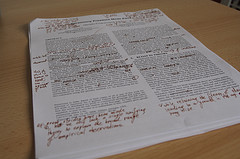
One of my later essays that semester included a sentence (the content of which I’ve long ago forgotten) that, by itself, would have been embarrassingly trite. In the margin, though, the professor wrote in red ink pen, “You had to do a lot of writing beforehand to say this.”
His point—one that still informs my aesthetics—is that simple gestures are often stale and vacuous without preparatory context and much hard work. For example, Charles D’Ambrosio’s short story, “Drummond and Son,” is—among other things—a successful experiment in writing a narrative in which the final bit of dialogue is “I love you.” What keeps it from descending into sentimentality is D’Ambrosio’s engrossing, sensitive, and finely detailed story.
In a New York Times opinion piece, Tenzin Gyatso, the fourteenth Dalai Lama, suggested that the great religious traditions have compassion at their core. He cites his 1968 conversations with Thomas Merton as an early invitation to interfaith dialogue using the centrality of compassion as a key. For both men, the meeting overcame conceptual obstacles to mutual understanding.
When I read the Dalai Lama or Merton on religious common ground, I’m willing to accept much of what they gesture toward. What I find less persuasive, however, are nods of approval from less disciplined American spiritual observers, often followed by clichéd observations like “All religions are really saying the same thing in different words.”
What’s the difference?
Whatever Merton and the Dalai Lama may mean when they write about common features of religious traditions, their insights and language are informed by years of demanding practice in a particular tradition. For all the similarities the two find between Christian prayer and Buddhist meditation, the conversation is grounded in specific daily practices ultimately directed toward a Triune God for Merton and that which lies beyond dukkha (suffering) and saṃsāra (the cycle of rebirth) for the Dalai Lama.
Such ends are—for these two disciplined men—vast, mysterious, and beyond human comprehension, but they are neither abstract nor interchangeable.
In contrast, too many interfaith conversations—especially those in the developed global north—deal almost exclusively in abstractions and dubious assumptions of equivalence.
Consider again the sentence “All religions are really saying the same thing in different words,” of which every word is contestable. How much scholarship is necessary before one can make even the simplest observation about all religions? What particular definition of religion would you use to embrace Christianity, Buddhism, Confucianism, and, if new Atheist Sam Harris has his way in redefining “religion,” Marxist-Leninism as well?
What counts as a religion and what historical conditions lead a particular religious tradition to so name itself? Why, for example, did Hinduism not describe itself as a “religion” until the British Raj? (For those interested in how the West came to identify “religion” as a universal, transcultural category distinguishable from other aspects of common life—particularly the politics of statecraft—see William Cavanaugh’s book,The Myth of Religious Violence: Secular Ideology and the Roots of Modern Conflict.
Finally, as a writer, I have no idea what “really saying the same thing in different words” might actually mean. If Middlemarch or The Waste Land is adequately expressed in brief paraphrase, then they are not art at all, but propaganda.
One might as well claim all governments are “really saying the same thing,” since all attempt, in decidedly different ways, to establish an equilibrium between individual action and public order.
Even the assertion that various religious traditions grasp isolated parts of a larger truth implies that the larger truth is, in fact, knowable by other means. As theologian D. Stephen Long observes about John Godfrey Saxe’s moralistic rendering of “The Blind Men and the Elephant,” the poem makes sense only because we already know what an elephant is, while the blind fools don’t.
I hope I’m never that arrogant when speaking of God.
What I’m suggesting here is not that religions (whatever we designate with that word) can’t engage in meaningful conversation or find common ground. To the contrary, I’m convinced that, in a world where secular nation states possess the technology and rationale to incinerate enemies by the millions, interfaith conversation is not only possible, but absolutely essential.
But such conversations will only be fruitful when engaged by those who have experienced their particular tradition profoundly, thoroughly, and honestly and who are willing to claim it. The “first world” assertion that one can engage the Other from a position of objective neutrality is, quite simply, a modernist lie that should have died with the collapse of European colonialism.
Each one of us—even the nonbeliever—speaks from a particular place within a tradition—from “somewhere,” not an abstract “anywhere.” I have little patience for non-practicing pundits who “stay above the fray” and boutique multiculturalists who pick and choose what suits them rather than deeply entering one tradition.
Sinking deep roots into a particular tradition is similar, I think, to what biologist and agricultural reformer Wes Jackson means when he invites restless Americans to “become native to a place.” Christian monastic traditions generally require of their members a vow of stability, of forsaking other places, however attractive. Instead of endlessly worrying if something better lies just over the horizon, the situated monk can engage in a lifetime of good work.
That’s why I look for truth less in the abstract pronouncements of dabblers or so-called experts than in the practical words of monks.
Originally published in Good Letters on August 9, 2010.
Brian Volck is Assistant Professor of Pediatrics in the Division of Hospital Medicine at Cincinnati Children’s Hospital Medical Center. Brian received his undergraduate degree in English Literature from Washington University in St. Louis and his MFA in creative writing from Seattle Pacific University. His first collection of poetry, Flesh Becomes Word, was released in October, 2013. He is coauthor of Reclaiming the Body: Christians and the Faithful Use of Modern Medicine and contributed essays to Wendell Berry and Religion: Heaven’s Earthly Life, and The Spirit of Food: Thirty-four Writers on Feasting and Fasting toward God. His essays, poetry, and reviews have appeared America, The Christian Century, DoubleTake, and IMAGE.
Photo above credited to Nic McPhee and used under a Creative Commons license.
The Blind Men and the Elephant
Previous Post

June 3, 2015
The Science and Sundayness of Play
Next Post
June 5, 2015 Hello, Insomnia, My Old Friend
Browse Our Archives
Select a Category A. G. Harmon Alissa Wilkinson Allison Backous Art Authors Brad Fruhauff Bradford Winters Bryan Bliss Caroline Langston Chad Thomas Johnston Chris Hoke Christiana N. Peterson Culture D.G. Myers D.L. Mayfield Daniel Bowman Jr. David Griffith Elizabeth Duffy Faith Film Greg Wolfe Guest Contributor Interview Jan Vallone Jeffrey Overstreet Jessica Eddings-Roeser Jessica Mesman Griffith Kelly Foster Lindsey Crittenden Morgan Meis music Natalie Vestin Nick Olson Peggy Rosenthal Personal Reflection Poetry Friday Reflection Relationships Review Richard Chess Richard Cole Sara Zarr Shannon Huffman Polson Sonya Bilocerkowycz Tania Runyan Tony Woodlief Topical Categories Uncategorized Vic Sizemore Writing
Select a Month October 2018 September 2018 August 2018 July 2018 June 2018 May 2018 April 2018 March 2018 February 2018 January 2018 December 2017 November 2017 October 2017 September 2017 August 2017 July 2017 June 2017 May 2017 April 2017 March 2017 February 2017 January 2017 December 2016 November 2016 October 2016 September 2016 August 2016 July 2016 June 2016 May 2016 April 2016 March 2016 February 2016 January 2016 December 2015 November 2015 October 2015 September 2015 August 2015 July 2015 June 2015 May 2015 April 2015 March 2015 February 2015 January 2015 December 2014 November 2014 October 2014 September 2014 August 2014 July 2014 June 2014 May 2014 April 2014 March 2014 February 2014 January 2014 December 2013 November 2013 October 2013 September 2013 August 2013 July 2013 June 2013 May 2013 April 2013 March 2013 February 2013 January 2013 December 2012 November 2012 October 2012 September 2012 August 2012 July 2012 June 2012 May 2012 February 2008
Follow Us!
TAKE THE
Religious Wisdom Quiz
What did Jeremiah see in his first vision as a young prophet?
Select your answer to see how you score.
A scroll An almond branch A burning coal A lion
Related posts from Good Letters

On Writing Odes: Taking Time to Celebrate

The Stars of the Earth Cry Out


TRENDING AT PATHEOS Catholic

Rejecting Doom: Christian Hope And Human Action
Christianity is a religion of hope. We are to have hope and...

It’s What Comes From Within Which Matters
One of the most difficult things for us to understand is why...

Why I Choose the Eucharist Over the Sermon
Choose the Eucharist, Not the Sermon What are we supposed to get...

5 Design Elements Found in Spiritually Rooted Homes
Putting Spirituality Into Home Decor Our homes are more than our living...

Credo: A Story of God Told with the...
About 10 years ago, I began to imagine a personal "Credo" that...

The Anatomy of Divine Revelation in Catholic Thought
The claim that God has made Himself known to human beings is...
view all Catholic blogs
Ad-Free & Subscriber Log-In Subscription Support
- About Us
- 2026 Calendar
- Videos
- Podcasts
- Library of World Religions
- Faith In Media Tracker
- Advertise With Us
- Write for Us
- Privacy Policy
- Terms of Service
- Do Not Sell My Data
- Contact Us
- Radiant Digital
- Manage Newsletter Subscriptions
- Unsubscribe From Notifications
- Sitemap
Copyright 2008-2026, Patheos. All rights reserved.
Subscription Support Ad-Free & Subscriber Log-In
Follow Patheos