
BuddhistCatholicContemplativeEvangelicalGeneral ChristianHinduJewishLatter-day SaintMuslimNew VisionsProgressive Christian
Beliefs
- Buddhist
- Catholic
- Contemplative
- Evangelical
- General Christian
- Hindu
- Jewish
- Latter-day Saint
- More Voices
- Muslim
- New Visions
- Pagan
- Progressive Christian
Topics
- Religion News
- Food and Religion
- Sports and Religion
- Religious Art
- Religious Music and Entertainment
- Religious Events
- History and Religion
- Style and Religion
- Politics and Religion
- Women in Religion
- Recreation Outdoors and Religion
- Business Finance and Religion
- Careers Workplace and Religion
- Education and Religion
- Family Parenting and Religion
- Health Fitness and Religion
- Home and Religion
- Relationships and Religion
- Technology and Religion
- Travel and Religion
Columnists
- Buddhist Columnists
- Business Finance and Religion Columnists
- Careers Workplace and Religion Columnists
- Catholic Columnists
- Contemplative Columnists
- Education and Religion Columnists
- Evangelists Columnists
- Family Parenting and Religion Columnists
- General Christian Columnists
- Health Fitness and Religion Columnists
- Hindu Columnists
- History and Religion Columnists
- Home and Religion Columnists
- Jewish Columnists
- More Voices Columnists
- Latter Day Columnists
- Muslim Columnists
- New Visions Columnists
- Nonreligious Columnists
- Pagan Columnists
- Politics and Religion Columnists
- Progressive Columnists
- Recreation Outdoors and Religion Columnists
- Relationships and Religion Columnists
- Religion News Columnists
- Religious Art Columnists
- Religious Events Columnists
- Religious Music and Entertainment Columnists
- Sports and Religion Columnists
- Style and Religion Columnists
- Technology and Religion Columnists
- Travel and Religion Columnists
- Women in Religion Columnists
Resource Library
- 2026 Calendar
- Library of World Religions
- The 100 Most Holy Places on Earth
- Patheos Answers
- Podcasts
- Videos
- Faith Leaders Database
- Anglican Episcopalian
- Bahai
- Baptist
- Buddhism
- Christianity
- Confucianism
- Eastern Orthodoxy
- Hinduism
- Holiness and Pentecostal
- ISKCON
- Islam
- Judaism
- Lutheran
- Methodist
- The Church of Jesus Christ of Latter-day Saints
- New Age
- Paganism
- Presbytarian and Reformed
- Protestantism
- Religion Behind the Scenes
- Roman Catholic
- Scientology
- Shia Islam
- Sikhism
- Sufism
- Sunni Islam
- Taoism
- Zen
- See all religions
Research Tools
 Ad-Free & Subscriber Log-In Subscription Support
Ad-Free & Subscriber Log-In Subscription Support
Follow Patheos 

- Trending:
- Forgiveness
- |
- Marriage
- |
- Consciousness
- |
- Death Penalty
- |
- Election
- |
- Halloween
 Good Letters
-
Contributors
- Home
- Catholic
- When We Die
When We Die
Last updated on: May 5, 2015 at 1:49 am by Richard Chess
When We Die 2015-04-29T12:23:45-07:00 Richard Chess
Patheos Explore the world's faith through different perspectives on religion and spirituality! Patheos has the views of the prevalent religions and spiritualities of the world.
 A text from a friend: “What do you believe happens when we die?”
She’d recently lost her son. He must have been no older than his late twenties, maybe early thirties. Over the years, she had told me enough about him that I knew he was troubled. I didn’t really know what kind of trouble. I knew she worried about him, about his ability to take care of himself. I don’t know how he died. I can only imagine.
But I cannot imagine what it feels like to have lost a son or daughter. I want to comfort my friend, but I don’t know how.
I promised to respond to her question—weeks ago. I still haven’t responded. I couldn’t imagine how, in a text message, I could respond—the thought of thumbing all the letters necessary to offer what would certainly be an inadequate response.
When we die: if we die on a sunny day, the sun will continue to illuminate mailbox and fly, door knob and dog leash. If we die on a clear night, stars, scattered like grains of salt across the rich, black bread of the sky, will make us hunger, thirst.
When we die: if we die in the middle of a Leonard Cohen song, Cohen will continue to sing—O see the darkness yielding / That tore the light apart / Come healing of the reason / Come healing of the heart—all the way to the end of the penitential hymn*.*
If we die in our sleep, we will slip away like a lover, quietly, hoping not to disturb her, because more than anything else in this world of pain she loves sleep and no one and nothing should trouble her when she’s wrapped in sleep’s arms.
If we die in a chair, the newspaper will remain open to a story growing old; if we die in a wreck, the salvageable parts of the vehicle will be recovered and sold; if we die without hearing I love you, our survivors will say, for a few days, maybe a week or two, I love you to our favorite shirt hanging in the closet, to the clutter on top of our bureau that, until we passed, annoyed them to no end.
No, that’s not what I meant, I imagine her saying. What happens to us when we die?
Well, then…I don’t know. I don’t know. One day, maybe forty-five years ago, I thought I did.
I was in high school. I smoked pot then. In my crowd, it was the thing to do—it was one of the things to do. I was moving in a certain direction, toward music, toward poetry, toward art. I was moving together with friends, I was moving alone and apart. Tim Buckley, Cecil Taylor, Robert Fripp. Rauschenberg, Ginsberg, Kafka, Duchamp. I was moving out. I was moving in. I was seeking a connection, a source without and within.
Strawbridge Lake, Moorestown, New Jersey. From my house on the north side of Cherry Hill, I bicycled there alone to be alone with “nature.” And I drove there with friends to walk by the water, to throw a Frisbee, to catch a glimpse of a life we longed for, we counter-culture teens, a reflective life we were already living, and to get stoned. Better there, by water and among trees, than the Cherry Hill Mall, though we wandered stoned in that climate-controlled Eden, too.
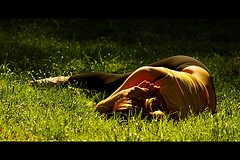
One sunny afternoon, I remember, I was stoned and while two friends walked one way, and one or two others walked another, I lay on the cropped grass near the lake. And on my back I felt the cold ground and then my back dissolved and my body was earth all the way down to the core.
And I gazed at the branches of a tree overhead and the sky through and beyond the tree and I was unbound and my body was light, leaf, bark, sky. No boundaries. Not even an “I” to say to loved ones who would mourn my disappearance, my absence, don’t be sad, I am the hot smoke you draw into your lungs and hold for a few seconds before releasing it; I am the spinning disc and its shadow moving toward your hand ready to snatch it.
And I heard a voice speak, and it said this is what happens when you die—you live as before, before you were reduced and confined to body and voice by which others knew you. You live now as life itself.
An out-of-body experience (it sounds silly saying it), and a voice telling me, now you know, now you need not worry about death. Get on with your life.
But now, I don’t know. And maybe, because, thank God, I haven’t lost a son or daughter, I enjoy the luxury of not having to think about it.
All I know is this: if we die before four in the afternoon on a Tuesday in America, the stock market will continue to post losses, gains. If we die old, they will say he lived a full life. If we die young, before our parents, they will say, it’s not supposed to be that way and he died before his time.
But Time will say nothing, and Time will do nothing to ease the pain of those who question and live, who call out and wait and wait for a reply.
Richard Chess is the author of three books of poetry, Tekiah, Chair in the Desert, and Third Temple. Poems of his have appeared in Telling and Remembering: A Century of American Jewish Poetry, Bearing the Mystery: Twenty Years of IMAGE, and Best Spiritual Writing 2005. He is the Roy Carroll Professor of Honors Arts and Sciences at the University of North Carolina at Asheville. He is also the director of UNC Asheville’s Center for Jewish Studies.
Photo above credited to Alex and used under a Creative Commons license.
Previous Post

May 4, 2015
Las Madres: Art and Death in the Arizona Desert
Next Post
May 6, 2015 My Rainbow Connection, Disconnected
Browse Our Archives
Select a Category A. G. Harmon Alissa Wilkinson Allison Backous Art Authors Brad Fruhauff Bradford Winters Bryan Bliss Caroline Langston Chad Thomas Johnston Chris Hoke Christiana N. Peterson Culture D.G. Myers D.L. Mayfield Daniel Bowman Jr. David Griffith Elizabeth Duffy Faith Film Greg Wolfe Guest Contributor Interview Jan Vallone Jeffrey Overstreet Jessica Eddings-Roeser Jessica Mesman Griffith Kelly Foster Lindsey Crittenden Morgan Meis music Natalie Vestin Nick Olson Peggy Rosenthal Personal Reflection Poetry Friday Reflection Relationships Review Richard Chess Richard Cole Sara Zarr Shannon Huffman Polson Sonya Bilocerkowycz Tania Runyan Tony Woodlief Topical Categories Uncategorized Vic Sizemore Writing
Select a Month October 2018 September 2018 August 2018 July 2018 June 2018 May 2018 April 2018 March 2018 February 2018 January 2018 December 2017 November 2017 October 2017 September 2017 August 2017 July 2017 June 2017 May 2017 April 2017 March 2017 February 2017 January 2017 December 2016 November 2016 October 2016 September 2016 August 2016 July 2016 June 2016 May 2016 April 2016 March 2016 February 2016 January 2016 December 2015 November 2015 October 2015 September 2015 August 2015 July 2015 June 2015 May 2015 April 2015 March 2015 February 2015 January 2015 December 2014 November 2014 October 2014 September 2014 August 2014 July 2014 June 2014 May 2014 April 2014 March 2014 February 2014 January 2014 December 2013 November 2013 October 2013 September 2013 August 2013 July 2013 June 2013 May 2013 April 2013 March 2013 February 2013 January 2013 December 2012 November 2012 October 2012 September 2012 August 2012 July 2012 June 2012 May 2012 February 2008
Follow Us!
TAKE THE
Religious Wisdom Quiz
What does "Shema" mean in Hebrew?
Select your answer to see how you score.
Obey Hear Wait Pray
Related posts from Good Letters



Ready or Not for the Days of Awe

TRENDING AT PATHEOS Catholic

Rejecting Doom: Christian Hope And Human Action
Christianity is a religion of hope. We are to have hope and...

It’s What Comes From Within Which Matters
One of the most difficult things for us to understand is why...

Why I Choose the Eucharist Over the Sermon
Choose the Eucharist, Not the Sermon What are we supposed to get...

5 Design Elements Found in Spiritually Rooted Homes
Putting Spirituality Into Home Decor Our homes are more than our living...

Credo: A Story of God Told with the...
About 10 years ago, I began to imagine a personal "Credo" that...

The Anatomy of Divine Revelation in Catholic Thought
The claim that God has made Himself known to human beings is...
view all Catholic blogs
Ad-Free & Subscriber Log-In Subscription Support
- About Us
- 2026 Calendar
- Videos
- Podcasts
- Library of World Religions
- Faith In Media Tracker
- Advertise With Us
- Write for Us
- Privacy Policy
- Terms of Service
- Do Not Sell My Data
- Contact Us
- Radiant Digital
- Manage Newsletter Subscriptions
- Unsubscribe From Notifications
- Sitemap
Copyright 2008-2026, Patheos. All rights reserved.
Subscription Support Ad-Free & Subscriber Log-In
Follow Patheos