
BuddhistCatholicContemplativeEvangelicalGeneral ChristianHinduJewishLatter-day SaintMuslimNew VisionsProgressive Christian
Beliefs
- Buddhist
- Catholic
- Contemplative
- Evangelical
- General Christian
- Hindu
- Jewish
- Latter-day Saint
- More Voices
- Muslim
- New Visions
- Pagan
- Progressive Christian
Topics
- Religion News
- Food and Religion
- Sports and Religion
- Religious Art
- Religious Music and Entertainment
- Religious Events
- History and Religion
- Style and Religion
- Politics and Religion
- Women in Religion
- Recreation Outdoors and Religion
- Business Finance and Religion
- Careers Workplace and Religion
- Education and Religion
- Family Parenting and Religion
- Health Fitness and Religion
- Home and Religion
- Relationships and Religion
- Technology and Religion
- Travel and Religion
Columnists
- Buddhist Columnists
- Business Finance and Religion Columnists
- Careers Workplace and Religion Columnists
- Catholic Columnists
- Contemplative Columnists
- Education and Religion Columnists
- Evangelists Columnists
- Family Parenting and Religion Columnists
- General Christian Columnists
- Health Fitness and Religion Columnists
- Hindu Columnists
- History and Religion Columnists
- Home and Religion Columnists
- Jewish Columnists
- More Voices Columnists
- Latter Day Columnists
- Muslim Columnists
- New Visions Columnists
- Nonreligious Columnists
- Pagan Columnists
- Politics and Religion Columnists
- Progressive Columnists
- Recreation Outdoors and Religion Columnists
- Relationships and Religion Columnists
- Religion News Columnists
- Religious Art Columnists
- Religious Events Columnists
- Religious Music and Entertainment Columnists
- Sports and Religion Columnists
- Style and Religion Columnists
- Technology and Religion Columnists
- Travel and Religion Columnists
- Women in Religion Columnists
Resource Library
- 2026 Calendar
- Library of World Religions
- The 100 Most Holy Places on Earth
- Patheos Answers
- Podcasts
- Videos
- Faith Leaders Database
- Anglican Episcopalian
- Bahai
- Baptist
- Buddhism
- Christianity
- Confucianism
- Eastern Orthodoxy
- Hinduism
- Holiness and Pentecostal
- ISKCON
- Islam
- Judaism
- Lutheran
- Methodist
- The Church of Jesus Christ of Latter-day Saints
- New Age
- Paganism
- Presbytarian and Reformed
- Protestantism
- Religion Behind the Scenes
- Roman Catholic
- Scientology
- Shia Islam
- Sikhism
- Sufism
- Sunni Islam
- Taoism
- Zen
- See all religions
Research Tools
 Ad-Free & Subscriber Log-In Subscription Support
Ad-Free & Subscriber Log-In Subscription Support
Follow Patheos 

- Trending:
- Forgiveness
- |
- Marriage
- |
- Consciousness
- |
- Death Penalty
- |
- Election
- |
- Halloween
 Good Letters
-
Contributors
- Home
- Catholic
- Self-Hating Jew: A Love Story, Part 1
Self-Hating Jew: A Love Story, Part 1
Last updated on: May 26, 2015 at 1:19 am by Richard Chess
Self-Hating Jew: A Love Story, Part 1 2015-05-18T12:08:48-07:00 Richard Chess
Patheos Explore the world's faith through different perspectives on religion and spirituality! Patheos has the views of the prevalent religions and spiritualities of the world.
 In response to “Never Again: Netanyahu’s Holocaust Cliché,” a recent post of mine on Good Letters, an old girlfriend messaged me on Facebook. “It was the first time in a while,” she wrote, “I felt proud to be an American…I wonder why the writers of our times don’t instead write about the speeches of some of the truly worrisome leaders of Iran, ISIS, Hamas, North Korea, etc.”
Then, this: “Self-hatred is so destructive.”
Am I self-hating Jew?
*
Lekh lekha.
For a few months in late summer of 1976, I spent five hours a day, six days a week in kitah aleph, beginner’s level Hebrew class. Along with seventy other volunteers in Sherut La’am (service to the people), I was learning Hebrew and preparing for my placement in a development town somewhere in Israel.
I had grown up as an assimilated middle class Jew in Cherry Hill, New Jersey. Until ’76, I had assumed that my Jewish education was over on Sunday morning, December 11, 1966, the day after I became a bar mitzvah.
The teacher who had helped me learn enough Hebrew to become a bar mitzvah urged me to continue studying Hebrew after my bar mitzvah because I was good at it. I listened to her politely, then walked out of the synagogue and into the mall.
I smoked pot, developed my own black and white film and printed artsy photographs in the darkroom I built in my home, played lead guitar in the Village Gates, read Kafka, and ached for oral sex. I fell in love with D. Then she broke my heart. I fell in love with T. Then she broke my heart.
Lekh lekha.
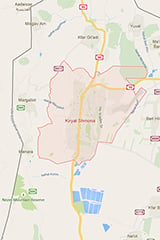
A decade later, I fell in love with a language—and a people and a place: Kiryat Shimona, a working-class town near Israel’s northern border with Lebanon, where what I thought would be my year in Israel began. Around the time I was there, an occasional bomb lobbed over the Lebanese border landed in Kiryat Shimona. But I wasn’t afraid. I was in love.
In love with the hike up hill into the Naftali mountains to the sanctuary-in-a-school where we welcomed Shabbat prayers and watched the sky explode into pastels as the sun, not visible, burned its way into the Mediterranean sea to the west of us. In love with the mercaz, the town center, where, on Saturday night after the end of Sabbath, male friends walked hand-in-hand with each other cruising for women, where kids with their parents enjoyed glida, ice cream, where Saturday night festivities ended not-too-late so everyone could get enough sleep to be ready the next day for work, school, morning prayers.
Lekh lekha.
That’s where it begins, the story of this people, the Jews, my people. God commands Avram to go forth from his land and from his birthplace and from his father’s house to the land God will show him.
The first time I remember hearing this passage from the Torah was in Ms. Tova’s class, kitah aleph, a month into my intensive Hebrew language studies. Lekh lekha: Ms. Tova said the words, and I, I understood, I understood, without having to translate I understood. This language was becoming my language, these words my words, this story my story.
*
Unlike the other Sherut La’am volunteers in my group, I hadn’t been involved in a Jewish youth group as a teen, I hadn’t been active in Hillel while I was in college, and I’d never before been to Israel. I wondered, as I sat during our orientation in the chapel at JFK airport across from the El Al terminal: What am I doing here in this place, with these people?
I didn’t have to listen deeply to hear it again, the voice within (my voice?) that had led me this far, the voice commanding me to leave my bi-coastal life (LA born, South Jersey raised), to leave my father’s plastic-wood sconces and paper work and my mother’s canned wax beans and her Temple Emanuel.
To leave and fly to Torah, to Genesis 12:1, to a government-issue mattress, sheet, pillow, blanket, and towel in an immigrant absorption center in Kiryat Shimona, to the modest apartment of my local “adoptive” family and to the east-facing balcony where my Israeli, temporary “father” described how on Yom Kippur 1973 he watched Syrian planes fly across the lush Hula Valley to deliver its bombs to his home town.
*
When my cohort of Sherut La’am volunteers arrived at the absorption center, we were asked to fill out an information card before we received the keys to our rooms. One question stumped me: profession. Profession? I had just graduated from what was then called Glassboro State College. My major: communications. My interests: creative writing, poetry in particular. Could I put down poet? Nah. So what should I say? I hesitated.
Then I realized that no one—not another volunteer in my group, not our group leaders, and certainly not the staff at the absorption center where I would spend the next three months learning Hebrew, getting acclimated to the Israel of the mid-to-late 1970s, making new friends, exploring the Galilee, attending for the first time in my life traditional Orthodox services—no one there knew me.
I was free. Free to invent myself anew! I put down this: educator. Little did I know then what I would stumble into (where I would be led?) just a few years from then.
*
Lekh lekha: “Go to yourself, to know yourself, to refine yourself.” That’s how the Zohar, the Book of Splendor, reads the phrase. Seeking self-hatred, I found love. So I’ll look again; I’ll look deeper. If I find it, I’ll refine it. But, dear readers, dear friends, you and I both will have to wait for a future post for that search to begin.
Richard Chess is the author of three books of poetry, Tekiah, Chair in the Desert, and Third Temple. Poems of his have appeared in Telling and Remembering: A Century of American Jewish Poetry, Bearing the Mystery: Twenty Years of IMAGE, and Best Spiritual Writing 2005. He is the Roy Carroll Professor of Honors Arts and Sciences at the University of North Carolina at Asheville. He is also the director of UNC Asheville’s Center for Jewish Studies.
Previous Post

May 22, 2015
The Two Lists
Next Post
May 27, 2015 What Cannot Be Fixed
Browse Our Archives
Select a Category A. G. Harmon Alissa Wilkinson Allison Backous Art Authors Brad Fruhauff Bradford Winters Bryan Bliss Caroline Langston Chad Thomas Johnston Chris Hoke Christiana N. Peterson Culture D.G. Myers D.L. Mayfield Daniel Bowman Jr. David Griffith Elizabeth Duffy Faith Film Greg Wolfe Guest Contributor Interview Jan Vallone Jeffrey Overstreet Jessica Eddings-Roeser Jessica Mesman Griffith Kelly Foster Lindsey Crittenden Morgan Meis music Natalie Vestin Nick Olson Peggy Rosenthal Personal Reflection Poetry Friday Reflection Relationships Review Richard Chess Richard Cole Sara Zarr Shannon Huffman Polson Sonya Bilocerkowycz Tania Runyan Tony Woodlief Topical Categories Uncategorized Vic Sizemore Writing
Select a Month October 2018 September 2018 August 2018 July 2018 June 2018 May 2018 April 2018 March 2018 February 2018 January 2018 December 2017 November 2017 October 2017 September 2017 August 2017 July 2017 June 2017 May 2017 April 2017 March 2017 February 2017 January 2017 December 2016 November 2016 October 2016 September 2016 August 2016 July 2016 June 2016 May 2016 April 2016 March 2016 February 2016 January 2016 December 2015 November 2015 October 2015 September 2015 August 2015 July 2015 June 2015 May 2015 April 2015 March 2015 February 2015 January 2015 December 2014 November 2014 October 2014 September 2014 August 2014 July 2014 June 2014 May 2014 April 2014 March 2014 February 2014 January 2014 December 2013 November 2013 October 2013 September 2013 August 2013 July 2013 June 2013 May 2013 April 2013 March 2013 February 2013 January 2013 December 2012 November 2012 October 2012 September 2012 August 2012 July 2012 June 2012 May 2012 February 2008
Follow Us!
TAKE THE
Religious Wisdom Quiz
What was the name of the garden where Jesus prayed before His arrest?
Select your answer to see how you score.
Gethsemane Bethany Eden Golgotha
Related posts from Good Letters

A Conversation with Alicia Ostriker: Part 1

Ready or Not for the Days of Awe

Meditations of a Library Assistant in the BS...

TRENDING AT PATHEOS Catholic

The Parable Of The Sower And The Word...
One of Christ’s most famous parables is that of the sower who...

Rejecting Doom: Christian Hope And Human Action
Christianity is a religion of hope. We are to have hope and...

Why I Choose the Eucharist Over the Sermon
Choose the Eucharist, Not the Sermon What are we supposed to get...

5 Design Elements Found in Spiritually Rooted Homes
Putting Spirituality Into Home Decor Our homes are more than our living...

Credo: A Story of God Told with the...
About 10 years ago, I began to imagine a personal "Credo" that...

The Anatomy of Divine Revelation in Catholic Thought
The claim that God has made Himself known to human beings is...
view all Catholic blogs
Ad-Free & Subscriber Log-In Subscription Support
- About Us
- 2026 Calendar
- Videos
- Podcasts
- Library of World Religions
- Faith In Media Tracker
- Advertise With Us
- Write for Us
- Privacy Policy
- Terms of Service
- Do Not Sell My Data
- Contact Us
- Radiant Digital
- Manage Newsletter Subscriptions
- Unsubscribe From Notifications
- Sitemap
Copyright 2008-2026, Patheos. All rights reserved.
Subscription Support Ad-Free & Subscriber Log-In
Follow Patheos