
BuddhistCatholicContemplativeEvangelicalGeneral ChristianHinduJewishLatter-day SaintMuslimNew VisionsProgressive Christian
Beliefs
- Buddhist
- Catholic
- Contemplative
- Evangelical
- General Christian
- Hindu
- Jewish
- Latter-day Saint
- More Voices
- Muslim
- New Visions
- Pagan
- Progressive Christian
Topics
- Religion News
- Food and Religion
- Sports and Religion
- Religious Art
- Religious Music and Entertainment
- Religious Events
- History and Religion
- Style and Religion
- Politics and Religion
- Women in Religion
- Recreation Outdoors and Religion
- Business Finance and Religion
- Careers Workplace and Religion
- Education and Religion
- Family Parenting and Religion
- Health Fitness and Religion
- Home and Religion
- Relationships and Religion
- Technology and Religion
- Travel and Religion
Columnists
- Buddhist Columnists
- Business Finance and Religion Columnists
- Careers Workplace and Religion Columnists
- Catholic Columnists
- Contemplative Columnists
- Education and Religion Columnists
- Evangelists Columnists
- Family Parenting and Religion Columnists
- General Christian Columnists
- Health Fitness and Religion Columnists
- Hindu Columnists
- History and Religion Columnists
- Home and Religion Columnists
- Jewish Columnists
- More Voices Columnists
- Latter Day Columnists
- Muslim Columnists
- New Visions Columnists
- Nonreligious Columnists
- Pagan Columnists
- Politics and Religion Columnists
- Progressive Columnists
- Recreation Outdoors and Religion Columnists
- Relationships and Religion Columnists
- Religion News Columnists
- Religious Art Columnists
- Religious Events Columnists
- Religious Music and Entertainment Columnists
- Sports and Religion Columnists
- Style and Religion Columnists
- Technology and Religion Columnists
- Travel and Religion Columnists
- Women in Religion Columnists
Resource Library
- 2026 Calendar
- Library of World Religions
- The 100 Most Holy Places on Earth
- Patheos Answers
- Podcasts
- Videos
- Faith Leaders Database
- Anglican Episcopalian
- Bahai
- Baptist
- Buddhism
- Christianity
- Confucianism
- Eastern Orthodoxy
- Hinduism
- Holiness and Pentecostal
- ISKCON
- Islam
- Judaism
- Lutheran
- Methodist
- The Church of Jesus Christ of Latter-day Saints
- New Age
- Paganism
- Presbytarian and Reformed
- Protestantism
- Religion Behind the Scenes
- Roman Catholic
- Scientology
- Shia Islam
- Sikhism
- Sufism
- Sunni Islam
- Taoism
- Zen
- See all religions
Research Tools
 Ad-Free & Subscriber Log-In Subscription Support
Ad-Free & Subscriber Log-In Subscription Support
Follow Patheos 

- Trending:
- Forgiveness
- |
- Marriage
- |
- Consciousness
- |
- Death Penalty
- |
- Election
- |
- Halloween
 Good Letters
-
Contributors
- Home
- Catholic
- Facing Calvary
Facing Calvary
Last updated on: May 12, 2015 at 1:21 am by A. G. Harmon
Facing Calvary 2015-05-04T13:20:02-07:00 A. G. Harmon
Patheos Explore the world's faith through different perspectives on religion and spirituality! Patheos has the views of the prevalent religions and spiritualities of the world.
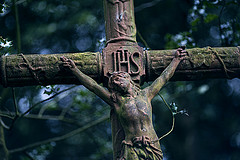 There’s a line from last year’s thought-provoking film, Calvary, that’s uttered by a young French woman. She has just lost her husband in a senseless car wreck somewhere along an Irish country road. After Father James (Brendan Gleeson) gives the last rites, he goes to sit with the woman for a time. Their subsequent discussion is the difficult one that follows all such traumatic events, when the comforting banality of the world has imploded, and the unmoored psyche bobs about in a world without physics.
Except there is a difference here, as the woman proves unlike any of the other people in the priest’s life. Instead of being enraged, vindictive, and accusatory, she remarks upon the good marriage that she’d had with her husband. She speaks with a marvelous repose.
I loved him, and he loved me. We were happy together. And now it’s over. It’s not unfair. It’s just what happened.
The woman goes on to say that to her way of thinking, the sense of unfairness in life belonged to those who have never loved, who have never had such happiness. Grief-stricken, she is nonetheless grateful for the time that was allotted her. Together, she and the priest say a “Hail Mary,” and the scene ends.
What goes unremarked upon, but not unfelt, is the majesty of the place from which a woman so bereft can say such a thing. The priest sees it as a gift of grace to have met her, and when he meets her again, as she is flying home to France with her husband’s body, she gives him the strength to face what is about to happen to him. He, too, has had a life—not unlike others, filled with happiness and sadness—and now it is about to be over.
It’s not unfair. It’s simply what will happen.
For Father James has been presented with his death sentence too, not by way of illness or old age, but as a sure and steady pronouncement. A week before, while he was hearing confessions, a man came into the booth. He told of a childhood in which he had been raped by an unnamed priest, repeatedly and without consequence. In return for the innocence he lost, for the injustice he suffered, he intends to exact a punishment. He will kill an innocent man, a good priest—Father James. In a week’s time, he will meet his confessor on the beach that borders the Irish village and murder him. This for that.
The following seven days in John Michael McDonagh’s film is a long litany of trials for Father James. The priest, a delayed vocation who entered holy orders only after his wife died, deals with the outrageous behavior and unmitigated hatred of his parishioners, who blame him and his God for all of their misfortunes.
Each life is a combination of bad fate and foolish choice, but the people exacerbate their troubles with a sense of rage that is beyond all proportion and direct it at Father James with a fury inconsistent with the good will of the man (in this, the film’s portrayal seems excessive—if not in the level of animosity to which those who wear collars and veils are actually subjected, then to the jaw-dropping degree to which it is overt).
So Father James faces his Calvary, an innocent man, a good priest, who will die for the sins of another. He is sorely tempted to save himself.
But in his Gethsemane moment, when he would have the cup pass, he sees the French woman bearing her husband’s body away. She is grateful for the life she was given and carries on with the loss she must bear. So the priest decides that he must face his life with a similar resolve. He returns to endure whatever fate awaits him.
But what is it that makes the two experiences—those of the French woman who bears loss in the way she does, and that of the angry parishioners, who bear it differently? How is it that one can take devastation with such understanding, and another is consumed with that devastation and seeks to replicate it, to punish blindly just as he was blindly punished?
“I took because I was never given anything” is the common justification of the thief. “I hate because I was hated.” “I scorn because I was scorned.” “Others were not cheated as I was cheated, so I must make up the balance and even the score.” For these things we can feel a kind of sympathy and understanding; we have said and felt them ourselves. We will extort the fairness that has eluded us.
But what of those who have that supreme perspicacity that appreciates the evanescence of all things, even that of those they held most dear? Those who see loss, even great loss, as the end of what was a good—but only a temporal good—as all things this side of eternity must be; who can release the hand of even those who were most cherished, and somehow utter a thank you for ever having had the hand at all; who walk to their Calvary, burdened, bleeding, and barefoot, but whose eyes are always focused elsewhere, beyond—at least a good three days hence.
A.G. Harmon teaches Shakespeare, Law and Literature, Jurisprudence, and Writing at The Catholic University of America in Washington, D.C. His novel, A House All Stilled, won the 2001 Peter Taylor Prize for the Novel.
Photo above credited to Luc. T and used under a Creative Commons license.
Previous Post

May 11, 2015
Finding God in Updike Country
Browse Our Archives
Select a Category A. G. Harmon Alissa Wilkinson Allison Backous Art Authors Brad Fruhauff Bradford Winters Bryan Bliss Caroline Langston Chad Thomas Johnston Chris Hoke Christiana N. Peterson Culture D.G. Myers D.L. Mayfield Daniel Bowman Jr. David Griffith Elizabeth Duffy Faith Film Greg Wolfe Guest Contributor Interview Jan Vallone Jeffrey Overstreet Jessica Eddings-Roeser Jessica Mesman Griffith Kelly Foster Lindsey Crittenden Morgan Meis music Natalie Vestin Nick Olson Peggy Rosenthal Personal Reflection Poetry Friday Reflection Relationships Review Richard Chess Richard Cole Sara Zarr Shannon Huffman Polson Sonya Bilocerkowycz Tania Runyan Tony Woodlief Topical Categories Uncategorized Vic Sizemore Writing
Select a Month October 2018 September 2018 August 2018 July 2018 June 2018 May 2018 April 2018 March 2018 February 2018 January 2018 December 2017 November 2017 October 2017 September 2017 August 2017 July 2017 June 2017 May 2017 April 2017 March 2017 February 2017 January 2017 December 2016 November 2016 October 2016 September 2016 August 2016 July 2016 June 2016 May 2016 April 2016 March 2016 February 2016 January 2016 December 2015 November 2015 October 2015 September 2015 August 2015 July 2015 June 2015 May 2015 April 2015 March 2015 February 2015 January 2015 December 2014 November 2014 October 2014 September 2014 August 2014 July 2014 June 2014 May 2014 April 2014 March 2014 February 2014 January 2014 December 2013 November 2013 October 2013 September 2013 August 2013 July 2013 June 2013 May 2013 April 2013 March 2013 February 2013 January 2013 December 2012 November 2012 October 2012 September 2012 August 2012 July 2012 June 2012 May 2012 February 2008
Follow Us!
TAKE THE
Religious Wisdom Quiz
What does "Rabboni" mean?
Select your answer to see how you score.
Holy One My Teacher Savior Master
Related posts from Good Letters



Poetry Friday: A Quick Interpretation of the Sixth...
TRENDING AT PATHEOS Catholic

Rejecting Doom: Christian Hope And Human Action
Christianity is a religion of hope. We are to have hope and...

It’s What Comes From Within Which Matters
One of the most difficult things for us to understand is why...

Why I Choose the Eucharist Over the Sermon
Choose the Eucharist, Not the Sermon What are we supposed to get...

5 Design Elements Found in Spiritually Rooted Homes
Putting Spirituality Into Home Decor Our homes are more than our living...

Credo: A Story of God Told with the...
About 10 years ago, I began to imagine a personal "Credo" that...

The Anatomy of Divine Revelation in Catholic Thought
The claim that God has made Himself known to human beings is...
view all Catholic blogs
Ad-Free & Subscriber Log-In Subscription Support
- About Us
- 2026 Calendar
- Videos
- Podcasts
- Library of World Religions
- Faith In Media Tracker
- Advertise With Us
- Write for Us
- Privacy Policy
- Terms of Service
- Do Not Sell My Data
- Contact Us
- Radiant Digital
- Manage Newsletter Subscriptions
- Unsubscribe From Notifications
- Sitemap
Copyright 2008-2026, Patheos. All rights reserved.
Subscription Support Ad-Free & Subscriber Log-In
Follow Patheos