
BuddhistCatholicContemplativeEvangelicalGeneral ChristianHinduJewishLatter-day SaintMuslimNew VisionsProgressive Christian
Beliefs
- Buddhist
- Catholic
- Contemplative
- Evangelical
- General Christian
- Hindu
- Jewish
- Latter-day Saint
- More Voices
- Muslim
- New Visions
- Pagan
- Progressive Christian
Topics
- Religion News
- Food and Religion
- Sports and Religion
- Religious Art
- Religious Music and Entertainment
- Religious Events
- History and Religion
- Style and Religion
- Politics and Religion
- Women in Religion
- Recreation Outdoors and Religion
- Business Finance and Religion
- Careers Workplace and Religion
- Education and Religion
- Family Parenting and Religion
- Health Fitness and Religion
- Home and Religion
- Relationships and Religion
- Technology and Religion
- Travel and Religion
Columnists
- Buddhist Columnists
- Business Finance and Religion Columnists
- Careers Workplace and Religion Columnists
- Catholic Columnists
- Contemplative Columnists
- Education and Religion Columnists
- Evangelists Columnists
- Family Parenting and Religion Columnists
- General Christian Columnists
- Health Fitness and Religion Columnists
- Hindu Columnists
- History and Religion Columnists
- Home and Religion Columnists
- Jewish Columnists
- More Voices Columnists
- Latter Day Columnists
- Muslim Columnists
- New Visions Columnists
- Nonreligious Columnists
- Pagan Columnists
- Politics and Religion Columnists
- Progressive Columnists
- Recreation Outdoors and Religion Columnists
- Relationships and Religion Columnists
- Religion News Columnists
- Religious Art Columnists
- Religious Events Columnists
- Religious Music and Entertainment Columnists
- Sports and Religion Columnists
- Style and Religion Columnists
- Technology and Religion Columnists
- Travel and Religion Columnists
- Women in Religion Columnists
Resource Library
- 2026 Calendar
- Library of World Religions
- The 100 Most Holy Places on Earth
- Patheos Answers
- Podcasts
- Videos
- Faith Leaders Database
- Anglican Episcopalian
- Bahai
- Baptist
- Buddhism
- Christianity
- Confucianism
- Eastern Orthodoxy
- Hinduism
- Holiness and Pentecostal
- ISKCON
- Islam
- Judaism
- Lutheran
- Methodist
- The Church of Jesus Christ of Latter-day Saints
- New Age
- Paganism
- Presbytarian and Reformed
- Protestantism
- Religion Behind the Scenes
- Roman Catholic
- Scientology
- Shia Islam
- Sikhism
- Sufism
- Sunni Islam
- Taoism
- Zen
- See all religions
Research Tools
 Ad-Free & Subscriber Log-In Subscription Support
Ad-Free & Subscriber Log-In Subscription Support
Follow Patheos 

- Trending:
- Forgiveness
- |
- Marriage
- |
- Consciousness
- |
- Death Penalty
- |
- Election
- |
- Halloween
 Good Letters
-
Contributors
- Home
- Catholic
- Prayer in Five Parts
Prayer in Five Parts
Last updated on: April 10, 2015 at 1:29 am by Allison Backous Troy
Prayer in Five Parts 2015-04-06T12:41:45-07:00 Allison Backous Troy
Patheos Explore the world's faith through different perspectives on religion and spirituality! Patheos has the views of the prevalent religions and spiritualities of the world.
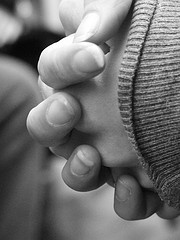 “Prayer…is always available to us.”
–St. Seraphim of Sarov
I
I sit atop my red metal bunk bed, thumbing through the orange, vinyl-bound pocket Bible that I received at a friend’s Vacation Bible School party. Tomorrow morning, I have an appointment with the doctor, who will examine a cyst on my left breast.
I am ten years old, and my mother cannot tell me what the cyst is. On my bed, the ceiling light spins in a crooked circle above me. I read Psalm 42:
As the deer pants for streams of water, so my soul pants for thee, O Lord. The fan shrieks as it swings, and I say out loud: “God, please don’t let me have cancer. Please don’t let me die.”
The next day, my prayer is answered––the cyst is harmless, and the doctor is kind. The Bible gets tucked into my bed sheets, the vinyl cover cold on my feet as I sleep.
II
I sit on the floor, the same bunk bed smooth and cool against my back. A lamp we snagged from a neighbor’s dumpster lights the room, dust blanketing its bulbous, turquoise frame.
I’m holding a map of Africa that unfolds from a magazine my youth pastor gave me. It lists countries in the 10/40 Window, a region between ten and forty degrees latitude where, the magazine says, people “know nothing about the Gospel.”
I trace the countries with my finger: Greece, Iraq, Sudan, Egypt. I do not know that there are domes in these countries that are gilded with golden crosses; I do not know anything about church, or history, or what it would look like to make the sign of the cross.
I only know that I am supposed to pray for these places. I rock my body back and forth as I keep in rhythm with the prayer that flows from my mouth:
Lord, save your people in these places; bring them your light, that they may know you.
The lamp broods in the corner, and I keep rocking, the words streaming from my mouth like incense.
III
It is early morning; I shuffle along the icy sidewalk into a school building, where, in a quiet gray classroom, my friends sit quietly. Their red prayer books are open to Psalm 95, the psalm we recite together each morning, the prayer that many monks and nuns, in their faraway cloisters and halls, recite with us:
Come, let us sing for joy to the LORD; let us shout aloud to the rock of our salvation.
Aron, one of the friends present, is also our professor, and has spent the past winter teaching us about praying the daily office: matins, midday prayer, compline. I have never known how to read the Bible, let alone pray its words.
And what we pray in this room is peaceful, anchored, steady. The frantic despair that accompanied my lonely, earlier prayers seems to be stilled as we take turns reading psalms aloud. There is an arc, an aim. The Psalms, Aron says, are a way to see our communion with the saints, with those who struggle and pray for us even now, even as the Canticle of Zechariah, another morning reading, falls on me.
“In the tender compassion of our God,” I say, “the dawn from on high will break upon us, to shine upon those who dwell in darkness and the shadow of death, and guide our feet in the way of peace.”
My voice trembles, but the line carries me right through the end. Aron nods his head and looks towards the blinds, where the morning light lines the windowpane, slim, piercing, true.
IV
Sitting in front of my students, I scribble a handful of prayer requests onto the back of an assignment sheet. There are a number of things: the panic of midterms, a friend who has lost a child in a car accident, a student who misses his family back in Kenya.
I am running on little sleep and a busied mind, and there is no way that my notes capture the weight of what my students lay down with sleepy, weighty words. I look at them.
“Well friends,” I say, “let’s pray.”
They bow their heads, and I wish that I had something to anoint them with: oil, water, something to help them feel the love I bear for them now, annoyed and sarcastic as I am about their papers in my office. Something to clean and bless the words I lift up for them, for us.
V
At home, I dunk my finger in the small vial of holy water, trace a small cross on my forehead. I know how to cross myself, now, know the way to bow, the quick pace needed to recite “Lord have mercy” twelve times in a breath.
My fiancé, who converted to Orthodoxy, has taught me to pray with him this way. It has been tiring to adopt this, to memorize a new series of petitions and supplications, to save Psalm 95 for the Divine Liturgy alone.
It feels like I have been running through prayers my whole life, and I know from the ache in my calves and the sleep in my eyes that there is much more to be learned.
Holy God, Holy Mighty, Holy Immortal, have mercy on us.
I say this three times, bend three times, rise three times. The words stream out of me, but not in spite of me, the cross dried on my skin, my mouth moving over what is given.
Originally published in Good Letters on May 31, 2012.
Allison Backous Troy teaches lives and writes in Boston, MA, with her family.
Photo used above credited to Keith Riley-Whittingham and used under a Creative Commons license.
Previous Post

April 9, 2015
Literacy Class: Learning the Language of Love
Next Post
April 13, 2015 No Glory in Jericho
Browse Our Archives
Select a Category A. G. Harmon Alissa Wilkinson Allison Backous Art Authors Brad Fruhauff Bradford Winters Bryan Bliss Caroline Langston Chad Thomas Johnston Chris Hoke Christiana N. Peterson Culture D.G. Myers D.L. Mayfield Daniel Bowman Jr. David Griffith Elizabeth Duffy Faith Film Greg Wolfe Guest Contributor Interview Jan Vallone Jeffrey Overstreet Jessica Eddings-Roeser Jessica Mesman Griffith Kelly Foster Lindsey Crittenden Morgan Meis music Natalie Vestin Nick Olson Peggy Rosenthal Personal Reflection Poetry Friday Reflection Relationships Review Richard Chess Richard Cole Sara Zarr Shannon Huffman Polson Sonya Bilocerkowycz Tania Runyan Tony Woodlief Topical Categories Uncategorized Vic Sizemore Writing
Select a Month October 2018 September 2018 August 2018 July 2018 June 2018 May 2018 April 2018 March 2018 February 2018 January 2018 December 2017 November 2017 October 2017 September 2017 August 2017 July 2017 June 2017 May 2017 April 2017 March 2017 February 2017 January 2017 December 2016 November 2016 October 2016 September 2016 August 2016 July 2016 June 2016 May 2016 April 2016 March 2016 February 2016 January 2016 December 2015 November 2015 October 2015 September 2015 August 2015 July 2015 June 2015 May 2015 April 2015 March 2015 February 2015 January 2015 December 2014 November 2014 October 2014 September 2014 August 2014 July 2014 June 2014 May 2014 April 2014 March 2014 February 2014 January 2014 December 2013 November 2013 October 2013 September 2013 August 2013 July 2013 June 2013 May 2013 April 2013 March 2013 February 2013 January 2013 December 2012 November 2012 October 2012 September 2012 August 2012 July 2012 June 2012 May 2012 February 2008
Follow Us!
TAKE THE
Religious Wisdom Quiz
What does Jesus say about storing up treasures on earth?
Select your answer to see how you score.
Treasure is godliness Store as much as possible Only store in banks Do not, because they are temporary
Related posts from Good Letters

Poetry Friday: "The Burned Butterfly"

Leonard Cohen’s Holy and Broken Hallelujah

Ready or Not for the Days of Awe

TRENDING AT PATHEOS Catholic

Rejecting Doom: Christian Hope And Human Action
Christianity is a religion of hope. We are to have hope and...

It’s What Comes From Within Which Matters
One of the most difficult things for us to understand is why...

Why I Choose the Eucharist Over the Sermon
Choose the Eucharist, Not the Sermon What are we supposed to get...

5 Design Elements Found in Spiritually Rooted Homes
Putting Spirituality Into Home Decor Our homes are more than our living...

Credo: A Story of God Told with the...
About 10 years ago, I began to imagine a personal "Credo" that...

The Anatomy of Divine Revelation in Catholic Thought
The claim that God has made Himself known to human beings is...
view all Catholic blogs
Ad-Free & Subscriber Log-In Subscription Support
- About Us
- 2026 Calendar
- Videos
- Podcasts
- Library of World Religions
- Faith In Media Tracker
- Advertise With Us
- Write for Us
- Privacy Policy
- Terms of Service
- Do Not Sell My Data
- Contact Us
- Radiant Digital
- Manage Newsletter Subscriptions
- Unsubscribe From Notifications
- Sitemap
Copyright 2008-2026, Patheos. All rights reserved.
Subscription Support Ad-Free & Subscriber Log-In
Follow Patheos