
BuddhistCatholicContemplativeEvangelicalGeneral ChristianHinduJewishLatter-day SaintMuslimNew VisionsProgressive Christian
Beliefs
- Buddhist
- Catholic
- Contemplative
- Evangelical
- General Christian
- Hindu
- Jewish
- Latter-day Saint
- More Voices
- Muslim
- New Visions
- Pagan
- Progressive Christian
Topics
- Religion News
- Food and Religion
- Sports and Religion
- Religious Art
- Religious Music and Entertainment
- Religious Events
- History and Religion
- Style and Religion
- Politics and Religion
- Women in Religion
- Recreation Outdoors and Religion
- Business Finance and Religion
- Careers Workplace and Religion
- Education and Religion
- Family Parenting and Religion
- Health Fitness and Religion
- Home and Religion
- Relationships and Religion
- Technology and Religion
- Travel and Religion
Columnists
- Buddhist Columnists
- Business Finance and Religion Columnists
- Careers Workplace and Religion Columnists
- Catholic Columnists
- Contemplative Columnists
- Education and Religion Columnists
- Evangelists Columnists
- Family Parenting and Religion Columnists
- General Christian Columnists
- Health Fitness and Religion Columnists
- Hindu Columnists
- History and Religion Columnists
- Home and Religion Columnists
- Jewish Columnists
- More Voices Columnists
- Latter Day Columnists
- Muslim Columnists
- New Visions Columnists
- Nonreligious Columnists
- Pagan Columnists
- Politics and Religion Columnists
- Progressive Columnists
- Recreation Outdoors and Religion Columnists
- Relationships and Religion Columnists
- Religion News Columnists
- Religious Art Columnists
- Religious Events Columnists
- Religious Music and Entertainment Columnists
- Sports and Religion Columnists
- Style and Religion Columnists
- Technology and Religion Columnists
- Travel and Religion Columnists
- Women in Religion Columnists
Resource Library
- 2026 Calendar
- Library of World Religions
- The 100 Most Holy Places on Earth
- Patheos Answers
- Podcasts
- Videos
- Faith Leaders Database
- Anglican Episcopalian
- Bahai
- Baptist
- Buddhism
- Christianity
- Confucianism
- Eastern Orthodoxy
- Hinduism
- Holiness and Pentecostal
- ISKCON
- Islam
- Judaism
- Lutheran
- Methodist
- The Church of Jesus Christ of Latter-day Saints
- New Age
- Paganism
- Presbytarian and Reformed
- Protestantism
- Religion Behind the Scenes
- Roman Catholic
- Scientology
- Shia Islam
- Sikhism
- Sufism
- Sunni Islam
- Taoism
- Zen
- See all religions
Research Tools
 Ad-Free & Subscriber Log-In Subscription Support
Ad-Free & Subscriber Log-In Subscription Support
Follow Patheos 

- Trending:
- Forgiveness
- |
- Marriage
- |
- Consciousness
- |
- Death Penalty
- |
- Election
- |
- Halloween
 Good Letters
-
Contributors
- Home
- Catholic
- Neil deGrasse Tyson’s Cosmos and the Megachurch
Neil deGrasse Tyson’s Cosmos and the Megachurch
Last updated on: July 20, 2015 at 12:36 pm by Tony Woodlief
Neil deGrasse Tyson’s Cosmos and the Megachurch 2015-07-20T12:36:36-07:00 Tony Woodlief
Patheos Explore the world's faith through different perspectives on religion and spirituality! Patheos has the views of the prevalent religions and spiritualities of the world.
This post was made possible through the support of a grant from The BioLogos Foundation’s Evolution and Christian Faith program. The opinions expressed are those of the author and do not necessarily reflect the views of BioLogos.
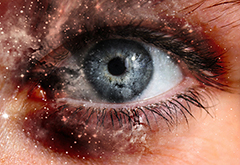 My suspicion grows apace with the slickness of a presentation. This is one reason I squirm in a megachurch. PowerPoint slides, emotion-tugging video clips during the pre-game show, music crafted to feel edgy and relevant—my skin crawls like I’m about to hear a sales pitch, which I guess I am, which maybe isn’t so bad for God-seekers who aren’t inveterate curmudgeons.
“Slick,” likewise, was my first response to Neil deGrasse Tyson’s Cosmos reboot, which evoked its own megachurch feeling, alternating sci-fi videography with fervent sermons about evolution. The risk in a new set of films from the BioLogos Foundation, which seeks to draw people into a conversation about the intersection of science and faith, is that they will spark exactly that, only one that marries the megachurch’s Jesus-Superbowl with the liberation theology that is evolution theory in the mouths of pop scientists like Tyson.
The danger, in short, is that the conversation is over before it begins, because participation requires one side to lay down their presuppositions, but allows the other to continue clutching theirs like a toddler his candy.
Unlike Cosmos and the megachurch, however, BioLogos features serious scientists and theologians. That in itself need not amount to much, of course—the multiplicity of each is both consequence and cause of the errors running through their fields. (That’s not a knock against science or theology. All fields of human exploration are error-riddled; the only question is whether a particular domain has the principles, procedures, and talent to systematically exclude those errors.)
The intellectuals associated with BioLogos could be wrong, in other words, but by inviting conversation, at least they seem to welcome the emergence of truth.
And what is the truth, when it comes to the intersection (the collision!) of science and faith? The very question is wrong. Instead we should ask: What is the evidence for the claims you wish me to accept as valid? You want me to believe an evolutionary account of humanity’s origin? Fine, lay out the evidence for natural selection, grapple with the objections rooted in irreducible complexity, indicate the clues that point to now-invisible bridges between organisms you claim are linked in an evolutionary ladder.
This can only be a dialogue, of course, because your explication invites (if you are honest and unafraid) responses, to which you respond in turn. Together we consider the evidence, we argue about what it means (an essential part of scientific inquiry), and we come to conclusions that can be upended with the introduction of new evidence.
This question doesn’t seek to close a door prematurely, in other words, and that’s essential because the history of science is replete with self-assurance later upended. It’s replete as well with busybodies haranguing and punishing dissenters. U.S. Congressmen trying to get scientists skeptical of global warming fired from university positions are not pioneers in that regard. Small-minded people who want to bully you into embracing the truth, rather than have a dialogue about the evidence, have always been commonplace.
So BioLogos seeks, it would seem, to spark conversations. Clergy in particular, its spokesmen argue, have an obligation to help their flocks consider these matters. Science, they claim, “is not a threat to religious belief.”
Well, that depends on what beliefs one holds, doesn’t it? There are some Christian sects that teach that God crafted the universe in six days, and that the earth is 7,000 years old. Various methods of dating the earth (which have some interesting anomalies, though pop scientists don’t want you to know that) suggest otherwise. Is science a threat to the beliefs of their adherents? I should say so.
Other sects teach that evolution is incompatible with the Genesis account of man being fashioned in the image and likeness of God. What if one of their followers becomes convinced that the evidence for natural selection is sufficient to render an evolution account reliable? Does that threaten his religious belief? To the core.
My Protestant friends, in particular, must navigate Scylla and Charybdis here—Biblical literalism leads to clashes with fundamental tenets of geological and biological science, while a tradition of personal Biblical interpretation makes it easier for adherents to drift away from basic tenets of Christian dogma. Both represent a threat to orthodoxy, and perhaps this is why opposition to science is strongest, according to survey evidence, among churches with least reliance on catechism, liturgy, and intellectual immersion in theologians who established their sects (if any such exist)—all of these the last vestiges of tradition in Protestantism.
Maybe it’s tempting to blast away with the scientific evidence regardless, but when people hold a faith in their creator that is ill-grounded, we who share that faith have an obligation to treat them gently, as weaker brethren.
This is treacherous territory, because undermining Biblical literalism, absent a steady faith tradition not itself dependent on that literalism, can be akin to jumping from a spacecraft—once you start drifting, you may never regain your footing. Read the comments sections of popular bloggers like Peter Enns and Rachel Held Evans, who specialize in deconstructing Biblical scriptures that undermine their social views, and you see this happening in real-time.
Tinkering with how Christians understand the Bible, then—especially those from sects less reliant on tradition—runs the risk of unraveling their faith altogether, rather than reorienting them to a worldview where science doesn’t threaten that faith. The Corpus Hippocraticum urged physicians to “do good or do no harm.” St. Paul enjoined us to speak truth in love. Both are valuable guides in this discussion, and I hope BioLogos will embody both, because both are greatly needed.
Join in the conversation about evolution and Christian faith by visiting the BioLogos symposium at Patheos. Click here for more on Image’s BioLogos colloquy.
Tony Woodlief lives in North Carolina*.* His essays have appeared in The Wall Street Journal and The London Times, and his short stories appeared in Image, Ruminate, Saint Katherine Review, and Dappled Things. His website is tonywoodlief.com.
Photo used above credited to Natasha and used under a Creative Commons license.
Previous Post

April 7, 2015
Saving the World: A Reflection on Germanwings Flight 9525
Next Post
April 9, 2015 Literacy Class: Learning the Language of Love
Browse Our Archives
Select a Category A. G. Harmon Alissa Wilkinson Allison Backous Art Authors Brad Fruhauff Bradford Winters Bryan Bliss Caroline Langston Chad Thomas Johnston Chris Hoke Christiana N. Peterson Culture D.G. Myers D.L. Mayfield Daniel Bowman Jr. David Griffith Elizabeth Duffy Faith Film Greg Wolfe Guest Contributor Interview Jan Vallone Jeffrey Overstreet Jessica Eddings-Roeser Jessica Mesman Griffith Kelly Foster Lindsey Crittenden Morgan Meis music Natalie Vestin Nick Olson Peggy Rosenthal Personal Reflection Poetry Friday Reflection Relationships Review Richard Chess Richard Cole Sara Zarr Shannon Huffman Polson Sonya Bilocerkowycz Tania Runyan Tony Woodlief Topical Categories Uncategorized Vic Sizemore Writing
Select a Month October 2018 September 2018 August 2018 July 2018 June 2018 May 2018 April 2018 March 2018 February 2018 January 2018 December 2017 November 2017 October 2017 September 2017 August 2017 July 2017 June 2017 May 2017 April 2017 March 2017 February 2017 January 2017 December 2016 November 2016 October 2016 September 2016 August 2016 July 2016 June 2016 May 2016 April 2016 March 2016 February 2016 January 2016 December 2015 November 2015 October 2015 September 2015 August 2015 July 2015 June 2015 May 2015 April 2015 March 2015 February 2015 January 2015 December 2014 November 2014 October 2014 September 2014 August 2014 July 2014 June 2014 May 2014 April 2014 March 2014 February 2014 January 2014 December 2013 November 2013 October 2013 September 2013 August 2013 July 2013 June 2013 May 2013 April 2013 March 2013 February 2013 January 2013 December 2012 November 2012 October 2012 September 2012 August 2012 July 2012 June 2012 May 2012 February 2008
Follow Us!
TAKE THE
Religious Wisdom Quiz
What happened to Jesus 40 days after His resurrection?
Select your answer to see how you score.
He went back into hiding He performed one last miracle He ascended into heaven He visited the temple
Related posts from Good Letters

Meditations of a Library Assistant in the BS...

Tyler Childers's Purgatory and Trump Country
The Liturgy of the Stars: Part 2

The Liturgy of the Stars: Part 1
TRENDING AT PATHEOS Catholic

Rejecting Doom: Christian Hope And Human Action
Christianity is a religion of hope. We are to have hope and...

It’s What Comes From Within Which Matters
One of the most difficult things for us to understand is why...

Why I Choose the Eucharist Over the Sermon
Choose the Eucharist, Not the Sermon What are we supposed to get...

5 Design Elements Found in Spiritually Rooted Homes
Putting Spirituality Into Home Decor Our homes are more than our living...

Credo: A Story of God Told with the...
About 10 years ago, I began to imagine a personal "Credo" that...

The Anatomy of Divine Revelation in Catholic Thought
The claim that God has made Himself known to human beings is...
view all Catholic blogs
Ad-Free & Subscriber Log-In Subscription Support
- About Us
- 2026 Calendar
- Videos
- Podcasts
- Library of World Religions
- Faith In Media Tracker
- Advertise With Us
- Write for Us
- Privacy Policy
- Terms of Service
- Do Not Sell My Data
- Contact Us
- Radiant Digital
- Manage Newsletter Subscriptions
- Unsubscribe From Notifications
- Sitemap
Copyright 2008-2026, Patheos. All rights reserved.
Subscription Support Ad-Free & Subscriber Log-In
Follow Patheos