
BuddhistCatholicContemplativeEvangelicalGeneral ChristianHinduJewishLatter-day SaintMuslimNew VisionsProgressive Christian
Beliefs
- Buddhist
- Catholic
- Contemplative
- Evangelical
- General Christian
- Hindu
- Jewish
- Latter-day Saint
- More Voices
- Muslim
- New Visions
- Pagan
- Progressive Christian
Topics
- Religion News
- Food and Religion
- Sports and Religion
- Religious Art
- Religious Music and Entertainment
- Religious Events
- History and Religion
- Style and Religion
- Politics and Religion
- Women in Religion
- Recreation Outdoors and Religion
- Business Finance and Religion
- Careers Workplace and Religion
- Education and Religion
- Family Parenting and Religion
- Health Fitness and Religion
- Home and Religion
- Relationships and Religion
- Technology and Religion
- Travel and Religion
Columnists
- Buddhist Columnists
- Business Finance and Religion Columnists
- Careers Workplace and Religion Columnists
- Catholic Columnists
- Contemplative Columnists
- Education and Religion Columnists
- Evangelists Columnists
- Family Parenting and Religion Columnists
- General Christian Columnists
- Health Fitness and Religion Columnists
- Hindu Columnists
- History and Religion Columnists
- Home and Religion Columnists
- Jewish Columnists
- More Voices Columnists
- Latter Day Columnists
- Muslim Columnists
- New Visions Columnists
- Nonreligious Columnists
- Pagan Columnists
- Politics and Religion Columnists
- Progressive Columnists
- Recreation Outdoors and Religion Columnists
- Relationships and Religion Columnists
- Religion News Columnists
- Religious Art Columnists
- Religious Events Columnists
- Religious Music and Entertainment Columnists
- Sports and Religion Columnists
- Style and Religion Columnists
- Technology and Religion Columnists
- Travel and Religion Columnists
- Women in Religion Columnists
Resource Library
- 2026 Calendar
- Library of World Religions
- The 100 Most Holy Places on Earth
- Patheos Answers
- Podcasts
- Videos
- Faith Leaders Database
- Anglican Episcopalian
- Bahai
- Baptist
- Buddhism
- Christianity
- Confucianism
- Eastern Orthodoxy
- Hinduism
- Holiness and Pentecostal
- ISKCON
- Islam
- Judaism
- Lutheran
- Methodist
- The Church of Jesus Christ of Latter-day Saints
- New Age
- Paganism
- Presbytarian and Reformed
- Protestantism
- Religion Behind the Scenes
- Roman Catholic
- Scientology
- Shia Islam
- Sikhism
- Sufism
- Sunni Islam
- Taoism
- Zen
- See all religions
Research Tools
 Ad-Free & Subscriber Log-In Subscription Support
Ad-Free & Subscriber Log-In Subscription Support
Follow Patheos 

- Trending:
- Forgiveness
- |
- Marriage
- |
- Consciousness
- |
- Death Penalty
- |
- Election
- |
- Halloween
 Good Letters
-
Contributors
- Home
- Catholic
- For the Love of Money
For the Love of Money
Last updated on: April 29, 2015 at 5:44 pm by Sara Zarr
For the Love of Money 2015-04-29T17:44:56-07:00 Sara Zarr
Patheos Explore the world's faith through different perspectives on religion and spirituality! Patheos has the views of the prevalent religions and spiritualities of the world.
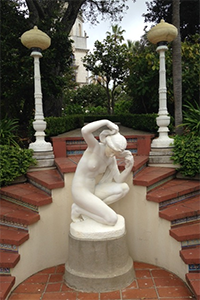 My husband and I took a spring break trip to the central coast of California, and we included a stop at the Hearst Castle—William Randolph Hearst’s 90,000 square foot, 61-bathroom home on 127 acres at the top of a hill overlooking the Pacific Ocean. Hearst was still expanding it when he died in 1951. It was never enough.
We bought a tour called “Upper Rooms and Suites” (since the size of the building makes it viewable only in chunks) and got to see, among other things, Hearst’s bedroom, boardroom, and library. As you might imagine, I got to thinking about money. Not in the context of Hearst being greedy or wasteful or ridiculous. More in the context of how much I’d love the chance to be rich myself.
I love money. Or, I love the idea of having lots and lots of it. As anyone who grew up in church (and most everyone else) has heard, the love of money is the root of all evil—or the root of “all kinds” of evil, depending on what version of I Timothy 6 you’re reading and what you’re trying to rationalize.
My relationship with money is complicated and strangely emotional. I imagine this is true for a lot of people, maybe most, but I suspect it’s more fraught for those of us who either grew up with lots of it or with virtually none of it. I fall into the latter category, with the kind of childhood that was full of hand-me-downs and twelve-for-a-dollar ramen and the specter of all the things our family didn’t do or have because we couldn’t afford it.
Our situation was a result specifically of the issues my parents had because of my father’s drinking. Multiple interstate moves, employment insecurity, and starting over again and again eventually eroded the financial stability they’d started out with as young adults. By the time they were raising my sister and me, they’d moved to the edge of that stability.
Other than “no” and “we can’t afford it,” we didn’t really talk about money. My sister and I never learned how to talk about money or think about money, how to spend it, how to save it, what it did or didn’t represent.
Now, the neighborhood near Golden Gate Park where I grew up was hardly a ghetto. This was the seventies when a family like ours could still rent something decent. So I didn’t have to endure all of the additional burdens of poverty that come with living in bad neighborhoods. We played in the streets without much danger and most kids I knew had nice houses or apartments and two parents. Our schools were great, and I had lots of free experiences that made life fun and gave me advantages.
I understand that I had a lot. But these things are relative, and all I saw around me were the toys and clothes I didn’t have and that we didn’t have a car and that I couldn’t join the Campfire Girls because of the cost of the uniform. I knew that sometimes people from our church slipped envelopes of cash under our front door to help us buy groceries, or passed on bags of clothes they thought we could use. In retrospect, I know that feeling of being a “have not” was greatly exacerbated by the abandonment that came with having a drunk father and a mother trying to deal with him.
Still, my identity of “growing up poor” is one of the identities I tend to cling to. Being poor isn’t something to be competitive about, but I sometimes am. All these identities we carry fuse themselves onto our pride in some clumsy way. We wind up defending even the identities we most despise if someone tries to take them away.
I had this friend who would often describe himself as “poor” or “broke,” meaning he didn’t currently have an income above poverty level. But he had five figures in savings, and his parents had paid for his college education and continued to gift or help with major purchases. When he used those words about himself, I really bristled. I felt like he was taking something away from me, or that my life experience was being trivialized. It felt like an attack on my identity.
Likewise, when I describe myself as “poor” or “broke,” a friend might furrow a brow and intimate that I make enough, that between my husband and me we should be able to provide for our needs and save and be just fine. Boy does that piss me off.
But the ramen, my God the ramen. The smell of thrift-store clothes never washes out; I can smell it right now in my memory.
Of course my friends are right. I have always had enough. The lack of material things would have felt very different if we weren’t dealing with an addict in the family, I know that.
Despite my rational knowledge of the truth, I am prone to spin from wanting to be secure to wanting to be “just a little bit rich” to fantasies of Hearst-like wealth that would finally, finally make me feel taken care of. I am so much more able to trust that God will provide for me and clothe me like the lilies if I have a nice fat chunk of change in the bank.
I suspect, though, that like the generation that lived through the Depression, I would feel financially insecure no matter what, because money, to me, is more than money. Money is the father who provides for your family, and the assurance of being accepted because you have the right things. Money is love.
So maybe it’s not that I love money, it’s that I think money can love me. Put it like that and it seems obviously silly, but it’s what we do with all idols. It’s not so much our love of those things that is the root of the dysfunctional relationship with them—it’s the belief that they can love us, approve of us, save us, redeem us.
We build our castles, and they will never be big enough.
Sara Zarr is the author of five novels for young adults, most recently The Lucy Variations, which the New York Times called “an elegant novel.” Her sixth, a collaborative novel with Tara Altebrando, came out December 2013. She’s a National Book Award finalist and two-time Utah Book Award winner. Her books have been variously named to annual best books lists of the American Library Association, Kirkus, Publisher’s Weekly, School Library Journal, the Guardian, the International Reading Association, the New York Public Library and Los Angeles Public Library, and have been translated into many languages. In 2010, she served as a judge for the National Book Award. In fall 2014, she received a MacDowell Colony Fellowship. She currently lives in Salt Lake City, Utah, with her husband, and online at www.sarazarr.com
Previous Post

April 21, 2015
What Will Pass for Mercy
Next Post
April 23, 2015 Fever
Browse Our Archives
Select a Category A. G. Harmon Alissa Wilkinson Allison Backous Art Authors Brad Fruhauff Bradford Winters Bryan Bliss Caroline Langston Chad Thomas Johnston Chris Hoke Christiana N. Peterson Culture D.G. Myers D.L. Mayfield Daniel Bowman Jr. David Griffith Elizabeth Duffy Faith Film Greg Wolfe Guest Contributor Interview Jan Vallone Jeffrey Overstreet Jessica Eddings-Roeser Jessica Mesman Griffith Kelly Foster Lindsey Crittenden Morgan Meis music Natalie Vestin Nick Olson Peggy Rosenthal Personal Reflection Poetry Friday Reflection Relationships Review Richard Chess Richard Cole Sara Zarr Shannon Huffman Polson Sonya Bilocerkowycz Tania Runyan Tony Woodlief Topical Categories Uncategorized Vic Sizemore Writing
Select a Month October 2018 September 2018 August 2018 July 2018 June 2018 May 2018 April 2018 March 2018 February 2018 January 2018 December 2017 November 2017 October 2017 September 2017 August 2017 July 2017 June 2017 May 2017 April 2017 March 2017 February 2017 January 2017 December 2016 November 2016 October 2016 September 2016 August 2016 July 2016 June 2016 May 2016 April 2016 March 2016 February 2016 January 2016 December 2015 November 2015 October 2015 September 2015 August 2015 July 2015 June 2015 May 2015 April 2015 March 2015 February 2015 January 2015 December 2014 November 2014 October 2014 September 2014 August 2014 July 2014 June 2014 May 2014 April 2014 March 2014 February 2014 January 2014 December 2013 November 2013 October 2013 September 2013 August 2013 July 2013 June 2013 May 2013 April 2013 March 2013 February 2013 January 2013 December 2012 November 2012 October 2012 September 2012 August 2012 July 2012 June 2012 May 2012 February 2008
Follow Us!
TAKE THE
Religious Wisdom Quiz
Who built the first temple in Jerusalem?
Select your answer to see how you score.
David Moses Solomon Joshua
Related posts from Good Letters




TRENDING AT PATHEOS Catholic

Rejecting Doom: Christian Hope And Human Action
Christianity is a religion of hope. We are to have hope and...

It’s What Comes From Within Which Matters
One of the most difficult things for us to understand is why...

Why I Choose the Eucharist Over the Sermon
Choose the Eucharist, Not the Sermon What are we supposed to get...

5 Design Elements Found in Spiritually Rooted Homes
Putting Spirituality Into Home Decor Our homes are more than our living...

Credo: A Story of God Told with the...
About 10 years ago, I began to imagine a personal "Credo" that...

The Anatomy of Divine Revelation in Catholic Thought
The claim that God has made Himself known to human beings is...
view all Catholic blogs
Ad-Free & Subscriber Log-In Subscription Support
- About Us
- 2026 Calendar
- Videos
- Podcasts
- Library of World Religions
- Faith In Media Tracker
- Advertise With Us
- Write for Us
- Privacy Policy
- Terms of Service
- Do Not Sell My Data
- Contact Us
- Radiant Digital
- Manage Newsletter Subscriptions
- Unsubscribe From Notifications
- Sitemap
Copyright 2008-2026, Patheos. All rights reserved.
Subscription Support Ad-Free & Subscriber Log-In
Follow Patheos