
BuddhistCatholicContemplativeEvangelicalGeneral ChristianHinduJewishLatter-day SaintMuslimNew VisionsProgressive Christian
Beliefs
- Buddhist
- Catholic
- Contemplative
- Evangelical
- General Christian
- Hindu
- Jewish
- Latter-day Saint
- More Voices
- Muslim
- New Visions
- Pagan
- Progressive Christian
Topics
- Religion News
- Food and Religion
- Sports and Religion
- Religious Art
- Religious Music and Entertainment
- Religious Events
- History and Religion
- Style and Religion
- Politics and Religion
- Women in Religion
- Recreation Outdoors and Religion
- Business Finance and Religion
- Careers Workplace and Religion
- Education and Religion
- Family Parenting and Religion
- Health Fitness and Religion
- Home and Religion
- Relationships and Religion
- Technology and Religion
- Travel and Religion
Columnists
- Buddhist Columnists
- Business Finance and Religion Columnists
- Careers Workplace and Religion Columnists
- Catholic Columnists
- Contemplative Columnists
- Education and Religion Columnists
- Evangelists Columnists
- Family Parenting and Religion Columnists
- General Christian Columnists
- Health Fitness and Religion Columnists
- Hindu Columnists
- History and Religion Columnists
- Home and Religion Columnists
- Jewish Columnists
- More Voices Columnists
- Latter Day Columnists
- Muslim Columnists
- New Visions Columnists
- Nonreligious Columnists
- Pagan Columnists
- Politics and Religion Columnists
- Progressive Columnists
- Recreation Outdoors and Religion Columnists
- Relationships and Religion Columnists
- Religion News Columnists
- Religious Art Columnists
- Religious Events Columnists
- Religious Music and Entertainment Columnists
- Sports and Religion Columnists
- Style and Religion Columnists
- Technology and Religion Columnists
- Travel and Religion Columnists
- Women in Religion Columnists
Resource Library
- 2026 Calendar
- Library of World Religions
- The 100 Most Holy Places on Earth
- Patheos Answers
- Podcasts
- Videos
- Faith Leaders Database
- Anglican Episcopalian
- Bahai
- Baptist
- Buddhism
- Christianity
- Confucianism
- Eastern Orthodoxy
- Hinduism
- Holiness and Pentecostal
- ISKCON
- Islam
- Judaism
- Lutheran
- Methodist
- The Church of Jesus Christ of Latter-day Saints
- New Age
- Paganism
- Presbytarian and Reformed
- Protestantism
- Religion Behind the Scenes
- Roman Catholic
- Scientology
- Shia Islam
- Sikhism
- Sufism
- Sunni Islam
- Taoism
- Zen
- See all religions
Research Tools
 Ad-Free & Subscriber Log-In Subscription Support
Ad-Free & Subscriber Log-In Subscription Support
Follow Patheos 

- Trending:
- Forgiveness
- |
- Marriage
- |
- Consciousness
- |
- Death Penalty
- |
- Election
- |
- Halloween
 Good Letters
-
Contributors
- Home
- Catholic
- The Healing Art: Doctors Prescribing Poems
The Healing Art: Doctors Prescribing Poems
Last updated on: March 23, 2015 at 5:28 pm by Peggy Rosenthal
The Healing Art: Doctors Prescribing Poems 2015-03-23T17:28:02-07:00 Peggy Rosenthal
Patheos Explore the world's faith through different perspectives on religion and spirituality! Patheos has the views of the prevalent religions and spiritualities of the world.
 My hematologist, who has monitored my leukemia for the past ten years, copied me into an email he sent to his colleagues. It was the poem “Beannacht” by Irish poet John O’Donohue, which begins:
On the day when
The weight deadens
On your shoulders
And you stumble,
May the clay dance
To balance you.
And when your eyes
Freeze behind
The gray window
And the ghost of loss
Gets in to you,
May a flock of colors,
Indigo, red, green
And azure blue,
Come to awaken in you
A meadow of delight.
What a grace to have a doctor who would send this around to his colleagues. This is what I want in all my doctors: human beings in touch with the full range of human emotions. People who respond to poetry.
My primary care doctor has similar sensibilities. Her special interest is in teaching doctors how to listen to their patients. She’s a knitter, hence someone in touch with her own creativity. She has long volunteered with hospice, so she’s attuned to the complex needs of dying people and their families.
My optometrist always asks about my current knitting project before she puts those stinging drops in my eyes to begin her examination.
The day after my husband went to the hospital for an angiogram and was found to need immediate quadruple by-pass surgery, his cardiologist phoned me to apologize: “I’m sorry I didn’t catch this sooner,” he humbly said.
When I was hospitalized with pneumonia last summer, the doctor on rounds would come in each morning to check on my condition. After he’d finished examining me, he and my husband would chat about books they were reading. I loved that; it was as healing as whatever meds he was giving me.
I’ve known since childhood that physicians are people. My father was one, and his colleagues were often at the house for social occasions. But, as I’m sure you’ve experienced, many physicians think that they’re not supposed to act like full human beings in their doctor-patient relationships. Or they’re afraid to show emotion, considering this unprofessional.
But—and what a gift of a “but” it is—to counterbalance this attitude, we have Rafael Campo: poet, physician, Harvard Medical School professor, essayist. At Harvard he teaches about art and medicine, describing the program with these words:
The difficulties of practicing medicine in a modern era increasingly dominated by economic constraints, technological hubris, and multicultural differences have been well described. Yet little constructive work has been done to refocus the attention of care providers on the universal nature of human suffering itself, and how empathy can continue to be modeled for aspiring care providers, especially medical students, under these changing and sometimes hostile conditions. The growing body of art and literature that responds to the illness experience is a powerful but underutilized medium for pondering and valuing the work of physicians, and for nurturing their personal growth and their dedication to what was once termed “the healing art.”
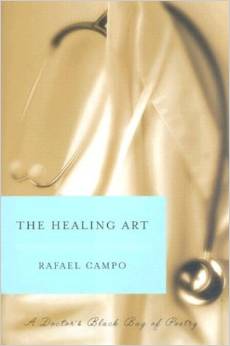
The Healing Art. Campo has in fact written a book with this title, in which he talks about how he gives his patients poems as well as prescriptions. He chooses poems by contemporary poets: poems about their own illnesses, because “poetry locates us inside the experience of illness, demanding that we consider it from within as attentively as we do from without.”
For each patient, he chooses a poem that offers metaphors for the patient’s particular illness. “Creating metaphors,” he writes, “is itself in fact a process similar to the healing process, involving an imaginative translocation from one state or position to the other.” Furthermore a poem, “in its rhythms and rhymes, metaphorically might restore the sufferer’s sense of control over deranged bodily functions.” Campo invites his patient to meditate with the poem he has “prescribed”—and also to write some lines in response to or in conversation with the poem.
In his own poetry, Campo sometimes writes about what it’s like, deep down, to be a doctor. One of my favorites about the doctor-patient relationship is called “What I Would Give” (from his collection Landscape with Human Figure):
What I would like to give them for a change
is not the usual prescription with
its hubris of the power to restore,
to cure; what I would like to give them, ill
from not enough of laying in the sun
not caring what the onlookers might think
while feeding some banana to their dogs—
what I would like to offer them is this,
not reassurance that their lungs sound fine,
or that the mole they’ve noticed change is not
a melanoma, but instead of fear
transfigured by some doctorly advice
I’d like to give them my astonishment
at sudden rainfall like the whole world weeping,
and how ridiculously gently it
slicked down my hair.
I’m blessed to have some doctors who are comfortable with giving me their “astonishment / at sudden rainfall.” But I want everyone to share in this blessing. If only all physicians gave what Campo offers.
Peggy Rosenthal is director of Poetry Retreats and writes widely on poetry as a spiritual resource. Her books include Praying through Poetry: Hope for Violent Times (Franciscan Media), and The Poets’ Jesus (Oxford). See Amazon for full list. She also teaches an online course, “Poetry as a Spiritual Practice,” through Image’s Glen Online program.
Previous Post

March 20, 2015
My Only Begotten Sin
Next Post
March 24, 2015 Resisting My Inner Columba Bush
Browse Our Archives
Select a Category A. G. Harmon Alissa Wilkinson Allison Backous Art Authors Brad Fruhauff Bradford Winters Bryan Bliss Caroline Langston Chad Thomas Johnston Chris Hoke Christiana N. Peterson Culture D.G. Myers D.L. Mayfield Daniel Bowman Jr. David Griffith Elizabeth Duffy Faith Film Greg Wolfe Guest Contributor Interview Jan Vallone Jeffrey Overstreet Jessica Eddings-Roeser Jessica Mesman Griffith Kelly Foster Lindsey Crittenden Morgan Meis music Natalie Vestin Nick Olson Peggy Rosenthal Personal Reflection Poetry Friday Reflection Relationships Review Richard Chess Richard Cole Sara Zarr Shannon Huffman Polson Sonya Bilocerkowycz Tania Runyan Tony Woodlief Topical Categories Uncategorized Vic Sizemore Writing
Select a Month October 2018 September 2018 August 2018 July 2018 June 2018 May 2018 April 2018 March 2018 February 2018 January 2018 December 2017 November 2017 October 2017 September 2017 August 2017 July 2017 June 2017 May 2017 April 2017 March 2017 February 2017 January 2017 December 2016 November 2016 October 2016 September 2016 August 2016 July 2016 June 2016 May 2016 April 2016 March 2016 February 2016 January 2016 December 2015 November 2015 October 2015 September 2015 August 2015 July 2015 June 2015 May 2015 April 2015 March 2015 February 2015 January 2015 December 2014 November 2014 October 2014 September 2014 August 2014 July 2014 June 2014 May 2014 April 2014 March 2014 February 2014 January 2014 December 2013 November 2013 October 2013 September 2013 August 2013 July 2013 June 2013 May 2013 April 2013 March 2013 February 2013 January 2013 December 2012 November 2012 October 2012 September 2012 August 2012 July 2012 June 2012 May 2012 February 2008
Follow Us!
TAKE THE
Religious Wisdom Quiz
What does the Parable of the Good Shepherd teach?
Select your answer to see how you score.
Shepherds are wealthy Jesus cares for each of His sheep Wolves are evil Goats are bad
Related posts from Good Letters


On Writing Odes: Taking Time to Celebrate

Poetry Friday: "The Burned Butterfly"

A Conversation with Alicia Ostriker: Part 1
TRENDING AT PATHEOS Catholic

The Parable Of The Sower And The Word...
One of Christ’s most famous parables is that of the sower who...

Rejecting Doom: Christian Hope And Human Action
Christianity is a religion of hope. We are to have hope and...

Why I Choose the Eucharist Over the Sermon
Choose the Eucharist, Not the Sermon What are we supposed to get...

5 Design Elements Found in Spiritually Rooted Homes
Putting Spirituality Into Home Decor Our homes are more than our living...

Credo: A Story of God Told with the...
About 10 years ago, I began to imagine a personal "Credo" that...

The Anatomy of Divine Revelation in Catholic Thought
The claim that God has made Himself known to human beings is...
view all Catholic blogs
Ad-Free & Subscriber Log-In Subscription Support
- About Us
- 2026 Calendar
- Videos
- Podcasts
- Library of World Religions
- Faith In Media Tracker
- Advertise With Us
- Write for Us
- Privacy Policy
- Terms of Service
- Do Not Sell My Data
- Contact Us
- Radiant Digital
- Manage Newsletter Subscriptions
- Unsubscribe From Notifications
- Sitemap
Copyright 2008-2026, Patheos. All rights reserved.
Subscription Support Ad-Free & Subscriber Log-In
Follow Patheos