
BuddhistCatholicContemplativeEvangelicalGeneral ChristianHinduJewishLatter-day SaintMuslimNew VisionsProgressive Christian
Beliefs
- Buddhist
- Catholic
- Contemplative
- Evangelical
- General Christian
- Hindu
- Jewish
- Latter-day Saint
- More Voices
- Muslim
- New Visions
- Pagan
- Progressive Christian
Topics
- Religion News
- Food and Religion
- Sports and Religion
- Religious Art
- Religious Music and Entertainment
- Religious Events
- History and Religion
- Style and Religion
- Politics and Religion
- Women in Religion
- Recreation Outdoors and Religion
- Business Finance and Religion
- Careers Workplace and Religion
- Education and Religion
- Family Parenting and Religion
- Health Fitness and Religion
- Home and Religion
- Relationships and Religion
- Technology and Religion
- Travel and Religion
Columnists
- Buddhist Columnists
- Business Finance and Religion Columnists
- Careers Workplace and Religion Columnists
- Catholic Columnists
- Contemplative Columnists
- Education and Religion Columnists
- Evangelists Columnists
- Family Parenting and Religion Columnists
- General Christian Columnists
- Health Fitness and Religion Columnists
- Hindu Columnists
- History and Religion Columnists
- Home and Religion Columnists
- Jewish Columnists
- More Voices Columnists
- Latter Day Columnists
- Muslim Columnists
- New Visions Columnists
- Nonreligious Columnists
- Pagan Columnists
- Politics and Religion Columnists
- Progressive Columnists
- Recreation Outdoors and Religion Columnists
- Relationships and Religion Columnists
- Religion News Columnists
- Religious Art Columnists
- Religious Events Columnists
- Religious Music and Entertainment Columnists
- Sports and Religion Columnists
- Style and Religion Columnists
- Technology and Religion Columnists
- Travel and Religion Columnists
- Women in Religion Columnists
Resource Library
- 2026 Calendar
- Library of World Religions
- The 100 Most Holy Places on Earth
- Patheos Answers
- Podcasts
- Videos
- Faith Leaders Database
- Anglican Episcopalian
- Bahai
- Baptist
- Buddhism
- Christianity
- Confucianism
- Eastern Orthodoxy
- Hinduism
- Holiness and Pentecostal
- ISKCON
- Islam
- Judaism
- Lutheran
- Methodist
- The Church of Jesus Christ of Latter-day Saints
- New Age
- Paganism
- Presbytarian and Reformed
- Protestantism
- Religion Behind the Scenes
- Roman Catholic
- Scientology
- Shia Islam
- Sikhism
- Sufism
- Sunni Islam
- Taoism
- Zen
- See all religions
Research Tools
 Ad-Free & Subscriber Log-In Subscription Support
Ad-Free & Subscriber Log-In Subscription Support
Follow Patheos 

- Trending:
- Forgiveness
- |
- Marriage
- |
- Consciousness
- |
- Death Penalty
- |
- Election
- |
- Halloween
 Good Letters
-
Contributors
- Home
- Catholic
- Resisting My Inner Columba Bush
Resisting My Inner Columba Bush
Last updated on: March 24, 2015 at 1:07 pm by Caroline Langston
Resisting My Inner Columba Bush 2015-03-24T13:07:50-07:00 Caroline Langston
Patheos Explore the world's faith through different perspectives on religion and spirituality! Patheos has the views of the prevalent religions and spiritualities of the world.
 Poor Columba Bush: On top of the doubtlessly-endless-hassle it must be to have your husband effectively running for president when you are known as a “low key sort,” it’s even worse to have Karen Tumulty of The Washington Post go digging through your disclosure forms to find out that—as goes the stock phrase that has now been repeated over and over like a bad penny—you “took out a loan to buy $42,311.70 worth of jewelry on a single day” in 2000. As well as to bring up, yet again, the old story about how you were held by customs officials, coming back from Paris, for lying about how much shopping you did, because you were trying to hide the $19,000 bill from your husband.
Despite my general tendency to describe myself in Dorothy Day-ish terms (religiously traditional; politically left, at least in my now most longstanding incarnation), I’m not being sarcastic about Columba here: I honestly think about how violating it would be to have my most intimate and comforting forms of consumption paraded before the polis—as though someone were reading my junior high school diary over a public address system. For the clothes and the jewels with which we array ourselves are a testament more to dreams and fancies than to the mere realities of sociology and weather.
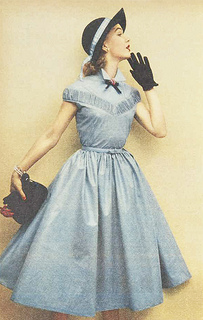
I’ve been thinking about Columba in particular lately because there’s a dress I want to buy—which would be perfect for midnight services at Pascha, perhaps with a pale blue pashmina thrown over top in deference to the spring night cold. It is modest—not baal te’shuva frum-type modest—but also sleek. Sparkles, but not slutty. Traditional, yet modern.
There’s just one thing: The dress costs $680.
One of the oddities of my life is that for about half the people I know, there would be nothing inherently remarkable about buying a pricey dress. I have multiple female relatives who have done just that, who would easily buy a pair of $500 Ferragamo shoes, although they would perhaps cloak their enthusiasm under a bit of Don’t Ask-Don’t Tell silence—or point to all the knit tops made by Bangladeshi children they’d bought at Target for $9.99 as evidence of their thrift.
The other half of the people I know would not only be horrified, but would call my ethical judgment—and for that matter, my sanity—into question. Among the parent communities of which I’m a part (neighborhood, school, etc.), there’s a perceptible reverse snobbery: One cannot compliment any article of clothing, of parent or child, without being told that it was “really cheap,” secondhand—was even, in fact, purchased at Value Village on “half-off” Thursdays.
The interesting thing is that these two factions do not align neatly into contemporary political categories—a fact I happen to love. Some of the folks I know who are most committed, ideologically, to “the free market system” are the ones who recycle clothes and turn their thermostats down low (Thrift!). At the same time, I also have plenty of friends of the Social Democratic persuasion, who’d have no problem socializing just about everything and frown on, say, mini-mansions, who have a passion for wearing their Manolo Blahnik shoes to the seminar at the Center for American Progress (Quality!).
I am somewhere in the middle here.
It is also true that in the metropolitan area in which I live—where two twenty-seven-year-old lawyers can, if they went to the “right” schools, easily make a combined salary of $450,000 a year—there’s the phenomenon whereby material tastes and expectations creep upward, based solely on one’s being surrounded by an affluent cohort.
Especially if you do not have any regular contact with anyone whose horizon of expectations might not be as lofty.
Around the time I opened the catalog and saw the $680 dress, I also happened to be volunteering at a kids’ event, and, in the course of conversation with another mother, learned that after months of arduous work and complicated scheduling, she had finished a vocational school program and had finally gotten a job at a retail pharmacy chain—the first “real” higher education she had attained, and the first job for which she’d had to earn a credential.
This was not someone being profiled on NPR or the NewsHour. This single mother was laboring with me at this event as an equal, not as an object of charity. A regular acquaintance, almost—though, sadly, not quite a friend.
She mentioned that having the job was great, but she didn’t like the two-hour daily ride on the Washington Metrobus to get to the store where she’d been assigned. That was not counting the days she had to get a ride, so she could go to dialysis.
St. Basil the Great said, “When someone steals another’s clothes, we call them a thief. Should we not give the same name to one who could clothe the naked and does not? The bread in your cupboard belongs to the hungry; the coat unused in your closet belongs to the one who needs it; the shoes rotting in your closet belong to the one who has no shoes; the money which you hoard up belongs to the poor.”
I burned with shame, then, thinking about what uses $680 might have for her. And it was a cleansing, curative shame. I felt, in that moment, how frivolous I truly was.
I can’t promise I won’t ever succumb to the desire to spend outrageously. But in the dark reaches of the night, the heart of recognition, I will know what I am doing.
A native of Yazoo City, Mississippi, Caroline Langston is a convert to the Eastern Orthodox Church. She is a widely published writer and essayist, a winner of the Pushcart Prize, and a commentator for NPR’s “All Things Considered.”
Previous Post

March 23, 2015
The Healing Art: Doctors Prescribing Poems
Next Post
March 25, 2015 Monasticism in Lockdown America, Part 6: Icons
Browse Our Archives
Select a Category A. G. Harmon Alissa Wilkinson Allison Backous Art Authors Brad Fruhauff Bradford Winters Bryan Bliss Caroline Langston Chad Thomas Johnston Chris Hoke Christiana N. Peterson Culture D.G. Myers D.L. Mayfield Daniel Bowman Jr. David Griffith Elizabeth Duffy Faith Film Greg Wolfe Guest Contributor Interview Jan Vallone Jeffrey Overstreet Jessica Eddings-Roeser Jessica Mesman Griffith Kelly Foster Lindsey Crittenden Morgan Meis music Natalie Vestin Nick Olson Peggy Rosenthal Personal Reflection Poetry Friday Reflection Relationships Review Richard Chess Richard Cole Sara Zarr Shannon Huffman Polson Sonya Bilocerkowycz Tania Runyan Tony Woodlief Topical Categories Uncategorized Vic Sizemore Writing
Select a Month October 2018 September 2018 August 2018 July 2018 June 2018 May 2018 April 2018 March 2018 February 2018 January 2018 December 2017 November 2017 October 2017 September 2017 August 2017 July 2017 June 2017 May 2017 April 2017 March 2017 February 2017 January 2017 December 2016 November 2016 October 2016 September 2016 August 2016 July 2016 June 2016 May 2016 April 2016 March 2016 February 2016 January 2016 December 2015 November 2015 October 2015 September 2015 August 2015 July 2015 June 2015 May 2015 April 2015 March 2015 February 2015 January 2015 December 2014 November 2014 October 2014 September 2014 August 2014 July 2014 June 2014 May 2014 April 2014 March 2014 February 2014 January 2014 December 2013 November 2013 October 2013 September 2013 August 2013 July 2013 June 2013 May 2013 April 2013 March 2013 February 2013 January 2013 December 2012 November 2012 October 2012 September 2012 August 2012 July 2012 June 2012 May 2012 February 2008
Follow Us!
TAKE THE
Religious Wisdom Quiz
What did King Nebuchadnezzar order everyone to worship?
Select your answer to see how you score.
His crown A golden statue The sun A lion
Related posts from Good Letters




TRENDING AT PATHEOS Catholic

Rejecting Doom: Christian Hope And Human Action
Christianity is a religion of hope. We are to have hope and...

It’s What Comes From Within Which Matters
One of the most difficult things for us to understand is why...

Why I Choose the Eucharist Over the Sermon
Choose the Eucharist, Not the Sermon What are we supposed to get...

5 Design Elements Found in Spiritually Rooted Homes
Putting Spirituality Into Home Decor Our homes are more than our living...

Credo: A Story of God Told with the...
About 10 years ago, I began to imagine a personal "Credo" that...

The Anatomy of Divine Revelation in Catholic Thought
The claim that God has made Himself known to human beings is...
view all Catholic blogs
Ad-Free & Subscriber Log-In Subscription Support
- About Us
- 2026 Calendar
- Videos
- Podcasts
- Library of World Religions
- Faith In Media Tracker
- Advertise With Us
- Write for Us
- Privacy Policy
- Terms of Service
- Do Not Sell My Data
- Contact Us
- Radiant Digital
- Manage Newsletter Subscriptions
- Unsubscribe From Notifications
- Sitemap
Copyright 2008-2026, Patheos. All rights reserved.
Subscription Support Ad-Free & Subscriber Log-In
Follow Patheos