
BuddhistCatholicContemplativeEvangelicalGeneral ChristianHinduJewishLatter-day SaintMuslimNew VisionsProgressive Christian
Beliefs
- Buddhist
- Catholic
- Contemplative
- Evangelical
- General Christian
- Hindu
- Jewish
- Latter-day Saint
- More Voices
- Muslim
- New Visions
- Pagan
- Progressive Christian
Topics
- Religion News
- Food and Religion
- Sports and Religion
- Religious Art
- Religious Music and Entertainment
- Religious Events
- History and Religion
- Style and Religion
- Politics and Religion
- Women in Religion
- Recreation Outdoors and Religion
- Business Finance and Religion
- Careers Workplace and Religion
- Education and Religion
- Family Parenting and Religion
- Health Fitness and Religion
- Home and Religion
- Relationships and Religion
- Technology and Religion
- Travel and Religion
Columnists
- Buddhist Columnists
- Business Finance and Religion Columnists
- Careers Workplace and Religion Columnists
- Catholic Columnists
- Contemplative Columnists
- Education and Religion Columnists
- Evangelists Columnists
- Family Parenting and Religion Columnists
- General Christian Columnists
- Health Fitness and Religion Columnists
- Hindu Columnists
- History and Religion Columnists
- Home and Religion Columnists
- Jewish Columnists
- More Voices Columnists
- Latter Day Columnists
- Muslim Columnists
- New Visions Columnists
- Nonreligious Columnists
- Pagan Columnists
- Politics and Religion Columnists
- Progressive Columnists
- Recreation Outdoors and Religion Columnists
- Relationships and Religion Columnists
- Religion News Columnists
- Religious Art Columnists
- Religious Events Columnists
- Religious Music and Entertainment Columnists
- Sports and Religion Columnists
- Style and Religion Columnists
- Technology and Religion Columnists
- Travel and Religion Columnists
- Women in Religion Columnists
Resource Library
- 2026 Calendar
- Library of World Religions
- The 100 Most Holy Places on Earth
- Patheos Answers
- Podcasts
- Videos
- Faith Leaders Database
- Anglican Episcopalian
- Bahai
- Baptist
- Buddhism
- Christianity
- Confucianism
- Eastern Orthodoxy
- Hinduism
- Holiness and Pentecostal
- ISKCON
- Islam
- Judaism
- Lutheran
- Methodist
- The Church of Jesus Christ of Latter-day Saints
- New Age
- Paganism
- Presbytarian and Reformed
- Protestantism
- Religion Behind the Scenes
- Roman Catholic
- Scientology
- Shia Islam
- Sikhism
- Sufism
- Sunni Islam
- Taoism
- Zen
- See all religions
Research Tools
 Ad-Free & Subscriber Log-In Subscription Support
Ad-Free & Subscriber Log-In Subscription Support
Follow Patheos 

- Trending:
- Forgiveness
- |
- Marriage
- |
- Consciousness
- |
- Death Penalty
- |
- Election
- |
- Halloween
 Good Letters
-
Contributors
- Home
- Catholic
- My Only Begotten Sin
My Only Begotten Sin
Last updated on: March 20, 2015 at 1:56 am by A. G. Harmon
My Only Begotten Sin 2015-03-16T16:11:56-07:00 A. G. Harmon
Patheos Explore the world's faith through different perspectives on religion and spirituality! Patheos has the views of the prevalent religions and spiritualities of the world.
 Because I remain restless and impatient even in middle age, I am often only halfway listening to important things spoken of in church. Therefore, I can mishear what the priest is saying, sometimes to comical effect.
Like Bart Simpson, “In the Garden of Eden” becomes “In-A-Gadda-Da-Vida.” I have heard “sex” for “sects” and “possums” for “apostles.” When I was a boy, for the longest time I thought “Agnus Dei” was the name of the woman up front who played the choir organ: “Agnes Day.”
There are no longer adults around who can yank my hair from behind when I’m inattentive, or who can stare me down with mortal looks that imply exactly what’s going to happen as soon as there are no witnesses about (I did not grow up in the era of timeouts and groundings, but in the era of sincere threats of swift and stinging justice).
The occasion of my latest negligent attention (such a common state should have a name: neglention, perhaps?) was the Old Testament reading in which God calls Abraham to sacrifice his son, Isaac. As you remember, this was a test of Abraham’s love for God, a test that the patriarch passed. Ready to offer his beloved child’s life, he was spared from having to fulfill the act. God provided the scapegoat, whose horns were caught in a nearby thicket.
“But that scapegoat God provided was his own beloved, Our Lord,” the priest went on to say. “God underwent what he spared Abraham from suffering—the loss of his only begotten Son.”
Except, in my woolgathering, I heard “sin”—“only begotten sin.”
My brain corrected my ears, and I smiled at the humor of it all; me again, being me. Except my amusement fell away as the priest went on to preach about Lent. About how in this time of putting things to rights, we must free ourselves of all that makes us unworthy of the sacrifice. We, too, have things to give up, which in comparison is only right, considering the depth of what God himself surrendered.
Then the comparison hit all too close, and the ironies stung a little too sharply, as rude awakenings often do. For I have no son; none that God could spare me from giving. But I do have sin. I have plenty of sin. That I beget in legion. And in this, Abraham and I share something: I love what I am called upon to sacrifice. Like him, I have a hard time surrendering my begotten.
The way that sin is conceived, how it is fed and raised, fostered and looked after, is very familiar, even very familial. We dote upon that which we love, upon that which is—as parents often say of their children—“a part of me.” It is carefully maintained, even spoiled. Things are foregone in favor of it.
The lusts we’ve cultivated, the wraths we’ve nursed, the idols we’ve bred and reared from the time they were small, until the point that they are large and hearty and even taller than we. Ah, yes, the fruit of our loins, the yield that has sprouted from our tender care and husbandry. How hale and fit they are, how much pleasure they give. Who could ask that they be placed upon a pyre, have a blade set against their throats?
I think of Julia Flyte in Waugh’s Brideshead Revisted. A wild girl, she returns to her aristocratic Catholic family not only divorced from a divorcee, but fresh from a miscarriage. Living openly with the still-married Charles Ryder, she’s confronted by her stodgy, but nevertheless correct, older brother about the adulterous state in which she’s been languishing. Shocked, angered, she’s still too honest to admit anything less than the truth:
Living in sin; not just doing wrong, knowing it is wrong, stopping doing it, forgetting…. [But] living in sin, with sin, by sin, for sin, every hour, every day, year in, year out. Waking up with sin in the morning, seeing the curtains drawn on sin, bathing it, dressing it, clipping diamonds to it, feeding it, showing it round, giving it a good time, putting it to sleep at night with a tablet…if it’s fretful.
Always the same, like an idiot child carefully nursed, guarded for the world. “Poor Julia,” they say, “she can’t go out. She’s got to take care of her little sin. A pity it ever lived,” they say, “but it’s so strong. Children like that always are. Julia’s so good to her little, mad sin.”
The immensity of her devastation confounds Ryder, who can’t believe, considering how she’s lived, that something so old—in his opinion, no more than a “pre-conditioning” from her childhood—can trouble her as it has.
“You do know at heart that it’s all bosh, don’t you?” he asks.
“How I wish it was,” she answers.
Her greatest pain is that she cannot relinquish the sin she has given birth to, even though it is “nameless and dead,” like the miscarried baby taken away before she even got a chance to see her.
How tightly we hold to these offspring; how rarely we can release them; how warmly we return to them when we’ve been away. We keep them about the house although they’ve long outgrown it. Like fond parents, we smother them even as they smother us.
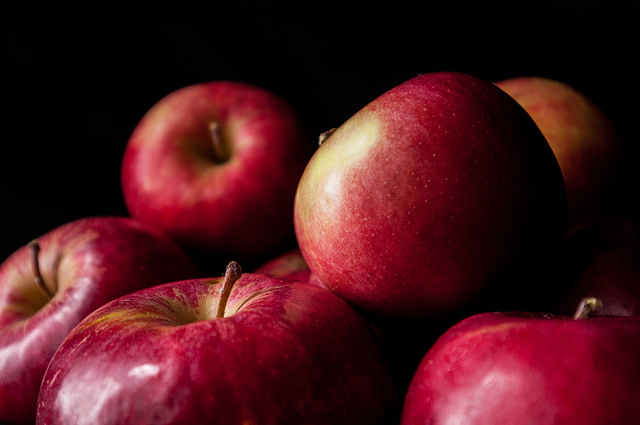
And at such times, I know how truly far away the kingdom is, and how far I am from the sacrifice that I claim to be the ordering principle of my life. While the light of the transfiguration is shining, I hang back in the dusk of that old garden. There I languish, with the progeny of Cains that run through my blood—that issue from it. I bounce them on my knee, as all the while I pick apple after apple after apple, at their urging, for their pleasing.
A.G. Harmon teaches Shakespeare, Law and Literature, Jurisprudence, and Writing at The Catholic University of America in Washington, D.C. His novel, A House All Stilled, won the 2001 Peter Taylor Prize for the Novel.
Image above credited to Samantha Forsberg, used under a Creative Commons license.
Previous Post

March 19, 2015
The Bible, Science, and Higher Education
Next Post
March 23, 2015 The Healing Art: Doctors Prescribing Poems
Browse Our Archives
Select a Category A. G. Harmon Alissa Wilkinson Allison Backous Art Authors Brad Fruhauff Bradford Winters Bryan Bliss Caroline Langston Chad Thomas Johnston Chris Hoke Christiana N. Peterson Culture D.G. Myers D.L. Mayfield Daniel Bowman Jr. David Griffith Elizabeth Duffy Faith Film Greg Wolfe Guest Contributor Interview Jan Vallone Jeffrey Overstreet Jessica Eddings-Roeser Jessica Mesman Griffith Kelly Foster Lindsey Crittenden Morgan Meis music Natalie Vestin Nick Olson Peggy Rosenthal Personal Reflection Poetry Friday Reflection Relationships Review Richard Chess Richard Cole Sara Zarr Shannon Huffman Polson Sonya Bilocerkowycz Tania Runyan Tony Woodlief Topical Categories Uncategorized Vic Sizemore Writing
Select a Month October 2018 September 2018 August 2018 July 2018 June 2018 May 2018 April 2018 March 2018 February 2018 January 2018 December 2017 November 2017 October 2017 September 2017 August 2017 July 2017 June 2017 May 2017 April 2017 March 2017 February 2017 January 2017 December 2016 November 2016 October 2016 September 2016 August 2016 July 2016 June 2016 May 2016 April 2016 March 2016 February 2016 January 2016 December 2015 November 2015 October 2015 September 2015 August 2015 July 2015 June 2015 May 2015 April 2015 March 2015 February 2015 January 2015 December 2014 November 2014 October 2014 September 2014 August 2014 July 2014 June 2014 May 2014 April 2014 March 2014 February 2014 January 2014 December 2013 November 2013 October 2013 September 2013 August 2013 July 2013 June 2013 May 2013 April 2013 March 2013 February 2013 January 2013 December 2012 November 2012 October 2012 September 2012 August 2012 July 2012 June 2012 May 2012 February 2008
Follow Us!
TAKE THE
Religious Wisdom Quiz
Who was the wife of Isaac?
Select your answer to see how you score.
Sarah Rebekah Rachel Leah
Related posts from Good Letters

Poetry Friday: "The Burned Butterfly"

Leonard Cohen’s Holy and Broken Hallelujah

Ready or Not for the Days of Awe

TRENDING AT PATHEOS Catholic

Rejecting Doom: Christian Hope And Human Action
Christianity is a religion of hope. We are to have hope and...

It’s What Comes From Within Which Matters
One of the most difficult things for us to understand is why...

Why I Choose the Eucharist Over the Sermon
Choose the Eucharist, Not the Sermon What are we supposed to get...

5 Design Elements Found in Spiritually Rooted Homes
Putting Spirituality Into Home Decor Our homes are more than our living...

Credo: A Story of God Told with the...
About 10 years ago, I began to imagine a personal "Credo" that...

The Anatomy of Divine Revelation in Catholic Thought
The claim that God has made Himself known to human beings is...
view all Catholic blogs
Ad-Free & Subscriber Log-In Subscription Support
- About Us
- 2026 Calendar
- Videos
- Podcasts
- Library of World Religions
- Faith In Media Tracker
- Advertise With Us
- Write for Us
- Privacy Policy
- Terms of Service
- Do Not Sell My Data
- Contact Us
- Radiant Digital
- Manage Newsletter Subscriptions
- Unsubscribe From Notifications
- Sitemap
Copyright 2008-2026, Patheos. All rights reserved.
Subscription Support Ad-Free & Subscriber Log-In
Follow Patheos