
BuddhistCatholicContemplativeEvangelicalGeneral ChristianHinduJewishLatter-day SaintMuslimNew VisionsProgressive Christian
Beliefs
- Buddhist
- Catholic
- Contemplative
- Evangelical
- General Christian
- Hindu
- Jewish
- Latter-day Saint
- More Voices
- Muslim
- New Visions
- Pagan
- Progressive Christian
Topics
- Religion News
- Food and Religion
- Sports and Religion
- Religious Art
- Religious Music and Entertainment
- Religious Events
- History and Religion
- Style and Religion
- Politics and Religion
- Women in Religion
- Recreation Outdoors and Religion
- Business Finance and Religion
- Careers Workplace and Religion
- Education and Religion
- Family Parenting and Religion
- Health Fitness and Religion
- Home and Religion
- Relationships and Religion
- Technology and Religion
- Travel and Religion
Columnists
- Buddhist Columnists
- Business Finance and Religion Columnists
- Careers Workplace and Religion Columnists
- Catholic Columnists
- Contemplative Columnists
- Education and Religion Columnists
- Evangelists Columnists
- Family Parenting and Religion Columnists
- General Christian Columnists
- Health Fitness and Religion Columnists
- Hindu Columnists
- History and Religion Columnists
- Home and Religion Columnists
- Jewish Columnists
- More Voices Columnists
- Latter Day Columnists
- Muslim Columnists
- New Visions Columnists
- Nonreligious Columnists
- Pagan Columnists
- Politics and Religion Columnists
- Progressive Columnists
- Recreation Outdoors and Religion Columnists
- Relationships and Religion Columnists
- Religion News Columnists
- Religious Art Columnists
- Religious Events Columnists
- Religious Music and Entertainment Columnists
- Sports and Religion Columnists
- Style and Religion Columnists
- Technology and Religion Columnists
- Travel and Religion Columnists
- Women in Religion Columnists
Resource Library
- 2026 Calendar
- Library of World Religions
- The 100 Most Holy Places on Earth
- Patheos Answers
- Podcasts
- Videos
- Faith Leaders Database
- Anglican Episcopalian
- Bahai
- Baptist
- Buddhism
- Christianity
- Confucianism
- Eastern Orthodoxy
- Hinduism
- Holiness and Pentecostal
- ISKCON
- Islam
- Judaism
- Lutheran
- Methodist
- The Church of Jesus Christ of Latter-day Saints
- New Age
- Paganism
- Presbytarian and Reformed
- Protestantism
- Religion Behind the Scenes
- Roman Catholic
- Scientology
- Shia Islam
- Sikhism
- Sufism
- Sunni Islam
- Taoism
- Zen
- See all religions
Research Tools
 Ad-Free & Subscriber Log-In Subscription Support
Ad-Free & Subscriber Log-In Subscription Support
Follow Patheos 

- Trending:
- Forgiveness
- |
- Marriage
- |
- Consciousness
- |
- Death Penalty
- |
- Election
- |
- Halloween
 Good Letters
-
Contributors
- Home
- Catholic
- The Power of Twelve
The Power of Twelve
Last updated on: February 3, 2015 at 1:29 am by Tania Runyan
The Power of Twelve 2015-02-02T12:53:04-07:00 Tania Runyan
Patheos Explore the world's faith through different perspectives on religion and spirituality! Patheos has the views of the prevalent religions and spiritualities of the world.
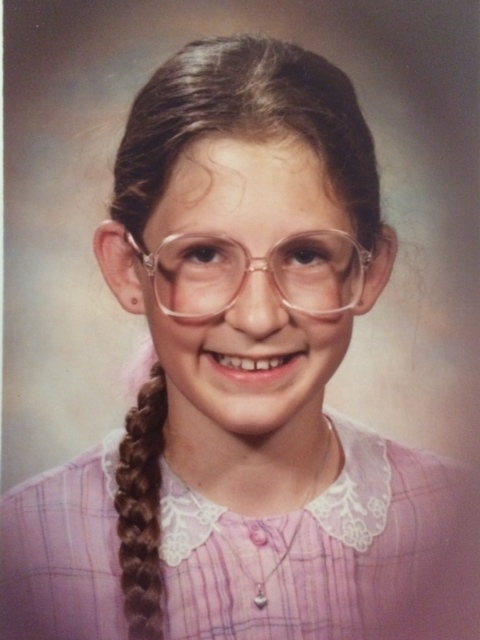 You won’t want to do it, but I’ll ask just the same: imagine being twelve again.
I was a mess: glasses, braces, and a wardrobe straight out of Little House on the Prairie. At five-foot-eight or so, I was not as skinny as a string bean but as a bean’s string.
Worse, I had just one friend that year, Rachel, so if she missed school, I had to eat lunch alone. On one of these occasions, a boy sauntered by, pointed at me, and sang, “Tania Po-o-o-ol-ner’s a lo-o-o-o-ner!”
I want to disappear, I thought. Also, that rhyme is a stretch.
What the other kids didn’t see beyond my awkwardness was my rich inner life. I didn’t see it either, of course. It was just the life I lived.
I played violin. I wrote stories, poems, and plays. I spent a lot of time alone in the backyard. And although I didn’t have many friends at school, I corresponded with pen pals, about fifty of them, from around the world.
Many years ago, I read somewhere (I’ve been searching for the quotation and source for months) that who we are at twelve—namely, the passions and skills we spend time developing‑—is the greatest predictor of our adult identity.
Perhaps I only dreamed this quotation, but I’ve been thinking about it ever since. After the age of twelve, I experimented. I made a short-lived foray into sports. I forsook my pen pals for more face-to-face communication. I taught myself flute.
In college, I convinced myself to major in elementary education for a semester or two. But I came back, fully back, to my twelve-year-old self.
Consider the fact that I’m a violinist and writer with a greenhouse. I conduct most of my communication through Facebook, my adult collection of pen pals. And after decades of contacts, I’m back to glasses again. The string bean thing, well, not so much.
Maybe it’s not all that surprising that most of us eventually come back to our childhoods. But without the encouragement I received in my preteen years, I don’t think I would have found the courage to stay twelve.
My parents weren’t all that involved with my activities. Sometimes their detachment hurt me, but it also helped me define myself outside of my their expectations, a luxury many children don’t have.
I think of Annie Dillard in An American Childhood, who discovers an amoeba under her microscope but can’t convince her parents to join in her excitement: “She [my mother] did not say, but I began to understand then, that you do what you do out of your private passion for the thing itself.”
Like Dillard’s parents, mine provided the means for exploration. They gave me the gift of weekly violin lessons, even when my dad went on strike. They supplied an endless stream of stamps for the half-dozen letters I wrote each day and a playhouse where I performed my scripts with paper puppets.
Without these resources to encourage my creative development, I would have glued myself to bad 1980s TV game shows and not discovered the riches of an artistic life. I realize not every child is this fortunate.
I write this with my daughter’s twelfth birthday just a few weeks away. Lydia is a strong student and a phenomenal trumpet player. But mostly, she is good at arguing. This is not a wink-wink, you-know-how-tweens-are statement. She is absolutely invigorated by conflict, anticipating responses and counter arguments several steps ahead, as in a game of chess.
She feels at home with persuasion, just as I felt at home writing letters and playing sonatas at that age.
As one who resists conflict at all costs, I find Lydia’s flourishing often quite difficult to live with. But I know that without the soul-splitting exercise of examining and defending truth, the world would be stuck in place. Injustices would have no end.
As a parent, the challenge is letting Lydia be who she is while providing appropriate boundaries for respectful behavior. One day, I’m sure, we will help by funding debate camp or contributing to her law school fund. But for now, we will watch this person grow into who she has already unfolded to be and pray that we make it out alive.
Perhaps you are a parent of a preadolescent, wondering just who has taken residence in your house. Who is this person at the root of it all, and how can you nourish those roots? Are you forcing piano lessons when all he wants to do is draw? Are you drilling for a spelling bee when her body wants to sprint through the woods?
How will you find the balance between providing experiences, teaching discipline, and allowing the child to be his or her mysterious self? My husband and I face these questions daily with no easy answers. I do know that adults who were forced to take on other selves in childhood eventually wilt like plants that have received shallow watering and scant light.
Even if you are not a parent, or at least not a parent of a child that age, you can shape the twelve-year-olds you encounter. Will you ignore them or roll your eyes at their noise and antics, as I am wont to do? Or will you take their words and passions to heart, attending their concerts, watching their games, and listening to the tales that issue from their pimpled faces?
I remember even passing criticisms and praises when I was this age more than words I received in high school or even college. During that phase of adolescent formation, while puzzling together my identity, I soaked up adult responses as truth.
The language arts teacher who read my work aloud in class to uproarious laughter taught me that art has the power to transcend social status. In fact, when I discovered that I could be both socially unpopular and successful as a writer, even as a comedic performer on stage, I did not despair. Rather, I reveled in language’s power to change reality and learned to covet the companionship of words most of all.
Twelve is hard and twelve is glorious, as promising and fragile as a carton of eggs. The world is full of these dozen-year-old wonders trying to become who they already are.
You won’t want to do it. I don’t want to do it. But let them take the lead.
Tania Runyan is the author of the poetry collections Second Sky (Cascade Poiema Series), A Thousand Vessels, Simple Weight, and Delicious Air, which was awarded Book of the Year by the Conference on Christianity and Literature in 2007. Her book How to Read a Poem, an instructional guide based on Billy Collins’s “Introduction to Poetry,” was recently released by T.S. Poetry Press. Her poems have appeared in many publications, including Poetry, Image, Books & Culture, Harvard Divinity Bulletin, The Christian Century, Atlanta Review, Indiana Review, and the anthology In a Fine Frenzy: Poets Respond to Shakespeare. Tania was awarded an NEA Literature Fellowship in 2011. She tutors high school students and edits for Every Day Poems and Relief.
Photo above belongs to Tania Runyan.
Previous Post

February 2, 2015
Seeking Mystery in a Secular World
Next Post
February 4, 2015 Cutting the Cord: An Observation from The Way of Saint James, Part 1
Browse Our Archives
Select a Category A. G. Harmon Alissa Wilkinson Allison Backous Art Authors Brad Fruhauff Bradford Winters Bryan Bliss Caroline Langston Chad Thomas Johnston Chris Hoke Christiana N. Peterson Culture D.G. Myers D.L. Mayfield Daniel Bowman Jr. David Griffith Elizabeth Duffy Faith Film Greg Wolfe Guest Contributor Interview Jan Vallone Jeffrey Overstreet Jessica Eddings-Roeser Jessica Mesman Griffith Kelly Foster Lindsey Crittenden Morgan Meis music Natalie Vestin Nick Olson Peggy Rosenthal Personal Reflection Poetry Friday Reflection Relationships Review Richard Chess Richard Cole Sara Zarr Shannon Huffman Polson Sonya Bilocerkowycz Tania Runyan Tony Woodlief Topical Categories Uncategorized Vic Sizemore Writing
Select a Month October 2018 September 2018 August 2018 July 2018 June 2018 May 2018 April 2018 March 2018 February 2018 January 2018 December 2017 November 2017 October 2017 September 2017 August 2017 July 2017 June 2017 May 2017 April 2017 March 2017 February 2017 January 2017 December 2016 November 2016 October 2016 September 2016 August 2016 July 2016 June 2016 May 2016 April 2016 March 2016 February 2016 January 2016 December 2015 November 2015 October 2015 September 2015 August 2015 July 2015 June 2015 May 2015 April 2015 March 2015 February 2015 January 2015 December 2014 November 2014 October 2014 September 2014 August 2014 July 2014 June 2014 May 2014 April 2014 March 2014 February 2014 January 2014 December 2013 November 2013 October 2013 September 2013 August 2013 July 2013 June 2013 May 2013 April 2013 March 2013 February 2013 January 2013 December 2012 November 2012 October 2012 September 2012 August 2012 July 2012 June 2012 May 2012 February 2008
Follow Us!
TAKE THE
Religious Wisdom Quiz
According to Philippians, whose name is above every name?
Select your answer to see how you score.
The Lord God Jesus Christ
Related posts from Good Letters

On Writing Odes: Taking Time to Celebrate


TRENDING AT PATHEOS Catholic

Rejecting Doom: Christian Hope And Human Action
Christianity is a religion of hope. We are to have hope and...

It’s What Comes From Within Which Matters
One of the most difficult things for us to understand is why...

Why I Choose the Eucharist Over the Sermon
Choose the Eucharist, Not the Sermon What are we supposed to get...

5 Design Elements Found in Spiritually Rooted Homes
Putting Spirituality Into Home Decor Our homes are more than our living...

Credo: A Story of God Told with the...
About 10 years ago, I began to imagine a personal "Credo" that...

The Anatomy of Divine Revelation in Catholic Thought
The claim that God has made Himself known to human beings is...
view all Catholic blogs
Ad-Free & Subscriber Log-In Subscription Support
- About Us
- 2026 Calendar
- Videos
- Podcasts
- Library of World Religions
- Faith In Media Tracker
- Advertise With Us
- Write for Us
- Privacy Policy
- Terms of Service
- Do Not Sell My Data
- Contact Us
- Radiant Digital
- Manage Newsletter Subscriptions
- Unsubscribe From Notifications
- Sitemap
Copyright 2008-2026, Patheos. All rights reserved.
Subscription Support Ad-Free & Subscriber Log-In
Follow Patheos