
BuddhistCatholicContemplativeEvangelicalGeneral ChristianHinduJewishLatter-day SaintMuslimNew VisionsProgressive Christian
Beliefs
- Buddhist
- Catholic
- Contemplative
- Evangelical
- General Christian
- Hindu
- Jewish
- Latter-day Saint
- More Voices
- Muslim
- New Visions
- Pagan
- Progressive Christian
Topics
- Religion News
- Food and Religion
- Sports and Religion
- Religious Art
- Religious Music and Entertainment
- Religious Events
- History and Religion
- Style and Religion
- Politics and Religion
- Women in Religion
- Recreation Outdoors and Religion
- Business Finance and Religion
- Careers Workplace and Religion
- Education and Religion
- Family Parenting and Religion
- Health Fitness and Religion
- Home and Religion
- Relationships and Religion
- Technology and Religion
- Travel and Religion
Columnists
- Buddhist Columnists
- Business Finance and Religion Columnists
- Careers Workplace and Religion Columnists
- Catholic Columnists
- Contemplative Columnists
- Education and Religion Columnists
- Evangelists Columnists
- Family Parenting and Religion Columnists
- General Christian Columnists
- Health Fitness and Religion Columnists
- Hindu Columnists
- History and Religion Columnists
- Home and Religion Columnists
- Jewish Columnists
- More Voices Columnists
- Latter Day Columnists
- Muslim Columnists
- New Visions Columnists
- Nonreligious Columnists
- Pagan Columnists
- Politics and Religion Columnists
- Progressive Columnists
- Recreation Outdoors and Religion Columnists
- Relationships and Religion Columnists
- Religion News Columnists
- Religious Art Columnists
- Religious Events Columnists
- Religious Music and Entertainment Columnists
- Sports and Religion Columnists
- Style and Religion Columnists
- Technology and Religion Columnists
- Travel and Religion Columnists
- Women in Religion Columnists
Resource Library
- 2026 Calendar
- Library of World Religions
- The 100 Most Holy Places on Earth
- Patheos Answers
- Podcasts
- Videos
- Faith Leaders Database
- Anglican Episcopalian
- Bahai
- Baptist
- Buddhism
- Christianity
- Confucianism
- Eastern Orthodoxy
- Hinduism
- Holiness and Pentecostal
- ISKCON
- Islam
- Judaism
- Lutheran
- Methodist
- The Church of Jesus Christ of Latter-day Saints
- New Age
- Paganism
- Presbytarian and Reformed
- Protestantism
- Religion Behind the Scenes
- Roman Catholic
- Scientology
- Shia Islam
- Sikhism
- Sufism
- Sunni Islam
- Taoism
- Zen
- See all religions
Research Tools
 Ad-Free & Subscriber Log-In Subscription Support
Ad-Free & Subscriber Log-In Subscription Support
Follow Patheos 

- Trending:
- Forgiveness
- |
- Marriage
- |
- Consciousness
- |
- Death Penalty
- |
- Election
- |
- Halloween
 Good Letters
-
Contributors
- Home
- Catholic
- The Inner Life of Everyday Objects
The Inner Life of Everyday Objects
Last updated on: February 17, 2015 at 1:58 am by Peggy Rosenthal
The Inner Life of Everyday Objects 2015-02-11T12:48:35-07:00 Peggy Rosenthal
Patheos Explore the world's faith through different perspectives on religion and spirituality! Patheos has the views of the prevalent religions and spiritualities of the world.
 On a morning when I was doing laundry, I was also reading Edward Dougherty’s new collection of poems, Everyday Objects. I would read some poems till the dryer buzzed, then go and fold the dried clothes, then return to reading until the next load was dry.
Because I was moving between these poems and my laundry, as I pulled each item from the dryer I related to it in a way I hadn’t previously. This years-old green washcloth: it has done more than a lifetime’s duty washing my husband’s face.
My socks: finding each one’s mate was like matching up two friends who can’t live apart from each other. That blouse: it has collected all the events I’ve worn it to.
Do objects have inner lives, or are we just projecting our fantasies onto them? Consider these lines from “The Romantic Quest”:
Like hummingbirds
that buzz and whir in their quest
for sweetness, the extension cord
is on a romantic search for beauty
We’ve had odes to hummingbirds a-plenty; but before Everyday Objects, have we had an ode to the extension cord?
It quietly crackles
when connecting that surge,
filled in an instant with
an awareness…
Is it fanciful or profound to imagine that inanimate objects have desires, awareness?
Dougherty’s poems persuade me that it’s both. Take “Emptiness (The Middle Way)”:
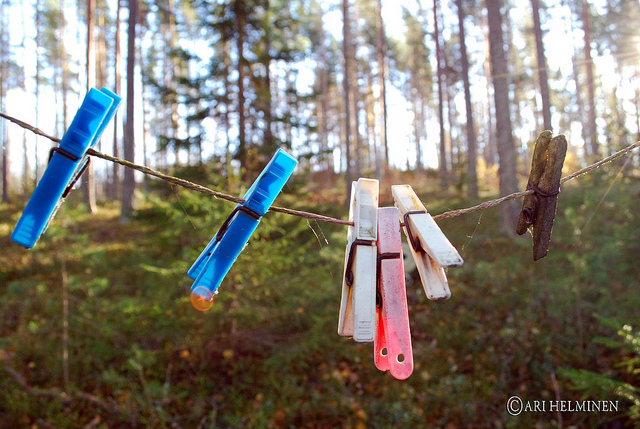
When the clothespins
first heard the Buddha’s
Middle Way—that instant—
they were convinced.
Not merely all-things-
in-moderation,
but the need for tension,
just enough to hold on
in sun and wind
and all the inner storms,
but not so much
to ruin the ride.…
One might say that here it’s not so much that clothespins actually live Buddha’s Middle Way as that they’re offered as a metaphor for the Buddhist values of “all-things-in-moderation” plus “the need for tension.”
Maybe it is just metaphor. And yet…years ago, when our hallway needed wallpapering, we hired a member of our nearby Zen Center—precisely because of the attention that Zen practitioners pay to objects.
I remember saying to myself back then: “Objects hold in them the spirit in which they were made. My wallpaper will continue to contain the spirit of peaceful attention with which it was installed.”
And “The Art of Attention” is in fact in the title of several poems in Everyday Objects. In “The Art of Attention: The Glassblower,” the poet is attending intensely to the glassblower’s own need for absolute attention as he throws “a lump of molten glass, / glowing, into a bulb, / then a teardrop,”
just as any one of us
makes of the materials at hand
a friendship or a song
to make the baby sleep.
I think of slowly crafting
our own lives in the heat
of attention.
Isn’t this true, that we make our lives out of the materials at hand?
My friend with cerebral palsy has had to make his life out of the disabled, pain-filled body he was born with. He has crafted a joyful life “in the heat of attention”: attention to his college literature students, to his needlepoint, to his partner, to all of us in the knitting group where I met him.
He takes pains (literally) and transfigures them.
Speaking of “Transfigurations,” it’s the title of one of my favorite poems in Dougherty’s collection, written “for the birth of a nephew”:
This is no lullaby, little man.
We all must pass from one form
of human being to another.
In the heart of each thing
is its opposite. A cross
can be crafted
from manger-wood, a saint
out of any one of us.
The joining of opposites has been a motif in the volume, and here it’s explicit: “in the heart of each thing is its opposite.” In the manger-wood cradling birth, there is the death of Christ—already present in the wood that will become the Cross.
(Early Christmas cards, from the end of the nineteenth century, literally visualized this transformation of manger to cross.)
But not only Christ: “We all must pass from one form / of human being to another.”
Of course our death is inherent in our birth. But, as I muse on this passage of the poem, on the passages and passings of our life, I see many (maybe infinitely) more transfigurations. For each moment we are created, “crafted” anew.
This transience can be dizzying; but it can also be grounding. For me, it can be grounding only if I call and re-call my attention to the God who is the ground of our being. Without this sense of grounding, I’d feel hurled from one moment to the next into ever-changing forms. I’d be almost literally scattered.
I need those clothespins from “Emptiness (The Middle Way).” In fact, I need all the everyday objects in Dougherty’s Everyday Objects: the bathtub, the empty beer cans, the spoon—all in poems I haven’t mentioned. These objects do have a life intertwined with ours.
Without the everyday objects that we’ve crafted and joined to our lives, we’d be wandering naked through a wilderness. With these objects, we craft our daily lives; they’re inseparable from the spiritual grounding of each moment.
In my (Catholic) faith, we talk about “the sacramentality of the ordinary.” It’s the belief, pictured delightfully in Orthodox icons of the Baptism of the Lord, that at Jesus’ incarnation all of creation was sacralized.
So in answer to my initial question of this post: Do objects have inner lives? Yes.
Objects share in our own inner lives and we in theirs. And in Dougherty’s Everyday Objects we see something of how this wonder works.
Peggy Rosenthal is director of Poetry Retreats and writes widely on poetry as a spiritual resource. Her books include Praying through Poetry: Hope for Violent Times (Franciscan Media), and The Poets’ Jesus (Oxford). See Amazon for full list. She also teaches an online course, “Poetry as a Spiritual Practice,” throughImage’s Glen Online program*.*
The photo above is credited to Ari Helminen, used under the Creative Commons License.
Previous Post

February 13, 2015
Monasticism In Lockdown America, Part 5: Holy Elders
Next Post
February 18, 2015 The Sex Offender and the Cross
Browse Our Archives
Select a Category A. G. Harmon Alissa Wilkinson Allison Backous Art Authors Brad Fruhauff Bradford Winters Bryan Bliss Caroline Langston Chad Thomas Johnston Chris Hoke Christiana N. Peterson Culture D.G. Myers D.L. Mayfield Daniel Bowman Jr. David Griffith Elizabeth Duffy Faith Film Greg Wolfe Guest Contributor Interview Jan Vallone Jeffrey Overstreet Jessica Eddings-Roeser Jessica Mesman Griffith Kelly Foster Lindsey Crittenden Morgan Meis music Natalie Vestin Nick Olson Peggy Rosenthal Personal Reflection Poetry Friday Reflection Relationships Review Richard Chess Richard Cole Sara Zarr Shannon Huffman Polson Sonya Bilocerkowycz Tania Runyan Tony Woodlief Topical Categories Uncategorized Vic Sizemore Writing
Select a Month October 2018 September 2018 August 2018 July 2018 June 2018 May 2018 April 2018 March 2018 February 2018 January 2018 December 2017 November 2017 October 2017 September 2017 August 2017 July 2017 June 2017 May 2017 April 2017 March 2017 February 2017 January 2017 December 2016 November 2016 October 2016 September 2016 August 2016 July 2016 June 2016 May 2016 April 2016 March 2016 February 2016 January 2016 December 2015 November 2015 October 2015 September 2015 August 2015 July 2015 June 2015 May 2015 April 2015 March 2015 February 2015 January 2015 December 2014 November 2014 October 2014 September 2014 August 2014 July 2014 June 2014 May 2014 April 2014 March 2014 February 2014 January 2014 December 2013 November 2013 October 2013 September 2013 August 2013 July 2013 June 2013 May 2013 April 2013 March 2013 February 2013 January 2013 December 2012 November 2012 October 2012 September 2012 August 2012 July 2012 June 2012 May 2012 February 2008
Follow Us!
TAKE THE
Religious Wisdom Quiz
Who was Boaz's kinsman-redeemer?
Select your answer to see how you score.
Ruth Unnamed relative Elimelech Naomi
Related posts from Good Letters



On Writing Odes: Taking Time to Celebrate

Poetry Friday: "The Burned Butterfly"
TRENDING AT PATHEOS Catholic

Rejecting Doom: Christian Hope And Human Action
Christianity is a religion of hope. We are to have hope and...

It’s What Comes From Within Which Matters
One of the most difficult things for us to understand is why...

Why I Choose the Eucharist Over the Sermon
Choose the Eucharist, Not the Sermon What are we supposed to get...

5 Design Elements Found in Spiritually Rooted Homes
Putting Spirituality Into Home Decor Our homes are more than our living...

Credo: A Story of God Told with the...
About 10 years ago, I began to imagine a personal "Credo" that...

The Anatomy of Divine Revelation in Catholic Thought
The claim that God has made Himself known to human beings is...
view all Catholic blogs
Ad-Free & Subscriber Log-In Subscription Support
- About Us
- 2026 Calendar
- Videos
- Podcasts
- Library of World Religions
- Faith In Media Tracker
- Advertise With Us
- Write for Us
- Privacy Policy
- Terms of Service
- Do Not Sell My Data
- Contact Us
- Radiant Digital
- Manage Newsletter Subscriptions
- Unsubscribe From Notifications
- Sitemap
Copyright 2008-2026, Patheos. All rights reserved.
Subscription Support Ad-Free & Subscriber Log-In
Follow Patheos