
BuddhistCatholicContemplativeEvangelicalGeneral ChristianHinduJewishLatter-day SaintMuslimNew VisionsProgressive Christian
Beliefs
- Buddhist
- Catholic
- Contemplative
- Evangelical
- General Christian
- Hindu
- Jewish
- Latter-day Saint
- More Voices
- Muslim
- New Visions
- Pagan
- Progressive Christian
Topics
- Religion News
- Food and Religion
- Sports and Religion
- Religious Art
- Religious Music and Entertainment
- Religious Events
- History and Religion
- Style and Religion
- Politics and Religion
- Women in Religion
- Recreation Outdoors and Religion
- Business Finance and Religion
- Careers Workplace and Religion
- Education and Religion
- Family Parenting and Religion
- Health Fitness and Religion
- Home and Religion
- Relationships and Religion
- Technology and Religion
- Travel and Religion
Columnists
- Buddhist Columnists
- Business Finance and Religion Columnists
- Careers Workplace and Religion Columnists
- Catholic Columnists
- Contemplative Columnists
- Education and Religion Columnists
- Evangelists Columnists
- Family Parenting and Religion Columnists
- General Christian Columnists
- Health Fitness and Religion Columnists
- Hindu Columnists
- History and Religion Columnists
- Home and Religion Columnists
- Jewish Columnists
- More Voices Columnists
- Latter Day Columnists
- Muslim Columnists
- New Visions Columnists
- Nonreligious Columnists
- Pagan Columnists
- Politics and Religion Columnists
- Progressive Columnists
- Recreation Outdoors and Religion Columnists
- Relationships and Religion Columnists
- Religion News Columnists
- Religious Art Columnists
- Religious Events Columnists
- Religious Music and Entertainment Columnists
- Sports and Religion Columnists
- Style and Religion Columnists
- Technology and Religion Columnists
- Travel and Religion Columnists
- Women in Religion Columnists
Resource Library
- 2026 Calendar
- Library of World Religions
- The 100 Most Holy Places on Earth
- Patheos Answers
- Podcasts
- Videos
- Faith Leaders Database
- Anglican Episcopalian
- Bahai
- Baptist
- Buddhism
- Christianity
- Confucianism
- Eastern Orthodoxy
- Hinduism
- Holiness and Pentecostal
- ISKCON
- Islam
- Judaism
- Lutheran
- Methodist
- The Church of Jesus Christ of Latter-day Saints
- New Age
- Paganism
- Presbytarian and Reformed
- Protestantism
- Religion Behind the Scenes
- Roman Catholic
- Scientology
- Shia Islam
- Sikhism
- Sufism
- Sunni Islam
- Taoism
- Zen
- See all religions
Research Tools
 Ad-Free & Subscriber Log-In Subscription Support
Ad-Free & Subscriber Log-In Subscription Support
Follow Patheos 

- Trending:
- Forgiveness
- |
- Marriage
- |
- Consciousness
- |
- Death Penalty
- |
- Election
- |
- Halloween
 Good Letters
-
Contributors
- Home
- Catholic
- The Crucifix’s Motley Crew
The Crucifix’s Motley Crew
Last updated on: January 28, 2015 at 1:34 am by Morgan Meis
The Crucifix’s Motley Crew 2015-01-26T12:49:32-07:00 Morgan Meis
Patheos Explore the world's faith through different perspectives on religion and spirituality! Patheos has the views of the prevalent religions and spiritualities of the world.
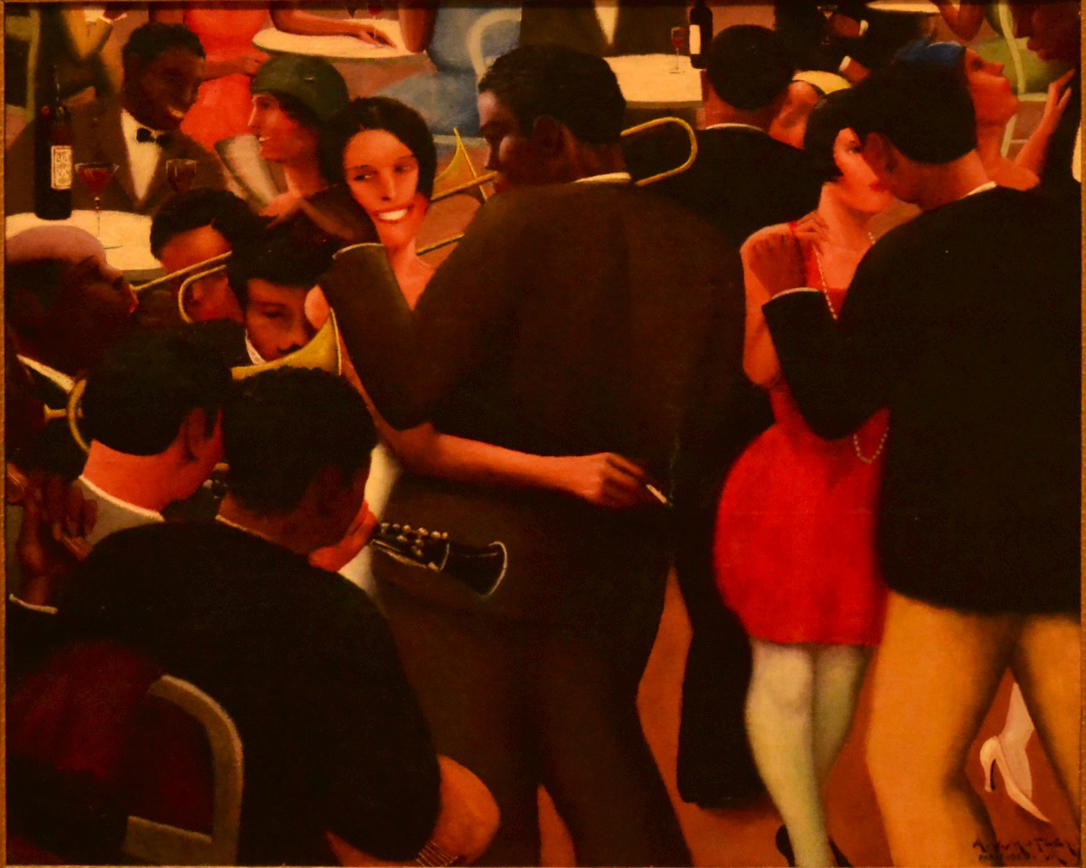 Archibald Motley’s most famous paintings jump and jive, then they wail. You might have seen Blues (1929) or Hot Rhythm (1961). There are a lot of people moving around on those two canvases.
There is music. There are fabulous outfits. The word “commotion” comes to mind when you look at a painting by the mature Motley (a retrospective of his work is currently on display at LACMA in Los Angeles).
Motley studied at the Art Institute of Chicago. Later, he received a Guggenheim Grant to go to Paris. This was in the late 1920s. Looking at a painting like Hot Rhythm, you can see that Motley picked up lessons in composition by studying everyone from Rubens to Picasso.
Getting motion-filled bodies together in one painterly frame is not, it turns out, a particularly easy thing to do. Just take a minute to study the balancing sets of upraised arms and objects in Hot Rhythm—the dancing girls, the musicians, the instruments—and you start to get a sense of how deeply planned out this otherwise “wild scene” really is.
The point is, Motley knew how to paint. He also knew what he wanted to paint, which was black people. Archibald Motley was, himself, a black man, born in New Orleans in 1891.
Actually, his racial identity was rather more complicated. That’s true of many African Americans, no doubt, but it is especially true in New Orleans. Motley claimed African American, European, and Native American heritage. America being America, he was usually tagged a black man.
The nuances and confusions of racial identity made their way into many of Motley’s most powerful paintings. To whit: The Octoroon Girl (1925), a portrait of an elegant young lady who, in the American obsession with precise racial identification of the time, was relegated to the category of people with one-eighth African ancestry.
The Octoroon Girl makes me think of Hans Holbein’s portrait of Christina of Denmark. It’s something about the intensity of the eyes versus the delicacy of the hands.
Motley graduated from art school in 1918, setting himself up to be a major figure in what’s now called the Harlem Renaissance—though Motley did most of his work in Chicago.
In 1933, Motley made a painting called Self-Portrait (Myself at Work). Motley, in an “I’m an artist” get-up that includes a beret, painter’s smock, and palette, stares directly out at the viewer. But when we look to the left of the canvas, just off to Motley’s right side, we see he’s not looking at us; he is looking at the model he is painting. That model is a nude woman.
This creates the unusual scenario in which we, the viewers of the painting, must imagine ourselves to be the nude model that Motley is painting. This situation is not completely unprecedented, of course. Velasquez did roughly the same thing with his famous (and after Foucault, notorious) Las Meninas.
In Las Meninas, we are meant to imagine ourselves as the King and Queen of Spain. Archibald Motley is slightly less ambitious with his Self-Portrait. Who is this woman being painted, anyway? Is she merely a model? Is she one of the ladies of ambiguous racial background that we see in other paintings?
It is hard to say. The point simply seems to be that we can stand in her place, and she in ours. Velasquez created the scenario in Las Meninas, it is conjectured, mostly to show the complicated layers with which paintings represent “reality.”
Motley’s point is a little bit different, I think. It is to use the medium of painting to get us mixed up with one another, mutually implicated. There’s a further key in the painting that points us in this direction. Hanging on the wall behind Mr. Motley, just off center but impossible to miss, is a crucifix.
Archibald Motley—like many African American-Native American-Europeans from New Orleans —was a devout Catholic. Motley’s Self-Portrait suggests that what holds everybody—the painter, the model, and the viewer—in the painting together is the Cross.
The crucifix isn’t just an incidental object in the painting. It isn’t just there. It hovers meaningfully over the scene in which Motley stares at us and we stare at him. The painting is a painting that, like Las Meninas, is also about painting. So, the act of painting, for Motley, and the meaning of the crucifix are deeply related.
Motley’s self-portrait is self-consciously about his own belonging and the belonging of all the racially mixed-up brothers and sisters that he was out there painting day after day. “How do I get all these people into the frame?” Motley seems to be asking. “How do I get them represented? How do I get them into the story?”
The answer is to do just that: to get everybody in the painting; to make painting big enough for all the ambiguities; to show all the wild scenes in the Bronzeville neighborhood of Chicago during the Jazz Age; to make portraits of the Quadroons and the Octoroons, and the Quintroons, too.
There’s a now famous phrase in James Joyce’s Finnegan’s Wake. The phrase is “here comes everybody,” which is a reference to the catholicity, the universality of the Church. Here Comes Everybody is also a play on the name of one of Finnegan’s Wake’s main characters Haroun Childeric Eggeberth, who has so many names and identities in Finnegan’s Wake, that he might as well be one of Motley’s Octoroons.
In an essay about Joyce’s book, Anthony Burgess wrote:
As long as the race exists, Finnegan’s Wake will remain one of its big pertinent codices. The corpse is “cropse.” Or, to borrow Eliot’s borrowing, “Sin is behovely, but all shall be well, and all manner of thing shall be well.” This is not the philosophy of Shaun, the vapid liberal demagogue, but the faith of HCE, who—”Here Comes Everybody”—is suffering man himself.
The crucifix was the key to painting as Motley envisioned it because only the crucifix has the room truly to let everybody in. Come ye, sinner, come on in to the great and infinite codex.
What gave Motley the faith that he could get everyone inside painting is that he knew everyone was already in there. So, he painted tons of pictures packed full of everyone. They kept coming, and he kept painting.
Morgan Meis is the critic-at-large for The Smart Set (thesmartset.com). He has a PhD in Philosophy and has written for n+1, The Believer, Harper’s Magazine, and The Virginia Quarterly Review. He won the Whiting Award in 2013. Morgan is also an editor at 3 Quarks Daily, and a winner of a Creative Capital | Warhol Foundation Arts Writers grant. A book of Morgan’s selected essays can be found here. He can be reached at [email protected].
The image above is titled “Blues” and is painted by Archibald Motley, found under ptwo, used through Creative Commons License.
Previous Post

January 27, 2015
Kissing Sideways
Next Post
January 29, 2015 The Sublime and Beautiful
Browse Our Archives
Select a Category A. G. Harmon Alissa Wilkinson Allison Backous Art Authors Brad Fruhauff Bradford Winters Bryan Bliss Caroline Langston Chad Thomas Johnston Chris Hoke Christiana N. Peterson Culture D.G. Myers D.L. Mayfield Daniel Bowman Jr. David Griffith Elizabeth Duffy Faith Film Greg Wolfe Guest Contributor Interview Jan Vallone Jeffrey Overstreet Jessica Eddings-Roeser Jessica Mesman Griffith Kelly Foster Lindsey Crittenden Morgan Meis music Natalie Vestin Nick Olson Peggy Rosenthal Personal Reflection Poetry Friday Reflection Relationships Review Richard Chess Richard Cole Sara Zarr Shannon Huffman Polson Sonya Bilocerkowycz Tania Runyan Tony Woodlief Topical Categories Uncategorized Vic Sizemore Writing
Select a Month October 2018 September 2018 August 2018 July 2018 June 2018 May 2018 April 2018 March 2018 February 2018 January 2018 December 2017 November 2017 October 2017 September 2017 August 2017 July 2017 June 2017 May 2017 April 2017 March 2017 February 2017 January 2017 December 2016 November 2016 October 2016 September 2016 August 2016 July 2016 June 2016 May 2016 April 2016 March 2016 February 2016 January 2016 December 2015 November 2015 October 2015 September 2015 August 2015 July 2015 June 2015 May 2015 April 2015 March 2015 February 2015 January 2015 December 2014 November 2014 October 2014 September 2014 August 2014 July 2014 June 2014 May 2014 April 2014 March 2014 February 2014 January 2014 December 2013 November 2013 October 2013 September 2013 August 2013 July 2013 June 2013 May 2013 April 2013 March 2013 February 2013 January 2013 December 2012 November 2012 October 2012 September 2012 August 2012 July 2012 June 2012 May 2012 February 2008
Follow Us!
TAKE THE
Religious Wisdom Quiz
Who said, “I am the way and the truth and the life”?
Select your answer to see how you score.
Peter Jesus John Paul
Related posts from Good Letters

Morning in a Forgotten Neighborhood



TRENDING AT PATHEOS Catholic

Rejecting Doom: Christian Hope And Human Action
Christianity is a religion of hope. We are to have hope and...

It’s What Comes From Within Which Matters
One of the most difficult things for us to understand is why...

Why I Choose the Eucharist Over the Sermon
Choose the Eucharist, Not the Sermon What are we supposed to get...

5 Design Elements Found in Spiritually Rooted Homes
Putting Spirituality Into Home Decor Our homes are more than our living...

Credo: A Story of God Told with the...
About 10 years ago, I began to imagine a personal "Credo" that...

The Anatomy of Divine Revelation in Catholic Thought
The claim that God has made Himself known to human beings is...
view all Catholic blogs
Ad-Free & Subscriber Log-In Subscription Support
- About Us
- 2026 Calendar
- Videos
- Podcasts
- Library of World Religions
- Faith In Media Tracker
- Advertise With Us
- Write for Us
- Privacy Policy
- Terms of Service
- Do Not Sell My Data
- Contact Us
- Radiant Digital
- Manage Newsletter Subscriptions
- Unsubscribe From Notifications
- Sitemap
Copyright 2008-2026, Patheos. All rights reserved.
Subscription Support Ad-Free & Subscriber Log-In
Follow Patheos