
BuddhistCatholicContemplativeEvangelicalGeneral ChristianHinduJewishLatter-day SaintMuslimNew VisionsProgressive Christian
Beliefs
- Buddhist
- Catholic
- Contemplative
- Evangelical
- General Christian
- Hindu
- Jewish
- Latter-day Saint
- More Voices
- Muslim
- New Visions
- Pagan
- Progressive Christian
Topics
- Religion News
- Food and Religion
- Sports and Religion
- Religious Art
- Religious Music and Entertainment
- Religious Events
- History and Religion
- Style and Religion
- Politics and Religion
- Women in Religion
- Recreation Outdoors and Religion
- Business Finance and Religion
- Careers Workplace and Religion
- Education and Religion
- Family Parenting and Religion
- Health Fitness and Religion
- Home and Religion
- Relationships and Religion
- Technology and Religion
- Travel and Religion
Columnists
- Buddhist Columnists
- Business Finance and Religion Columnists
- Careers Workplace and Religion Columnists
- Catholic Columnists
- Contemplative Columnists
- Education and Religion Columnists
- Evangelists Columnists
- Family Parenting and Religion Columnists
- General Christian Columnists
- Health Fitness and Religion Columnists
- Hindu Columnists
- History and Religion Columnists
- Home and Religion Columnists
- Jewish Columnists
- More Voices Columnists
- Latter Day Columnists
- Muslim Columnists
- New Visions Columnists
- Nonreligious Columnists
- Pagan Columnists
- Politics and Religion Columnists
- Progressive Columnists
- Recreation Outdoors and Religion Columnists
- Relationships and Religion Columnists
- Religion News Columnists
- Religious Art Columnists
- Religious Events Columnists
- Religious Music and Entertainment Columnists
- Sports and Religion Columnists
- Style and Religion Columnists
- Technology and Religion Columnists
- Travel and Religion Columnists
- Women in Religion Columnists
Resource Library
- 2026 Calendar
- Library of World Religions
- The 100 Most Holy Places on Earth
- Patheos Answers
- Podcasts
- Videos
- Faith Leaders Database
- Anglican Episcopalian
- Bahai
- Baptist
- Buddhism
- Christianity
- Confucianism
- Eastern Orthodoxy
- Hinduism
- Holiness and Pentecostal
- ISKCON
- Islam
- Judaism
- Lutheran
- Methodist
- The Church of Jesus Christ of Latter-day Saints
- New Age
- Paganism
- Presbytarian and Reformed
- Protestantism
- Religion Behind the Scenes
- Roman Catholic
- Scientology
- Shia Islam
- Sikhism
- Sufism
- Sunni Islam
- Taoism
- Zen
- See all religions
Research Tools
 Ad-Free & Subscriber Log-In Subscription Support
Ad-Free & Subscriber Log-In Subscription Support
Follow Patheos 

- Trending:
- Forgiveness
- |
- Marriage
- |
- Consciousness
- |
- Death Penalty
- |
- Election
- |
- Halloween
 Good Letters
-
Contributors
- Home
- Catholic
- The Birmingham Project
The Birmingham Project
Last updated on: January 20, 2015 at 1:01 am by Peggy Rosenthal
The Birmingham Project 2015-01-16T15:46:52-07:00 Peggy Rosenthal
Patheos Explore the world's faith through different perspectives on religion and spirituality! Patheos has the views of the prevalent religions and spiritualities of the world.
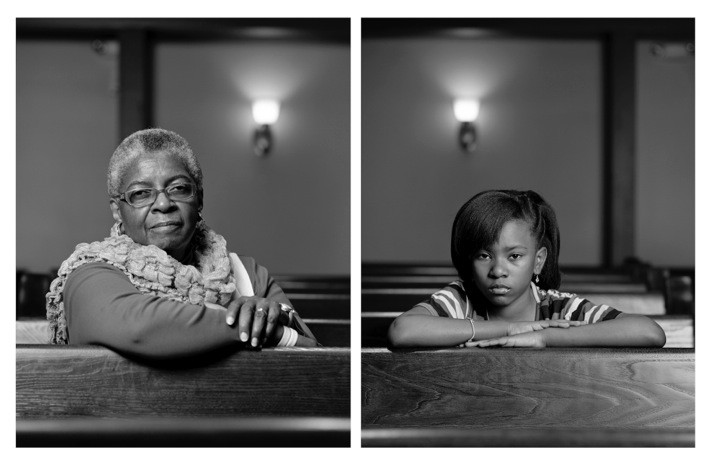 I was looking into the eyes of a black girl around thirteen years old. She looked back, her eyes pensive and a bit sullen. Then I shifted my gaze to the black woman seated as if next to her, about fifty years her senior. The woman’s eyes were those of a survivor, the eyes of someone who has lived through and somehow managed to transcend unimaginable pain.
What this woman from Birmingham, Alabama had survived was the racial violence that overtook her city in the early 1960s. The federal government had ordered Alabama’s public schools to de-segregate; Governor George Wallace was determined to resist.
Though I was a student safely snuggled up in my northeast college, I remember being chilled by Wallace’s hate-filled racist rhetoric, remember hearing how the Ku Klux Klan had vowed to bomb those “nigger troublemakers” to kingdom come.
Negro activists were indeed stirring up “trouble” in Birmingham. Martin Luther King came to town to join the nonviolent campaign against racial segregation. The campaigners would meet at black churches, often the Sixteenth Street Baptist Church. Negro homes and churches were regularly bombed by white supremacists, though national news wasn’t much covering these bombings.
Not until this one: On the morning of September 15, 1963, during Sunday school classes, a bomb ripped through the Sixteenth Street Baptist Church, killing four girls, ages eleven to fourteen. The news shocked the nation awake to the horrors that Negro Americans in the South had been experiencing for years.
The federal government responded with the Civil Rights Act of 1964.
Nearly fifty years later, renowned photographer Dawoud Bey responded with The Birmingham Project, an extraordinary exhibit of paired life-size photo-portraits. Commissioned by the Birmingham Museum of Art, the exhibit opened there on the fiftieth anniversary of the church bombing. It’s on exhibit now in my city’s (Rochester, New York) photography museum, and I went as my way of commemorating Martin Luther King Day this year.
And so it was that I found myself gazing into the eyes of that young black girl and the woman who could have been her grandmother. And then into the eyes of another paired couple: one young, one old; and then another pair and another, in diptychs along the walls.
To bring these people to us, Bey went to Birmingham and photographed seventy-five black residents: about half of them the age of the children killed in the church bombing, the others the age those children would now be if they’d survived.
Only after all the photographing was complete did Bey begin pairing the portraits, looking for relationships of similarity or complementarity. Through these diptychs of real people alive today, Bey hoped to redeem from abstractness the loss of those four girls—and of two young boys murdered by whites in the ongoing violence of that terrible day.
As I stood before each pair, I felt them communicating to each other across the decades—and to me across the American racial divide. Yet the communications are open-ended. They say: here we are, in this dignity that the photographer has granted us. And they ask: Do you grant me this dignity? How will your life affect mine, and mine yours?
One very small way that their lives—at least, the lives of their fellow black southerners—affected mine was in moving me, a few years ago, to make a sort of civil rights pilgrimage through the South.
Birmingham was of course a central stop. Across the street from the restored Sixteenth Street Baptist Church now sits the Birmingham Civil Rights Museum. Showing complete respect for its subjects throughout, the museum includes key documents, photos of major incidents, and even a mock-up of Martin Luther King’s cell from which he wrote his famous “Letter from a Birmingham Jail.”
I had mixed feelings about the museum’s respectful tribute to the civil rights movement. Partly I was grateful that this movement is finally an accepted and tourist-worthy part of Alabama history. But partly I was skeptical about the tourist-worthiness: First this state destroys the lives of its black citizens; then it turns this abominable history into a tourist attraction? (Well, all human motives are mixed, so I can’t let myself get too self-righteous here.)
I don’t know why, then, I was unequivocally moved by the public park across the street from the Museum and Church. But I was. Maybe because this very spot saw the violent police repressions of the nonviolent civil rights marches of the 1960s.
The park has been turned into a sculpture garden that depicts those events: life-size sculptures of police fire-hosing demonstrators; a black boy and girl holding hands, saying “I ain’t afraid”; a young black man being jabbed by a policeman, whose huge dog leaps forward, jaws open for attack.
In contrast to the violence intentionally evoked at the park, Dawoud Bey’s photographs convey a deep stillness. He’d told each photographic subject: “Just make yourself comfortable; be your natural self.” Each resulting portrait conveys a striking individuality, silently proclaiming: Here I am, this is my own particular life; I’m living it before your eyes.
It’s the profound individuality of each face, each person, that I’m gazing into. What greater dignity can we grant to another than by recognizing his or her uniqueness? Uniqueness yes, yet also, especially among the elders, a solidarity in suffering.
Bey draws us as viewers into the spiritual space of this solidarity. And into another dimension of what dignity might mean: a calm refusal to relinquish the human in oneself and others despite the brutalities of decades, even centuries—along with resolute hopefulness in a better future for the vulnerable young.
The young faces, for all their inexperience, are poignant too, but in a different way. They look into a future that has already been shaped for them by a violent history over which they had no control, but whose direction from now on lies—perhaps— within them to change.
Peggy Rosenthal is director of Poetry Retreats and writes widely on poetry as a spiritual resource. Her books include Praying through Poetry: Hope for Violent Times (Franciscan Media), and The Poets’ Jesus (Oxford). See Amazon for full list. She also teaches an online course, “Poetry as a Spiritual Practice,” throughImage’s Glen Online program*.*
Photo: Mary Parker and Caela Cowan, 2012. Copyright © Dawoud Bey. Used by permission.
Previous Post

January 16, 2015
It’s Time to Derail the Gravy Train
Next Post
January 21, 2015 Childhood Cinema Redux
Browse Our Archives
Select a Category A. G. Harmon Alissa Wilkinson Allison Backous Art Authors Brad Fruhauff Bradford Winters Bryan Bliss Caroline Langston Chad Thomas Johnston Chris Hoke Christiana N. Peterson Culture D.G. Myers D.L. Mayfield Daniel Bowman Jr. David Griffith Elizabeth Duffy Faith Film Greg Wolfe Guest Contributor Interview Jan Vallone Jeffrey Overstreet Jessica Eddings-Roeser Jessica Mesman Griffith Kelly Foster Lindsey Crittenden Morgan Meis music Natalie Vestin Nick Olson Peggy Rosenthal Personal Reflection Poetry Friday Reflection Relationships Review Richard Chess Richard Cole Sara Zarr Shannon Huffman Polson Sonya Bilocerkowycz Tania Runyan Tony Woodlief Topical Categories Uncategorized Vic Sizemore Writing
Select a Month October 2018 September 2018 August 2018 July 2018 June 2018 May 2018 April 2018 March 2018 February 2018 January 2018 December 2017 November 2017 October 2017 September 2017 August 2017 July 2017 June 2017 May 2017 April 2017 March 2017 February 2017 January 2017 December 2016 November 2016 October 2016 September 2016 August 2016 July 2016 June 2016 May 2016 April 2016 March 2016 February 2016 January 2016 December 2015 November 2015 October 2015 September 2015 August 2015 July 2015 June 2015 May 2015 April 2015 March 2015 February 2015 January 2015 December 2014 November 2014 October 2014 September 2014 August 2014 July 2014 June 2014 May 2014 April 2014 March 2014 February 2014 January 2014 December 2013 November 2013 October 2013 September 2013 August 2013 July 2013 June 2013 May 2013 April 2013 March 2013 February 2013 January 2013 December 2012 November 2012 October 2012 September 2012 August 2012 July 2012 June 2012 May 2012 February 2008
Follow Us!
TAKE THE
Religious Wisdom Quiz
Who was Jonathan's son, crippled as a child, whom David showed kindness?
Select your answer to see how you score.
Abinadab Mephibosheth Siba Jedidiah
Related posts from Good Letters




Leonard Cohen’s Holy and Broken Hallelujah
TRENDING AT PATHEOS Catholic

Rejecting Doom: Christian Hope And Human Action
Christianity is a religion of hope. We are to have hope and...

It’s What Comes From Within Which Matters
One of the most difficult things for us to understand is why...

Why I Choose the Eucharist Over the Sermon
Choose the Eucharist, Not the Sermon What are we supposed to get...

5 Design Elements Found in Spiritually Rooted Homes
Putting Spirituality Into Home Decor Our homes are more than our living...

Credo: A Story of God Told with the...
About 10 years ago, I began to imagine a personal "Credo" that...

The Anatomy of Divine Revelation in Catholic Thought
The claim that God has made Himself known to human beings is...
view all Catholic blogs
Ad-Free & Subscriber Log-In Subscription Support
- About Us
- 2026 Calendar
- Videos
- Podcasts
- Library of World Religions
- Faith In Media Tracker
- Advertise With Us
- Write for Us
- Privacy Policy
- Terms of Service
- Do Not Sell My Data
- Contact Us
- Radiant Digital
- Manage Newsletter Subscriptions
- Unsubscribe From Notifications
- Sitemap
Copyright 2008-2026, Patheos. All rights reserved.
Subscription Support Ad-Free & Subscriber Log-In
Follow Patheos