
BuddhistCatholicContemplativeEvangelicalGeneral ChristianHinduJewishLatter-day SaintMuslimNew VisionsProgressive Christian
Beliefs
- Buddhist
- Catholic
- Contemplative
- Evangelical
- General Christian
- Hindu
- Jewish
- Latter-day Saint
- More Voices
- Muslim
- New Visions
- Pagan
- Progressive Christian
Topics
- Religion News
- Food and Religion
- Sports and Religion
- Religious Art
- Religious Music and Entertainment
- Religious Events
- History and Religion
- Style and Religion
- Politics and Religion
- Women in Religion
- Recreation Outdoors and Religion
- Business Finance and Religion
- Careers Workplace and Religion
- Education and Religion
- Family Parenting and Religion
- Health Fitness and Religion
- Home and Religion
- Relationships and Religion
- Technology and Religion
- Travel and Religion
Columnists
- Buddhist Columnists
- Business Finance and Religion Columnists
- Careers Workplace and Religion Columnists
- Catholic Columnists
- Contemplative Columnists
- Education and Religion Columnists
- Evangelists Columnists
- Family Parenting and Religion Columnists
- General Christian Columnists
- Health Fitness and Religion Columnists
- Hindu Columnists
- History and Religion Columnists
- Home and Religion Columnists
- Jewish Columnists
- More Voices Columnists
- Latter Day Columnists
- Muslim Columnists
- New Visions Columnists
- Nonreligious Columnists
- Pagan Columnists
- Politics and Religion Columnists
- Progressive Columnists
- Recreation Outdoors and Religion Columnists
- Relationships and Religion Columnists
- Religion News Columnists
- Religious Art Columnists
- Religious Events Columnists
- Religious Music and Entertainment Columnists
- Sports and Religion Columnists
- Style and Religion Columnists
- Technology and Religion Columnists
- Travel and Religion Columnists
- Women in Religion Columnists
Resource Library
- 2026 Calendar
- Library of World Religions
- The 100 Most Holy Places on Earth
- Patheos Answers
- Podcasts
- Videos
- Faith Leaders Database
- Anglican Episcopalian
- Bahai
- Baptist
- Buddhism
- Christianity
- Confucianism
- Eastern Orthodoxy
- Hinduism
- Holiness and Pentecostal
- ISKCON
- Islam
- Judaism
- Lutheran
- Methodist
- The Church of Jesus Christ of Latter-day Saints
- New Age
- Paganism
- Presbytarian and Reformed
- Protestantism
- Religion Behind the Scenes
- Roman Catholic
- Scientology
- Shia Islam
- Sikhism
- Sufism
- Sunni Islam
- Taoism
- Zen
- See all religions
Research Tools
 Ad-Free & Subscriber Log-In Subscription Support
Ad-Free & Subscriber Log-In Subscription Support
Follow Patheos 

- Trending:
- Forgiveness
- |
- Marriage
- |
- Consciousness
- |
- Death Penalty
- |
- Election
- |
- Halloween
 Good Letters
-
Contributors
- Home
- Catholic
- St. Francis and the Bloody-Nosed Friar
St. Francis and the Bloody-Nosed Friar
Last updated on: January 13, 2015 at 1:14 am by Morgan Meis
St. Francis and the Bloody-Nosed Friar 2015-01-12T11:40:26-07:00 Morgan Meis
Patheos Explore the world's faith through different perspectives on religion and spirituality! Patheos has the views of the prevalent religions and spiritualities of the world.
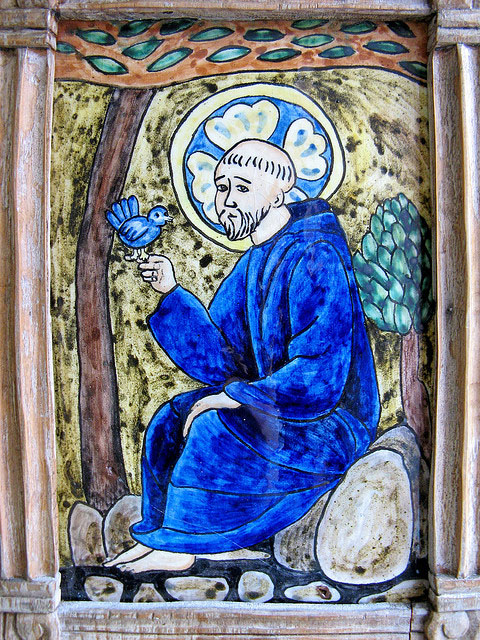 Staying with friends in Silver Lake, Los Angeles for the holidays, I’ve taken to walking down the Micheltorena Street steps in the mornings, ten or fifteen minutes before Mass at eight o’clock. The steps wind down between the houses in the foothills, terminating at Sunset Boulevard. They are forlorn in the way of all empty places within busy cities.
Soon enough, I arrive at Saint Francis of Assisi Church on Golden Gate Avenue, just off Sunset. The church itself is a simple rectangular box of a structure, built of cheap bricks and concrete block. The only adornment is the stained glass: sharp, bold, minimal in a vaguely modernist way. The faces of the saints and biblical figures are rendered almost as cartoons.
Now that Epiphany has come and gone, the inside of the church is bare bones. But I will not soon forget the Christmas decorations. They consisted mostly of scraggly pine trees arranged freestyle around the back of the altar tossed with red and green strings of lights. The lights were on blinking mode. While the old priest was giving his homily, green lights were flashing on one side of his face, red lights on the other. It looked like a bordello.
The other morning at Mass, the celebrant was another elderly Franciscan friar. This one had a stringy white beard and brown sandals. During the hallelujah, he got up from his seat, walked behind the altar, and passed through a doorway at the back of the church. A couple of seconds later we heard a door slam. Then nothing. Minutes passed.
The fifteen or so of us in the pews started to look around. The front of the church was completely empty. After five minutes, it seemed he would not be coming back. Perhaps no one else would come either. What do you do when you’re trapped in a half-finished Mass? A middle-aged Latino couple got up and left.
Finally, we heard a door opening. The friar shuffled back behind the altar. He had a huge wad of toilet paper stuffed in his right nostril and blood smeared on his face and beard. “My nose started bleeding,” he said, and then read the Gospel.
I wanted him to laugh, so that I could laugh too. But he didn’t. So we didn’t.
The bloody-nosed Franciscan then preached his homily about the story in John’s Gospel where Philip encourages his friend Nathanael to come and see Jesus. There results a humorous episode of verbal sparring between Jesus and Nathanael on the nature of truth and seeing. Nathanael is surprised, on approaching, that Jesus already knows who he is.
“How’d you know me?” Nathanael asks Jesus, half expecting a miraculous answer. “Because I saw you sitting under that fig tree with Philip,” is Jesus’s sardonic reply.
In his homily, my bleeding Franciscan did not mention the humor of this Gospel story. He talked about the fact that the Gospels impel us to come and see for ourselves, to find out what this fellow Jesus is talking about and what it might mean for us. It was a good point, a perfectly decent homily.
But he delivered the homily as if he hadn’t just wandered out of the church without telling anyone where he was going. He seemed entirely uninterested in the fact that he left us all in a strange and surreal predicament, wondering what to do in the midst of a suspended Mass. He’d injected a moment of absurdity into the liturgical certainty of the daily Mass.
Slowly, it dawned on me. This had been a particularly Franciscan thing to do. His action was his real homily. What he was doing, not what he was saying. In his book on Saint Francis, G. K. Chesterton wrote that Francis was:
One of the strongest and strangest and most original personalities that human history has known. He was, among other things, emphatically what we call a character; almost as we speak of a character in a good novel or play. He was not only a humanist, but a humorist; a humorist especially in the old English sense of a man always in his humor, going his own way and doing what nobody else would have done.
Some Franciscans (and not all of them, by any means) are able to pull-off the trick whereby they inject a sense of absurdity into the highest things without belittling them. Francis was a master of this trick. And my bloody-nosed friar had done a fair job of following the master.
It is easy to be light with the Mass, to ridicule it, if it is something in which you do not believe. But this Franciscan friar has dedicated his entire life to prayer, worship, liturgy. He is nothing if not serious.
And yet, he walked out of that Mass—strolling out of the church to tend to his nosebleed, returning in his own due time. It was a small-scale act of mastery and freedom. We would wait. The Mass would wait. God, even, would wait.
When I walked up to take Holy Communion I locked eyes with him for a second or two. I thought I might detect a glint of amusement. But he was staring right at the host. Intent, involved, priestly as can be.
Morgan Meis is the critic-at-large for The Smart Set (thesmartset.com). He has a PhD in Philosophy and has written for n+1, The Believer, Harper’s Magazine, and The Virginia Quarterly Review. He won the Whiting Award in 2013. Morgan is also an editor at 3 Quarks Daily, and a winner of a Creative Capital | Warhol Foundation Arts Writers grant. A book of Morgan’s selected essays can be found here. He can be reached at [email protected].
Photo by Randy OHC, used under the Creative Common License
Previous Post

January 12, 2015
Monasticism In Lockdown America, Part 4: Asceticism
Next Post
January 14, 2015 Hitch Your Wagon to a Want Ad
Browse Our Archives
Select a Category A. G. Harmon Alissa Wilkinson Allison Backous Art Authors Brad Fruhauff Bradford Winters Bryan Bliss Caroline Langston Chad Thomas Johnston Chris Hoke Christiana N. Peterson Culture D.G. Myers D.L. Mayfield Daniel Bowman Jr. David Griffith Elizabeth Duffy Faith Film Greg Wolfe Guest Contributor Interview Jan Vallone Jeffrey Overstreet Jessica Eddings-Roeser Jessica Mesman Griffith Kelly Foster Lindsey Crittenden Morgan Meis music Natalie Vestin Nick Olson Peggy Rosenthal Personal Reflection Poetry Friday Reflection Relationships Review Richard Chess Richard Cole Sara Zarr Shannon Huffman Polson Sonya Bilocerkowycz Tania Runyan Tony Woodlief Topical Categories Uncategorized Vic Sizemore Writing
Select a Month October 2018 September 2018 August 2018 July 2018 June 2018 May 2018 April 2018 March 2018 February 2018 January 2018 December 2017 November 2017 October 2017 September 2017 August 2017 July 2017 June 2017 May 2017 April 2017 March 2017 February 2017 January 2017 December 2016 November 2016 October 2016 September 2016 August 2016 July 2016 June 2016 May 2016 April 2016 March 2016 February 2016 January 2016 December 2015 November 2015 October 2015 September 2015 August 2015 July 2015 June 2015 May 2015 April 2015 March 2015 February 2015 January 2015 December 2014 November 2014 October 2014 September 2014 August 2014 July 2014 June 2014 May 2014 April 2014 March 2014 February 2014 January 2014 December 2013 November 2013 October 2013 September 2013 August 2013 July 2013 June 2013 May 2013 April 2013 March 2013 February 2013 January 2013 December 2012 November 2012 October 2012 September 2012 August 2012 July 2012 June 2012 May 2012 February 2008
Follow Us!
TAKE THE
Religious Wisdom Quiz
What was the primary occupation in ancient Israel?
Select your answer to see how you score.
Fishing Shepherding Farming Carpentry
Related posts from Good Letters

Morning in a Forgotten Neighborhood

Leonard Cohen’s Holy and Broken Hallelujah

Ready or Not for the Days of Awe

TRENDING AT PATHEOS Catholic

Creation, Preservation, and Teleology in Catholic Theology
As I write this, it is very early Monday morning. Like millions...

The Parable Of The Sower And The Word...
One of Christ’s most famous parables is that of the sower who...

Rejecting Doom: Christian Hope And Human Action
Christianity is a religion of hope. We are to have hope and...

Why I Choose the Eucharist Over the Sermon
Choose the Eucharist, Not the Sermon What are we supposed to get...

5 Design Elements Found in Spiritually Rooted Homes
Putting Spirituality Into Home Decor Our homes are more than our living...

Credo: A Story of God Told with the...
About 10 years ago, I began to imagine a personal "Credo" that...
view all Catholic blogs
Ad-Free & Subscriber Log-In Subscription Support
- About Us
- 2026 Calendar
- Videos
- Podcasts
- Library of World Religions
- Faith In Media Tracker
- Advertise With Us
- Write for Us
- Privacy Policy
- Terms of Service
- Do Not Sell My Data
- Contact Us
- Radiant Digital
- Manage Newsletter Subscriptions
- Unsubscribe From Notifications
- Sitemap
Copyright 2008-2026, Patheos. All rights reserved.
Subscription Support Ad-Free & Subscriber Log-In
Follow Patheos