
BuddhistCatholicContemplativeEvangelicalGeneral ChristianHinduJewishLatter-day SaintMuslimNew VisionsProgressive Christian
Beliefs
- Buddhist
- Catholic
- Contemplative
- Evangelical
- General Christian
- Hindu
- Jewish
- Latter-day Saint
- More Voices
- Muslim
- New Visions
- Pagan
- Progressive Christian
Topics
- Religion News
- Food and Religion
- Sports and Religion
- Religious Art
- Religious Music and Entertainment
- Religious Events
- History and Religion
- Style and Religion
- Politics and Religion
- Women in Religion
- Recreation Outdoors and Religion
- Business Finance and Religion
- Careers Workplace and Religion
- Education and Religion
- Family Parenting and Religion
- Health Fitness and Religion
- Home and Religion
- Relationships and Religion
- Technology and Religion
- Travel and Religion
Columnists
- Buddhist Columnists
- Business Finance and Religion Columnists
- Careers Workplace and Religion Columnists
- Catholic Columnists
- Contemplative Columnists
- Education and Religion Columnists
- Evangelists Columnists
- Family Parenting and Religion Columnists
- General Christian Columnists
- Health Fitness and Religion Columnists
- Hindu Columnists
- History and Religion Columnists
- Home and Religion Columnists
- Jewish Columnists
- More Voices Columnists
- Latter Day Columnists
- Muslim Columnists
- New Visions Columnists
- Nonreligious Columnists
- Pagan Columnists
- Politics and Religion Columnists
- Progressive Columnists
- Recreation Outdoors and Religion Columnists
- Relationships and Religion Columnists
- Religion News Columnists
- Religious Art Columnists
- Religious Events Columnists
- Religious Music and Entertainment Columnists
- Sports and Religion Columnists
- Style and Religion Columnists
- Technology and Religion Columnists
- Travel and Religion Columnists
- Women in Religion Columnists
Resource Library
- 2026 Calendar
- Library of World Religions
- The 100 Most Holy Places on Earth
- Patheos Answers
- Podcasts
- Videos
- Faith Leaders Database
- Anglican Episcopalian
- Bahai
- Baptist
- Buddhism
- Christianity
- Confucianism
- Eastern Orthodoxy
- Hinduism
- Holiness and Pentecostal
- ISKCON
- Islam
- Judaism
- Lutheran
- Methodist
- The Church of Jesus Christ of Latter-day Saints
- New Age
- Paganism
- Presbytarian and Reformed
- Protestantism
- Religion Behind the Scenes
- Roman Catholic
- Scientology
- Shia Islam
- Sikhism
- Sufism
- Sunni Islam
- Taoism
- Zen
- See all religions
Research Tools
 Ad-Free & Subscriber Log-In Subscription Support
Ad-Free & Subscriber Log-In Subscription Support
Follow Patheos 

- Trending:
- Forgiveness
- |
- Marriage
- |
- Consciousness
- |
- Death Penalty
- |
- Election
- |
- Halloween
 Good Letters
-
Contributors
- Home
- Catholic
- Hitch Your Wagon to a Want Ad
Hitch Your Wagon to a Want Ad
Last updated on: January 14, 2015 at 1:47 am by A. G. Harmon
Hitch Your Wagon to a Want Ad 2015-01-12T12:14:02-07:00 A. G. Harmon
Patheos Explore the world's faith through different perspectives on religion and spirituality! Patheos has the views of the prevalent religions and spiritualities of the world.
 The year has turned, and I have yet another chapter in the annals of things I’ve learned from farming in the quasi-way that I do it—on breaks in my teaching schedule and long weekends away from work.
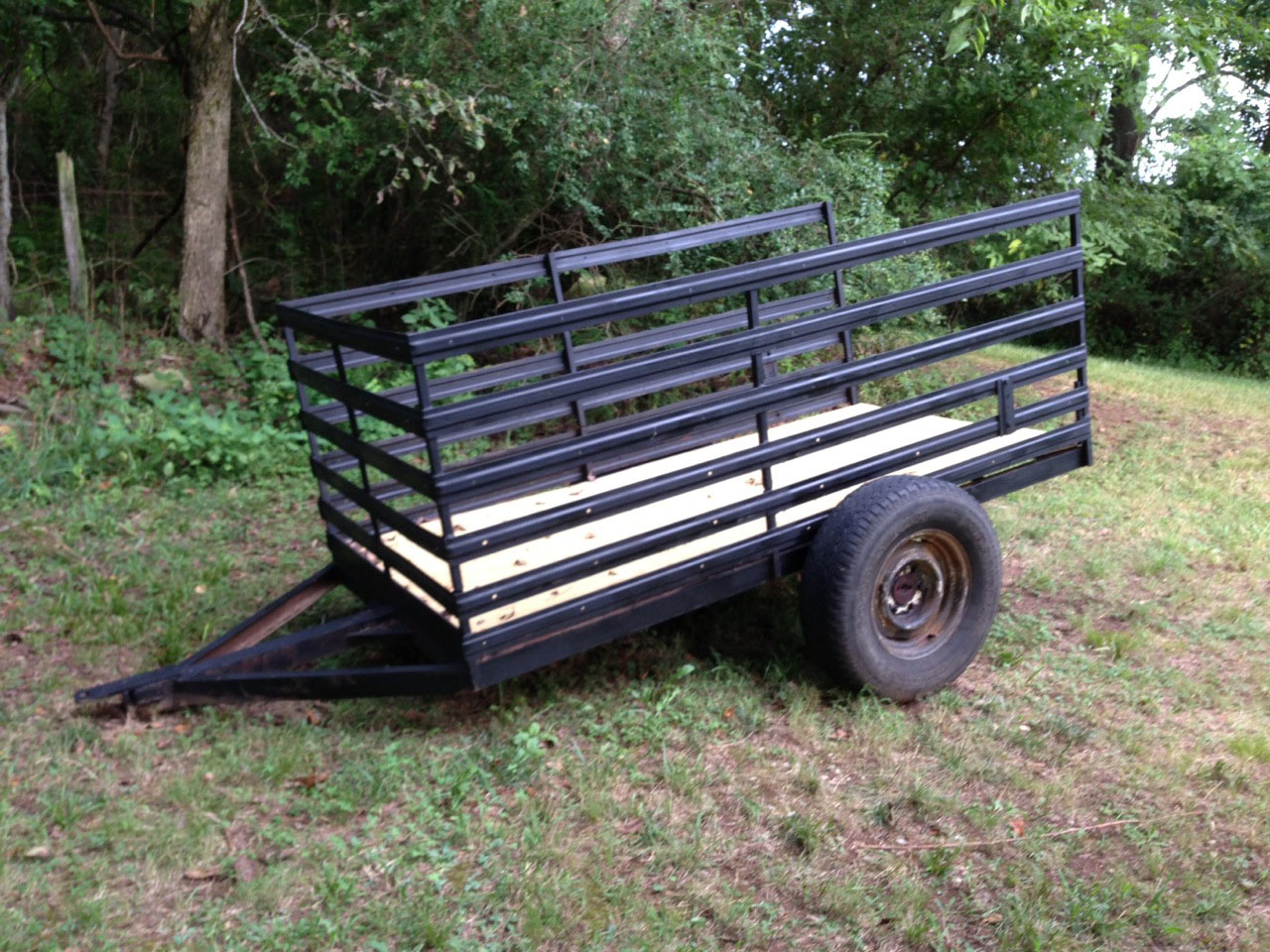
Last summer, I found an old wagon off the side of the road on the back of our place. It had been abandoned there around twenty or thirty years ago, forged together by a man who was once a metalworker, long gone now. It seems he used the axle from an old car, then built a metal box frame around it. He then installed a ply board floor, and fashioned some kind of a tongue that would allow the wagon to be secured to the back of a tractor with a linchpin.
“Found” the wagon is a way of putting it. I knew it was there all along. Every time I went down the dirt road to the back of the place, I could see a mound of honeysuckle over it, like a piano hidden in a Tim Burton movie. The wagon was full of old fence posts—fencing being one of the main preoccupations of any farm devoted mostly to livestock and horses.
Why it had been left there for so long I can’t say and nobody can remember. I assume it was because much of the place was later developed into a subdivision, and there was no need for it anymore. What fencing had to be done could be managed with a truck.
At any rate, having passed the mass of honeysuckle year after year, last summer something got into me. I decided to get the thing out. So during whatever time I could steal from other tasks, I labored at the undertaking. It was hot, mosquito-infested work, and I suspect more than one snake decided to slither off in another direction due to the noise, which prompted me to make a louder job of the work than was probably necessary.
First, it was a matter of clearing out the vines and trees that had grown up in and around the wagon. That meant a chainsaw and brush loppers. It’s amazing how vines and saplings can grow around and up and through things, holding onto the rails and wheels and axles in Gordian knots. Alexander didn’t have a sixteen-inch Homelite, but he passed through my mind from time to time even so.
Once all the brush was cleared, I began the work of emptying the bed. The posts were mostly rotten, so I threw them into the back of a truck I pulled alongside, then carried them to the dump. Eventually, I got down to the ply board floor, which had rotted through to the metal frame below. A couple of good bounces and I shattered it, so that the skeleton of metal was all that was left.
Predictably, the tires were sunken down into the earth and had gone flat. At least one of them was; miraculously, the other retained some air. So the next job was digging out around the rubber to free the tires so that I could bust the wagon loose. I also had to dig the tongue out of the earth, jack it up, and stick a pole beneath the bar so that I could get a logging chain around the brace posts. Then, in a triumph of four-wheel driving, I broke the wagon free of its decades-long confines and dragged it out to clear ground.
Next, I sanded down the metal, painted the structure with black Rustoleum, put in a new ply board floor, and bought a serviceable tire at a discount store (using about two gallons of Fix-A-Flat on the other one in a fit of thriftiness). All told, I put about fifty dollars into the job, but the reclamation was complete. A few pictures from a digital camera testified to the fact, and I began the task of trying to market the wagon. In a world gone mad with restoration fever, I was sure things would move quickly.
But everybody I contacted about it—farmers and landscapers –showed only a passing interest. None of the things I thought would make it more valuable than the newer models seemed to hold much weight. The frame was more solid than anything you could buy—a metal worker had made it, after all—and the sides were high enough to landscape with or even to carry a calf (my fanciful imagination at work).
The new paint, the new tires, the new floor—none of them seemed to matter. I didn’t even price it; I just asked for offers and would’ve taken anything reasonable.
Still, after months of trying, the only way I could sell the wagon was to throw it in with a newer wagon purchased a few years ago at a trailer store. In fact, according to the math, I really just gave it away.
It could be that I overestimated the value of the enterprise. I thought a great deal of myself for my efforts and the beauty of the thing I reclaimed from the wild. But the truth is, the wagon was very heavy, took a special kind of hitch, and isn’t all that practical (after all, who needs to take a single calf anywhere? There are no county fairs anymore and this isn’t Charlotte’s Web territory).
The bottom line is that I’m the kind of guy who wants to make money on what I’m proud of, not the kind who takes pleasure in a job well done. Things in themselves do not give me as much pleasure as those goods that are fungible.
That flaw will need to change at some point; it will be my self-improvement project this year. However, according to my conscience, the catalog of such yearly promises is growing rather daunting. At this rate, I’ll have to live a long time to get it done.
A.G. Harmon teaches Shakespeare, Law and Literature, Jurisprudence, and Writing at The Catholic University of America in Washington, D.C. His novel, A House All Stilled, won the 2001 Peter Taylor Prize for the Novel.
Photo by A.G. Harmon.
Previous Post

January 13, 2015
St. Francis and the Bloody-Nosed Friar
Next Post
January 15, 2015 Breaking Up with My Job
Browse Our Archives
Select a Category A. G. Harmon Alissa Wilkinson Allison Backous Art Authors Brad Fruhauff Bradford Winters Bryan Bliss Caroline Langston Chad Thomas Johnston Chris Hoke Christiana N. Peterson Culture D.G. Myers D.L. Mayfield Daniel Bowman Jr. David Griffith Elizabeth Duffy Faith Film Greg Wolfe Guest Contributor Interview Jan Vallone Jeffrey Overstreet Jessica Eddings-Roeser Jessica Mesman Griffith Kelly Foster Lindsey Crittenden Morgan Meis music Natalie Vestin Nick Olson Peggy Rosenthal Personal Reflection Poetry Friday Reflection Relationships Review Richard Chess Richard Cole Sara Zarr Shannon Huffman Polson Sonya Bilocerkowycz Tania Runyan Tony Woodlief Topical Categories Uncategorized Vic Sizemore Writing
Select a Month October 2018 September 2018 August 2018 July 2018 June 2018 May 2018 April 2018 March 2018 February 2018 January 2018 December 2017 November 2017 October 2017 September 2017 August 2017 July 2017 June 2017 May 2017 April 2017 March 2017 February 2017 January 2017 December 2016 November 2016 October 2016 September 2016 August 2016 July 2016 June 2016 May 2016 April 2016 March 2016 February 2016 January 2016 December 2015 November 2015 October 2015 September 2015 August 2015 July 2015 June 2015 May 2015 April 2015 March 2015 February 2015 January 2015 December 2014 November 2014 October 2014 September 2014 August 2014 July 2014 June 2014 May 2014 April 2014 March 2014 February 2014 January 2014 December 2013 November 2013 October 2013 September 2013 August 2013 July 2013 June 2013 May 2013 April 2013 March 2013 February 2013 January 2013 December 2012 November 2012 October 2012 September 2012 August 2012 July 2012 June 2012 May 2012 February 2008
Follow Us!
TAKE THE
Religious Wisdom Quiz
Who was the king who arranged for Hezekiah's scribes to compile additional Proverbs?
Select your answer to see how you score.
Solomon Ahab Jeroboam Hezekiah
Related posts from Good Letters


Morning in a Forgotten Neighborhood


TRENDING AT PATHEOS Catholic

Rejecting Doom: Christian Hope And Human Action
Christianity is a religion of hope. We are to have hope and...

It’s What Comes From Within Which Matters
One of the most difficult things for us to understand is why...

Why I Choose the Eucharist Over the Sermon
Choose the Eucharist, Not the Sermon What are we supposed to get...

5 Design Elements Found in Spiritually Rooted Homes
Putting Spirituality Into Home Decor Our homes are more than our living...

Credo: A Story of God Told with the...
About 10 years ago, I began to imagine a personal "Credo" that...

The Anatomy of Divine Revelation in Catholic Thought
The claim that God has made Himself known to human beings is...
view all Catholic blogs
Ad-Free & Subscriber Log-In Subscription Support
- About Us
- 2026 Calendar
- Videos
- Podcasts
- Library of World Religions
- Faith In Media Tracker
- Advertise With Us
- Write for Us
- Privacy Policy
- Terms of Service
- Do Not Sell My Data
- Contact Us
- Radiant Digital
- Manage Newsletter Subscriptions
- Unsubscribe From Notifications
- Sitemap
Copyright 2008-2026, Patheos. All rights reserved.
Subscription Support Ad-Free & Subscriber Log-In
Follow Patheos