
BuddhistCatholicContemplativeEvangelicalGeneral ChristianHinduJewishLatter-day SaintMuslimNew VisionsProgressive Christian
Beliefs
- Buddhist
- Catholic
- Contemplative
- Evangelical
- General Christian
- Hindu
- Jewish
- Latter-day Saint
- More Voices
- Muslim
- New Visions
- Pagan
- Progressive Christian
Topics
- Religion News
- Food and Religion
- Sports and Religion
- Religious Art
- Religious Music and Entertainment
- Religious Events
- History and Religion
- Style and Religion
- Politics and Religion
- Women in Religion
- Recreation Outdoors and Religion
- Business Finance and Religion
- Careers Workplace and Religion
- Education and Religion
- Family Parenting and Religion
- Health Fitness and Religion
- Home and Religion
- Relationships and Religion
- Technology and Religion
- Travel and Religion
Columnists
- Buddhist Columnists
- Business Finance and Religion Columnists
- Careers Workplace and Religion Columnists
- Catholic Columnists
- Contemplative Columnists
- Education and Religion Columnists
- Evangelists Columnists
- Family Parenting and Religion Columnists
- General Christian Columnists
- Health Fitness and Religion Columnists
- Hindu Columnists
- History and Religion Columnists
- Home and Religion Columnists
- Jewish Columnists
- More Voices Columnists
- Latter Day Columnists
- Muslim Columnists
- New Visions Columnists
- Nonreligious Columnists
- Pagan Columnists
- Politics and Religion Columnists
- Progressive Columnists
- Recreation Outdoors and Religion Columnists
- Relationships and Religion Columnists
- Religion News Columnists
- Religious Art Columnists
- Religious Events Columnists
- Religious Music and Entertainment Columnists
- Sports and Religion Columnists
- Style and Religion Columnists
- Technology and Religion Columnists
- Travel and Religion Columnists
- Women in Religion Columnists
Resource Library
- 2026 Calendar
- Library of World Religions
- The 100 Most Holy Places on Earth
- Patheos Answers
- Podcasts
- Videos
- Faith Leaders Database
- Anglican Episcopalian
- Bahai
- Baptist
- Buddhism
- Christianity
- Confucianism
- Eastern Orthodoxy
- Hinduism
- Holiness and Pentecostal
- ISKCON
- Islam
- Judaism
- Lutheran
- Methodist
- The Church of Jesus Christ of Latter-day Saints
- New Age
- Paganism
- Presbytarian and Reformed
- Protestantism
- Religion Behind the Scenes
- Roman Catholic
- Scientology
- Shia Islam
- Sikhism
- Sufism
- Sunni Islam
- Taoism
- Zen
- See all religions
Research Tools
 Ad-Free & Subscriber Log-In Subscription Support
Ad-Free & Subscriber Log-In Subscription Support
Follow Patheos 

- Trending:
- Forgiveness
- |
- Marriage
- |
- Consciousness
- |
- Death Penalty
- |
- Election
- |
- Halloween
 Good Letters
-
Contributors
- Home
- Catholic
- American Idol: A Guide for Hearing God’s Voice, Part 2
American Idol: A Guide for Hearing God’s Voice, Part 2
Last updated on: February 1, 2015 at 12:20 pm by Jan Vallone
American Idol: A Guide for Hearing God’s Voice, Part 2 2015-02-01T12:20:55-07:00 Jan Vallone
Patheos Explore the world's faith through different perspectives on religion and spirituality! Patheos has the views of the prevalent religions and spiritualities of the world.
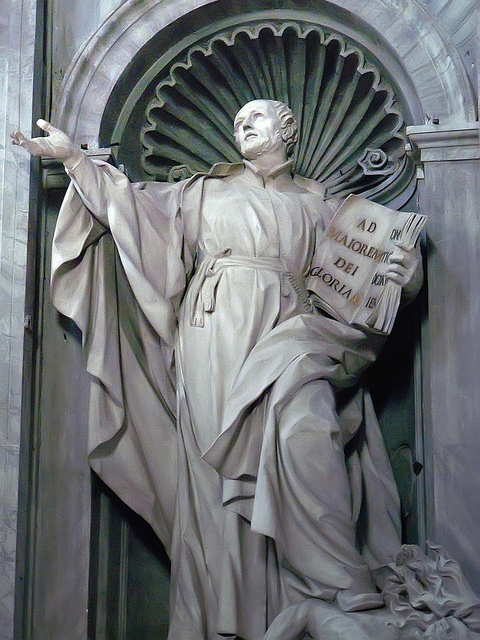
While many desires prompt goodness, others trigger evil and thus can’t be signs of our vocation to love. Ignatius called these desires disordered, meaning that a God-given longing—a holy desire—has become perverted.
If you’re a contestant on American Idol, you may have the holy desires to uplift your fans through your singing and to earn a living for your family. But if you sabotage another entrant to better your chances of prevailing, your holy desires have become warped.
When Ignatius was a young man, he happened upon a system for distinguishing holy from disordered desires. At the time, he was pulled by two strong yearnings, one to be a womanizer, the other to become a monk, and when he pondered these conflicting urges he noticed a difference in the feelings each aroused.
When Ignatius thought about philandering, at first he felt great pleasure, but this gave way to desolation—nagging feelings of depression, turmoil, and alienation. When he thought about religious life, initially he felt great fear and insecurity, but these gave way to *consolation—*lasting feelings of joy, tranquility, and connectedness.
Ignatius then deduced: when a longing brings us consolation, God is calling us to act on it; when conflicting desires bring us consolation, God is calling us to follow the one that brings us the most; and when a desire brings us desolation, God is warning us to snuff it out.
Ignatius, though, wasn’t suggesting that we should simply follow our bliss. He was letting us know that our bliss will endure only if it serves other people, and that it will turn into grief if it simply serves our self.
Ignatius, thus, became a monk.
If you read the Bible, you’ll see that fear and insecurity often precede consolation, as they did for Ignatius.
When God called Moses to rescue the Israelites in Egypt, Moses said, “Who am I to go?” and tried to weasel out. When God’s angel told the Virgin Mary that she would bear the Christ, she was troubled and asked, “How’s that possible?” When Jesus called Peter to discipleship, Peter said, “Go away. I’m no good.”
But God reassured all three people that they were worthy and capable and gave each the means to succeed in their vocations: to Moses, he gave a magic staff; to Mary, a miraculous conception; to Peter, the keys to heaven.
Christians use the word gifts to refer to the abilities God grants us to complete a call*.* Gifts are more than vocational tools, though. Catholic writer Sherry Weddell, social critic Os Guinness, and educator Dawna Markova all explain that gifts not only enable us to perform our vocation, but also signal what it entails.
Sixteenth century Anglican theologian William Perkins gave advice to help us identify the gifts that point to our vocation: since we’re innately biased, we should not assume we have a talent unless reliable assessors say we do.
Rabbi Heschel, Os Guinness, Sherry Weddell, and Parker Palmer add other indicators: we can presume to have a gift if using it benefits others and brings us great delight. So, if multiple choirmasters ask you to join their chorales and your singing moves others and elates you, God is likely calling you to sing.
The opposite, though, is also true: a limitation—a lack of desire, positive feedback, joy, or beneficent effects—can signal our vocation just as much as our strengths do. Thus, if you love to sing, but audiences boo you, or if you hate to sing despite the praise you reap from it, God is probably not calling you to sing, but to something else.
Yet some of us ignore our limitations or let others talk us out us of them. Throughout our lives, we’re surrounded by people—parents, teachers, religious leaders, peers, marketeers, spouses, bosses, children—whose expectations counter our vocation although their intentions may be good. Attempting to meet their expectations, we take on tasks we’re not called to do.
Even if we do this out of love, the results can be disastrous. Ignatius, Os Guinness, Parker Palmer, Sister Joan Chittister, and many other theorists have all noted the result: desolation or depression, that can cause us to be bitter and turn our love to hate.
This was my mistake when I chose to practice law instead of teaching: I listened to my father’s voice instead of to my Father’s voice. I wasn’t interested in law and disliked my job, even though my skills were praised, benefitted my clients, and helped support my family. By persisting in practicing law, I made myself and those around me miserable, although my motivation had been good—to please my dad.
Coveting or assuming a vocation that’s not ours isn’t only harmful, but also unwarranted. Saint Paul once explained that humankind is like a body and each person is like a body part. Eyes can’t be or spurn ears. Ears can’t be or spurn hands. Each has a unique and necessary function that together with the others makes the body healthy, efficient, and whole.
Thus, teachers shouldn’t be or eschew lawyers, and painters shouldn’t be or eschew singers. Each of us has our own vocation, and the more often we find and honor our vocations, the more fully we meet the world’s needs.
Discovering vocation, though, doesn’t mean we’ll always be happy. It’s unrealistic to pretend that every task we do and every minute of life will be exciting, fulfilling, and successful. Sometimes work is drudgery that simply must be done, and often the job market is tight, forcing us to take whatever work we can get.
While some of us may find a paying job that matches our vocation, many of us will not. Instead, we may find volunteer work and hobbies that jibe with our call.
So, if you love and have the gift of singing, I hope to see you on American Idol. But win or lose, if you sing because you’re called to, you’ll bring joy to both your listeners and yourself for as long as your voice responds to God’s call.
Jan Vallone is the author of Pieces of Someday: One Woman’s Search for Meaning in Lawyering Family, Italy, Church, and a Tiny Jewish High School,which won the Reader Views Reviewers’ Choice Award. Her stories have appeared in The Seattle Times, Good Letters, Faith & Values in the Public Square, Catholic Digest, Guideposts Magazine, English Journal, Chicken Soup for the Soul, and Writing it Real. She lives and teaches writing in Seattle.
Image above created by Camillo and Giuseppe Rusconi, found under Mary Harrsch, used under the Creative Common License.
Previous Post

January 22, 2015
American Idol: A Guide for Hearing God's Voice, Part 1
Next Post
January 26, 2015 Is My Truth Your Truth?
Browse Our Archives
Select a Category A. G. Harmon Alissa Wilkinson Allison Backous Art Authors Brad Fruhauff Bradford Winters Bryan Bliss Caroline Langston Chad Thomas Johnston Chris Hoke Christiana N. Peterson Culture D.G. Myers D.L. Mayfield Daniel Bowman Jr. David Griffith Elizabeth Duffy Faith Film Greg Wolfe Guest Contributor Interview Jan Vallone Jeffrey Overstreet Jessica Eddings-Roeser Jessica Mesman Griffith Kelly Foster Lindsey Crittenden Morgan Meis music Natalie Vestin Nick Olson Peggy Rosenthal Personal Reflection Poetry Friday Reflection Relationships Review Richard Chess Richard Cole Sara Zarr Shannon Huffman Polson Sonya Bilocerkowycz Tania Runyan Tony Woodlief Topical Categories Uncategorized Vic Sizemore Writing
Select a Month October 2018 September 2018 August 2018 July 2018 June 2018 May 2018 April 2018 March 2018 February 2018 January 2018 December 2017 November 2017 October 2017 September 2017 August 2017 July 2017 June 2017 May 2017 April 2017 March 2017 February 2017 January 2017 December 2016 November 2016 October 2016 September 2016 August 2016 July 2016 June 2016 May 2016 April 2016 March 2016 February 2016 January 2016 December 2015 November 2015 October 2015 September 2015 August 2015 July 2015 June 2015 May 2015 April 2015 March 2015 February 2015 January 2015 December 2014 November 2014 October 2014 September 2014 August 2014 July 2014 June 2014 May 2014 April 2014 March 2014 February 2014 January 2014 December 2013 November 2013 October 2013 September 2013 August 2013 July 2013 June 2013 May 2013 April 2013 March 2013 February 2013 January 2013 December 2012 November 2012 October 2012 September 2012 August 2012 July 2012 June 2012 May 2012 February 2008
Follow Us!
TAKE THE
Religious Wisdom Quiz
What does the helmet represent?
Select your answer to see how you score.
The power of prayer The Holy Spirit Salvation Faith
Related posts from Good Letters

Morning in a Forgotten Neighborhood



Leonard Cohen’s Holy and Broken Hallelujah
TRENDING AT PATHEOS Catholic

Rejecting Doom: Christian Hope And Human Action
Christianity is a religion of hope. We are to have hope and...

It’s What Comes From Within Which Matters
One of the most difficult things for us to understand is why...

Why I Choose the Eucharist Over the Sermon
Choose the Eucharist, Not the Sermon What are we supposed to get...

5 Design Elements Found in Spiritually Rooted Homes
Putting Spirituality Into Home Decor Our homes are more than our living...

Credo: A Story of God Told with the...
About 10 years ago, I began to imagine a personal "Credo" that...

The Anatomy of Divine Revelation in Catholic Thought
The claim that God has made Himself known to human beings is...
view all Catholic blogs
Ad-Free & Subscriber Log-In Subscription Support
- About Us
- 2026 Calendar
- Videos
- Podcasts
- Library of World Religions
- Faith In Media Tracker
- Advertise With Us
- Write for Us
- Privacy Policy
- Terms of Service
- Do Not Sell My Data
- Contact Us
- Radiant Digital
- Manage Newsletter Subscriptions
- Unsubscribe From Notifications
- Sitemap
Copyright 2008-2026, Patheos. All rights reserved.
Subscription Support Ad-Free & Subscriber Log-In
Follow Patheos