
BuddhistCatholicContemplativeEvangelicalGeneral ChristianHinduJewishLatter-day SaintMuslimNew VisionsProgressive Christian
Beliefs
- Buddhist
- Catholic
- Contemplative
- Evangelical
- General Christian
- Hindu
- Jewish
- Latter-day Saint
- More Voices
- Muslim
- New Visions
- Pagan
- Progressive Christian
Topics
- Religion News
- Food and Religion
- Sports and Religion
- Religious Art
- Religious Music and Entertainment
- Religious Events
- History and Religion
- Style and Religion
- Politics and Religion
- Women in Religion
- Recreation Outdoors and Religion
- Business Finance and Religion
- Careers Workplace and Religion
- Education and Religion
- Family Parenting and Religion
- Health Fitness and Religion
- Home and Religion
- Relationships and Religion
- Technology and Religion
- Travel and Religion
Columnists
- Buddhist Columnists
- Business Finance and Religion Columnists
- Careers Workplace and Religion Columnists
- Catholic Columnists
- Contemplative Columnists
- Education and Religion Columnists
- Evangelists Columnists
- Family Parenting and Religion Columnists
- General Christian Columnists
- Health Fitness and Religion Columnists
- Hindu Columnists
- History and Religion Columnists
- Home and Religion Columnists
- Jewish Columnists
- More Voices Columnists
- Latter Day Columnists
- Muslim Columnists
- New Visions Columnists
- Nonreligious Columnists
- Pagan Columnists
- Politics and Religion Columnists
- Progressive Columnists
- Recreation Outdoors and Religion Columnists
- Relationships and Religion Columnists
- Religion News Columnists
- Religious Art Columnists
- Religious Events Columnists
- Religious Music and Entertainment Columnists
- Sports and Religion Columnists
- Style and Religion Columnists
- Technology and Religion Columnists
- Travel and Religion Columnists
- Women in Religion Columnists
Resource Library
- 2026 Calendar
- Library of World Religions
- The 100 Most Holy Places on Earth
- Patheos Answers
- Podcasts
- Videos
- Faith Leaders Database
- Anglican Episcopalian
- Bahai
- Baptist
- Buddhism
- Christianity
- Confucianism
- Eastern Orthodoxy
- Hinduism
- Holiness and Pentecostal
- ISKCON
- Islam
- Judaism
- Lutheran
- Methodist
- The Church of Jesus Christ of Latter-day Saints
- New Age
- Paganism
- Presbytarian and Reformed
- Protestantism
- Religion Behind the Scenes
- Roman Catholic
- Scientology
- Shia Islam
- Sikhism
- Sufism
- Sunni Islam
- Taoism
- Zen
- See all religions
Research Tools
 Ad-Free & Subscriber Log-In Subscription Support
Ad-Free & Subscriber Log-In Subscription Support
Follow Patheos 

- Trending:
- Forgiveness
- |
- Marriage
- |
- Consciousness
- |
- Death Penalty
- |
- Election
- |
- Halloween
 Good Letters
-
Contributors
- Home
- Catholic
- #BlackLivesMatter to Poets
#BlackLivesMatter to Poets
Last updated on: January 16, 2015 at 3:36 pm by Peggy Rosenthal
#BlackLivesMatter to Poets 2015-01-16T15:36:08-07:00 Peggy Rosenthal
Patheos Explore the world's faith through different perspectives on religion and spirituality! Patheos has the views of the prevalent religions and spiritualities of the world.
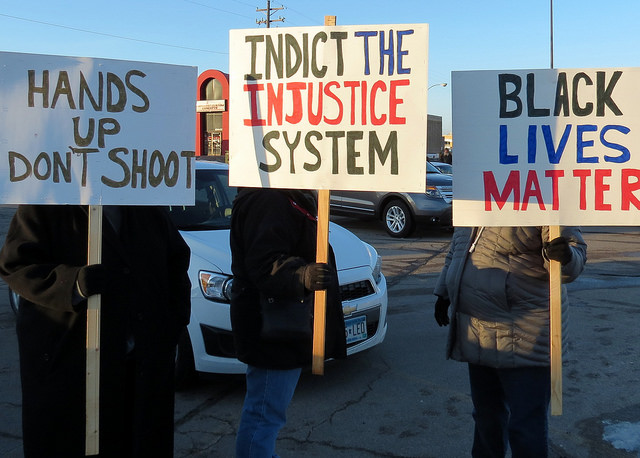 Poets are rising to the cause, hands raised (“Don’t shoot!”) but hands also holding pencils and paper or at the computer keys, writing poems.
The cause I refer to is clear to anyone who has lived in this country since August 9, 2014, the date of Michael Brown’s murder. It’s not a new cause, alas; racial injustice has never been absent from our land.
But what’s new—and hopeful—is the depth and breadth of public outcry. It had actually begun a couple weeks earlier, with the caught-on-camera police choking of Eric Garner, then swelled as Michael Brown’s dead body lay for four and a half hours in the street.
Then in late November-early December, the swell became a roar of indignation, as black Americans felt slap after slap after slap on the face of their worth as human beings: on November 22, the police killing (“when will they ever learn?”) of twelve-year old Tamir Rice, playing in a public park; on November 24, the non-indictment of the police officer who killed Brown; on December 3, the non-indictment of the police officer who had choked Eric Garner to death.
Poets, both black and white, are lending their particular poetic voice to the outcry. Or, I should say, “voices,” since the poetic voices are diverse. There’s the bitter irony of David Almaleck Wolinsky**‘**s “Lament for Darren Wilson and Tamir Rice (Thanksgiving, 2014)”:
Precious, precious, precious.
The lives of killers are precious;
they are prisms of truth.
They are because they are.
They are as lives are
precious, sanctus, precious,
the lives of killers
and the lives ended,
oh listeners in whom they must live.
There’s the pensive pain of “I Don’t Pretend to Know All the Facts” by Shevaun Brannigan, dedicated to Michael Brown’s mother, Lesley McSpadden:
What it’s like to be a mother, what it’s like
to want to give someone all the good in the whole world…
If I knew what it was like to be a mother,
I hope I would not know what it was like to suddenly not be a mother,
(though an embankment is still an embankment even after the river is gone,
the embankment still remembers the feel of water against it,
still curves to make room for the water and all it contained).…
I don’t pretend to know how many mothers are watching
TV now, terrified of the world they have gifted to the sons they will lose
in upcoming months, I do not know who is next,
but I do not pretend that some boy will not be next,
and here he is, 12 years old in Cleveland and now not in Cleveland,
though I do not pretend to know what happens after death,
I have been told of heaven just as I have been told of the water cycle,
that an evaporated river is held in our clouds, our bodies,
each tear,
though mothers, I don’t pretend that will bring you comfort.
Then there’s Maureen Doalles’s “one nation,” taking on the prophetic, oracular voice of Martin Luther King’s “I Have a Dream” speech, quoted from as the poem’s epigraph:
for one hundred years
hope was tranquilizing
despair a mountain
of solid stone in hands
crippled by manacles
but we emerge now
not drinking from a cup
of hatred, of violence
of bitterness, not jangling
chains of distrust
but able to sing here today
our protests in community
battered, suffering, we will
not turn back…
These poems and many more are published online:
A call for poems on racial injustice sent out by the website Split This Rock, resulted in some thirty-five poems posted over several days beginning December 9, 2014. (The poems above are from this site.)
Nicholas Kristof launched a poetry contest on his New York Times blog; as of the December 18 deadline, over 260 poems had been posted.
Winter Tangerine Review has called for poems on the theme of “Hands Up Don’t Shoot” exploring what it means to be black in America. They’ll be published on February 5, 2015, in honor of Trayvon Martin’s birthday.
And Power Poetry has been printing a wealth of poems about race.
Reading through this outpouring of poetic sense—in the face of the insensitivity of racial profiling and police impunity—I recall a previous outbreak of poems appealing to the conscience of our country. As President George W. Bush prepared for his “Shock and Awe” attack on Iraq in late 2002, poet Sam Hamill happened to be among the poets whom Laura Bush invited to the White House for a February symposium on “Poetry and the American Voice.”
Knowing that his own voice at the symposium would be strongly against the President’s military plans, Hamill emailed a few poet-friends to ask for poems he might read there. Within a few weeks he’d received poems from about eleven thousand people (via email forwarding in those pre-twitter and Facebook days); poetsagainstthewar.org was set up; and Laura Bush cancelled her symposium.
Inspired by Poets Against the War, I compiled an anthology for Pax Christi USA in 2005 called Imagine a World: Poetry for Peacemakers, my title borrowed from the opening of Scott Cairns’s “The Theology of Delight”:
Imagine a world, this ridiculous,
tentative bud blooming
in your hand…
Yes, imagine it. Our world is ridiculous and tentative…yet it is a bud blooming in your hand: your hand holding pencil and paper or at the computer keys, writing poems. Poets find language to tell it like it is, but also language to tell it as it might be.
Can poetry move us toward a post-racial world? Not alone. But it can join its voices to the marches for justice, laying its lines on the line, blossoming #BlackLivesMatter into a fuller picture of indignities suffered…and further into a vision of how a world with dignity for all might look.
Peggy Rosenthal is director of Poetry Retreats and writes widely on poetry as a spiritual resource. Her books include Praying through Poetry: Hope for Violent Times (Franciscan Media), and The Poets’ Jesus (Oxford). See Amazon for full list. She also teaches an online course, “Poetry as a Spiritual Practice,” through Image’s Glen Online program*.*
Photo above by Rose Colored Photo, used under a Creative Commons License.
Previous Post

January 2, 2015
This Dark World is Precious to Me: 14 Songs for 2014
Next Post
January 6, 2015 An Introvert’s Resolution
Browse Our Archives
Select a Category A. G. Harmon Alissa Wilkinson Allison Backous Art Authors Brad Fruhauff Bradford Winters Bryan Bliss Caroline Langston Chad Thomas Johnston Chris Hoke Christiana N. Peterson Culture D.G. Myers D.L. Mayfield Daniel Bowman Jr. David Griffith Elizabeth Duffy Faith Film Greg Wolfe Guest Contributor Interview Jan Vallone Jeffrey Overstreet Jessica Eddings-Roeser Jessica Mesman Griffith Kelly Foster Lindsey Crittenden Morgan Meis music Natalie Vestin Nick Olson Peggy Rosenthal Personal Reflection Poetry Friday Reflection Relationships Review Richard Chess Richard Cole Sara Zarr Shannon Huffman Polson Sonya Bilocerkowycz Tania Runyan Tony Woodlief Topical Categories Uncategorized Vic Sizemore Writing
Select a Month October 2018 September 2018 August 2018 July 2018 June 2018 May 2018 April 2018 March 2018 February 2018 January 2018 December 2017 November 2017 October 2017 September 2017 August 2017 July 2017 June 2017 May 2017 April 2017 March 2017 February 2017 January 2017 December 2016 November 2016 October 2016 September 2016 August 2016 July 2016 June 2016 May 2016 April 2016 March 2016 February 2016 January 2016 December 2015 November 2015 October 2015 September 2015 August 2015 July 2015 June 2015 May 2015 April 2015 March 2015 February 2015 January 2015 December 2014 November 2014 October 2014 September 2014 August 2014 July 2014 June 2014 May 2014 April 2014 March 2014 February 2014 January 2014 December 2013 November 2013 October 2013 September 2013 August 2013 July 2013 June 2013 May 2013 April 2013 March 2013 February 2013 January 2013 December 2012 November 2012 October 2012 September 2012 August 2012 July 2012 June 2012 May 2012 February 2008
Follow Us!
TAKE THE
Religious Wisdom Quiz
Who was the ruler of Egypt during Joseph's time?
Select your answer to see how you score.
Pharaoh Cyrus Caesar Nebuchadnezzar
Related posts from Good Letters



On Writing Odes: Taking Time to Celebrate

Poetry Friday: "The Burned Butterfly"
TRENDING AT PATHEOS Catholic

The Parable Of The Sower And The Word...
One of Christ’s most famous parables is that of the sower who...

Rejecting Doom: Christian Hope And Human Action
Christianity is a religion of hope. We are to have hope and...

Why I Choose the Eucharist Over the Sermon
Choose the Eucharist, Not the Sermon What are we supposed to get...

5 Design Elements Found in Spiritually Rooted Homes
Putting Spirituality Into Home Decor Our homes are more than our living...

Credo: A Story of God Told with the...
About 10 years ago, I began to imagine a personal "Credo" that...

The Anatomy of Divine Revelation in Catholic Thought
The claim that God has made Himself known to human beings is...
view all Catholic blogs
Ad-Free & Subscriber Log-In Subscription Support
- About Us
- 2026 Calendar
- Videos
- Podcasts
- Library of World Religions
- Faith In Media Tracker
- Advertise With Us
- Write for Us
- Privacy Policy
- Terms of Service
- Do Not Sell My Data
- Contact Us
- Radiant Digital
- Manage Newsletter Subscriptions
- Unsubscribe From Notifications
- Sitemap
Copyright 2008-2026, Patheos. All rights reserved.
Subscription Support Ad-Free & Subscriber Log-In
Follow Patheos