
BuddhistCatholicContemplativeEvangelicalGeneral ChristianHinduJewishLatter-day SaintMuslimNew VisionsProgressive Christian
Beliefs
- Buddhist
- Catholic
- Contemplative
- Evangelical
- General Christian
- Hindu
- Jewish
- Latter-day Saint
- More Voices
- Muslim
- New Visions
- Pagan
- Progressive Christian
Topics
- Religion News
- Food and Religion
- Sports and Religion
- Religious Art
- Religious Music and Entertainment
- Religious Events
- History and Religion
- Style and Religion
- Politics and Religion
- Women in Religion
- Recreation Outdoors and Religion
- Business Finance and Religion
- Careers Workplace and Religion
- Education and Religion
- Family Parenting and Religion
- Health Fitness and Religion
- Home and Religion
- Relationships and Religion
- Technology and Religion
- Travel and Religion
Columnists
- Buddhist Columnists
- Business Finance and Religion Columnists
- Careers Workplace and Religion Columnists
- Catholic Columnists
- Contemplative Columnists
- Education and Religion Columnists
- Evangelists Columnists
- Family Parenting and Religion Columnists
- General Christian Columnists
- Health Fitness and Religion Columnists
- Hindu Columnists
- History and Religion Columnists
- Home and Religion Columnists
- Jewish Columnists
- More Voices Columnists
- Latter Day Columnists
- Muslim Columnists
- New Visions Columnists
- Nonreligious Columnists
- Pagan Columnists
- Politics and Religion Columnists
- Progressive Columnists
- Recreation Outdoors and Religion Columnists
- Relationships and Religion Columnists
- Religion News Columnists
- Religious Art Columnists
- Religious Events Columnists
- Religious Music and Entertainment Columnists
- Sports and Religion Columnists
- Style and Religion Columnists
- Technology and Religion Columnists
- Travel and Religion Columnists
- Women in Religion Columnists
Resource Library
- 2026 Calendar
- Library of World Religions
- The 100 Most Holy Places on Earth
- Patheos Answers
- Podcasts
- Videos
- Faith Leaders Database
- Anglican Episcopalian
- Bahai
- Baptist
- Buddhism
- Christianity
- Confucianism
- Eastern Orthodoxy
- Hinduism
- Holiness and Pentecostal
- ISKCON
- Islam
- Judaism
- Lutheran
- Methodist
- The Church of Jesus Christ of Latter-day Saints
- New Age
- Paganism
- Presbytarian and Reformed
- Protestantism
- Religion Behind the Scenes
- Roman Catholic
- Scientology
- Shia Islam
- Sikhism
- Sufism
- Sunni Islam
- Taoism
- Zen
- See all religions
Research Tools
 Ad-Free & Subscriber Log-In Subscription Support
Ad-Free & Subscriber Log-In Subscription Support
Follow Patheos 

- Trending:
- Forgiveness
- |
- Marriage
- |
- Consciousness
- |
- Death Penalty
- |
- Election
- |
- Halloween
 Good Letters
-
Contributors
- Home
- Catholic
- The Subtle Traitor
The Subtle Traitor
Last updated on: November 21, 2014 at 1:18 am by A. G. Harmon
The Subtle Traitor 2014-11-19T13:15:27-07:00 A. G. Harmon
Patheos Explore the world's faith through different perspectives on religion and spirituality! Patheos has the views of the prevalent religions and spiritualities of the world.
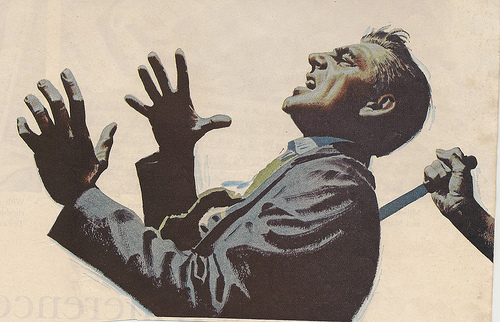 I’m about to describe a character. He doesn’t exist everywhere, nor is he a threat to everyone. But it’s important to sketch out his profile, because he’s hardly ever seen for what he is, and because his brotherly embraces can end with a knife between your ribs.
To be even halfway familiar with him, you have to be from a place, or of a group, that has a “checkered past”—a group whose forebears transgressed against the modern orthodoxies in a big time way. I’m talking “Mark of Cain” stuff that gets you centuries of bad PR. These forebears are often losers in the wars, both military and cultural, so their sins get chiseled into marble.
Being a white (rumor of a Choctaw somewhere won’t cut it), Christian, Southern, heterosexual male, in good health and with no certifiable mental deficits (damn it), I’m in pretty bad standing. My immediate family didn’t even have the decency to be poor. So I’m everybody’s worst nightmare—on the wrong side of all government quotas. Worse, if you dig around in my family magnolia tree, you’ll find the reason those quotas got instituted in the first place.
I think Germans know what I mean. Their past makes them particularly vulnerable, and they’re easily silenced by a raised eyebrow and an implied accusation: “Of course you say that/act that way/are of that opinion, considering…”
Watch how fast a German backtracks—even when arguing over where to eat lunch—when bigotry is suggested. He can’t shut up fast enough. And he can’t complain either, because then he’ll sound defensive, be accused of backlash: “See? Look how angry he is! I told you he was crazy. And I bet he’s not one bit sorry for…”
They’ve got him at every turn.
Here’s the part where I have to make an obligatory disclaimer: “I’m not in any way condoning the actions of the past. It was all a tragedy and I don’t for one minute dismiss how horrible it was. I’m just saying…”
That Please Don’t Misunderstand Me preface is an indispensible part of all apologias uttered by the Mr. Hamstrungs of the world.
Of course, they should be able to defend themselves, to establish something based on facts without surrendering the right to facts altogether, or ceding the right to speak whatsoever. But often they surrender and cede anyhow. Though the ad hominem is a logical fallacy, it’s very effective in this case.
The traitor I speak of is so successful, it seems, because the people he betrays are so susceptible. Maybe that’s the way of treason. It’s easy to get close to outcasts; they’re pretty desperate for friends.
That being the case, here are the traitor’s subtleties: First, like all quislings, he has to be a member of the exiled group, with impeccable credentials. He’s the guy who grew up next to you, or knows your next of kin: “Why, I went to school with your Mama and Daddy…”
Second, he has to have a major forum. And the best way to get that is to tell his audience—the vast group of winners on the other side of the war—what they want to hear.
Because nobody ever went broke in the scapegoat business. Raise a good herd, and they’ll always sell high; the market never dries up or tops out. People love to load the mangy little bastards up with everything imaginable, then start flailing away: “Hey everybody. He’s the racist, sexist, classist pig—that guy over there. Look good, so you won’t ever mistake us for one.”
Third, you’ll often find he no longer lives among his kind. Preferring the company of winners, he usually finds it either in cities far away, or ones that have an inoculating hipness to them directly proportionate to the degree that 1) their pre-twentieth century architecture has survived; 2) they’re associated with some sort of roots music; and 3) they have some exotic cuisine the food idolaters go completely orgasmic about. Such cities are very self-congratulatory; their citizens absolutely adore themselves for living there.
Of course, our traitor really “couldn’t” stay down home, because he’s just so darn “different” from his kin—love them though he does. And oh how he insists that he does indeed looooove them. With all their faults.
That last part is key. Because the goats he sells—by way of essays (especially “journalistic” ones), screenplays, etc.—must come from an “insider,” telling the same tired story about the buck-toothed, knuckle-bumping trogs—“one of them,” speaking from a “grieved heart”—pretending it takes courage to shoot fish in a barrel—because it’s important that we “never forget.” Fat chance.
He won’t speak of how things are better, or how we’ve moved on, because he’s making too much money out of it for that to be the case. The stock for sham bravery is forever on the rise.
Here’s another move: if the homefolks gain some fleeting glory—if the world starts to value something they’ve got and they get a little press from it (e.g., sports victories)—he’ll be right there to cozy up—“one of them” again; imagine that. The camera somehow always manages to find him too.
Justifiably wary at first, the home crowd often succumbs in the end: “He’s not so bad—he means well—we are pretty rotten, after all.”
Ha. When the party’s over, he’ll sell them like a pack of two-bit whores at a jungle boot camp.
Now, this is neither a call for revenge nor a refusal to grant forgiveness.
Please don’t misunderstand me.
But it’s an absolute invitation to betrayal—and certain downfall—when the sheep can’t be discerned from the goats. People simply have to be watchful, so that they can distinguish those who intend them good from those who don’t.
Even bad guys like me, if we’re to make any progress in this old world, must have the eyes of foxes over the souls of lambs.
A.G. Harmon teaches Shakespeare, Law and Literature, Jurisprudence, and Writing at The Catholic University of America in Washington, D.C. His novel, A House All Stilled, won the 2001 Peter Taylor Prize for the Novel.
Previous Post

November 20, 2014
The Treasure in the Trash
Next Post
November 24, 2014 The Benevolent Season
Browse Our Archives
Select a Category A. G. Harmon Alissa Wilkinson Allison Backous Art Authors Brad Fruhauff Bradford Winters Bryan Bliss Caroline Langston Chad Thomas Johnston Chris Hoke Christiana N. Peterson Culture D.G. Myers D.L. Mayfield Daniel Bowman Jr. David Griffith Elizabeth Duffy Faith Film Greg Wolfe Guest Contributor Interview Jan Vallone Jeffrey Overstreet Jessica Eddings-Roeser Jessica Mesman Griffith Kelly Foster Lindsey Crittenden Morgan Meis music Natalie Vestin Nick Olson Peggy Rosenthal Personal Reflection Poetry Friday Reflection Relationships Review Richard Chess Richard Cole Sara Zarr Shannon Huffman Polson Sonya Bilocerkowycz Tania Runyan Tony Woodlief Topical Categories Uncategorized Vic Sizemore Writing
Select a Month October 2018 September 2018 August 2018 July 2018 June 2018 May 2018 April 2018 March 2018 February 2018 January 2018 December 2017 November 2017 October 2017 September 2017 August 2017 July 2017 June 2017 May 2017 April 2017 March 2017 February 2017 January 2017 December 2016 November 2016 October 2016 September 2016 August 2016 July 2016 June 2016 May 2016 April 2016 March 2016 February 2016 January 2016 December 2015 November 2015 October 2015 September 2015 August 2015 July 2015 June 2015 May 2015 April 2015 March 2015 February 2015 January 2015 December 2014 November 2014 October 2014 September 2014 August 2014 July 2014 June 2014 May 2014 April 2014 March 2014 February 2014 January 2014 December 2013 November 2013 October 2013 September 2013 August 2013 July 2013 June 2013 May 2013 April 2013 March 2013 February 2013 January 2013 December 2012 November 2012 October 2012 September 2012 August 2012 July 2012 June 2012 May 2012 February 2008
Follow Us!
TAKE THE
Religious Wisdom Quiz
What is the last book in the New Testament before Revelation?
Select your answer to see how you score.
3 John Philemon Jude 1 John
Related posts from Good Letters


Marital Anger and Icelandic Rock Spirits

The Crown and Victoria: Tales of Two Queens

TRENDING AT PATHEOS Catholic

Rejecting Doom: Christian Hope And Human Action
Christianity is a religion of hope. We are to have hope and...

It’s What Comes From Within Which Matters
One of the most difficult things for us to understand is why...

Why I Choose the Eucharist Over the Sermon
Choose the Eucharist, Not the Sermon What are we supposed to get...

5 Design Elements Found in Spiritually Rooted Homes
Putting Spirituality Into Home Decor Our homes are more than our living...

Credo: A Story of God Told with the...
About 10 years ago, I began to imagine a personal "Credo" that...

The Anatomy of Divine Revelation in Catholic Thought
The claim that God has made Himself known to human beings is...
view all Catholic blogs
Ad-Free & Subscriber Log-In Subscription Support
- About Us
- 2026 Calendar
- Videos
- Podcasts
- Library of World Religions
- Faith In Media Tracker
- Advertise With Us
- Write for Us
- Privacy Policy
- Terms of Service
- Do Not Sell My Data
- Contact Us
- Radiant Digital
- Manage Newsletter Subscriptions
- Unsubscribe From Notifications
- Sitemap
Copyright 2008-2026, Patheos. All rights reserved.
Subscription Support Ad-Free & Subscriber Log-In
Follow Patheos