
BuddhistCatholicContemplativeEvangelicalGeneral ChristianHinduJewishLatter-day SaintMuslimNew VisionsProgressive Christian
Beliefs
- Buddhist
- Catholic
- Contemplative
- Evangelical
- General Christian
- Hindu
- Jewish
- Latter-day Saint
- More Voices
- Muslim
- New Visions
- Pagan
- Progressive Christian
Topics
- Religion News
- Food and Religion
- Sports and Religion
- Religious Art
- Religious Music and Entertainment
- Religious Events
- History and Religion
- Style and Religion
- Politics and Religion
- Women in Religion
- Recreation Outdoors and Religion
- Business Finance and Religion
- Careers Workplace and Religion
- Education and Religion
- Family Parenting and Religion
- Health Fitness and Religion
- Home and Religion
- Relationships and Religion
- Technology and Religion
- Travel and Religion
Columnists
- Buddhist Columnists
- Business Finance and Religion Columnists
- Careers Workplace and Religion Columnists
- Catholic Columnists
- Contemplative Columnists
- Education and Religion Columnists
- Evangelists Columnists
- Family Parenting and Religion Columnists
- General Christian Columnists
- Health Fitness and Religion Columnists
- Hindu Columnists
- History and Religion Columnists
- Home and Religion Columnists
- Jewish Columnists
- More Voices Columnists
- Latter Day Columnists
- Muslim Columnists
- New Visions Columnists
- Nonreligious Columnists
- Pagan Columnists
- Politics and Religion Columnists
- Progressive Columnists
- Recreation Outdoors and Religion Columnists
- Relationships and Religion Columnists
- Religion News Columnists
- Religious Art Columnists
- Religious Events Columnists
- Religious Music and Entertainment Columnists
- Sports and Religion Columnists
- Style and Religion Columnists
- Technology and Religion Columnists
- Travel and Religion Columnists
- Women in Religion Columnists
Resource Library
- 2026 Calendar
- Library of World Religions
- The 100 Most Holy Places on Earth
- Patheos Answers
- Podcasts
- Videos
- Faith Leaders Database
- Anglican Episcopalian
- Bahai
- Baptist
- Buddhism
- Christianity
- Confucianism
- Eastern Orthodoxy
- Hinduism
- Holiness and Pentecostal
- ISKCON
- Islam
- Judaism
- Lutheran
- Methodist
- The Church of Jesus Christ of Latter-day Saints
- New Age
- Paganism
- Presbytarian and Reformed
- Protestantism
- Religion Behind the Scenes
- Roman Catholic
- Scientology
- Shia Islam
- Sikhism
- Sufism
- Sunni Islam
- Taoism
- Zen
- See all religions
Research Tools
 Ad-Free & Subscriber Log-In Subscription Support
Ad-Free & Subscriber Log-In Subscription Support
Follow Patheos 

- Trending:
- Forgiveness
- |
- Marriage
- |
- Consciousness
- |
- Death Penalty
- |
- Election
- |
- Halloween
 Good Letters
-
Contributors
- Home
- Catholic
- The Benevolent Season
The Benevolent Season
Last updated on: November 24, 2014 at 1:40 am by D.L. Mayfield
The Benevolent Season 2014-11-21T12:15:49-07:00 D.L. Mayfield
Patheos Explore the world's faith through different perspectives on religion and spirituality! Patheos has the views of the prevalent religions and spiritualities of the world.
 “Good Letters” is pleased today to welcome D.L. Mayfield to our team of bloggers.
“That day we cook the big chicken” is what one of our neighbors called Thanksgiving, which seemed entirely appropriate to me. That year my husband and I invited all of our neighbors—refugees mostly from Bhutan and Somalia—to the community center of our low-income apartment complex to experience a traditional American holiday meal.
It was not going well.
People had filed into the community room, sitting at folding tables. We’d asked a few friends and family members to help us cook, and striving to be culturally appropriate, my husband and I dished up the plates and served them to the guests starting with the most distinguished (older, male) and ending with the children.
I began to notice the tentative interactions with the food: people were squinting, poking with their forks, shifting uncomfortably in their chairs. People (my friends) were taking one or two bites and then unceremoniously dumping the rest into the trash. I watched, horrified, as the food I cooked was wasted, right in front of my eyes.
I thought of the dozens and dozens of meals I’d eaten in their apartments. Much of it had been delicious, to be sure, a privilege and an honor. But some of the meals…the goat liver and the weird, fatty, gelatinous cubes, the undercooked beans topped with canola oil and a heaping teaspoon of sugar…. There were more than a few that I’d had to pray my way through, begging for the grace to keep swallowing, keep smiling, to do my duty as a good guest.
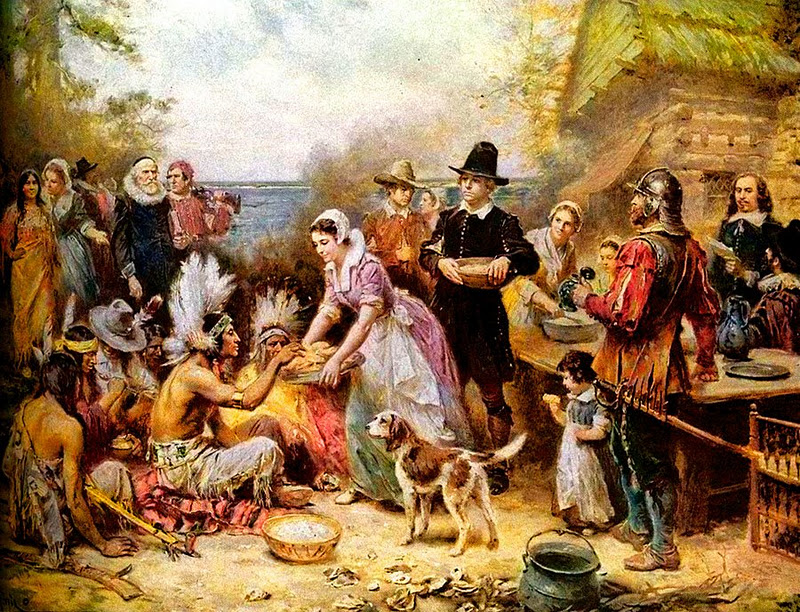
And here, in trying to repay the favor, I was being dismissed. Not only that, but my dream of recreating the (admittedly whitewashed and rosy-colored) image of the mythological first Thanksgiving—two cultures, coming together to sit and eat—was not going well.
Our neighbors from East Africa sat at one table; our neighbors from Southeast Asia sat at another. People stuck tight to their groups, occasionally whispering to each other. I circulated, desperately, trying to make introductions and whip up some pleasing chitchat. But both sides only wanted to tell me grievances they had against the people at the next table over; I could feel the tensions rising.
I explained away problems and chided the guests to be nicer to one another, scolding the little boys who were running wild through the room and knocking over chairs. The volunteers we had conscripted stood limply at the counter, ready to dish out seconds to people who clearly were not at all impressed with the food.
I looked at the scene: a rapidly decomposing tableaux of good intentions and the reality of complex relationships. The uneaten food, the arms folded across chests, the general sense of separateness. It was not a glowing picture of hospitality, commonality, of celebration.
It was what it was—an awkward getting together of people who all, in one way or another, had experienced more than their fair share of broken relationships.
I was only just starting to realize how broken I was relationally. I’d spent many countless hours trying to force community. I’d been determined, time and time again, to reach out—but only on my terms. I expected participation, reciprocation, and—if I am being honest—a miracle or two from the good Lord above.
But there was none in sight. Near tears, I finally decided it was time to serve pie. Everyone, especially the children, finally agreed on this point: sugar was good. As people ate their pumpkin pie with whipped cream on tiny paper plates, I reconsidered why I had thought it was a good idea to put together this event.
My neighbors began to get up, one by one, to leave. As they did so they came over and shook my hand, to say thank you. I watched them all walk out the door with a mixture of regret and confusion, wondering how it had all wandered so far away from my benevolent plans.
I did not think about what it means to ask people to leave their places of safety and security, to come to a bare community center and sit next to people they didn’t know very well and to eat foods they had never tried. I didn’t understand how I was asking my friends and neighbors to risk in ways that I would not have to.
I did not ask them to contribute, to bring the foods that brought them so much joy and pleasure and a sense of stability in a world broken apart by war and geography. I was unable to perceive how concerned I was with being the amazing hostess, the bringer of goodwill, of celebrating a holiday that had cultural meaning only for me.
I did not think about the needs of my neighbors, because it turns out I was only using them for my own satisfaction.
My memory of the event now has the sense of true, gritty community about it: community that is formed when there are places for people to repent, and places for people to be forgiven. Where there is room for us all, to eat or not to eat. Despite everything, my friends and neighbors had come—because they cared about me.
Later, some neighbors told me privately how much they hated the turkey I cooked. They were astonished that anyone would want to eat something so dry and tasteless, but their request, when the next Thanksgiving rolled around, I signed them up for a holiday food box from a church.
They took the large turkey that came with it, and hacked it into a thousand pieces with a giant cleaver—bones, innards, and all. And then they dumped it into a giant pot and made the most delicious turkey curry I have ever had, served in their apartment, eaten on the tin plates they used, with plenty of rice and spicy chutney to accompany it.
It was the perfect Thanksgiving meal.
D.L. Mayfield lives and writes in the Midwest, where she currently is a part of a Christian order among the poor. Mayfield’s writing has appeared in McSweeney’s, Image, Christianity Today, Books and Culture, and The Other Journal. Her book of essays is forthcoming from HarperOne in 2016. She blogs here and can be found on twitter here.
Previous Post

November 21, 2014
The Subtle Traitor
Next Post
November 25, 2014 A Tradition without Tryptophan
Browse Our Archives
Select a Category A. G. Harmon Alissa Wilkinson Allison Backous Art Authors Brad Fruhauff Bradford Winters Bryan Bliss Caroline Langston Chad Thomas Johnston Chris Hoke Christiana N. Peterson Culture D.G. Myers D.L. Mayfield Daniel Bowman Jr. David Griffith Elizabeth Duffy Faith Film Greg Wolfe Guest Contributor Interview Jan Vallone Jeffrey Overstreet Jessica Eddings-Roeser Jessica Mesman Griffith Kelly Foster Lindsey Crittenden Morgan Meis music Natalie Vestin Nick Olson Peggy Rosenthal Personal Reflection Poetry Friday Reflection Relationships Review Richard Chess Richard Cole Sara Zarr Shannon Huffman Polson Sonya Bilocerkowycz Tania Runyan Tony Woodlief Topical Categories Uncategorized Vic Sizemore Writing
Select a Month October 2018 September 2018 August 2018 July 2018 June 2018 May 2018 April 2018 March 2018 February 2018 January 2018 December 2017 November 2017 October 2017 September 2017 August 2017 July 2017 June 2017 May 2017 April 2017 March 2017 February 2017 January 2017 December 2016 November 2016 October 2016 September 2016 August 2016 July 2016 June 2016 May 2016 April 2016 March 2016 February 2016 January 2016 December 2015 November 2015 October 2015 September 2015 August 2015 July 2015 June 2015 May 2015 April 2015 March 2015 February 2015 January 2015 December 2014 November 2014 October 2014 September 2014 August 2014 July 2014 June 2014 May 2014 April 2014 March 2014 February 2014 January 2014 December 2013 November 2013 October 2013 September 2013 August 2013 July 2013 June 2013 May 2013 April 2013 March 2013 February 2013 January 2013 December 2012 November 2012 October 2012 September 2012 August 2012 July 2012 June 2012 May 2012 February 2008
Follow Us!
TAKE THE
Religious Wisdom Quiz
Who became Moses' spokesperson to Pharaoh?
Select your answer to see how you score.
Aaron Joshua Miriam Hur
Related posts from Good Letters




Marital Anger and Icelandic Rock Spirits
TRENDING AT PATHEOS Catholic

Rejecting Doom: Christian Hope And Human Action
Christianity is a religion of hope. We are to have hope and...

It’s What Comes From Within Which Matters
One of the most difficult things for us to understand is why...

Why I Choose the Eucharist Over the Sermon
Choose the Eucharist, Not the Sermon What are we supposed to get...

5 Design Elements Found in Spiritually Rooted Homes
Putting Spirituality Into Home Decor Our homes are more than our living...

Credo: A Story of God Told with the...
About 10 years ago, I began to imagine a personal "Credo" that...

The Anatomy of Divine Revelation in Catholic Thought
The claim that God has made Himself known to human beings is...
view all Catholic blogs
Ad-Free & Subscriber Log-In Subscription Support
- About Us
- 2026 Calendar
- Videos
- Podcasts
- Library of World Religions
- Faith In Media Tracker
- Advertise With Us
- Write for Us
- Privacy Policy
- Terms of Service
- Do Not Sell My Data
- Contact Us
- Radiant Digital
- Manage Newsletter Subscriptions
- Unsubscribe From Notifications
- Sitemap
Copyright 2008-2026, Patheos. All rights reserved.
Subscription Support Ad-Free & Subscriber Log-In
Follow Patheos