
BuddhistCatholicContemplativeEvangelicalGeneral ChristianHinduJewishLatter-day SaintMuslimNew VisionsProgressive Christian
Beliefs
- Buddhist
- Catholic
- Contemplative
- Evangelical
- General Christian
- Hindu
- Jewish
- Latter-day Saint
- More Voices
- Muslim
- New Visions
- Pagan
- Progressive Christian
Topics
- Religion News
- Food and Religion
- Sports and Religion
- Religious Art
- Religious Music and Entertainment
- Religious Events
- History and Religion
- Style and Religion
- Politics and Religion
- Women in Religion
- Recreation Outdoors and Religion
- Business Finance and Religion
- Careers Workplace and Religion
- Education and Religion
- Family Parenting and Religion
- Health Fitness and Religion
- Home and Religion
- Relationships and Religion
- Technology and Religion
- Travel and Religion
Columnists
- Buddhist Columnists
- Business Finance and Religion Columnists
- Careers Workplace and Religion Columnists
- Catholic Columnists
- Contemplative Columnists
- Education and Religion Columnists
- Evangelists Columnists
- Family Parenting and Religion Columnists
- General Christian Columnists
- Health Fitness and Religion Columnists
- Hindu Columnists
- History and Religion Columnists
- Home and Religion Columnists
- Jewish Columnists
- More Voices Columnists
- Latter Day Columnists
- Muslim Columnists
- New Visions Columnists
- Nonreligious Columnists
- Pagan Columnists
- Politics and Religion Columnists
- Progressive Columnists
- Recreation Outdoors and Religion Columnists
- Relationships and Religion Columnists
- Religion News Columnists
- Religious Art Columnists
- Religious Events Columnists
- Religious Music and Entertainment Columnists
- Sports and Religion Columnists
- Style and Religion Columnists
- Technology and Religion Columnists
- Travel and Religion Columnists
- Women in Religion Columnists
Resource Library
- 2026 Calendar
- Library of World Religions
- The 100 Most Holy Places on Earth
- Patheos Answers
- Podcasts
- Videos
- Faith Leaders Database
- Anglican Episcopalian
- Bahai
- Baptist
- Buddhism
- Christianity
- Confucianism
- Eastern Orthodoxy
- Hinduism
- Holiness and Pentecostal
- ISKCON
- Islam
- Judaism
- Lutheran
- Methodist
- The Church of Jesus Christ of Latter-day Saints
- New Age
- Paganism
- Presbytarian and Reformed
- Protestantism
- Religion Behind the Scenes
- Roman Catholic
- Scientology
- Shia Islam
- Sikhism
- Sufism
- Sunni Islam
- Taoism
- Zen
- See all religions
Research Tools
 Ad-Free & Subscriber Log-In Subscription Support
Ad-Free & Subscriber Log-In Subscription Support
Follow Patheos 

- Trending:
- Forgiveness
- |
- Marriage
- |
- Consciousness
- |
- Death Penalty
- |
- Election
- |
- Halloween
 Good Letters
-
Contributors
- Home
- Catholic
- Inside My Nostalgia Box
Inside My Nostalgia Box
Last updated on: November 10, 2014 at 1:19 am by Peggy Rosenthal
Inside My Nostalgia Box 2014-11-07T11:56:05-07:00 Peggy Rosenthal
Patheos Explore the world's faith through different perspectives on religion and spirituality! Patheos has the views of the prevalent religions and spiritualities of the world.
 Look at my new Easter eggs.
Red and blue with yellow legs.
See them run around and around.
Then they tumble on the ground.
I’ve just discovered this intriguingly surrealist verse in a box in my attic labeled “Nostalgia.” The box has been sitting there for decades, and I got curious recently about what might be in it. Judging from the large, carefully printed lettering of this poem, I’d guess it’s from first grade, before I’d learned cursive.
Examples of my literary juvenilia abound in this box. I’ll spare you most of them. But one poem from my high-school literary magazine, Inkling, stands out for me. Called “Waiting,” it begins:
On a battered bench in a city park
Sits a man—old, tired, and weak;
On his aged skin there is many a mark—
A scar on his neck. A cut on his cheek.
The jingly lines go on, describing his tattered clothes, etc., until this final verse:
There is no one to try to relieve his distress—
His want for security, never to cease.
So he wanders about feeling lost and depressed
Waiting for death to bring comfort and peace.
What fascinates me now about this poem is that not a word of it had any grounding in my experience. I did not frequent city parks where abandoned old people sat on benches waiting for death. Though I’m sure I felt at age fifteen that this poem was sincere, now I can say with equal certainty that its pathos was wholly invented. I thought this was what poems were supposed to be about and how they should sound.
Further down in the Nostalgia box, beneath the piano and dance recital programs, I come to my high-school scrapbook. I flip through (as the dried-out Scotch-taped items fall off the pages): a glossy book cover emblazoned with “Forest Park High School”; the dried, pressed corsage from my Junior Prom; a playbill from Damn Yankees, with its back cover ad showing a woman happily smoking a Chesterfield cigarette (“mild, yet they Satisfy!”); a newspaper clipping listing Top News Stories of 1957 (#1. Sputniks launched… #10. Civil rights bill passed); program from a “Sweetheart Dance” with my writing on the cover saying “I went with Fred Barron,” of whom I have absolutely zero memory; a glossy ad-filled program for a game between the rival boys’ high-school football teams.
Scrapbooks: do girls still make them?
Digging further down, under the scrapbooks, there’s a ribbon-tied bundle of letters I wrote to my parents from college. I can’t bear to open and read them, but I’m quite sure they’re a model of self-censorship. I certainly did not report, for instance, what to me was the most important event of my college years: the time I first “went all the way” with my boyfriend.
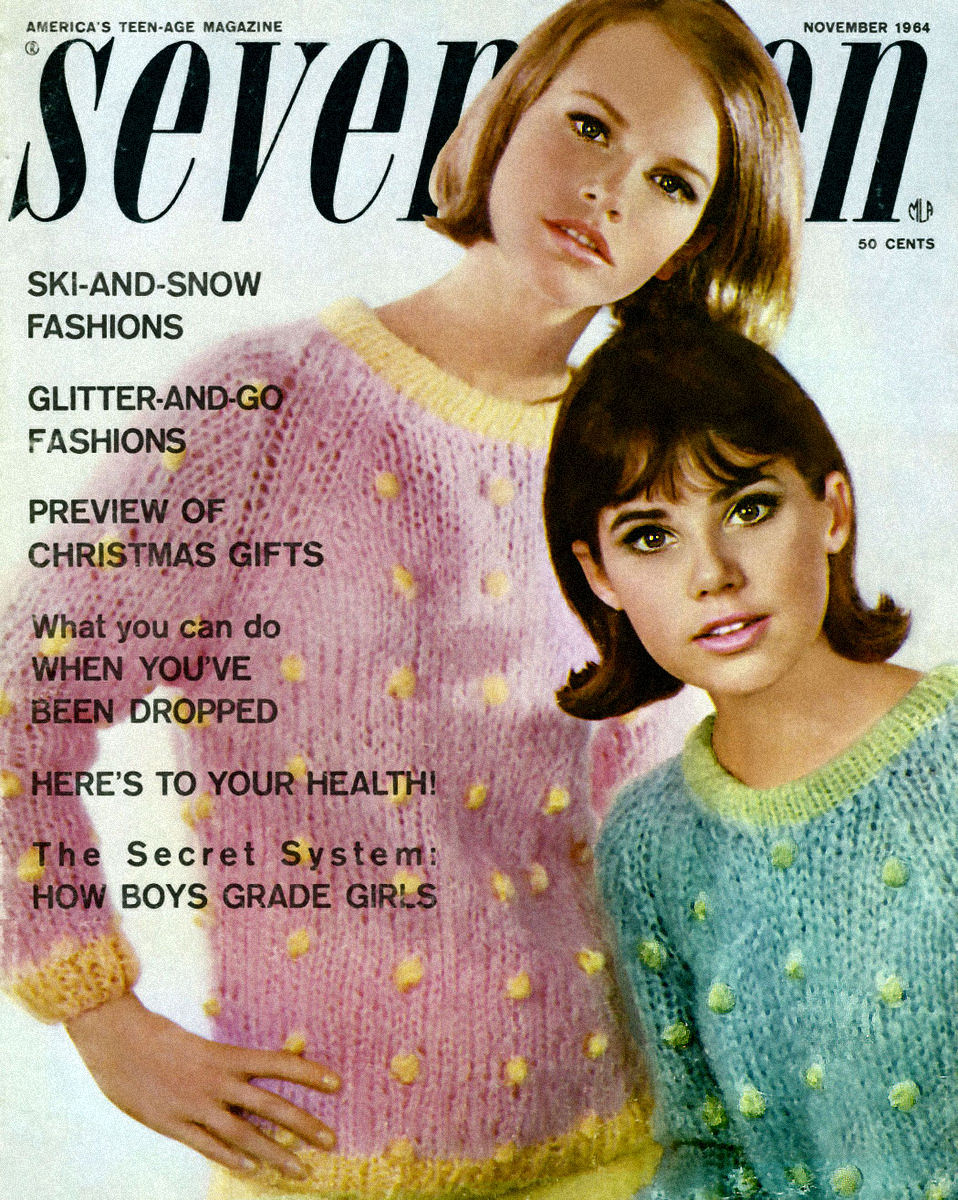
Finally, at the very bottom of the box, I reach the treasure I’d been seeking throughout this archeological dig: a dozen issues of Seventeen magazine, which I subscribed to from age thirteen to fifteen. Certainly not when I was seventeen! Did anyone subscribe to Seventeen at seventeen?
I lift the heavy magazines out of my box and start flipping through. Mostly there are ads for clothes (shirtwaist dresses, bras, nighties) and deodorants (stoking the fear that you might give off…horrors…body odor!). Quite a few ads, too, for diamond engagement rings and the silver pattern you must choose for your wedding. The only ads relating to jobs are for secretarial schools. This was the 1950s; girls (we weren’t “women” yet) didn’t have careers.
There are regular monthly features on makeup and hairstyles. In the March, 1957 issue (I would have just turned thirteen), I see in the Table of Contents that I’d checked the “Dear Beauty Editor” feature. I turn to its page, and there’s my telltale pencil mark revealing the problem that plagued me at the time: “Dear Beauty Editor, I have a very small bosom, and I wonder if exercise could improve my figure. —J.D., Detroit, Michigan.” (The answer is “no; try a padded bra.”)
But the monthly feature I’m most drawn to today is “From a Boy’s Point of View.” Written by Jimmy Wescott, it contains helpful tips on how a girl should behave toward boys. “Don’t talk about yourself,” Jimmy advises. “Learn enough about things that fellows like so you can ask him questions about them.”
“Foreign cars. Every fellow loves sports cars, and you don’t have to know a lot about one just to mention it. Stop by a place that sells foreign cars and look inside them. They’re beautiful inside, you know. And if you just say this to a fellow, he’ll take off on the topic and then you’ll be in a real conversation!”
Occasionally Seventeen includes a quiz. I see in one issue “How Do You Rate on a Date?” In another, I see “How’s Your Party Etiquette?”
But I’m frustrated because, in this stash of issues that I saved in my Nostalgia box, I don’t find the one quiz that has given me laughs over the years whenever I’ve recalled it: “How Do You Know If It’s Really Love?” Questions included “Do you sit by the phone waiting for his calls?” “Does he remember you on your birthday and Valentine’s Day?” But surely the clincher is this: “Does he seem more attractive to you when you’re together or when you’re apart?”
My son has asked me not to throw out my Nostalgia box; he wants to keep it as family memorabilia. I think his daughters (now twelve and fourteen) would get a kick out of it. They’re just about the age for Seventeen—but I sure hope they’ll see it as campy, and not (as I did) as gospel.
Peggy Rosenthal is director of Poetry Retreats and writes widely on poetry as a spiritual resource. Her books include Praying through Poetry: Hope for Violent Times (Franciscan Media), and The Poets’ Jesus (Oxford). See Amazon for full list. She also teaches an online course, “Poetry as a Spiritual Practice,” through Image’s Glen Online program*.*
Previous Post

November 7, 2014
The Jewish Roots of Christian Worship for Churchgoing Dummies
Next Post
November 12, 2014 Epic Tales: an Interview with Amit Majmudar, part 1
Browse Our Archives
Select a Category A. G. Harmon Alissa Wilkinson Allison Backous Art Authors Brad Fruhauff Bradford Winters Bryan Bliss Caroline Langston Chad Thomas Johnston Chris Hoke Christiana N. Peterson Culture D.G. Myers D.L. Mayfield Daniel Bowman Jr. David Griffith Elizabeth Duffy Faith Film Greg Wolfe Guest Contributor Interview Jan Vallone Jeffrey Overstreet Jessica Eddings-Roeser Jessica Mesman Griffith Kelly Foster Lindsey Crittenden Morgan Meis music Natalie Vestin Nick Olson Peggy Rosenthal Personal Reflection Poetry Friday Reflection Relationships Review Richard Chess Richard Cole Sara Zarr Shannon Huffman Polson Sonya Bilocerkowycz Tania Runyan Tony Woodlief Topical Categories Uncategorized Vic Sizemore Writing
Select a Month October 2018 September 2018 August 2018 July 2018 June 2018 May 2018 April 2018 March 2018 February 2018 January 2018 December 2017 November 2017 October 2017 September 2017 August 2017 July 2017 June 2017 May 2017 April 2017 March 2017 February 2017 January 2017 December 2016 November 2016 October 2016 September 2016 August 2016 July 2016 June 2016 May 2016 April 2016 March 2016 February 2016 January 2016 December 2015 November 2015 October 2015 September 2015 August 2015 July 2015 June 2015 May 2015 April 2015 March 2015 February 2015 January 2015 December 2014 November 2014 October 2014 September 2014 August 2014 July 2014 June 2014 May 2014 April 2014 March 2014 February 2014 January 2014 December 2013 November 2013 October 2013 September 2013 August 2013 July 2013 June 2013 May 2013 April 2013 March 2013 February 2013 January 2013 December 2012 November 2012 October 2012 September 2012 August 2012 July 2012 June 2012 May 2012 February 2008
Follow Us!
TAKE THE
Religious Wisdom Quiz
What is the biblical view of work?
Select your answer to see how you score.
Work is a curse Work hard as for the Lord Only kings should work Avoid work
Related posts from Good Letters



On Writing Odes: Taking Time to Celebrate

TRENDING AT PATHEOS Catholic

Rejecting Doom: Christian Hope And Human Action
Christianity is a religion of hope. We are to have hope and...

It’s What Comes From Within Which Matters
One of the most difficult things for us to understand is why...

Why I Choose the Eucharist Over the Sermon
Choose the Eucharist, Not the Sermon What are we supposed to get...

5 Design Elements Found in Spiritually Rooted Homes
Putting Spirituality Into Home Decor Our homes are more than our living...

Credo: A Story of God Told with the...
About 10 years ago, I began to imagine a personal "Credo" that...

The Anatomy of Divine Revelation in Catholic Thought
The claim that God has made Himself known to human beings is...
view all Catholic blogs
Ad-Free & Subscriber Log-In Subscription Support
- About Us
- 2026 Calendar
- Videos
- Podcasts
- Library of World Religions
- Faith In Media Tracker
- Advertise With Us
- Write for Us
- Privacy Policy
- Terms of Service
- Do Not Sell My Data
- Contact Us
- Radiant Digital
- Manage Newsletter Subscriptions
- Unsubscribe From Notifications
- Sitemap
Copyright 2008-2026, Patheos. All rights reserved.
Subscription Support Ad-Free & Subscriber Log-In
Follow Patheos