
BuddhistCatholicContemplativeEvangelicalGeneral ChristianHinduJewishLatter-day SaintMuslimNew VisionsProgressive Christian
Beliefs
- Buddhist
- Catholic
- Contemplative
- Evangelical
- General Christian
- Hindu
- Jewish
- Latter-day Saint
- More Voices
- Muslim
- New Visions
- Pagan
- Progressive Christian
Topics
- Religion News
- Food and Religion
- Sports and Religion
- Religious Art
- Religious Music and Entertainment
- Religious Events
- History and Religion
- Style and Religion
- Politics and Religion
- Women in Religion
- Recreation Outdoors and Religion
- Business Finance and Religion
- Careers Workplace and Religion
- Education and Religion
- Family Parenting and Religion
- Health Fitness and Religion
- Home and Religion
- Relationships and Religion
- Technology and Religion
- Travel and Religion
Columnists
- Buddhist Columnists
- Business Finance and Religion Columnists
- Careers Workplace and Religion Columnists
- Catholic Columnists
- Contemplative Columnists
- Education and Religion Columnists
- Evangelists Columnists
- Family Parenting and Religion Columnists
- General Christian Columnists
- Health Fitness and Religion Columnists
- Hindu Columnists
- History and Religion Columnists
- Home and Religion Columnists
- Jewish Columnists
- More Voices Columnists
- Latter Day Columnists
- Muslim Columnists
- New Visions Columnists
- Nonreligious Columnists
- Pagan Columnists
- Politics and Religion Columnists
- Progressive Columnists
- Recreation Outdoors and Religion Columnists
- Relationships and Religion Columnists
- Religion News Columnists
- Religious Art Columnists
- Religious Events Columnists
- Religious Music and Entertainment Columnists
- Sports and Religion Columnists
- Style and Religion Columnists
- Technology and Religion Columnists
- Travel and Religion Columnists
- Women in Religion Columnists
Resource Library
- 2026 Calendar
- Library of World Religions
- The 100 Most Holy Places on Earth
- Patheos Answers
- Podcasts
- Videos
- Faith Leaders Database
- Anglican Episcopalian
- Bahai
- Baptist
- Buddhism
- Christianity
- Confucianism
- Eastern Orthodoxy
- Hinduism
- Holiness and Pentecostal
- ISKCON
- Islam
- Judaism
- Lutheran
- Methodist
- The Church of Jesus Christ of Latter-day Saints
- New Age
- Paganism
- Presbytarian and Reformed
- Protestantism
- Religion Behind the Scenes
- Roman Catholic
- Scientology
- Shia Islam
- Sikhism
- Sufism
- Sunni Islam
- Taoism
- Zen
- See all religions
Research Tools
 Ad-Free & Subscriber Log-In Subscription Support
Ad-Free & Subscriber Log-In Subscription Support
Follow Patheos 

- Trending:
- Forgiveness
- |
- Marriage
- |
- Consciousness
- |
- Death Penalty
- |
- Election
- |
- Halloween
 Good Letters
-
Contributors
- Home
- Catholic
- The Self and the Shadow
The Self and the Shadow
Last updated on: October 6, 2014 at 9:41 am by Guest Contributor
The Self and the Shadow 2014-10-06T09:41:42-07:00 Guest Contributor
Patheos Explore the world's faith through different perspectives on religion and spirituality! Patheos has the views of the prevalent religions and spiritualities of the world.
 Guest post by Holly LeCraw
Lately, I am drawn more and more to the thought of Carl Jung. I’ve been thinking a good deal about the stages of life (I’m approaching fifty); I’ve been having some pretty vivid dreams. Jung has plenty to say about both these things, and he’s always been especially appealing to me because he was a scientist who endorsed humankind’s need for the spiritual.
This past week, a friend with far more knowledge of Jungian thought than I brought up the fact that Yom Kippur and Eid al-Adha, the Feast of the Sacrifice, will coincide this year—are coinciding as I write this, on October 3.
Eid al-Adha, the Feast of the Sacrifice (not to be confused with Eid al-Fitr, the Feast of the Fast-Breaking, which occurs at the end of Ramadan) is the second-biggest holiday on the Muslim calendar, commemorating Abraham’s willingness to sacrifice his son. It’s a joyous celebration with a great deal of food, music, and family gatherings.
In contrast, Yom Kippur is, of course, the Day of Atonement, a solemn turning inward. While not central to Yom Kippur, the Binding of Isaac, or the akedah, is a vital story in Judaism in much the same way it is in Islam: a symbol of the willingness to martyr oneself for God and to submit completely to God’s will. The Temple Mount, in Jerusalem, is traditionally believed to be the site of the akedah, and the blowing of the shofar is a reminder of the ram who took Isaac’s place once he was spared.
But I hadn’t known, until I began to explore the parallels, that according to mainstream Islamic tradition the Binding—in Arabic, the dhabih—is not of Isaac but of Ishmael, Abraham’s first, illegitimate son. The son isn’t actually named in the Q’uran, and there’s rampant sniping between Jews and Muslims, at least online, about the identity of the sacrificee.
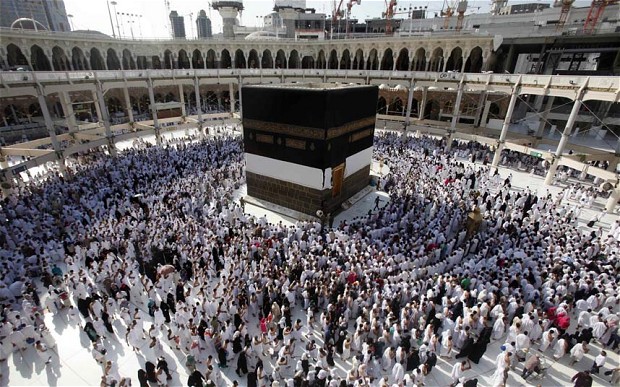
But it makes sense that Islam would make Ishmael the vital participant in this story: he and his mother, the slavewoman Hagar, are at the root of the Muslim family tree, and the Prophet Mohammed is believed to be their direct descendant. Ishmael and Abraham together built the kaaba, in Mecca, which pilgrims circle seven times, in a great sea of humanity, during the hajj.
In my friend’s view, the story—whichever son it involves—is actually the drama of humans moving beyond the need for human sacrifice, a widespread practice at the time of the origins of these stories, and substituting animals. In other words, it’s a story of human progression. These days, I find any notion of progression in human relations comforting. (Although vegetarians might consider further progression necessary; millions of animals are slaughtered worldwide during the two days of Eid al-Adha.)
If we bring the half-brothers back together, the dual/dueling tales of the akedah and the dhabih are also yet another example of individual progression writ large through the personalities of these scriptures—of the dark and the light at odds, the self trying to reconcile with the shadow.
For Jews, Ishmael is the other; for Muslims, Isaac. The Old Testament abounds with stories of brotherly strife: Cain and Abel, Jacob and Esau, Joseph and his brothers who sold him into slavery. In a Jungi-an interpretation these are narratives of the struggle for individuation, bringing together the opposite parts of one’s self to achieve wholeness.
Successful individuation means not isolating or abjuring the shadow but accepting and absorbing it; resisting individuation leads to strife. Jung wrote, “We are convinced that certain people have all the bad qualities we do not know in ourselves or that they practice those vices which could, of course, never be our own.”
We want to resist the shadow self, and we also want to believe in the progression of humankind. It’s tempting to cast not just individuals but entire religions as less evolved. Thus, in Genesis, Ishmael is described as “a wild donkey of a man; his hand will be against everyone and everyone’s hand against him, and he will live in hostility toward all his brothers” (Genesis 16:12). Thus, in Islam, Mohammed is the final prophet, the glorious culmination, superseding Abraham and Jesus.
As a child, I was appalled by the story of Abraham and Isaac. I still think that’s a pretty rational response. What kind of god asks such a thing? In the fundamentalist world of my upbringing, the stories of the Old Testament and this bloodthirsty, sadistic God were presented as fact, but for me this story in particular marked the beginning of skepticism. It could not possibly be true, in the way I was used to thinking of truth.
And that break was the beginning of my understanding that these were tales, myths, although it’s taken me a long time to understand that their power is not thereby reduced, but increased: these are our most basic human dramas, told and retold for thousands of years. They hold truths not about God but about ourselves in relation to our own humanity. In relation to God, if you so believe.
This year, with the coinciding of the holidays (and because of a quirk of the calendar, next year will see the same coincidence), Jews and Muslims living together in Jerusalem must tread even more carefully than usual. For Yom Kippur is a day of contemplation, an introvert’s holiday, whereas Eid al-Adha is a day of exuberance, of music in the streets and bleating car horns. (Although next March, with the feast of Purim, Jews will have their turn.)
In “Psychology and Religion,” Jung wrote, of a mature adult who is conscious of his “shadow”: “Such a man knows that whatever is wrong with the world is in himself, and if he only learns to deal with his own shadow he has done something real for the world. He has succeeded in shouldering at least an infinitesimal part of the gigantic, unsolved social problems of our day.”
As of this writing, police and security forces in Jerusalem are on high alert, but the peace, however fragile, is holding. Thanks be to God.
Holly LeCraw is the author of The Swimming Pool (Doubleday, 2010). She has written for The Millions, Post Road, Writer’s Digest and other publications, and been nominated for a Pushcart Prize. Her next book, The Half Brother, is coming from Doubleday in February of 2015. A native of Atlanta, she now lives outside Boston with her family.
Previous Post

October 3, 2014
Goodbye to My Nuclear Days
Next Post
October 7, 2014 The Saints of Mount Midoriyama
Browse Our Archives
Select a Category A. G. Harmon Alissa Wilkinson Allison Backous Art Authors Brad Fruhauff Bradford Winters Bryan Bliss Caroline Langston Chad Thomas Johnston Chris Hoke Christiana N. Peterson Culture D.G. Myers D.L. Mayfield Daniel Bowman Jr. David Griffith Elizabeth Duffy Faith Film Greg Wolfe Guest Contributor Interview Jan Vallone Jeffrey Overstreet Jessica Eddings-Roeser Jessica Mesman Griffith Kelly Foster Lindsey Crittenden Morgan Meis music Natalie Vestin Nick Olson Peggy Rosenthal Personal Reflection Poetry Friday Reflection Relationships Review Richard Chess Richard Cole Sara Zarr Shannon Huffman Polson Sonya Bilocerkowycz Tania Runyan Tony Woodlief Topical Categories Uncategorized Vic Sizemore Writing
Select a Month October 2018 September 2018 August 2018 July 2018 June 2018 May 2018 April 2018 March 2018 February 2018 January 2018 December 2017 November 2017 October 2017 September 2017 August 2017 July 2017 June 2017 May 2017 April 2017 March 2017 February 2017 January 2017 December 2016 November 2016 October 2016 September 2016 August 2016 July 2016 June 2016 May 2016 April 2016 March 2016 February 2016 January 2016 December 2015 November 2015 October 2015 September 2015 August 2015 July 2015 June 2015 May 2015 April 2015 March 2015 February 2015 January 2015 December 2014 November 2014 October 2014 September 2014 August 2014 July 2014 June 2014 May 2014 April 2014 March 2014 February 2014 January 2014 December 2013 November 2013 October 2013 September 2013 August 2013 July 2013 June 2013 May 2013 April 2013 March 2013 February 2013 January 2013 December 2012 November 2012 October 2012 September 2012 August 2012 July 2012 June 2012 May 2012 February 2008
Follow Us!
TAKE THE
Religious Wisdom Quiz
What was the name of the disciple who replaced Judas Iscariot?
Select your answer to see how you score.
Silas Matthias Barnabas Timothy
Related posts from Good Letters

A Conversation with Alicia Ostriker: Part 1

The Stars of the Earth Cry Out


TRENDING AT PATHEOS Catholic

Rejecting Doom: Christian Hope And Human Action
Christianity is a religion of hope. We are to have hope and...

It’s What Comes From Within Which Matters
One of the most difficult things for us to understand is why...

Why I Choose the Eucharist Over the Sermon
Choose the Eucharist, Not the Sermon What are we supposed to get...

5 Design Elements Found in Spiritually Rooted Homes
Putting Spirituality Into Home Decor Our homes are more than our living...

Credo: A Story of God Told with the...
About 10 years ago, I began to imagine a personal "Credo" that...

The Anatomy of Divine Revelation in Catholic Thought
The claim that God has made Himself known to human beings is...
view all Catholic blogs
Ad-Free & Subscriber Log-In Subscription Support
- About Us
- 2026 Calendar
- Videos
- Podcasts
- Library of World Religions
- Faith In Media Tracker
- Advertise With Us
- Write for Us
- Privacy Policy
- Terms of Service
- Do Not Sell My Data
- Contact Us
- Radiant Digital
- Manage Newsletter Subscriptions
- Unsubscribe From Notifications
- Sitemap
Copyright 2008-2026, Patheos. All rights reserved.
Subscription Support Ad-Free & Subscriber Log-In
Follow Patheos