
BuddhistCatholicContemplativeEvangelicalGeneral ChristianHinduJewishLatter-day SaintMuslimNew VisionsProgressive Christian
Beliefs
- Buddhist
- Catholic
- Contemplative
- Evangelical
- General Christian
- Hindu
- Jewish
- Latter-day Saint
- More Voices
- Muslim
- New Visions
- Pagan
- Progressive Christian
Topics
- Religion News
- Food and Religion
- Sports and Religion
- Religious Art
- Religious Music and Entertainment
- Religious Events
- History and Religion
- Style and Religion
- Politics and Religion
- Women in Religion
- Recreation Outdoors and Religion
- Business Finance and Religion
- Careers Workplace and Religion
- Education and Religion
- Family Parenting and Religion
- Health Fitness and Religion
- Home and Religion
- Relationships and Religion
- Technology and Religion
- Travel and Religion
Columnists
- Buddhist Columnists
- Business Finance and Religion Columnists
- Careers Workplace and Religion Columnists
- Catholic Columnists
- Contemplative Columnists
- Education and Religion Columnists
- Evangelists Columnists
- Family Parenting and Religion Columnists
- General Christian Columnists
- Health Fitness and Religion Columnists
- Hindu Columnists
- History and Religion Columnists
- Home and Religion Columnists
- Jewish Columnists
- More Voices Columnists
- Latter Day Columnists
- Muslim Columnists
- New Visions Columnists
- Nonreligious Columnists
- Pagan Columnists
- Politics and Religion Columnists
- Progressive Columnists
- Recreation Outdoors and Religion Columnists
- Relationships and Religion Columnists
- Religion News Columnists
- Religious Art Columnists
- Religious Events Columnists
- Religious Music and Entertainment Columnists
- Sports and Religion Columnists
- Style and Religion Columnists
- Technology and Religion Columnists
- Travel and Religion Columnists
- Women in Religion Columnists
Resource Library
- 2026 Calendar
- Library of World Religions
- The 100 Most Holy Places on Earth
- Patheos Answers
- Podcasts
- Videos
- Faith Leaders Database
- Anglican Episcopalian
- Bahai
- Baptist
- Buddhism
- Christianity
- Confucianism
- Eastern Orthodoxy
- Hinduism
- Holiness and Pentecostal
- ISKCON
- Islam
- Judaism
- Lutheran
- Methodist
- The Church of Jesus Christ of Latter-day Saints
- New Age
- Paganism
- Presbytarian and Reformed
- Protestantism
- Religion Behind the Scenes
- Roman Catholic
- Scientology
- Shia Islam
- Sikhism
- Sufism
- Sunni Islam
- Taoism
- Zen
- See all religions
Research Tools
 Ad-Free & Subscriber Log-In Subscription Support
Ad-Free & Subscriber Log-In Subscription Support
Follow Patheos 

- Trending:
- Forgiveness
- |
- Marriage
- |
- Consciousness
- |
- Death Penalty
- |
- Election
- |
- Halloween
 Good Letters
-
Contributors
- Home
- Catholic
- Pasternak: Artist and Holy Fool
Pasternak: Artist and Holy Fool
Last updated on: October 10, 2014 at 11:52 am by Vic Sizemore
Pasternak: Artist and Holy Fool 2014-10-10T11:52:04-07:00 Vic Sizemore
Patheos Explore the world's faith through different perspectives on religion and spirituality! Patheos has the views of the prevalent religions and spiritualities of the world.
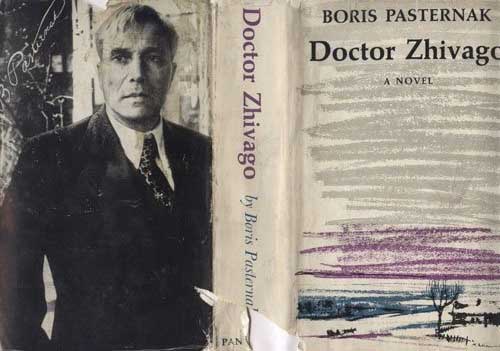 As I read the essay “The Writer and the Valet” in my latest issue of the London Review of Books, an image came to mind of a T-shirt I saw in one of the random catalogs that come in the mail. It was a simple black shirt with the sentence, “Artists make bad slaves” printed on it.
The essay by Frances Stoner Saunders is about how Boris Pasternak’s novel Doctor Zhivago came to publication, and it is a story filled with Cold War suspense and intrigue. It also parallels the novel itself—the story of an individual artist whose life and living are wrecked by revolution in his homeland.
Pasternak was born in 1890 into the home of an artist father and pianist mother. Artists and musicians frequented his parents’ home, including the likes of Sergei Rachmaninoff. Pasternak himself started his studies in music, switched to philosophy, and then found his calling with poetry. He was a poet who loved botany, and was, according to Alan Furst in his review of The Zhivago Affair, “above all else, a poet of the human spirit, a poet in love with a world of weather, landscapes, romance and the Russian soul.”
After his poetry collection Second Birth was deemed unacceptable by the authorities, he was forbidden to publish and turned for a living to translating great works of literature. He initially tried to go through proper channels to have Doctor Zhivago published in his beloved fatherland and he was denied.
Pasternak was relocated by the authorities to a village near Moscow where Stalin had corralled Russian writers in among government watchers. It was more, Mr. Furst explains, than just a matter of keeping an eye on the possible thought criminals: “After 1917, nearly 1,500 writers in the Soviet Union were executed or died in labor camps for various alleged infractions.” Pasternak’s writer friend and next-door neighbor Boris Pilnyak was one—he got a bullet to the head one night. Isaac Babel was one of these doomed writers as well.
Furst writes that Pasternak originally supported the revolution, but became disenchanted with the brutality of the Bolsheviks. As for his writing, he knew that “the Soviet publishing world would recoil from the alien tone of [the novel], its overt religiosity, its sprawling indifference to the demands of socialist realism and the obligation to genuflect before the October Revolution.”
Pasternak refused to neuter his work to meet the stark demands of socialist realism—the only government sanctioned genre. According to Peter Finn, writing for The Washington Post, he “had long displayed an unusual fearlessness: visiting and giving money to the relatives of people who had been sent to the gulag…intervening with authorities to ask for mercy for those accused of political crimes…refusing to sign trumped-up petitions demanding execution for those designated enemies of the state.”
“Don’t yell at me,” he once told a group shouting him down for asserting that writers must not be told what and how to write. “But if you must yell, at least don’t do it in unison.”
According to newly declassified documents, the CIA saw Zhivago as a fantastic propaganda tool against the Soviets. Fighting Soviet oppression was a noble goal, and like another great Russian character, Rodion Raskolnikov, the Americans were not opposed to stepping over corpses to reach their goal—what was another dead writer on such a large pile already? If Pasternak was a holy fool willing to take a bullet for his art, the CIA was certainly willing to usher him along as it suited their purposes. When he secretly passed the manuscript along to an Italian publisher he said, “You are invited to my execution.”
That Pasternak survived while so many didn’t has raised questions about how brave he actually was, as well as questions about his relationship to Stalin. Michael Scammell writes that once when the writer’s name showed up on an execution log, Stalin told them to leave the “holy fool” alone.
The Russian holy fool, the yurodivy, appears foolish to the world because the fool is focused not on the world but on a transcendent reality. Holy fools cannot be bothered with the mores of society, and when they do look to the world, their vision is colored by their transcendent vision.
One famous example is Nicholas of Pskov who confronted Ivan the Terrible after the Czar had massacred thousands, destroyed homes and farms, and sacked monasteries. The holy fool Nicholas called Ivan out publically. For emphasis, the fool pulled out a piece of bloody, raw meat and slapped it into the Czar’s bare hand.
Some say that artists cannot fit into this category, the holy fool, but I disagree with such pedantry. Pasternak wanted to concern himself with the transcendent instead of the harsh affairs of Soviet Russia. He wanted to see through to eternal, lasting truths, and came under criticism for it. “He is shirking his responsibility,” his critics said. “He should be fighting the good fight and yet he looks beyond the suffering of humanity. He has his head in the clouds.”
Pasternak did not write Doctor Zhivago for it to be used as propaganda. He was a poet who penned a lyrical and grand epic novel, and in doing so ended up also depicting the harsh realities of Soviet Russia in his novel, which won the Nobel Prize in 1958.
He had expected to be shot, or sent to a gulag, or at best exiled. Instead, the Soviet authorities forced him to decline the Nobel Prize, and kicked him out of the Union of Soviet Writers, which stripped him of his right to earn a living even as a translator. He lived out the rest of his life under state oppression and in poverty.
Still he refused to kowtow. He was an artist and a holy fool. Both make bad slaves.
Vic Sizemore earned his MFA in fiction from Seattle Pacific University in 2009. His short stories are published or forthcoming in Story Quarterly, Southern Humanities Review, Connecticut Review, Portland Review, Blue Mesa Review, Sou’wester, Silk Road Review, Atticus Review, PANK Magazine Fiction Fix, Vol.1 Brooklyn, Conclave, and elsewhere. Excerpts from his novel The Calling are published in Connecticut Review, Portland Review, Prick of the Spindle, Burrow Press Review, Rock & Sling, and Relief. His fiction has won the New Millennium Writings Award for Fiction, and been nominated for Best American Nonrequired Reading and a Pushcart Prize. You can find Vic at http://vicsizemore.wordpress.com/.
Previous Post

October 9, 2014
Commodifying Myself
Next Post
October 13, 2014 The Iron Cross: An Observation from the Way of Saint James, Part 1
Browse Our Archives
Select a Category A. G. Harmon Alissa Wilkinson Allison Backous Art Authors Brad Fruhauff Bradford Winters Bryan Bliss Caroline Langston Chad Thomas Johnston Chris Hoke Christiana N. Peterson Culture D.G. Myers D.L. Mayfield Daniel Bowman Jr. David Griffith Elizabeth Duffy Faith Film Greg Wolfe Guest Contributor Interview Jan Vallone Jeffrey Overstreet Jessica Eddings-Roeser Jessica Mesman Griffith Kelly Foster Lindsey Crittenden Morgan Meis music Natalie Vestin Nick Olson Peggy Rosenthal Personal Reflection Poetry Friday Reflection Relationships Review Richard Chess Richard Cole Sara Zarr Shannon Huffman Polson Sonya Bilocerkowycz Tania Runyan Tony Woodlief Topical Categories Uncategorized Vic Sizemore Writing
Select a Month October 2018 September 2018 August 2018 July 2018 June 2018 May 2018 April 2018 March 2018 February 2018 January 2018 December 2017 November 2017 October 2017 September 2017 August 2017 July 2017 June 2017 May 2017 April 2017 March 2017 February 2017 January 2017 December 2016 November 2016 October 2016 September 2016 August 2016 July 2016 June 2016 May 2016 April 2016 March 2016 February 2016 January 2016 December 2015 November 2015 October 2015 September 2015 August 2015 July 2015 June 2015 May 2015 April 2015 March 2015 February 2015 January 2015 December 2014 November 2014 October 2014 September 2014 August 2014 July 2014 June 2014 May 2014 April 2014 March 2014 February 2014 January 2014 December 2013 November 2013 October 2013 September 2013 August 2013 July 2013 June 2013 May 2013 April 2013 March 2013 February 2013 January 2013 December 2012 November 2012 October 2012 September 2012 August 2012 July 2012 June 2012 May 2012 February 2008
Follow Us!
TAKE THE
Religious Wisdom Quiz
What does "blessed are the peacemakers" mean?
Select your answer to see how you score.
Cause trouble Always win Start fights Promote peace
Related posts from Good Letters

On Writing Odes: Taking Time to Celebrate


A Conversation with Barbara Brown Taylor
TRENDING AT PATHEOS Catholic

The Parable Of The Sower And The Word...
One of Christ’s most famous parables is that of the sower who...

Rejecting Doom: Christian Hope And Human Action
Christianity is a religion of hope. We are to have hope and...

Why I Choose the Eucharist Over the Sermon
Choose the Eucharist, Not the Sermon What are we supposed to get...

5 Design Elements Found in Spiritually Rooted Homes
Putting Spirituality Into Home Decor Our homes are more than our living...

Credo: A Story of God Told with the...
About 10 years ago, I began to imagine a personal "Credo" that...

The Anatomy of Divine Revelation in Catholic Thought
The claim that God has made Himself known to human beings is...
view all Catholic blogs
Ad-Free & Subscriber Log-In Subscription Support
- About Us
- 2026 Calendar
- Videos
- Podcasts
- Library of World Religions
- Faith In Media Tracker
- Advertise With Us
- Write for Us
- Privacy Policy
- Terms of Service
- Do Not Sell My Data
- Contact Us
- Radiant Digital
- Manage Newsletter Subscriptions
- Unsubscribe From Notifications
- Sitemap
Copyright 2008-2026, Patheos. All rights reserved.
Subscription Support Ad-Free & Subscriber Log-In
Follow Patheos