
BuddhistCatholicContemplativeEvangelicalGeneral ChristianHinduJewishLatter-day SaintMuslimNew VisionsProgressive Christian
Beliefs
- Buddhist
- Catholic
- Contemplative
- Evangelical
- General Christian
- Hindu
- Jewish
- Latter-day Saint
- More Voices
- Muslim
- New Visions
- Pagan
- Progressive Christian
Topics
- Religion News
- Food and Religion
- Sports and Religion
- Religious Art
- Religious Music and Entertainment
- Religious Events
- History and Religion
- Style and Religion
- Politics and Religion
- Women in Religion
- Recreation Outdoors and Religion
- Business Finance and Religion
- Careers Workplace and Religion
- Education and Religion
- Family Parenting and Religion
- Health Fitness and Religion
- Home and Religion
- Relationships and Religion
- Technology and Religion
- Travel and Religion
Columnists
- Buddhist Columnists
- Business Finance and Religion Columnists
- Careers Workplace and Religion Columnists
- Catholic Columnists
- Contemplative Columnists
- Education and Religion Columnists
- Evangelists Columnists
- Family Parenting and Religion Columnists
- General Christian Columnists
- Health Fitness and Religion Columnists
- Hindu Columnists
- History and Religion Columnists
- Home and Religion Columnists
- Jewish Columnists
- More Voices Columnists
- Latter Day Columnists
- Muslim Columnists
- New Visions Columnists
- Nonreligious Columnists
- Pagan Columnists
- Politics and Religion Columnists
- Progressive Columnists
- Recreation Outdoors and Religion Columnists
- Relationships and Religion Columnists
- Religion News Columnists
- Religious Art Columnists
- Religious Events Columnists
- Religious Music and Entertainment Columnists
- Sports and Religion Columnists
- Style and Religion Columnists
- Technology and Religion Columnists
- Travel and Religion Columnists
- Women in Religion Columnists
Resource Library
- 2026 Calendar
- Library of World Religions
- The 100 Most Holy Places on Earth
- Patheos Answers
- Podcasts
- Videos
- Faith Leaders Database
- Anglican Episcopalian
- Bahai
- Baptist
- Buddhism
- Christianity
- Confucianism
- Eastern Orthodoxy
- Hinduism
- Holiness and Pentecostal
- ISKCON
- Islam
- Judaism
- Lutheran
- Methodist
- The Church of Jesus Christ of Latter-day Saints
- New Age
- Paganism
- Presbytarian and Reformed
- Protestantism
- Religion Behind the Scenes
- Roman Catholic
- Scientology
- Shia Islam
- Sikhism
- Sufism
- Sunni Islam
- Taoism
- Zen
- See all religions
Research Tools
 Ad-Free & Subscriber Log-In Subscription Support
Ad-Free & Subscriber Log-In Subscription Support
Follow Patheos 

- Trending:
- Forgiveness
- |
- Marriage
- |
- Consciousness
- |
- Death Penalty
- |
- Election
- |
- Halloween
 Good Letters
-
Contributors
- Home
- Catholic
- Holding the Blade of Sacrifice
Holding the Blade of Sacrifice
Last updated on: October 16, 2014 at 1:25 am by Caroline Langston
Holding the Blade of Sacrifice 2014-10-15T10:52:13-07:00 Caroline Langston
Patheos Explore the world's faith through different perspectives on religion and spirituality! Patheos has the views of the prevalent religions and spiritualities of the world.
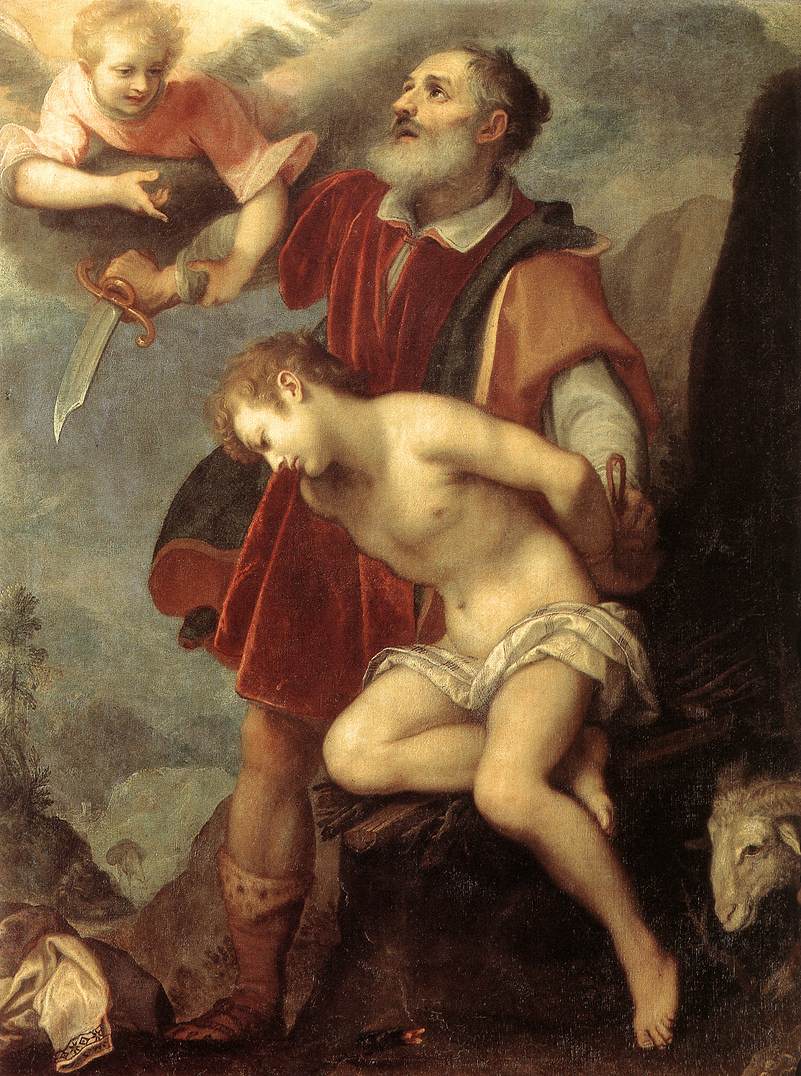 I had fallen asleep thinking about the Sacrifice of Isaac: The account, given in Genesis, in which patriarch Abraham is called by God to venture to Mt. Moriah, and sacrifice his young and beloved son—the son born to him and Sarah in old age, for whom he had longed for decades. And as the Genesis narrative relates, at the very moment Abraham has steeled himself to bear the knife, a ram appears “in a thicket,” and Isaac is saved, and the ram is sacrificed in Isaac’s place.
I’d gone to bed mulling over what I was going to write in the very post you are reading now. At that point, I intended to focus on how the compact of parenthood has seemed to expand since I was a child: Whereas my older siblings and I had been more or less “thrown” into the world to survive by our own devices, young people today, middle-class and above, seem so tethered to their parents—by cell phones, by cars that parents pay the insurance on well into their children’s twenties, by the occasional checks for thousands of dollars meted out for Christmas and mortgages for sons and daughters closing in on forty.
Mostly, I’m just envious.
By contrast, I thought about a time in 1982, when, owing to some travel mix-ups, I found myself alone late one night in the Trailways bus station in Boston, with barely any money, let alone cell phone or credit cards. I was fourteen years old, and kept making collect calls on a pay phone to my mother and brother, down in Mississippi and not in a position to help with anything. The panic I heard in their voices just made my own worse.
The fact of my lingering resentment, though, seemed too insubstantial on which to hang an essay, fortunately—else you might have had to deal with my self-indulgent whining about buying our house with 100% financing in 2005.
The Sacrifice of Isaac story came to my mind, initially, as an archetype of the opposite of hand-holding parenting.
But through the dark of the night, and the cloud of sleep, the blunt bare facts of the Genesis story kept cycling through my mind: the patriarch obeying God’s command, the journey to Mt. Moriah, the youthful ephebe’s confusion and then horror, the father’s own sorrow and disbelief, the last-minute reprieve. Its stark and crazy violence.
And as I turned the narrative over in my head—“Turn it and turn it, for everything is in it,” as Ben Bag-Bag remarked about the Torah—it struck me that I had even less a notion of whatever meaning I was supposed to draw from it.
Naturally, the next morning, I went on Facebook and solicited comment from all my friends. And while it’s possible that I may have known that Islam teaches that Abraham was called to sacrifice Ishmael, the son born to concubine Hagar, instead of Isaac, I had completely forgotten until my friends Jehan and Aisha reminded me of it.
Many other friends echoed the version of the story that I had been taught, that Abraham’s stalwart obedience was, positively, a foreshadowing of the Father’s willingness to sacrifice his own son Jesus.
My friend Nan took a more anthropological view. In remarking that Abraham would have lived in a society where human sacrifice was quite common, she points to the narrative as a touchstone in the development of religion:
All the stuff about how God told him to do it was protesting too much. When he was about to kill Isaac, he had a clear revelation that this was wrong. He told people this and it got written down in the form of the times. Abraham is a hero for realizing the true law of God underneath his cultural bullshit.
I have always thought this was a happy story. I know I am alone in this.
Nan’s understanding is going to have me thinking for some time, but ultimately, both interpretations do not seem to encompass the radical, and essential, violence that belief entails, both then and now. The former comes across as too simplistic to me; the latter too utopian.
It occurs to me that all the violent Old Testament stories that are routinely dismissed by contemporary Christian progressives for their supposed brutality and vengeance are, in fact, the very ones I love. For are not the depictions of riven families and murder and inconclusive journeys how we actually experience life here, in the Far Country?
It strikes me that the stories of the Hebrew Bible, read in an evolutionary manner, are a great mercy to us humans, for they bring God nearer to us than we could ever imagine. We who are clueless, bumbling about in our wilderness, thinking we are trying to be obedient.
And if we are parents, we are ever—and of necessity—holding up the blade to sacrifice our children, as we seek to dispatch them into the world. As poet (and “Good Letters” contributor) Tania Runyan writes in “Keeping My Daughter”:
…I will have to give her
to the strangers who will bump her on the sidewalk
and move on, as if her body were not some miracle,
to the hundreds of cars and planes traveling
over distant, churning surfaces. I will give her
to the teacher rolling her eyes, to the HR head
shoving her resume under an old coffee cup,
to the man who will touch her face the day after
he touches another woman’s face,
to the cells in her own body
that may spin out of orbit and consume her…
We must stay here as long as we can, balanced
on this precipice of light. The moment I let go
the knife will come down, no ram in the thicket to save us.
The curse. The blessing.
A native of Yazoo City, Mississippi, Caroline Langston is a convert to the Eastern Orthodox Church. She is a widely published writer and essayist, a winner of the Pushcart Prize, and a commentator for NPR’s “All Things Considered.”
Previous Post

October 15, 2014
Smelling a Rat
Next Post
October 17, 2014 Inside Matisse's Chapel of Cut-Outs
Browse Our Archives
Select a Category A. G. Harmon Alissa Wilkinson Allison Backous Art Authors Brad Fruhauff Bradford Winters Bryan Bliss Caroline Langston Chad Thomas Johnston Chris Hoke Christiana N. Peterson Culture D.G. Myers D.L. Mayfield Daniel Bowman Jr. David Griffith Elizabeth Duffy Faith Film Greg Wolfe Guest Contributor Interview Jan Vallone Jeffrey Overstreet Jessica Eddings-Roeser Jessica Mesman Griffith Kelly Foster Lindsey Crittenden Morgan Meis music Natalie Vestin Nick Olson Peggy Rosenthal Personal Reflection Poetry Friday Reflection Relationships Review Richard Chess Richard Cole Sara Zarr Shannon Huffman Polson Sonya Bilocerkowycz Tania Runyan Tony Woodlief Topical Categories Uncategorized Vic Sizemore Writing
Select a Month October 2018 September 2018 August 2018 July 2018 June 2018 May 2018 April 2018 March 2018 February 2018 January 2018 December 2017 November 2017 October 2017 September 2017 August 2017 July 2017 June 2017 May 2017 April 2017 March 2017 February 2017 January 2017 December 2016 November 2016 October 2016 September 2016 August 2016 July 2016 June 2016 May 2016 April 2016 March 2016 February 2016 January 2016 December 2015 November 2015 October 2015 September 2015 August 2015 July 2015 June 2015 May 2015 April 2015 March 2015 February 2015 January 2015 December 2014 November 2014 October 2014 September 2014 August 2014 July 2014 June 2014 May 2014 April 2014 March 2014 February 2014 January 2014 December 2013 November 2013 October 2013 September 2013 August 2013 July 2013 June 2013 May 2013 April 2013 March 2013 February 2013 January 2013 December 2012 November 2012 October 2012 September 2012 August 2012 July 2012 June 2012 May 2012 February 2008
Follow Us!
TAKE THE
Religious Wisdom Quiz
Who was the first king of Judah after Israel split?
Select your answer to see how you score.
Ahab Asa Rehoboam Jeroboam
Related posts from Good Letters


On Writing Odes: Taking Time to Celebrate

Leonard Cohen’s Holy and Broken Hallelujah

Ready or Not for the Days of Awe
TRENDING AT PATHEOS Catholic

Rejecting Doom: Christian Hope And Human Action
Christianity is a religion of hope. We are to have hope and...

It’s What Comes From Within Which Matters
One of the most difficult things for us to understand is why...

Why I Choose the Eucharist Over the Sermon
Choose the Eucharist, Not the Sermon What are we supposed to get...

5 Design Elements Found in Spiritually Rooted Homes
Putting Spirituality Into Home Decor Our homes are more than our living...

Credo: A Story of God Told with the...
About 10 years ago, I began to imagine a personal "Credo" that...

The Anatomy of Divine Revelation in Catholic Thought
The claim that God has made Himself known to human beings is...
view all Catholic blogs
Ad-Free & Subscriber Log-In Subscription Support
- About Us
- 2026 Calendar
- Videos
- Podcasts
- Library of World Religions
- Faith In Media Tracker
- Advertise With Us
- Write for Us
- Privacy Policy
- Terms of Service
- Do Not Sell My Data
- Contact Us
- Radiant Digital
- Manage Newsletter Subscriptions
- Unsubscribe From Notifications
- Sitemap
Copyright 2008-2026, Patheos. All rights reserved.
Subscription Support Ad-Free & Subscriber Log-In
Follow Patheos