
BuddhistCatholicContemplativeEvangelicalGeneral ChristianHinduJewishLatter-day SaintMuslimNew VisionsProgressive Christian
Beliefs
- Buddhist
- Catholic
- Contemplative
- Evangelical
- General Christian
- Hindu
- Jewish
- Latter-day Saint
- More Voices
- Muslim
- New Visions
- Pagan
- Progressive Christian
Topics
- Religion News
- Food and Religion
- Sports and Religion
- Religious Art
- Religious Music and Entertainment
- Religious Events
- History and Religion
- Style and Religion
- Politics and Religion
- Women in Religion
- Recreation Outdoors and Religion
- Business Finance and Religion
- Careers Workplace and Religion
- Education and Religion
- Family Parenting and Religion
- Health Fitness and Religion
- Home and Religion
- Relationships and Religion
- Technology and Religion
- Travel and Religion
Columnists
- Buddhist Columnists
- Business Finance and Religion Columnists
- Careers Workplace and Religion Columnists
- Catholic Columnists
- Contemplative Columnists
- Education and Religion Columnists
- Evangelists Columnists
- Family Parenting and Religion Columnists
- General Christian Columnists
- Health Fitness and Religion Columnists
- Hindu Columnists
- History and Religion Columnists
- Home and Religion Columnists
- Jewish Columnists
- More Voices Columnists
- Latter Day Columnists
- Muslim Columnists
- New Visions Columnists
- Nonreligious Columnists
- Pagan Columnists
- Politics and Religion Columnists
- Progressive Columnists
- Recreation Outdoors and Religion Columnists
- Relationships and Religion Columnists
- Religion News Columnists
- Religious Art Columnists
- Religious Events Columnists
- Religious Music and Entertainment Columnists
- Sports and Religion Columnists
- Style and Religion Columnists
- Technology and Religion Columnists
- Travel and Religion Columnists
- Women in Religion Columnists
Resource Library
- 2026 Calendar
- Library of World Religions
- The 100 Most Holy Places on Earth
- Patheos Answers
- Podcasts
- Videos
- Faith Leaders Database
- Anglican Episcopalian
- Bahai
- Baptist
- Buddhism
- Christianity
- Confucianism
- Eastern Orthodoxy
- Hinduism
- Holiness and Pentecostal
- ISKCON
- Islam
- Judaism
- Lutheran
- Methodist
- The Church of Jesus Christ of Latter-day Saints
- New Age
- Paganism
- Presbytarian and Reformed
- Protestantism
- Religion Behind the Scenes
- Roman Catholic
- Scientology
- Shia Islam
- Sikhism
- Sufism
- Sunni Islam
- Taoism
- Zen
- See all religions
Research Tools
 Ad-Free & Subscriber Log-In Subscription Support
Ad-Free & Subscriber Log-In Subscription Support
Follow Patheos 

- Trending:
- Forgiveness
- |
- Marriage
- |
- Consciousness
- |
- Death Penalty
- |
- Election
- |
- Halloween
 Good Letters
-
Contributors
- Home
- Catholic
- Greg Wolfe Made Me a Better Writer: 25 Years of Image
Greg Wolfe Made Me a Better Writer: 25 Years of Image
Last updated on: October 29, 2014 at 7:44 am by Guest Contributor
Greg Wolfe Made Me a Better Writer: 25 Years of Image 2014-10-29T07:44:48-07:00 Guest Contributor
Patheos Explore the world's faith through different perspectives on religion and spirituality! Patheos has the views of the prevalent religions and spiritualities of the world.
 Guest post by William Coleman
To celebrate Image’s twenty-fifth anniversary we are posting a series of essays by people who have encountered our programs over the years.
My first task at Image was to write to Ray Bradbury. That, I told my disbelieving self, was my job: to send proof pages of new work to the man whose old work so absorbed me at fifteen that all I could do for a year was write version after watered-down version of Dandelion Wine.
What saved my cover letter from devolving into a Chris Farley SNL sketch (“You remember when you said the birds scattered like skipped stones across the inverted pond of heaven? Yeah…that was…that was awesome.”) was my overweening desire not to be sent home on the very morning I began acting as managing editor of Image: A Journal of the Arts and Religion.
Luckily for me, my predecessor, Richard Wilkinson, had left some ready language in the Dell, and I was able to maintain my position.
Close to six, Image’s founder Greg Wolfe returned from his think-tank day job somewhere in the woods of Delaware and invited me to join him and his wife Suzanne in their living room for drinks. To accomplish this, I walked all of thirty feet. In those days, the whole of Image’s office space comprised Greg’s study, next to the family laundry room.
As Suzanne wrote and took care of their son Ben, who was still in diapers, and as the rest of the Wolfe clan was at school, I’d recline in Greg’s blanketed rocker to read submissions, or slouch on the metal folding chair that faced a blank wall and a black monitor, to work on business.
As I sipped my red wine, Greg and Suzanne regaled me with stories of the British-loyalist history of the township my fiancé and I had just traveled 1,173 miles to reach, and extolled the stark wonders of Wyeth country, which existed, tantalizingly, well within driving distance, and brought me up to speed about my new hometown’s mushroom festival (an annual affair that included a parade and the election of a mushroom queen).
Every bit of it was fascinating or hilarious—for this was Greg and Suzanne Wolfe talking—but all the same, I felt my attention grow increasingly divided by the irresistible fact that the room in which we sat composed far less than half the available space. The lion’s share—lined with heavy, identical cases—was devoted entirely to books. No other furniture cluttered that part of the room, and no windows broke the lines of shelves: just a skylight glowing with late afternoon, and the whole of the vast interior open to it: hardwood floors, exposed beams.
I’m tempted to say it had the look of Montaigne’s tower, or of a particularly extended and well-preserved branch of an Oxford college library, but all I could have told you then, after Greg sensed my mind’s direction and ushered me past an invisible threshold, was that it had the feeling, for me, of something altogether more sacred.
“Feel free,” Greg said, “to read whatever you’d like.”
You know that poem by Robert Hass, where his friend gives up academic life for farming, and, discovering the exigencies of survival, begins “to read The American Sheepman with an intensity of concentration he had never even approximated when he was reading political theory for his Ph.D. orals”?
Replace the Sheepman with Maritain, or with The Chicago Manual of Style, or with the weathered hardback Greg found for me at a yard sale, James J. Kilpatrick’s The Writer’s Art, and Hass’s struggling companion was me during my first few years out of grad school, in Kennett Square, Pennsylvania.
I read as though my life depended on it. I still do.
Each September, when I return my high school students’ first essays of the year, I make a point of telling them a story about Greg Wolfe. “I want you to write a review for the magazine,” Greg wrote in an email later that first week. “Choose a couple books you love.” And so I took down my copy of Effort at Speech by William Meredith, as well as Laura Fargas’s An Animal of the Sixth Day, from which Sanda and I had recently selected a poem, “October-Struck,” for our wedding invitations.
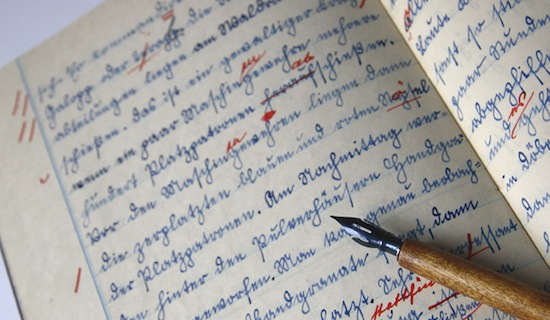
I read and read. I plumped the margins with ink. And then I wrote my words, the best I could imagine. Seventeen hours later, Greg gave my pages back, accompanied by a single-spaced, printed letter nearly as long as the piece I’d given him. He praised what deserved to be praised, and took the rest—which was nearly everything—apart: sentences that wandered from native intent, phrases that hoped to make their way on charm alone, images that, if they knew any ideas at all, knew them only in passing.
I was, to say the least, upset. Every teacher since I’d been ten had praised my prose! Why, one professor in college even said…
I vented. Sanda commiserated. And then I got to the work at hand. I considered every query Greg wrote, and thus was led to more precise attendance to the turns of phrase and thought within my work. At long last, I began to see my words not as tender nerves composing precious me, but as versions of a medium within which I worked and lived, out there, in here, to be formed in accordance with reality I’d perceived.
A month later, my piece was put into print. I held the issue again and again, reviewing the familiar table of contents, turning to the memorized page. It was the best thing I’d ever written.
That was seventeen years ago. The same age as some of my students. The magazine’s now about the age I was when I got there.
“This is where we’ll talk in an essential way,” I say to my students about their writing, and about my snaking comments that inevitably encircle the whole of each page’s rectangles of text. “The amount I write is a measure of my engagement with your writing,” I tell them. “Greg Wolfe made me a better writer because he paid attention to what I wrote.”
In August, my wife and daughter and I flew to Philadelphia for a family reunion. Afterward, we drove down to Kennett. We showed Madeleine the almost hilariously narrow row house where her mom and dad first lived together. We showed her the outside of the Half-Moon Saloon, and the empty space where once there stood a store that rented videotape copies of movies. We lamented the loss of the old library building, and laughed at the endurance of the combination Taco Bell/KFC. And then we turned the corner onto Broad Street.
It was smaller than I’d remembered, the house that held the space that’s grown to hold nearly every living writer and artist that I love, imaginative space that essentially holds me still.
William Coleman has served as managing editor for Image and executive editor of nonfiction for DoubleTake. A former teaching fellow at Harvard University, he teaches literature and writing for Northfield School of the Liberal Arts, in Wichita, Kansas. His poems have been published in Poetry, The Paris Review, The New Criterion, Image, Western Humanities Review, Phoebe, Third Coast, and other publications. His book and music reviews have been published in Image and The Martha’s Vineyard Times, respectively. His poetry manuscript, Once I Held a Stone, was a finalist for the 2012 Emily Dickinson First Book Award.
Previous Post

October 28, 2014
The Trouble with Time
Next Post
October 30, 2014 Breaking the Fall in Alice McDermott’s Someone
Browse Our Archives
Select a Category A. G. Harmon Alissa Wilkinson Allison Backous Art Authors Brad Fruhauff Bradford Winters Bryan Bliss Caroline Langston Chad Thomas Johnston Chris Hoke Christiana N. Peterson Culture D.G. Myers D.L. Mayfield Daniel Bowman Jr. David Griffith Elizabeth Duffy Faith Film Greg Wolfe Guest Contributor Interview Jan Vallone Jeffrey Overstreet Jessica Eddings-Roeser Jessica Mesman Griffith Kelly Foster Lindsey Crittenden Morgan Meis music Natalie Vestin Nick Olson Peggy Rosenthal Personal Reflection Poetry Friday Reflection Relationships Review Richard Chess Richard Cole Sara Zarr Shannon Huffman Polson Sonya Bilocerkowycz Tania Runyan Tony Woodlief Topical Categories Uncategorized Vic Sizemore Writing
Select a Month October 2018 September 2018 August 2018 July 2018 June 2018 May 2018 April 2018 March 2018 February 2018 January 2018 December 2017 November 2017 October 2017 September 2017 August 2017 July 2017 June 2017 May 2017 April 2017 March 2017 February 2017 January 2017 December 2016 November 2016 October 2016 September 2016 August 2016 July 2016 June 2016 May 2016 April 2016 March 2016 February 2016 January 2016 December 2015 November 2015 October 2015 September 2015 August 2015 July 2015 June 2015 May 2015 April 2015 March 2015 February 2015 January 2015 December 2014 November 2014 October 2014 September 2014 August 2014 July 2014 June 2014 May 2014 April 2014 March 2014 February 2014 January 2014 December 2013 November 2013 October 2013 September 2013 August 2013 July 2013 June 2013 May 2013 April 2013 March 2013 February 2013 January 2013 December 2012 November 2012 October 2012 September 2012 August 2012 July 2012 June 2012 May 2012 February 2008
Follow Us!
TAKE THE
Religious Wisdom Quiz
What does "Gideon" mean in Hebrew?
Select your answer to see how you score.
God is my Strength Warrior Hewer Redeemer
Related posts from Good Letters

On Writing Odes: Taking Time to Celebrate


A Conversation with Barbara Brown Taylor
Sonnets in the Prime of My Life
TRENDING AT PATHEOS Catholic

Rejecting Doom: Christian Hope And Human Action
Christianity is a religion of hope. We are to have hope and...

It’s What Comes From Within Which Matters
One of the most difficult things for us to understand is why...

Why I Choose the Eucharist Over the Sermon
Choose the Eucharist, Not the Sermon What are we supposed to get...

5 Design Elements Found in Spiritually Rooted Homes
Putting Spirituality Into Home Decor Our homes are more than our living...

Credo: A Story of God Told with the...
About 10 years ago, I began to imagine a personal "Credo" that...

The Anatomy of Divine Revelation in Catholic Thought
The claim that God has made Himself known to human beings is...
view all Catholic blogs
Ad-Free & Subscriber Log-In Subscription Support
- About Us
- 2026 Calendar
- Videos
- Podcasts
- Library of World Religions
- Faith In Media Tracker
- Advertise With Us
- Write for Us
- Privacy Policy
- Terms of Service
- Do Not Sell My Data
- Contact Us
- Radiant Digital
- Manage Newsletter Subscriptions
- Unsubscribe From Notifications
- Sitemap
Copyright 2008-2026, Patheos. All rights reserved.
Subscription Support Ad-Free & Subscriber Log-In
Follow Patheos