
BuddhistCatholicContemplativeEvangelicalGeneral ChristianHinduJewishLatter-day SaintMuslimNew VisionsProgressive Christian
Beliefs
- Buddhist
- Catholic
- Contemplative
- Evangelical
- General Christian
- Hindu
- Jewish
- Latter-day Saint
- More Voices
- Muslim
- New Visions
- Pagan
- Progressive Christian
Topics
- Religion News
- Food and Religion
- Sports and Religion
- Religious Art
- Religious Music and Entertainment
- Religious Events
- History and Religion
- Style and Religion
- Politics and Religion
- Women in Religion
- Recreation Outdoors and Religion
- Business Finance and Religion
- Careers Workplace and Religion
- Education and Religion
- Family Parenting and Religion
- Health Fitness and Religion
- Home and Religion
- Relationships and Religion
- Technology and Religion
- Travel and Religion
Columnists
- Buddhist Columnists
- Business Finance and Religion Columnists
- Careers Workplace and Religion Columnists
- Catholic Columnists
- Contemplative Columnists
- Education and Religion Columnists
- Evangelists Columnists
- Family Parenting and Religion Columnists
- General Christian Columnists
- Health Fitness and Religion Columnists
- Hindu Columnists
- History and Religion Columnists
- Home and Religion Columnists
- Jewish Columnists
- More Voices Columnists
- Latter Day Columnists
- Muslim Columnists
- New Visions Columnists
- Nonreligious Columnists
- Pagan Columnists
- Politics and Religion Columnists
- Progressive Columnists
- Recreation Outdoors and Religion Columnists
- Relationships and Religion Columnists
- Religion News Columnists
- Religious Art Columnists
- Religious Events Columnists
- Religious Music and Entertainment Columnists
- Sports and Religion Columnists
- Style and Religion Columnists
- Technology and Religion Columnists
- Travel and Religion Columnists
- Women in Religion Columnists
Resource Library
- 2026 Calendar
- Library of World Religions
- The 100 Most Holy Places on Earth
- Patheos Answers
- Podcasts
- Videos
- Faith Leaders Database
- Anglican Episcopalian
- Bahai
- Baptist
- Buddhism
- Christianity
- Confucianism
- Eastern Orthodoxy
- Hinduism
- Holiness and Pentecostal
- ISKCON
- Islam
- Judaism
- Lutheran
- Methodist
- The Church of Jesus Christ of Latter-day Saints
- New Age
- Paganism
- Presbytarian and Reformed
- Protestantism
- Religion Behind the Scenes
- Roman Catholic
- Scientology
- Shia Islam
- Sikhism
- Sufism
- Sunni Islam
- Taoism
- Zen
- See all religions
Research Tools
 Ad-Free & Subscriber Log-In Subscription Support
Ad-Free & Subscriber Log-In Subscription Support
Follow Patheos 

- Trending:
- Forgiveness
- |
- Marriage
- |
- Consciousness
- |
- Death Penalty
- |
- Election
- |
- Halloween
 Good Letters
-
Contributors
- Home
- Catholic
- Goodbye to My Nuclear Days
Goodbye to My Nuclear Days
Last updated on: October 3, 2014 at 1:30 am by Peggy Rosenthal
Goodbye to My Nuclear Days 2014-10-01T16:59:36-07:00 Peggy Rosenthal
Patheos Explore the world's faith through different perspectives on religion and spirituality! Patheos has the views of the prevalent religions and spiritualities of the world.
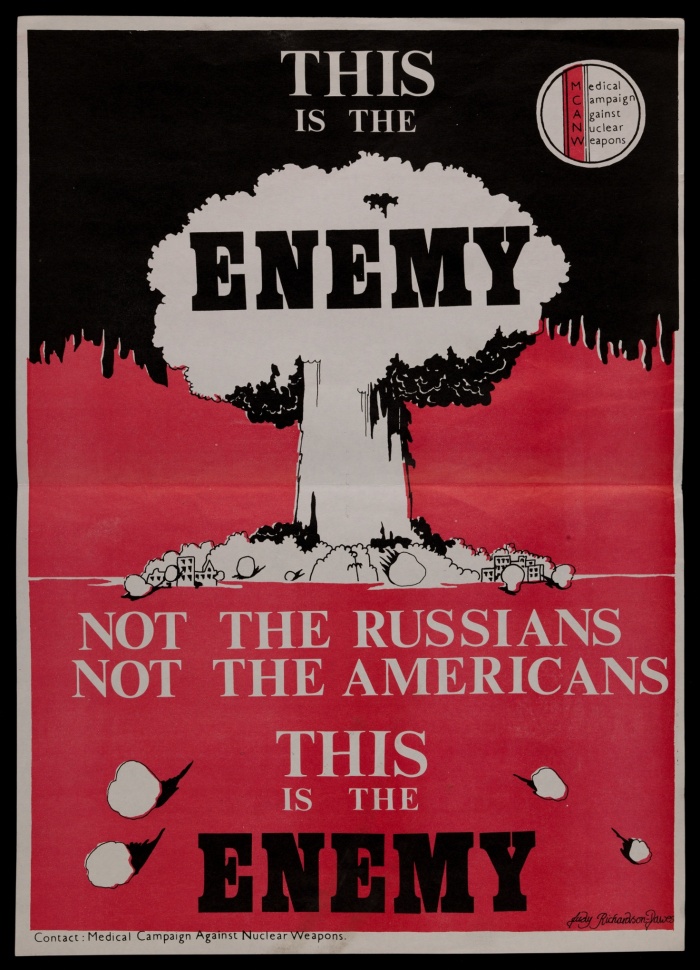 From the mid-1980s through the early 1990s, I devoted my research and writing to the nuclear arms race and nonviolent responses to it. The mid-eighties marked the height of the Cold War. The U.S. and the Soviet Union were locked in an arms race that our government referred to as (I kid you not) “MAD.”
The acronym stood for Mutually Assured Destruction.
The strategic theory behind MAD was that if both nations had enough nuclear bombs to totally annihilate the other country and its inhabitants, then neither nation would push the button—because even after a first strike by one side, the other side was capable of launching a second strike in retaliation. Second strike capability was housed mostly in nuclear submarines that cruised the ocean floors.
By 1988, the U.S. had about 23,5000 nuclear bombs in reserve, the U.S.S.R about 33,000. Overkill, to put it euphemistically.
Feeling maddened by MAD, I joined several anti-nuclear organizations, received all their newsletters (this was of course in snail-mail days): Union of Concerned Scientists, Council for a Livable World, Natural Resources Defense Council, and more. I saved all these mailings in huge boxes in my attic.
Coming to anti-nuclear activism from the academic field of semiotics, I got interested in the discourse of the nuclear weapons debate. I subscribed to magazines on both sides of the debate and bought piles of books on the topic. I saved all these materials in huge boxes in my attic.
But I also began studying nonviolence, inspired by Thomas Merton. The spirituality of nonviolence taught me to seek the good in the “enemy,” that in my case wasn’t the Soviet Union but rather the pro-nuclear people in my own country. I subscribed to periodicals like Fellowship and Sojourners to learn more about the spirituality and practice of nonviolence. I saved all these magazines in huge boxes in my attic.
Nonviolence told me that I must learn to see the world from the “enemy’s” viewpoint. So I left my New York home for a year to go to New Mexico’s Los Alamos National Laboratory (LANL), where nuclear physicists were designing ever more “sophisticated” bombs. My friends in the anti-nuclear movement assumed I was going to Los Alamos to join in protests; but, no, I was going in order to listen to the physicists talk about why they’d chosen to put their careers at the service of MAD.
I talked with many of the physicists; I attended LANL’s public lectures. I was invited to sit in on a discussion between a visiting Soviet nuclear physicist and his Los Alamos counterparts. Their friendly repartee astonished me: like rival football coaches having a beer together after the game, they laughed “well, if you do this, then of course we’ll do that to you.” I made voluminous notes on all my Lab experiences, and saved them in a box in my attic.
While at Los Alamos, the semioticist in me got intrigued by the mushroom cloud image and the various meanings then being imposed on it.
I visited the Los Alamos museum, with its photo-wall of specific atomic explosions. Like baby pictures, the mushroom clouds were captioned with names: “George, May 8, 1951”; “Charlie, Oct. 30, 1951”; “Mike, Oct. 31, 1952.”
I stood before the five-foot-high mushroom cloud poster at the museum’s entrance, with its text justifying LANL’s existence:
If peace is viewed as the absence of general war among major states, the world has enjoyed more years of peace since 1945 than has been known in this century; and nuclear weapons have been a major force working for peace in the postwar world. They make the cost of war seem frighteningly high, and thus discourage nations from starting wars that might lead to their use.
This is MAD run through a rhetorical “peace” machine, I thought.
In the museum gift shop, I bought postcards of the named mushroom clouds and brought them home for an attic box.
Meanwhile, I’d seen a newspaper article about Richland High School, near the Hanford Nuclear Reservation in the state of Washington. The school emblem was a cartoon mushroom cloud, its geyser bubbling up with adolescent energy—perfect emblem for the school’s sports teams, or so most residents thought. I stashed the article in an attic box along with mushroom clouds cut out from some of my anti-nuclear mailings, where the very same mushroom cloud was an image of monstrous evil.
Up in my attic recently, I stared at all these boxes from my long-ago fifteen-year obsession. The nuclear arms debate subsided with the collapse of the Soviet Union in 1991. Mushroom clouds faded from the popular imagination. Despite the little-known fact that the U.S. currently stockpiles and continually “modernizes” some 7,700 nuclear bombs, at a cost of $372 billion annually, the topic has disappeared from both public and private conversation.
Contemplating my heaps of boxes, I knew I’d never again open them. Our life has phases, and this one—as stimulating as it had been—was from a past I wouldn’t return to. The boxes had to go. But I hated just to haul them to the curb for recycling.
My husband had an inspiration: “They’re of historical value. Maybe the Gandhi Institute would want them.”
Backstory: when Mahatma Gandhi’s grandson Arun Gandhi moved to my city about eight years ago to be near his own grandkids, he brought with him the M.K. Gandhi Institute for Nonviolence. I emailed the Institute, described my boxes of materials, and offered them. “Yes, we’d love them,” was the reply.
A few days later, one of the staff came to pick up my half-dozen huge, heavy boxes. As he loaded them into his car, I felt a bit empty at seeing fifteen-plus years of my past go out the door. But I also felt gratified that my collection had found the right home. I let myself picture my books and magazines and newsletters on the Gandhi Institute’s shelves, where anyone from the public could go in and read them. Maybe the nuclear cloud photos would be hung on the wall above, so a new generation could get a sense of the MADness of that era.
Peggy Rosenthal is director of Poetry Retreats and writes widely on poetry as a spiritual resource. Her books include Praying through Poetry: Hope for Violent Times (Franciscan Media), and The Poets’ Jesus (Oxford). See Amazon for full list. She also teaches an online course, “Poetry as a Spiritual Practice,” through Image’s Glen Online program*.*
Previous Post

October 2, 2014
The Saint John’s Bible: Back to the Future
Next Post
October 6, 2014 The Self and the Shadow
Browse Our Archives
Select a Category A. G. Harmon Alissa Wilkinson Allison Backous Art Authors Brad Fruhauff Bradford Winters Bryan Bliss Caroline Langston Chad Thomas Johnston Chris Hoke Christiana N. Peterson Culture D.G. Myers D.L. Mayfield Daniel Bowman Jr. David Griffith Elizabeth Duffy Faith Film Greg Wolfe Guest Contributor Interview Jan Vallone Jeffrey Overstreet Jessica Eddings-Roeser Jessica Mesman Griffith Kelly Foster Lindsey Crittenden Morgan Meis music Natalie Vestin Nick Olson Peggy Rosenthal Personal Reflection Poetry Friday Reflection Relationships Review Richard Chess Richard Cole Sara Zarr Shannon Huffman Polson Sonya Bilocerkowycz Tania Runyan Tony Woodlief Topical Categories Uncategorized Vic Sizemore Writing
Select a Month October 2018 September 2018 August 2018 July 2018 June 2018 May 2018 April 2018 March 2018 February 2018 January 2018 December 2017 November 2017 October 2017 September 2017 August 2017 July 2017 June 2017 May 2017 April 2017 March 2017 February 2017 January 2017 December 2016 November 2016 October 2016 September 2016 August 2016 July 2016 June 2016 May 2016 April 2016 March 2016 February 2016 January 2016 December 2015 November 2015 October 2015 September 2015 August 2015 July 2015 June 2015 May 2015 April 2015 March 2015 February 2015 January 2015 December 2014 November 2014 October 2014 September 2014 August 2014 July 2014 June 2014 May 2014 April 2014 March 2014 February 2014 January 2014 December 2013 November 2013 October 2013 September 2013 August 2013 July 2013 June 2013 May 2013 April 2013 March 2013 February 2013 January 2013 December 2012 November 2012 October 2012 September 2012 August 2012 July 2012 June 2012 May 2012 February 2008
Follow Us!
TAKE THE
Religious Wisdom Quiz
What does "apostle" literally mean in Greek?
Select your answer to see how you score.
Writer Friend Sent one Leader
Related posts from Good Letters




Can a Racist Drive a Prius? Stereotypes and...
TRENDING AT PATHEOS Catholic

Rejecting Doom: Christian Hope And Human Action
Christianity is a religion of hope. We are to have hope and...

It’s What Comes From Within Which Matters
One of the most difficult things for us to understand is why...

Why I Choose the Eucharist Over the Sermon
Choose the Eucharist, Not the Sermon What are we supposed to get...

5 Design Elements Found in Spiritually Rooted Homes
Putting Spirituality Into Home Decor Our homes are more than our living...

Credo: A Story of God Told with the...
About 10 years ago, I began to imagine a personal "Credo" that...

The Anatomy of Divine Revelation in Catholic Thought
The claim that God has made Himself known to human beings is...
view all Catholic blogs
Ad-Free & Subscriber Log-In Subscription Support
- About Us
- 2026 Calendar
- Videos
- Podcasts
- Library of World Religions
- Faith In Media Tracker
- Advertise With Us
- Write for Us
- Privacy Policy
- Terms of Service
- Do Not Sell My Data
- Contact Us
- Radiant Digital
- Manage Newsletter Subscriptions
- Unsubscribe From Notifications
- Sitemap
Copyright 2008-2026, Patheos. All rights reserved.
Subscription Support Ad-Free & Subscriber Log-In
Follow Patheos