
BuddhistCatholicContemplativeEvangelicalGeneral ChristianHinduJewishLatter-day SaintMuslimNew VisionsProgressive Christian
Beliefs
- Buddhist
- Catholic
- Contemplative
- Evangelical
- General Christian
- Hindu
- Jewish
- Latter-day Saint
- More Voices
- Muslim
- New Visions
- Pagan
- Progressive Christian
Topics
- Religion News
- Food and Religion
- Sports and Religion
- Religious Art
- Religious Music and Entertainment
- Religious Events
- History and Religion
- Style and Religion
- Politics and Religion
- Women in Religion
- Recreation Outdoors and Religion
- Business Finance and Religion
- Careers Workplace and Religion
- Education and Religion
- Family Parenting and Religion
- Health Fitness and Religion
- Home and Religion
- Relationships and Religion
- Technology and Religion
- Travel and Religion
Columnists
- Buddhist Columnists
- Business Finance and Religion Columnists
- Careers Workplace and Religion Columnists
- Catholic Columnists
- Contemplative Columnists
- Education and Religion Columnists
- Evangelists Columnists
- Family Parenting and Religion Columnists
- General Christian Columnists
- Health Fitness and Religion Columnists
- Hindu Columnists
- History and Religion Columnists
- Home and Religion Columnists
- Jewish Columnists
- More Voices Columnists
- Latter Day Columnists
- Muslim Columnists
- New Visions Columnists
- Nonreligious Columnists
- Pagan Columnists
- Politics and Religion Columnists
- Progressive Columnists
- Recreation Outdoors and Religion Columnists
- Relationships and Religion Columnists
- Religion News Columnists
- Religious Art Columnists
- Religious Events Columnists
- Religious Music and Entertainment Columnists
- Sports and Religion Columnists
- Style and Religion Columnists
- Technology and Religion Columnists
- Travel and Religion Columnists
- Women in Religion Columnists
Resource Library
- 2026 Calendar
- Library of World Religions
- The 100 Most Holy Places on Earth
- Patheos Answers
- Podcasts
- Videos
- Faith Leaders Database
- Anglican Episcopalian
- Bahai
- Baptist
- Buddhism
- Christianity
- Confucianism
- Eastern Orthodoxy
- Hinduism
- Holiness and Pentecostal
- ISKCON
- Islam
- Judaism
- Lutheran
- Methodist
- The Church of Jesus Christ of Latter-day Saints
- New Age
- Paganism
- Presbytarian and Reformed
- Protestantism
- Religion Behind the Scenes
- Roman Catholic
- Scientology
- Shia Islam
- Sikhism
- Sufism
- Sunni Islam
- Taoism
- Zen
- See all religions
Research Tools
 Ad-Free & Subscriber Log-In Subscription Support
Ad-Free & Subscriber Log-In Subscription Support
Follow Patheos 

- Trending:
- Forgiveness
- |
- Marriage
- |
- Consciousness
- |
- Death Penalty
- |
- Election
- |
- Halloween
 Good Letters
-
Contributors
- Home
- Catholic
- Breaking the Fall in Alice McDermott’s Someone
Breaking the Fall in Alice McDermott’s Someone
Last updated on: October 30, 2014 at 1:36 am by A. G. Harmon
Breaking the Fall in Alice McDermott’s Someone 2014-10-29T11:22:29-07:00 A. G. Harmon
Patheos Explore the world's faith through different perspectives on religion and spirituality! Patheos has the views of the prevalent religions and spiritualities of the world.
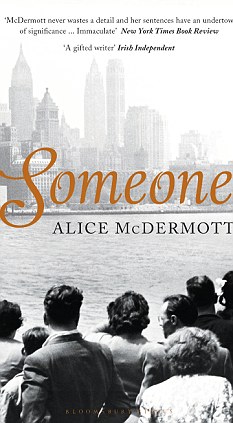 At the beginning of Alice McDermott’s latest novel, Someone, an unattractive but good-natured girl divulges her deepest desire. One day, coming home on the subway, she fell against a man—someone who managed to catch her—an event that was memorable because he was kind in the way that he did it. It’s clear that in that short moment she comes to love him, as we are fully capable of doing with strangers—even those who will always remain strangers.
She does not see the man again, but that does not stop her from looking. Laughing at her own foolishness, she says that she finds herself watching for him—subway ride after ride—in hopes of another such encounter. If it ever happened again, this time she would fall against him on purpose, to be caught by design. Because the best thing she has known in life so far has been the very fact that she was caught, and that someone was kind to her in the act of doing so.
This character, richly drawn, makes her appearance early in the novel, and like the man she hopes to encounter but never will, evanesces from the story within a few short pages. But the impression that she makes upon the narrator, Mary—a child when she first hears the story—lasts throughout the balance of the work. The rest of Mary’s life is marked by the relation of this yearning—that there be someone there when she, and those she loves, invariably, ineluctably, inescapably, fall.
And in this work, character after character stumbles, whether through their own ineptitude or through the devices of another. But whether the consequences of the fall be great or minor, it is the aftermath of such a thing that resonates. Some are lucky enough to have others to catch them; some are not; some rise anyway, while some can never quite reach their feet again. It seems that one of the greatest lessons in the work is that the introductory character’s fanciful wish—that a catcher be there when the fateful day comes—is one that is actually common to all.
Among McDermott’s talents has always been an ability to portray the quiet appeal, the soft allure, of the conventional life. She does not soften the edges of things, but she does not exaggerate them either. If the picture she sets of the working-class Irish neighborhood in mid-twentieth century Brooklyn is of a smaller, quieter world—one that like so many others is probably hard to find these days—it is not an insular or forbidding place. Rather, it is an ordinary one, full of both wheat and tares, side by side, growing.
Unlike too many novelists of her generation, McDermott never scolds her characters, their places, or their times, not any more than she canonizes them. Instead, she uses her considerable skill in the composition of a deftly-made world, as finely wrought as though she was rendering it with needle and thread.
Perhaps her greatest achievements come in the successive ways in which she portrays the great vulnerability of the fallen—a soldier in war, a businessman with a limp; a priest who has abandoned his vows—even the narrator, who in her age relates a largely happy life, but one fraught with disappointments and unbidden mysteries.
McDermott’s accomplishment lies in her ability to portray vulnerability without falling over into the maudlin. Her characters risk, often unawares, the exposure of the soft underbelly of their shames, or weaknesses, or tragedies. It could be that it is the very fact that these exposures are unwitting, instead of conscious, that we trust their honesty. It is to the writer’s credit that she finds the proper moment to highlight them as she does.
In some ways, the work is reminiscent of an older master, Katherine Anne Porter, who had a knack for portraying those who are in turns valiant and crippled. In some ways, it is reminiscent of Ian McEwan’s achievements, in the quiet reflectiveness with which the tale is told, laced with regret and shy hope.
But in the most compelling way, it is the story of those who spend their lives knowing that the truest thing about them is their innate penchant for those things that will bruise, if not break, their hearts entirely, and their innate hope, and perhaps faith, that someone will be there to catch them when they do.
A.G. Harmon teaches Shakespeare, Law and Literature, Jurisprudence, and Writing at The Catholic University of America in Washington, D.C. His novel, A House All Stilled, won the 2001 Peter Taylor Prize for the Novel.
Previous Post

October 29, 2014
Greg Wolfe Made Me a Better Writer: 25 Years of Image
Next Post
October 31, 2014 Monasticism in Lockdown America, Part 1
Browse Our Archives
Select a Category A. G. Harmon Alissa Wilkinson Allison Backous Art Authors Brad Fruhauff Bradford Winters Bryan Bliss Caroline Langston Chad Thomas Johnston Chris Hoke Christiana N. Peterson Culture D.G. Myers D.L. Mayfield Daniel Bowman Jr. David Griffith Elizabeth Duffy Faith Film Greg Wolfe Guest Contributor Interview Jan Vallone Jeffrey Overstreet Jessica Eddings-Roeser Jessica Mesman Griffith Kelly Foster Lindsey Crittenden Morgan Meis music Natalie Vestin Nick Olson Peggy Rosenthal Personal Reflection Poetry Friday Reflection Relationships Review Richard Chess Richard Cole Sara Zarr Shannon Huffman Polson Sonya Bilocerkowycz Tania Runyan Tony Woodlief Topical Categories Uncategorized Vic Sizemore Writing
Select a Month October 2018 September 2018 August 2018 July 2018 June 2018 May 2018 April 2018 March 2018 February 2018 January 2018 December 2017 November 2017 October 2017 September 2017 August 2017 July 2017 June 2017 May 2017 April 2017 March 2017 February 2017 January 2017 December 2016 November 2016 October 2016 September 2016 August 2016 July 2016 June 2016 May 2016 April 2016 March 2016 February 2016 January 2016 December 2015 November 2015 October 2015 September 2015 August 2015 July 2015 June 2015 May 2015 April 2015 March 2015 February 2015 January 2015 December 2014 November 2014 October 2014 September 2014 August 2014 July 2014 June 2014 May 2014 April 2014 March 2014 February 2014 January 2014 December 2013 November 2013 October 2013 September 2013 August 2013 July 2013 June 2013 May 2013 April 2013 March 2013 February 2013 January 2013 December 2012 November 2012 October 2012 September 2012 August 2012 July 2012 June 2012 May 2012 February 2008
Follow Us!
TAKE THE
Religious Wisdom Quiz
What was the primary light source in Biblical times?
Select your answer to see how you score.
Candle Torch Oil lamp Bonfire
Related posts from Good Letters
Taking Our Chances with Choice

The Crown and Victoria: Tales of Two Queens


TRENDING AT PATHEOS Catholic

Rejecting Doom: Christian Hope And Human Action
Christianity is a religion of hope. We are to have hope and...

It’s What Comes From Within Which Matters
One of the most difficult things for us to understand is why...

Why I Choose the Eucharist Over the Sermon
Choose the Eucharist, Not the Sermon What are we supposed to get...

5 Design Elements Found in Spiritually Rooted Homes
Putting Spirituality Into Home Decor Our homes are more than our living...

Credo: A Story of God Told with the...
About 10 years ago, I began to imagine a personal "Credo" that...

The Anatomy of Divine Revelation in Catholic Thought
The claim that God has made Himself known to human beings is...
view all Catholic blogs
Ad-Free & Subscriber Log-In Subscription Support
- About Us
- 2026 Calendar
- Videos
- Podcasts
- Library of World Religions
- Faith In Media Tracker
- Advertise With Us
- Write for Us
- Privacy Policy
- Terms of Service
- Do Not Sell My Data
- Contact Us
- Radiant Digital
- Manage Newsletter Subscriptions
- Unsubscribe From Notifications
- Sitemap
Copyright 2008-2026, Patheos. All rights reserved.
Subscription Support Ad-Free & Subscriber Log-In
Follow Patheos