
BuddhistCatholicContemplativeEvangelicalGeneral ChristianHinduJewishLatter-day SaintMuslimNew VisionsProgressive Christian
Beliefs
- Buddhist
- Catholic
- Contemplative
- Evangelical
- General Christian
- Hindu
- Jewish
- Latter-day Saint
- More Voices
- Muslim
- New Visions
- Pagan
- Progressive Christian
Topics
- Religion News
- Food and Religion
- Sports and Religion
- Religious Art
- Religious Music and Entertainment
- Religious Events
- History and Religion
- Style and Religion
- Politics and Religion
- Women in Religion
- Recreation Outdoors and Religion
- Business Finance and Religion
- Careers Workplace and Religion
- Education and Religion
- Family Parenting and Religion
- Health Fitness and Religion
- Home and Religion
- Relationships and Religion
- Technology and Religion
- Travel and Religion
Columnists
- Buddhist Columnists
- Business Finance and Religion Columnists
- Careers Workplace and Religion Columnists
- Catholic Columnists
- Contemplative Columnists
- Education and Religion Columnists
- Evangelists Columnists
- Family Parenting and Religion Columnists
- General Christian Columnists
- Health Fitness and Religion Columnists
- Hindu Columnists
- History and Religion Columnists
- Home and Religion Columnists
- Jewish Columnists
- More Voices Columnists
- Latter Day Columnists
- Muslim Columnists
- New Visions Columnists
- Nonreligious Columnists
- Pagan Columnists
- Politics and Religion Columnists
- Progressive Columnists
- Recreation Outdoors and Religion Columnists
- Relationships and Religion Columnists
- Religion News Columnists
- Religious Art Columnists
- Religious Events Columnists
- Religious Music and Entertainment Columnists
- Sports and Religion Columnists
- Style and Religion Columnists
- Technology and Religion Columnists
- Travel and Religion Columnists
- Women in Religion Columnists
Resource Library
- 2026 Calendar
- Library of World Religions
- The 100 Most Holy Places on Earth
- Patheos Answers
- Podcasts
- Videos
- Faith Leaders Database
- Anglican Episcopalian
- Bahai
- Baptist
- Buddhism
- Christianity
- Confucianism
- Eastern Orthodoxy
- Hinduism
- Holiness and Pentecostal
- ISKCON
- Islam
- Judaism
- Lutheran
- Methodist
- The Church of Jesus Christ of Latter-day Saints
- New Age
- Paganism
- Presbytarian and Reformed
- Protestantism
- Religion Behind the Scenes
- Roman Catholic
- Scientology
- Shia Islam
- Sikhism
- Sufism
- Sunni Islam
- Taoism
- Zen
- See all religions
Research Tools
 Ad-Free & Subscriber Log-In Subscription Support
Ad-Free & Subscriber Log-In Subscription Support
Follow Patheos 

- Trending:
- Forgiveness
- |
- Marriage
- |
- Consciousness
- |
- Death Penalty
- |
- Election
- |
- Halloween
 Good Letters
-
Contributors
- Home
- Catholic
- We All Have a Place on the Great Chain of Being
We All Have a Place on the Great Chain of Being
Last updated on: September 26, 2014 at 3:46 pm by A. G. Harmon
We All Have a Place on the Great Chain of Being 2014-09-26T15:46:59-07:00 A. G. Harmon
Patheos Explore the world's faith through different perspectives on religion and spirituality! Patheos has the views of the prevalent religions and spiritualities of the world.
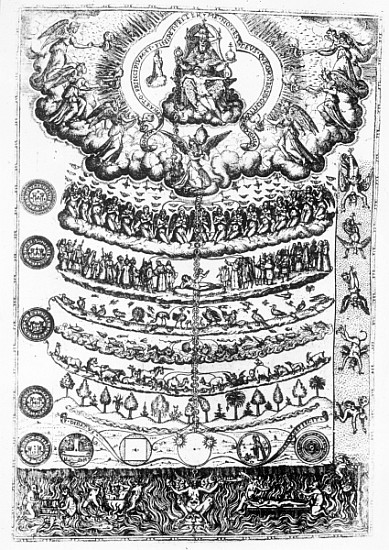 Somewhere along the Great Chain of Being, we all have our place. That’s an old concept, and perhaps one that doesn’t fit our times as easily as it did in the past, but there’s much of it that still holds true.
From the ancients comes the idea that all things in reality can be located along a continuum—a “Great Chain,” as it were—hierarchized so that each thing possesses an attribute in addition to those that rest immediately below it, and lack an attribute possessed by those immediately above. Plants have life, so are above sand, which has only existence; but plants cannot move, so they are below animals.
Likewise, each entrant within a category can be hierarchized: The lion is the king of the beasts, because it possesses all of the prized attributes of creatures—strength, courage, beauty, etc. But because it lacks a soul, the prophets would rate even the most glorious of the leonine family below the most inglorious of the human.
And among men, so goes the narrative, the Sovereign is at the top of the seating chart, with his subjects arranged in a cascading scale. Above men, at least for the time being, are the ranks of angels, from cherubim to seraphim (we are intended for a place higher than angels, once the eschaton arrives), and of course God Almighty is highest of all.
In drama, this idea has provided much fictive material. Because one of the greatest transgressions, perhaps the primordial transgression, is when a thing resists its place—either by aspiring to a role for which it is not fit, or by abdicating from a role for which it was made; pretending to more than one’s lot or deserting the lot that one possesses.
Drama, particularly Renaissance Drama (particularly Shakespeare), is full of it. It was, of course, the sin of Adam and Eve. When things leave their proper station, resist what they fundamentally are, the cosmos is upset: “Cry havoc! and let slip the dogs of war.”
For though nature is said to abhor a vacuum, she is not very good at either filling it or maintaining equilibrium. Things rush into the void, but often they are not apt for their new station.
Macbeth wants Duncan’s place, but look what good that did him; striving for a level too high, taking it by force, he brings the realm into turmoil. Similarly, by abdicating his throne, Lear puts ancient England—nay, all of creation—on the skids. There is no lack of pretenders and deserters in the world, nor a lack of those who will jockey for their places once they leave them.
What explains this itch?—this desire to look high and low, but seldom to rest? The irony is that we are slaves to our appetites—driven to seek things we cannot have or to abandon duties we should not forego; as such, we lose the freedom that comes from knowing our paths, from filling the clothes cut for us. High ambitions are a good thing, but they must be tempered by the realm of the possible, and the possible changes from person to person.
It is important to know what we are so that we can be what we are. It is important to reflect upon our gifts, upon what is our natural state, so that we don’t waste time. The Greeks counseled this above all, as their greatest aphorism was “know thyself.”
Granted, it is not always pleasant, getting acquainted with what you are. I recall hearing of a young girl who had a great comedic flair on the stage, acknowledged by all, but was heartbroken that she was never cast as the ingénue. She was the Nurse to another’s Juliet; the wise-cracking sidekick, the worldly lady in waiting, but never the romantic lead. She could not abide her lack of fortune, and so deserted what fortunes she had. Try as she might, she could not pull off the role of the beloved, as she was not made for that place; her talents betrayed her desires, but she could not see past them.
What a waste, it was said of her. Because she could not be what she wanted, she would not be what she was. A whole world of real possibilities was foregone in favor of bitterness over sheer impossibilities.
Today, this kind of stark lesson is not in favor. We are told that achieving what we want is only an amount of effort and heart. But while effort and heart are key ingredients to success (as is, I would add, a fair amount of luck), they must be spent in favor of a likely objective. Conquering obstacles is great, and our most worthy heroes have often come from the furthest back, but that is because they knew that what they were belied what they were told they were. They proceeded from a knowledge hidden from others, not from an irrational or overweening desire.
None of this is said easily; I know well that contentment is a hard thing to achieve. There is a negative connotation to it, too. “Playing it safe” is deplored, and if it means a lack of courage, it is deplored rightly. But a difference is worth noting; there is the refusal to take up the burden of what one is in favor of a lesser place, which is cowardice—a desertion; then there is the blindness of not wanting to be what one is in favor of a higher place, which is foolishness—a pretense.
“Rest there,” counsels the soul, when we have found what we are. But this rest is not one of inaction; it is rest from a search for that understanding; only when that search is over can we act, with great pitch and moment. For we can only be and do what we truly are.
A.G. Harmon teaches Shakespeare, Law and Literature, Jurisprudence, and Writing at The Catholic University of America in Washington, D.C. His novel, *A House All Stilled,*won the 2001 Peter Taylor Prize for the Novel.
Previous Post

September 16, 2014
There’s No Original Art
Browse Our Archives
Select a Category A. G. Harmon Alissa Wilkinson Allison Backous Art Authors Brad Fruhauff Bradford Winters Bryan Bliss Caroline Langston Chad Thomas Johnston Chris Hoke Christiana N. Peterson Culture D.G. Myers D.L. Mayfield Daniel Bowman Jr. David Griffith Elizabeth Duffy Faith Film Greg Wolfe Guest Contributor Interview Jan Vallone Jeffrey Overstreet Jessica Eddings-Roeser Jessica Mesman Griffith Kelly Foster Lindsey Crittenden Morgan Meis music Natalie Vestin Nick Olson Peggy Rosenthal Personal Reflection Poetry Friday Reflection Relationships Review Richard Chess Richard Cole Sara Zarr Shannon Huffman Polson Sonya Bilocerkowycz Tania Runyan Tony Woodlief Topical Categories Uncategorized Vic Sizemore Writing
Select a Month October 2018 September 2018 August 2018 July 2018 June 2018 May 2018 April 2018 March 2018 February 2018 January 2018 December 2017 November 2017 October 2017 September 2017 August 2017 July 2017 June 2017 May 2017 April 2017 March 2017 February 2017 January 2017 December 2016 November 2016 October 2016 September 2016 August 2016 July 2016 June 2016 May 2016 April 2016 March 2016 February 2016 January 2016 December 2015 November 2015 October 2015 September 2015 August 2015 July 2015 June 2015 May 2015 April 2015 March 2015 February 2015 January 2015 December 2014 November 2014 October 2014 September 2014 August 2014 July 2014 June 2014 May 2014 April 2014 March 2014 February 2014 January 2014 December 2013 November 2013 October 2013 September 2013 August 2013 July 2013 June 2013 May 2013 April 2013 March 2013 February 2013 January 2013 December 2012 November 2012 October 2012 September 2012 August 2012 July 2012 June 2012 May 2012 February 2008
Follow Us!
TAKE THE
Religious Wisdom Quiz
What separated the Holy Place from the Most Holy Place in the Tabernacle?
Select your answer to see how you score.
An incense altar A bronze door A stone wall A curtain (veil)
Related posts from Good Letters

Leonard Cohen’s Holy and Broken Hallelujah

Ready or Not for the Days of Awe


TRENDING AT PATHEOS Catholic

The Parable Of The Sower And The Word...
One of Christ’s most famous parables is that of the sower who...

Rejecting Doom: Christian Hope And Human Action
Christianity is a religion of hope. We are to have hope and...

Why I Choose the Eucharist Over the Sermon
Choose the Eucharist, Not the Sermon What are we supposed to get...

5 Design Elements Found in Spiritually Rooted Homes
Putting Spirituality Into Home Decor Our homes are more than our living...

Credo: A Story of God Told with the...
About 10 years ago, I began to imagine a personal "Credo" that...

The Anatomy of Divine Revelation in Catholic Thought
The claim that God has made Himself known to human beings is...
view all Catholic blogs
Ad-Free & Subscriber Log-In Subscription Support
- About Us
- 2026 Calendar
- Videos
- Podcasts
- Library of World Religions
- Faith In Media Tracker
- Advertise With Us
- Write for Us
- Privacy Policy
- Terms of Service
- Do Not Sell My Data
- Contact Us
- Radiant Digital
- Manage Newsletter Subscriptions
- Unsubscribe From Notifications
- Sitemap
Copyright 2008-2026, Patheos. All rights reserved.
Subscription Support Ad-Free & Subscriber Log-In
Follow Patheos