
BuddhistCatholicContemplativeEvangelicalGeneral ChristianHinduJewishLatter-day SaintMuslimNew VisionsProgressive Christian
Beliefs
- Buddhist
- Catholic
- Contemplative
- Evangelical
- General Christian
- Hindu
- Jewish
- Latter-day Saint
- More Voices
- Muslim
- New Visions
- Pagan
- Progressive Christian
Topics
- Religion News
- Food and Religion
- Sports and Religion
- Religious Art
- Religious Music and Entertainment
- Religious Events
- History and Religion
- Style and Religion
- Politics and Religion
- Women in Religion
- Recreation Outdoors and Religion
- Business Finance and Religion
- Careers Workplace and Religion
- Education and Religion
- Family Parenting and Religion
- Health Fitness and Religion
- Home and Religion
- Relationships and Religion
- Technology and Religion
- Travel and Religion
Columnists
- Buddhist Columnists
- Business Finance and Religion Columnists
- Careers Workplace and Religion Columnists
- Catholic Columnists
- Contemplative Columnists
- Education and Religion Columnists
- Evangelists Columnists
- Family Parenting and Religion Columnists
- General Christian Columnists
- Health Fitness and Religion Columnists
- Hindu Columnists
- History and Religion Columnists
- Home and Religion Columnists
- Jewish Columnists
- More Voices Columnists
- Latter Day Columnists
- Muslim Columnists
- New Visions Columnists
- Nonreligious Columnists
- Pagan Columnists
- Politics and Religion Columnists
- Progressive Columnists
- Recreation Outdoors and Religion Columnists
- Relationships and Religion Columnists
- Religion News Columnists
- Religious Art Columnists
- Religious Events Columnists
- Religious Music and Entertainment Columnists
- Sports and Religion Columnists
- Style and Religion Columnists
- Technology and Religion Columnists
- Travel and Religion Columnists
- Women in Religion Columnists
Resource Library
- 2026 Calendar
- Library of World Religions
- The 100 Most Holy Places on Earth
- Patheos Answers
- Podcasts
- Videos
- Faith Leaders Database
- Anglican Episcopalian
- Bahai
- Baptist
- Buddhism
- Christianity
- Confucianism
- Eastern Orthodoxy
- Hinduism
- Holiness and Pentecostal
- ISKCON
- Islam
- Judaism
- Lutheran
- Methodist
- The Church of Jesus Christ of Latter-day Saints
- New Age
- Paganism
- Presbytarian and Reformed
- Protestantism
- Religion Behind the Scenes
- Roman Catholic
- Scientology
- Shia Islam
- Sikhism
- Sufism
- Sunni Islam
- Taoism
- Zen
- See all religions
Research Tools
 Ad-Free & Subscriber Log-In Subscription Support
Ad-Free & Subscriber Log-In Subscription Support
Follow Patheos 

- Trending:
- Forgiveness
- |
- Marriage
- |
- Consciousness
- |
- Death Penalty
- |
- Election
- |
- Halloween
 Good Letters
-
Contributors
- Home
- Catholic
- Rubble and Re-Creation
Rubble and Re-Creation
Last updated on: July 20, 2015 at 12:40 pm by Chris Hoke
Rubble and Re-Creation 2015-07-20T12:40:03-07:00 Chris Hoke
Patheos Explore the world's faith through different perspectives on religion and spirituality! Patheos has the views of the prevalent religions and spiritualities of the world.
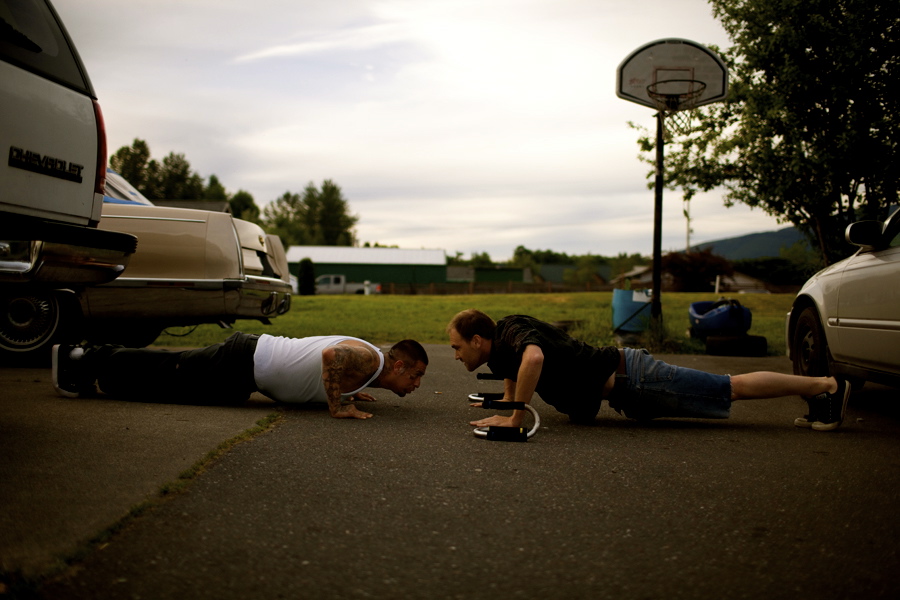 “Good Letters” is pleased today to welcome Chris Hoke as a regular contributor.
In the beginning, when God was creating the heavens and the earth, the earth was a desolate waste. Chaos. Smoking rubble. Like after a war. Our beginning, we Bible readers should understand, was post-apocalyptic.
That’s what I tell the guys in jail, as a regular chaplain there, when someone pipes up now and then with the Genesis and evolution question.
I back us up, and—depending on how much time we have before the guards come and pop the heavy door open—I teach the guys a Biblical Hebrew phrase: tohu wa-bohu. It’s fun to say. You get men with tattoos on their face all saying “tohu wa-bohu,” starting to laugh, and the dark, often-futile topic already has some light shining in.
Tohu wa-bohu is the description of God’s canvas where he began to create in Genesis 1:2. In the guys’ different American Bibles it’s often translated as “formless and void,” or “without form and empty.” But, I say, lots of scholars insist the best translation would be something like “chaos and destruction.” In the Aramaic Bible—the language Jesus spoke—it’s translated as “the earth had become ruined and uninhabited.”
What? That doesn’t sound right. At the beginning?
The conversation in the jail Bible study—and the entire creation account—shifts here.
Paying attention to the Biblical author’s language, and not to our ideologies we impose on the text, invites a different reading of how and where God is Creator. Does creation happen primarily on a blank canvas, or out of the brokenness?
The whole idea of God creating ex nihilio, out of nothing, is a Western philosophical tradition. Augustine’s actually. It gets at the same speculation as modern science’s Big Bang theories. The hypothetical hunt for a blank slate underneath all of history’s layers of butterflies and hurricanes, waterfalls and warlords.
When was the clean beginning?
But it’s possible that the author of Genesis was—and is—answering a very different set of questions. Questions much more relevant to ancient audiences, and much more relevant to my fellow readers in jail.
I share with the circle of men in red scrubs, their toes sticking out of lousy orange rubber sandals, that it’s very probable this portion of Genesis was written when the people of Israel were in captivity. In Babylon. They’d seen the tohu wa-bohu of their worlds, seen Jerusalem sacked, their Temple (the presence of their God) in a smoking rubble, their lives and meaning and orchards and children’s laughter all destroyed. They lived as captives in a darkness many men in our jail group know all too well.
What caused this “desolate waste” in Genesis 1:2? We can’t help but ask. What came before the mess?
Maybe, some scholars say, the Hebrews were surrounded by the creation myths of the Babylonians, where they were slaves: the Epic of Gilgamesh, the Enuma Elish, where the primordial gods war for power and tear at each other’s throats and create empires from the cadavers of their defeated foes. Maybe the Genesis account is picking up in the waste and devastation left by the old gods, peacefully, generously creating. But the text doesn’t tell us, doesn’t go into any of that primordial backstory.
Many times, neither do the inmates want to go into all the gnarly backstory of what brought them to this place. Genesis begins with what we face now, without speculation and investigation into all the horrors of what’s past. The creation account describes God making a new beginning out of what looked like the ending.
That’s good news when you’re looking at the ending. Or sitting in it.
“Where is God in all this?” That’s often the question for inmates I visit and with whom I pray. It’s a similar question my ecologically-minded friends are asking in the face of climate change and the steady devastation of our tender planet.
According to the creation account, God’s Spirit is right there, hovering over the deep, the abyss, the waters—ancient symbols of chaos, death and flood (already present, we should note, before God begins to create).
It is at “such places,” post-apocalyptic novelist Cormac McCarthy writes in The Crossing, “that God sits and conspires in the destruction of that which he has been at such pains to create.” That’s where you find God. Hovering over the tohu wa-bohu.
There in the chaos, Genesis tells us, God creates a beautiful garden. God separates the light from the darkness, the waters from the land—the way my guerilla gardener friends pull old tires from the brambles of abandoned lots, hack back the thorns, and drive in trucks full of organic composted soil. Then flowers. Then trees. Fruit to eat, and vegetables. Then homeless folks wander in. Then potlucks, and communion, and God’s story continues.
These guys in the circle, awaiting judges’ decisions of hope or doom, usually aren’t thinking about the other apocalypses of climate change, the devastation of species, or the collapse of Western civilization. But it applies to all that tohu wa-bohu too.
The point of all this, I might say to them, is that God as Creator is not some one-time thing at the dawn of time. Rather—like evolution—it is an ongoing, creative process across the eons. Like a guerilla artist’s career. God adapts.
Jesus sees withered and useless eye sockets of a man born blind, and there he creates sight—using dirt and spit. He sees the Roman cross outside Jerusalem, a site of criminal execution, the tohu wa-bohu where stories come to a rotting, suffocating end, and there he surprisingly manifests God’s glory to a world hardly watching. Then, from the belly of the dark grave, God’s irrepressible life bursts forth and renews all creation, Christians believe.
“So,” I might ask just before the doors pop open, “where is the darkness and waste in your life? Go back and read Genesis, sit in your darkness. Read it like an ancient design for how God might continue creating something new in the midst of your mess.”
This post was made possible through the support of a grant from The BioLogos Foundation’s Evolution and Christian Faith program. The opinions expressed are those of the author and do not necessarily reflect the views of BioLogos.
Previous Post

September 23, 2014
Bar Rescue, the Wedding at Cana, and Me
Next Post
September 25, 2014 Better Red(head) than Dead
Browse Our Archives
Select a Category A. G. Harmon Alissa Wilkinson Allison Backous Art Authors Brad Fruhauff Bradford Winters Bryan Bliss Caroline Langston Chad Thomas Johnston Chris Hoke Christiana N. Peterson Culture D.G. Myers D.L. Mayfield Daniel Bowman Jr. David Griffith Elizabeth Duffy Faith Film Greg Wolfe Guest Contributor Interview Jan Vallone Jeffrey Overstreet Jessica Eddings-Roeser Jessica Mesman Griffith Kelly Foster Lindsey Crittenden Morgan Meis music Natalie Vestin Nick Olson Peggy Rosenthal Personal Reflection Poetry Friday Reflection Relationships Review Richard Chess Richard Cole Sara Zarr Shannon Huffman Polson Sonya Bilocerkowycz Tania Runyan Tony Woodlief Topical Categories Uncategorized Vic Sizemore Writing
Select a Month October 2018 September 2018 August 2018 July 2018 June 2018 May 2018 April 2018 March 2018 February 2018 January 2018 December 2017 November 2017 October 2017 September 2017 August 2017 July 2017 June 2017 May 2017 April 2017 March 2017 February 2017 January 2017 December 2016 November 2016 October 2016 September 2016 August 2016 July 2016 June 2016 May 2016 April 2016 March 2016 February 2016 January 2016 December 2015 November 2015 October 2015 September 2015 August 2015 July 2015 June 2015 May 2015 April 2015 March 2015 February 2015 January 2015 December 2014 November 2014 October 2014 September 2014 August 2014 July 2014 June 2014 May 2014 April 2014 March 2014 February 2014 January 2014 December 2013 November 2013 October 2013 September 2013 August 2013 July 2013 June 2013 May 2013 April 2013 March 2013 February 2013 January 2013 December 2012 November 2012 October 2012 September 2012 August 2012 July 2012 June 2012 May 2012 February 2008
Follow Us!
TAKE THE
Religious Wisdom Quiz
Who said, "Speak, Lord, for your servant is listening"?
Select your answer to see how you score.
Eli Saul Samuel David
Related posts from Good Letters

Leonard Cohen’s Holy and Broken Hallelujah

Ready or Not for the Days of Awe


TRENDING AT PATHEOS Catholic

Rejecting Doom: Christian Hope And Human Action
Christianity is a religion of hope. We are to have hope and...

It’s What Comes From Within Which Matters
One of the most difficult things for us to understand is why...

Why I Choose the Eucharist Over the Sermon
Choose the Eucharist, Not the Sermon What are we supposed to get...

5 Design Elements Found in Spiritually Rooted Homes
Putting Spirituality Into Home Decor Our homes are more than our living...

Credo: A Story of God Told with the...
About 10 years ago, I began to imagine a personal "Credo" that...

The Anatomy of Divine Revelation in Catholic Thought
The claim that God has made Himself known to human beings is...
view all Catholic blogs
Ad-Free & Subscriber Log-In Subscription Support
- About Us
- 2026 Calendar
- Videos
- Podcasts
- Library of World Religions
- Faith In Media Tracker
- Advertise With Us
- Write for Us
- Privacy Policy
- Terms of Service
- Do Not Sell My Data
- Contact Us
- Radiant Digital
- Manage Newsletter Subscriptions
- Unsubscribe From Notifications
- Sitemap
Copyright 2008-2026, Patheos. All rights reserved.
Subscription Support Ad-Free & Subscriber Log-In
Follow Patheos