
BuddhistCatholicContemplativeEvangelicalGeneral ChristianHinduJewishLatter-day SaintMuslimNew VisionsProgressive Christian
Beliefs
- Buddhist
- Catholic
- Contemplative
- Evangelical
- General Christian
- Hindu
- Jewish
- Latter-day Saint
- More Voices
- Muslim
- New Visions
- Pagan
- Progressive Christian
Topics
- Religion News
- Food and Religion
- Sports and Religion
- Religious Art
- Religious Music and Entertainment
- Religious Events
- History and Religion
- Style and Religion
- Politics and Religion
- Women in Religion
- Recreation Outdoors and Religion
- Business Finance and Religion
- Careers Workplace and Religion
- Education and Religion
- Family Parenting and Religion
- Health Fitness and Religion
- Home and Religion
- Relationships and Religion
- Technology and Religion
- Travel and Religion
Columnists
- Buddhist Columnists
- Business Finance and Religion Columnists
- Careers Workplace and Religion Columnists
- Catholic Columnists
- Contemplative Columnists
- Education and Religion Columnists
- Evangelists Columnists
- Family Parenting and Religion Columnists
- General Christian Columnists
- Health Fitness and Religion Columnists
- Hindu Columnists
- History and Religion Columnists
- Home and Religion Columnists
- Jewish Columnists
- More Voices Columnists
- Latter Day Columnists
- Muslim Columnists
- New Visions Columnists
- Nonreligious Columnists
- Pagan Columnists
- Politics and Religion Columnists
- Progressive Columnists
- Recreation Outdoors and Religion Columnists
- Relationships and Religion Columnists
- Religion News Columnists
- Religious Art Columnists
- Religious Events Columnists
- Religious Music and Entertainment Columnists
- Sports and Religion Columnists
- Style and Religion Columnists
- Technology and Religion Columnists
- Travel and Religion Columnists
- Women in Religion Columnists
Resource Library
- 2026 Calendar
- Library of World Religions
- The 100 Most Holy Places on Earth
- Patheos Answers
- Podcasts
- Videos
- Faith Leaders Database
- Anglican Episcopalian
- Bahai
- Baptist
- Buddhism
- Christianity
- Confucianism
- Eastern Orthodoxy
- Hinduism
- Holiness and Pentecostal
- ISKCON
- Islam
- Judaism
- Lutheran
- Methodist
- The Church of Jesus Christ of Latter-day Saints
- New Age
- Paganism
- Presbytarian and Reformed
- Protestantism
- Religion Behind the Scenes
- Roman Catholic
- Scientology
- Shia Islam
- Sikhism
- Sufism
- Sunni Islam
- Taoism
- Zen
- See all religions
Research Tools
 Ad-Free & Subscriber Log-In Subscription Support
Ad-Free & Subscriber Log-In Subscription Support
Follow Patheos 

- Trending:
- Forgiveness
- |
- Marriage
- |
- Consciousness
- |
- Death Penalty
- |
- Election
- |
- Halloween
 Good Letters
-
Contributors
- Home
- Catholic
- We Who Are Left Behind
We Who Are Left Behind
Last updated on: September 26, 2014 at 3:44 pm by Tony Woodlief
We Who Are Left Behind 2014-09-26T15:44:57-07:00 Tony Woodlief
Patheos Explore the world's faith through different perspectives on religion and spirituality! Patheos has the views of the prevalent religions and spiritualities of the world.
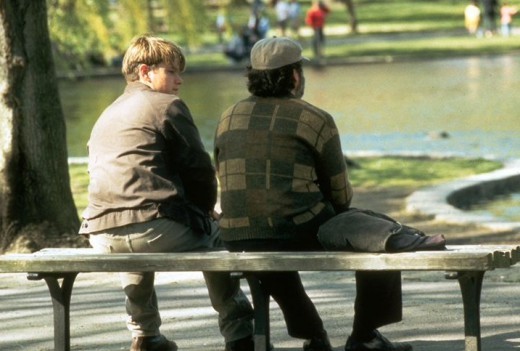 “Why’d you let go?” Conrad Jarrett shouts at the ceiling, in a climactic scene in Ordinary People. Conrad’s family has unraveled after a boating accident took his older brother, and after his own attempted suicide. In flashbacks we see the Jarrett boys gripping a rope slung across their storm-tossed, capsized sailboat. Conrad’s brother loses hold, is swallowed by the water.
Conrad’s psychiatrist elicits from him the truth beneath his survivor’s guilt, which is that he is angry. Angry his brother didn’t head for shelter sooner. Angry he couldn’t hang on. “Did it ever occur to you,” asks his psychiatrist, “that you might have been stronger?”
Seventeen years after Ordinary People garnered four Oscars, Robin Williams received an Oscar for his role in Good Will Hunting, as a psychiatrist much like the one played by Judd Hirsch in Ordinary People. In a similarly dramatic counseling scene, Williams helps the film’s protagonist find the beginning of peace.
Perhaps Robin Williams had no one to help him this way. Seventeen years after the debut of Good Will Hunting, he took his own life. Many people are talking about his suicide—most especially about how other people are talking about suicide and getting it wrong.
It’s an odd sort of game, given that none of us has ever killed himself. Not a one of us knows the thoughts of a person squeezing the last of his life like toothpaste from its tube. None of us knows whether crossing death’s threshold brings with it regret, or terror, or satisfaction, or indifference.
We only know how we feel when we are left behind, and how we feel about how other people feel. A corpse represents an opportunity for righteousness, and so people fight over the body of Robin Williams, denouncing one another as insensitive, or coddling, or whatever is the opposite of what they imagine their own noble sensibilities on this matter to be.
There was a time when Christians treated suicide harshly, as a rebellion against God, a form of destruction of Christ, insofar as the Church considered all people icons. For centuries, suicides were often refused funeral services. Sometimes their bodies were desecrated. That such abominations were committed in the name of Christ likely made them harder for families to bear.
Because let’s be clear, it’s the ones left behind who pay. The one who took his own life has departed this present misery. He is beyond our reach. Herein lies the grief and the fury, for those who remain.
Robin Williams left behind a wife and three children. Their business with him is their business, their feelings are solely and justly their own. We can try to muster sympathy, and those who have experienced something similar can conjure empathy, but here is the very real truth of things: in days we will begin to forget, and in weeks we will only remember Robin Williams on rare occasion.
Will there be a day his family forgets him? A day they do not wonder if they might have done their parts better?
Months after my mother died, her sister called the coroner. Then she spread word that my mother had overdosed. My mother always felt like her sister judged her. Perhaps she was right.
I’ve intended for months to clear this up, but I’m afraid to call the coroner. My mother suffered her entire life from depression. The heart’s pain is a weight and some days the weight presses you onto your bed so brutally that you can’t get up, and if you’ve never lain in bed for days, dreading the sight of people, ashamed that you haven’t the will to rise, straining to find the courage, then you don’t understand what depression really is.
I don’t know if my mother was pulled beneath the waves because it was her time, or if she let go. I don’t know if I might have stretched my hand across the hull and saved her.
She told me once that when I was a little boy, I was her only companion. I remember watching Mork and Mindy with her, she laughing at Robin Williams’s antics in spite of herself, and me with her, and we gripping the hull-stretched rope, not knowing that we were already in the water, that we are, all of us, in the water and clinging to this life. We hope those we love will hold on, and sometimes we even pray, but it doesn’t feel like it’s enough, because no matter how much we hope and how much we pray, they slip beneath the waves one after another, and our turn is coming.
And what happens, when my hand slips, when yours slips? I suppose that’s between each of us and a God whose judgment is at once more piercing—and more grace-filled—than our own.
So there is neither sense nor charity in judging—for good or for ill—someone who kills himself. “There is one Lawgiver,” wrote James, “who is able to save and to destroy. Who are you to judge another?” Far more useful than our judgment is prayer, for all who suffer in darkness, and for those left behind who wonder: Why’d you let go?
Tony Woodlief lives in North Carolina*.* His essays have appeared in The Wall Street Journal and *The London Times,*and his short stories appeared in Image, Ruminate, Saint Katherine Review, and Dappled Things. His website iswww.tonywoodlief.com.
Previous Post

August 22, 2014
How to Talk to the Dying
Next Post
August 26, 2014 Lessons of The Giver
Browse Our Archives
Select a Category A. G. Harmon Alissa Wilkinson Allison Backous Art Authors Brad Fruhauff Bradford Winters Bryan Bliss Caroline Langston Chad Thomas Johnston Chris Hoke Christiana N. Peterson Culture D.G. Myers D.L. Mayfield Daniel Bowman Jr. David Griffith Elizabeth Duffy Faith Film Greg Wolfe Guest Contributor Interview Jan Vallone Jeffrey Overstreet Jessica Eddings-Roeser Jessica Mesman Griffith Kelly Foster Lindsey Crittenden Morgan Meis music Natalie Vestin Nick Olson Peggy Rosenthal Personal Reflection Poetry Friday Reflection Relationships Review Richard Chess Richard Cole Sara Zarr Shannon Huffman Polson Sonya Bilocerkowycz Tania Runyan Tony Woodlief Topical Categories Uncategorized Vic Sizemore Writing
Select a Month October 2018 September 2018 August 2018 July 2018 June 2018 May 2018 April 2018 March 2018 February 2018 January 2018 December 2017 November 2017 October 2017 September 2017 August 2017 July 2017 June 2017 May 2017 April 2017 March 2017 February 2017 January 2017 December 2016 November 2016 October 2016 September 2016 August 2016 July 2016 June 2016 May 2016 April 2016 March 2016 February 2016 January 2016 December 2015 November 2015 October 2015 September 2015 August 2015 July 2015 June 2015 May 2015 April 2015 March 2015 February 2015 January 2015 December 2014 November 2014 October 2014 September 2014 August 2014 July 2014 June 2014 May 2014 April 2014 March 2014 February 2014 January 2014 December 2013 November 2013 October 2013 September 2013 August 2013 July 2013 June 2013 May 2013 April 2013 March 2013 February 2013 January 2013 December 2012 November 2012 October 2012 September 2012 August 2012 July 2012 June 2012 May 2012 February 2008
Follow Us!
TAKE THE
Religious Wisdom Quiz
What does the name "Samuel" mean?
Select your answer to see how you score.
The Lord saves Chosen one God is my judge God has heard
Related posts from Good Letters

Morning in a Forgotten Neighborhood



Leonard Cohen’s Holy and Broken Hallelujah
TRENDING AT PATHEOS Catholic

Rejecting Doom: Christian Hope And Human Action
Christianity is a religion of hope. We are to have hope and...

It’s What Comes From Within Which Matters
One of the most difficult things for us to understand is why...

Why I Choose the Eucharist Over the Sermon
Choose the Eucharist, Not the Sermon What are we supposed to get...

5 Design Elements Found in Spiritually Rooted Homes
Putting Spirituality Into Home Decor Our homes are more than our living...

Credo: A Story of God Told with the...
About 10 years ago, I began to imagine a personal "Credo" that...

The Anatomy of Divine Revelation in Catholic Thought
The claim that God has made Himself known to human beings is...
view all Catholic blogs
Ad-Free & Subscriber Log-In Subscription Support
- About Us
- 2026 Calendar
- Videos
- Podcasts
- Library of World Religions
- Faith In Media Tracker
- Advertise With Us
- Write for Us
- Privacy Policy
- Terms of Service
- Do Not Sell My Data
- Contact Us
- Radiant Digital
- Manage Newsletter Subscriptions
- Unsubscribe From Notifications
- Sitemap
Copyright 2008-2026, Patheos. All rights reserved.
Subscription Support Ad-Free & Subscriber Log-In
Follow Patheos