
BuddhistCatholicContemplativeEvangelicalGeneral ChristianHinduJewishLatter-day SaintMuslimNew VisionsProgressive Christian
Beliefs
- Buddhist
- Catholic
- Contemplative
- Evangelical
- General Christian
- Hindu
- Jewish
- Latter-day Saint
- More Voices
- Muslim
- New Visions
- Pagan
- Progressive Christian
Topics
- Religion News
- Food and Religion
- Sports and Religion
- Religious Art
- Religious Music and Entertainment
- Religious Events
- History and Religion
- Style and Religion
- Politics and Religion
- Women in Religion
- Recreation Outdoors and Religion
- Business Finance and Religion
- Careers Workplace and Religion
- Education and Religion
- Family Parenting and Religion
- Health Fitness and Religion
- Home and Religion
- Relationships and Religion
- Technology and Religion
- Travel and Religion
Columnists
- Buddhist Columnists
- Business Finance and Religion Columnists
- Careers Workplace and Religion Columnists
- Catholic Columnists
- Contemplative Columnists
- Education and Religion Columnists
- Evangelists Columnists
- Family Parenting and Religion Columnists
- General Christian Columnists
- Health Fitness and Religion Columnists
- Hindu Columnists
- History and Religion Columnists
- Home and Religion Columnists
- Jewish Columnists
- More Voices Columnists
- Latter Day Columnists
- Muslim Columnists
- New Visions Columnists
- Nonreligious Columnists
- Pagan Columnists
- Politics and Religion Columnists
- Progressive Columnists
- Recreation Outdoors and Religion Columnists
- Relationships and Religion Columnists
- Religion News Columnists
- Religious Art Columnists
- Religious Events Columnists
- Religious Music and Entertainment Columnists
- Sports and Religion Columnists
- Style and Religion Columnists
- Technology and Religion Columnists
- Travel and Religion Columnists
- Women in Religion Columnists
Resource Library
- 2026 Calendar
- Library of World Religions
- The 100 Most Holy Places on Earth
- Patheos Answers
- Podcasts
- Videos
- Faith Leaders Database
- Anglican Episcopalian
- Bahai
- Baptist
- Buddhism
- Christianity
- Confucianism
- Eastern Orthodoxy
- Hinduism
- Holiness and Pentecostal
- ISKCON
- Islam
- Judaism
- Lutheran
- Methodist
- The Church of Jesus Christ of Latter-day Saints
- New Age
- Paganism
- Presbytarian and Reformed
- Protestantism
- Religion Behind the Scenes
- Roman Catholic
- Scientology
- Shia Islam
- Sikhism
- Sufism
- Sunni Islam
- Taoism
- Zen
- See all religions
Research Tools
 Ad-Free & Subscriber Log-In Subscription Support
Ad-Free & Subscriber Log-In Subscription Support
Follow Patheos 

- Trending:
- Forgiveness
- |
- Marriage
- |
- Consciousness
- |
- Death Penalty
- |
- Election
- |
- Halloween
 Good Letters
-
Contributors
- Home
- Catholic
- The Creationist Crisis Reprise
The Creationist Crisis Reprise
Last updated on: July 20, 2015 at 12:40 pm by Vic Sizemore
The Creationist Crisis Reprise 2015-07-20T12:40:58-07:00 Vic Sizemore
Patheos Explore the world's faith through different perspectives on religion and spirituality! Patheos has the views of the prevalent religions and spiritualities of the world.
Sev eral months ago I blogged about the Ken Ham Bill Nye debate at Liberty University. I hadn’t given the two much thought since then until last week when they both rose back into the media. My son’s Popular Science magazine arrived with Nye on the front, his fists wrapped like a boxer’s, and the title of the article about him: Nerd Fight! The same day, Ham hit the news as a butt of jokes for blogging that intelligent alien life cannot exist because, “the Bible makes it clear that Adam’s sin affected the whole universe. This means that any aliens would also be affected by Adam’s sin, but because they are not Adam’s descendants, they can’t have salvation… To suggest that aliens could respond to the gospel is just totally wrong.”
What struck me about the Ham kerfuffle is how this arises from the same place that his strict stance on young earth creationism does. At its core, this is not about the science; it is about hermeneutics.
After my post about the LU debate, I had a brief exchange with a commenter who identified himself as Paul. Paul took issue with my calling Ken Ham a biblical literalist—and my saying that this was the reason he could not look at the scientific evidence honestly.
In our subsequent exchange, Paul made the following assertions:
If you interpret Genesis as figurative, that cause problems with what the Bible says elsewhere (example: Romans 5:12 says that death is a result of sin, but if evolution is true then death existed before Adam and Eve existed).
Of course the days in Genesis 1 are 24-hour days. If they weren’t, you’d have problems with Exodus 20:11, Exodus 31:17, as well as other verses. So, yes, it is natural to read Genesis 1 as literal 24-hour days.
Like I said, when Ken Ham responded with “I’m a Christian”, I think he means that there is no scientific or historical evidence that would contradict the Christian worldview.
What does one part of scripture’s relation to another have to do with an analysis of scientific evidence?
The basic theology behind what Paul calls the Christian worldview, and this insistence on young-earth creationism is Premillennial Dispensationalism. It was developed in the late 1800s by John Nelson Darby and it harmonizes the entire Bible into an all-encompassing story of the entire universe. It is a map, a guide for looking at history, judging present crises, and knowing with certainty what will come in the future.
According to this system, the purpose of all creation is God’s relationship with humanity, which he carries out according to seven different governing systems or dispensations:
1. Innocence: begins with the literal six-day creation and ends when Adam and Eve screw up
2. Conscience: everyone screws this up and has to be drowned, except for Noah and his family
3. Government: this takes us from Noah to the promise that Abraham will father nations
4. Promise: from Abraham to Moses and the Law
5. Law: this dispensation takes us from Moses to Jesus
6. Grace: the dispensation in which we are living right now
7. Millennial Kingdom: after the Rapture and the seven years of the Great Tribulation
Before the first dispensation is eternity past, in which only God exists, and after the thousand-year rule of the Millennial Kingdom is eternity future, in which human beings exist consciously in heaven or hell.
I remember Sunday school charts in the dank church basement depicting all of existence, past present and future. With some variations—I remember some hot controversies over whether or not Christians would be raptured before the Great Tribulation or suffer through it—this is the basic timeline.
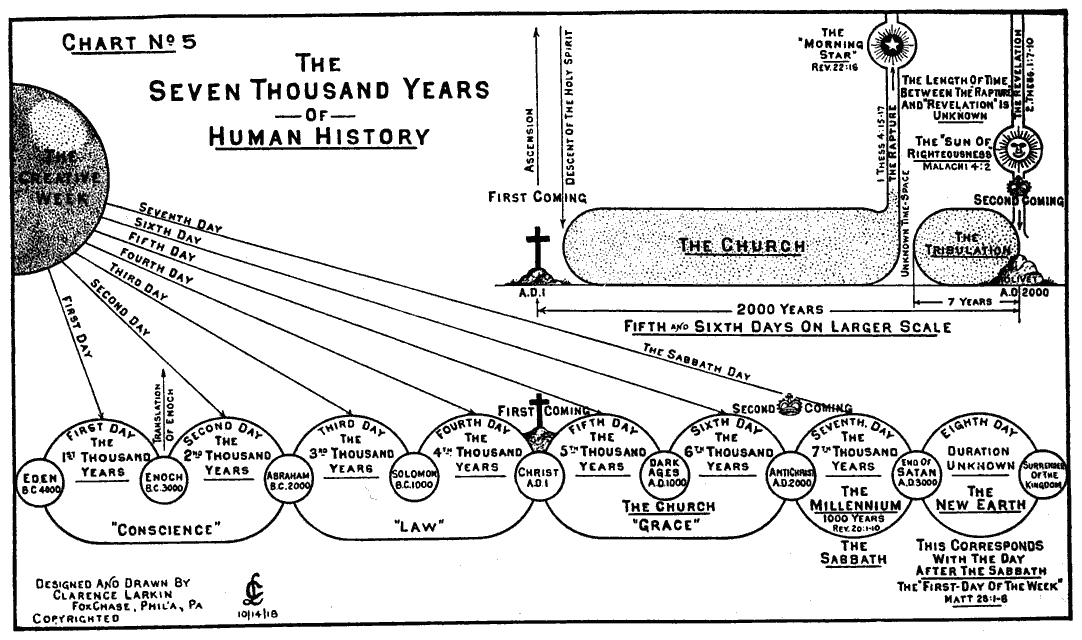
It is a tightly structured harmonization of the entire Bible into a categorical universal history, coupled with the doctrine of Biblical inerrancy—the Bible does not contain one iota of mistaken or false information—at the root of young earth creationists’ refusal to look honestly at the scientific evidence. If one tenet falls, the whole system collapses.
Several years ago I blogged here about a group of former Liberty students in town who have left their childhood faith:
The belief system they’ve been taught all their lives is a theology of one calcified piece, each point taught with the same absolute certainty as every other. They begin to notice oddities in this theological landscape. A stone seems fake, held in place unnaturally—say the doctrine of verbal, plenary biblical inspiration and its subsequent inerrancy; or the prohibition against women in the ministry; or the insistence on a literal, twenty-four-hour, six-day creation six thousand years ago—and they get suspicious, start to kick around.
They kick away a stone—decide, for example, that they cannot believe in a literal talking snake causing all the world’s woes any more than they could believe in a literal, historical Pandora. The one stone falls away, and then another falls after it, and with that the collapse begins.
The ground crumbles from beneath them in outward circles like ripples on water. Everything their lives were built on falls away until they are floating, totally unmoored, casting about among the twisting and drifting fragments of their childhood faith, trying to cobble something together that they can live with.
When I was young, I heard more than once in church that if a single scientific or historical claim in Scripture was wrong then none of it could be trusted. It terrified me because even at a young age I recognized inconsistencies and seeming contradictions in the texts.
It came as a great relief years later to realize Biblical literalism is not the only option, the Christian worldview is bigger, and richer, and deeper than that. It is quite possible to be a Christian who engages the scientific community without the spirit of fear.
This post was made possible through the support of a grant from The BioLogos Foundation’s Evolution and Christian Faith program. The opinions expressed are those of the author and do not necessarily reflect the views of BioLogos.
Vic Sizemore earned his MFA in fiction from Seattle Pacific University in 2009. His short stories are published or forthcoming in StoryQuarterly, Southern Humanities Review, Connecticut Review, Portland Review, Blue Mesa Review, Sou’wester, Silk Road Review, Atticus Review, PANK Magazine Fiction Fix, Vol.1 Brooklyn, Conclave, and elsewhere. Excerpts from his novel The Calling are published in Connecticut Review, Portland Review, Prick of the Spindle, Burrow Press Review, Rock & Sling, and Relief. His fiction has won the New Millennium Writings Award for Fiction, and been nominated for Best American Nonrequired Reading and a Pushcart Prize. You can find Vic at http://vicsizemore.wordpress.com/.
Previous Post

August 27, 2014
Your Life Doesn't Mean What You Think It Means
Next Post
August 29, 2014 Fiction is Truer than Fact
Browse Our Archives
Select a Category A. G. Harmon Alissa Wilkinson Allison Backous Art Authors Brad Fruhauff Bradford Winters Bryan Bliss Caroline Langston Chad Thomas Johnston Chris Hoke Christiana N. Peterson Culture D.G. Myers D.L. Mayfield Daniel Bowman Jr. David Griffith Elizabeth Duffy Faith Film Greg Wolfe Guest Contributor Interview Jan Vallone Jeffrey Overstreet Jessica Eddings-Roeser Jessica Mesman Griffith Kelly Foster Lindsey Crittenden Morgan Meis music Natalie Vestin Nick Olson Peggy Rosenthal Personal Reflection Poetry Friday Reflection Relationships Review Richard Chess Richard Cole Sara Zarr Shannon Huffman Polson Sonya Bilocerkowycz Tania Runyan Tony Woodlief Topical Categories Uncategorized Vic Sizemore Writing
Select a Month October 2018 September 2018 August 2018 July 2018 June 2018 May 2018 April 2018 March 2018 February 2018 January 2018 December 2017 November 2017 October 2017 September 2017 August 2017 July 2017 June 2017 May 2017 April 2017 March 2017 February 2017 January 2017 December 2016 November 2016 October 2016 September 2016 August 2016 July 2016 June 2016 May 2016 April 2016 March 2016 February 2016 January 2016 December 2015 November 2015 October 2015 September 2015 August 2015 July 2015 June 2015 May 2015 April 2015 March 2015 February 2015 January 2015 December 2014 November 2014 October 2014 September 2014 August 2014 July 2014 June 2014 May 2014 April 2014 March 2014 February 2014 January 2014 December 2013 November 2013 October 2013 September 2013 August 2013 July 2013 June 2013 May 2013 April 2013 March 2013 February 2013 January 2013 December 2012 November 2012 October 2012 September 2012 August 2012 July 2012 June 2012 May 2012 February 2008
Follow Us!
TAKE THE
Religious Wisdom Quiz
Who betrayed Jesus for thirty pieces of silver?
Select your answer to see how you score.
James Peter Judas Saul
Related posts from Good Letters

Leonard Cohen’s Holy and Broken Hallelujah

Ready or Not for the Days of Awe


TRENDING AT PATHEOS Catholic

Rejecting Doom: Christian Hope And Human Action
Christianity is a religion of hope. We are to have hope and...

It’s What Comes From Within Which Matters
One of the most difficult things for us to understand is why...

Why I Choose the Eucharist Over the Sermon
Choose the Eucharist, Not the Sermon What are we supposed to get...

5 Design Elements Found in Spiritually Rooted Homes
Putting Spirituality Into Home Decor Our homes are more than our living...

Credo: A Story of God Told with the...
About 10 years ago, I began to imagine a personal "Credo" that...

The Anatomy of Divine Revelation in Catholic Thought
The claim that God has made Himself known to human beings is...
view all Catholic blogs
Ad-Free & Subscriber Log-In Subscription Support
- About Us
- 2026 Calendar
- Videos
- Podcasts
- Library of World Religions
- Faith In Media Tracker
- Advertise With Us
- Write for Us
- Privacy Policy
- Terms of Service
- Do Not Sell My Data
- Contact Us
- Radiant Digital
- Manage Newsletter Subscriptions
- Unsubscribe From Notifications
- Sitemap
Copyright 2008-2026, Patheos. All rights reserved.
Subscription Support Ad-Free & Subscriber Log-In
Follow Patheos