
BuddhistCatholicContemplativeEvangelicalGeneral ChristianHinduJewishLatter-day SaintMuslimNew VisionsProgressive Christian
Beliefs
- Buddhist
- Catholic
- Contemplative
- Evangelical
- General Christian
- Hindu
- Jewish
- Latter-day Saint
- More Voices
- Muslim
- New Visions
- Pagan
- Progressive Christian
Topics
- Religion News
- Food and Religion
- Sports and Religion
- Religious Art
- Religious Music and Entertainment
- Religious Events
- History and Religion
- Style and Religion
- Politics and Religion
- Women in Religion
- Recreation Outdoors and Religion
- Business Finance and Religion
- Careers Workplace and Religion
- Education and Religion
- Family Parenting and Religion
- Health Fitness and Religion
- Home and Religion
- Relationships and Religion
- Technology and Religion
- Travel and Religion
Columnists
- Buddhist Columnists
- Business Finance and Religion Columnists
- Careers Workplace and Religion Columnists
- Catholic Columnists
- Contemplative Columnists
- Education and Religion Columnists
- Evangelists Columnists
- Family Parenting and Religion Columnists
- General Christian Columnists
- Health Fitness and Religion Columnists
- Hindu Columnists
- History and Religion Columnists
- Home and Religion Columnists
- Jewish Columnists
- More Voices Columnists
- Latter Day Columnists
- Muslim Columnists
- New Visions Columnists
- Nonreligious Columnists
- Pagan Columnists
- Politics and Religion Columnists
- Progressive Columnists
- Recreation Outdoors and Religion Columnists
- Relationships and Religion Columnists
- Religion News Columnists
- Religious Art Columnists
- Religious Events Columnists
- Religious Music and Entertainment Columnists
- Sports and Religion Columnists
- Style and Religion Columnists
- Technology and Religion Columnists
- Travel and Religion Columnists
- Women in Religion Columnists
Resource Library
- 2026 Calendar
- Library of World Religions
- The 100 Most Holy Places on Earth
- Patheos Answers
- Podcasts
- Videos
- Faith Leaders Database
- Anglican Episcopalian
- Bahai
- Baptist
- Buddhism
- Christianity
- Confucianism
- Eastern Orthodoxy
- Hinduism
- Holiness and Pentecostal
- ISKCON
- Islam
- Judaism
- Lutheran
- Methodist
- The Church of Jesus Christ of Latter-day Saints
- New Age
- Paganism
- Presbytarian and Reformed
- Protestantism
- Religion Behind the Scenes
- Roman Catholic
- Scientology
- Shia Islam
- Sikhism
- Sufism
- Sunni Islam
- Taoism
- Zen
- See all religions
Research Tools
 Ad-Free & Subscriber Log-In Subscription Support
Ad-Free & Subscriber Log-In Subscription Support
Follow Patheos 

- Trending:
- Forgiveness
- |
- Marriage
- |
- Consciousness
- |
- Death Penalty
- |
- Election
- |
- Halloween
 Good Letters
-
Contributors
- Home
- Catholic
- Rules for Celebrating: An Observation from the Way of Saint James, Part 2
Rules for Celebrating: An Observation from the Way of Saint James, Part 2
Last updated on: November 24, 2014 at 8:44 am by Jan Vallone
Rules for Celebrating: An Observation from the Way of Saint James, Part 2 2014-11-24T08:44:54-07:00 Jan Vallone
Patheos Explore the world's faith through different perspectives on religion and spirituality! Patheos has the views of the prevalent religions and spiritualities of the world.
 Continued from last week.
The Way of Saint James—El Camino de Santiago—is a pilgrimage across Spain that began in the Middle Ages and remains popular today. Each year 200,000 pilgrims walk a route to Santiago de Compostela, a city where, according to tradition, the apostle James the Greater is interred.
Last September my husband and I were among the pilgrims. We hiked 200 miles from Léon in stages, many with Fr. Lukasz, a sprightly, thirty-something priest, and a group of young adults from the Catholic Newman Center at the University of Washington.
Fr. Lukasz set the pattern of our days right at the outset of the journey. We rose before dawn and departed Rabanal del Camino, a stone village with a tiny central square. As we walked beneath the moon and stars, guided by a few pilgrim headlamps, I could feel the grade increasing, straining the backs of my legs. We were ascending the pass of Irago. Soon the sun rose lemon-yellow, revealing iridescent mountains, releasing the scents of heather and gorse.
By midmorning we reached the Cruz de Ferro, a simple iron cross atop a weathered pole that marks the Camino’s highest point. There we stopped for morning prayers before descending the pass through several villages: Manjarín, Acebo, and Riego de Ambros, where we walked through a grove of giant chestnuts and a green, wild-flowered vale. After crossing a Roman stone bridge over the Río Meruelo, we stopped at Molinaseca, a medieval town where we would spend the night.
Fr. Lukasz’s practice was to celebrate Mass every evening at the local church. When we arrived at a destination, he’d call the parish priest to make arrangements. Our Mass in Rabanal had taken place at the Iglesia de la Santa Maria, a twelfth century Romanesque chapel. There, the Benedictine monks had sung us vespers and then joined us for our English-language Mass.
In Molinaseca, though, Fr. Lukasz could reach no priest on the phone, so at six that evening we gathered at the parish church to see if we could rustle someone up. The place was shut tight and deserted.
We decided to try another church. Walking up a hill, we found the Santuario de Nuestra Señora de las Angustias tucked into the slope. This eleventh century stone chapel has a bell tower at its center with a courtyard on either side enclosed by iron palisades. Every door was bolted, every gate padlocked.
What were we to do? Have the Mass outside? Unthinkable. More rules govern Roman Catholic Masses than formal dinners in my home.
Like those formal dinners, the Mass has four components: introductory rites, when the priest enters the church and promenades to the altar as the parishioners sing a hymn; the Liturgy of the Word, when the priest reads from the Gospel and gives a homily; the Liturgy of the Eucharist, when the priest prepares the bread and wine and gives Holy Communion to the congregation; concluding rites, when the priest dismisses the church.
Every part of the Mass requires a fixed set of prayers, each with a designated posture—sitting, standing, bowing, genuflecting, kneeling—each in a specified location—pew, aisle, ambo, altar—some with a designated gesture—signing the cross, striking the breast, folding the hands.
At Mass, the altar is central. Most often it’s covered in white linen with a crucifix on it or close by. A corporal—another, smaller cloth—must be placed front and center on the altar. There the priest will prepare the Eucharist, pouring wine in a chalice and placing the hosts on a paten—a special communion plate. All serving vessels must be made of precious metal. Two lit candles are required at the altar, though four or six are preferred.
Knowing these rules and procedures, I assumed we’d have to cancel our Mass in Molinaseca, given the closure of the church.
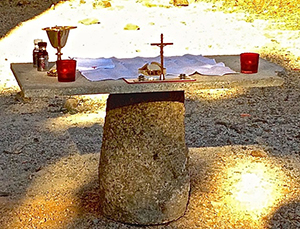
Fr. Lukasz was unfazed, though, and his flock flew into action. Bordering one church courtyard was a gravel lot edged by a curb. There sat a knee-high stone baluster abandoned in a corner. Two muscled pilgrims dragged and rolled it to a central place. Inside the palisaded courtyard a broken marble slab leaned against a wall. Three pilgrims scaled the iron rails and heaved the slab to the other side where others reached up to receive it, hauled it to the baluster, and set it like a tabletop.
Fr. Lukasz whipped some items from his backpack: crucifix, corporal, chalice, flasks of wine and water, hosts, paten, Missal, two votive candles in red glass. He set them on the improvised altar and invited us to Mass.
That evening the sun set tangerine as Fr. Lukasz led our celebration. Passersby joined us in other languages—Spanish, Italian, French. Some of us stood on the gravel, others sat on the curb, few ever changed postures, no one bothered to kneel. After the Eucharist, a breeze came across the mountain and we sang Taizé hymns. I can’t remember ever feeling more communion or a greater peace.
This is why I calmly ditched the rules at my son’s commencement celebration.
We pulled a plywood board from our basement and placed it on our dining table, making it big enough for our guests. We covered it with a threadbare cloth, the only cloth large enough to fit. We set the table with mismatched plates and flatware, paper napkins, and partly used candles. As the rain fell outside the window, our guests chose their own seats, drank beer from bottles, ate corn and burgers with their hands. All of us chatted and laughed.
Oh, that Molinaseca feeling.
Once, a woman named Martha knocked herself out cooking dinner while her sister sat talking with Jesus. Martha complained about her sister’s idleness; it was the women’s job to serve. Jesus didn’t take her side. Instead, he told Martha to relax and to emulate her sister, who better knew what a celebration was.
Jan Vallone is the author of Pieces of Someday: One Woman’s Search for Meaning in Lawyering Family, Italy, Church, and a Tiny Jewish High School,which won the Reader Views Reviewers’ Choice Award. Her stories have appeared in many publications. She lives and teaches writing in Seattle.
Previous Post

August 15, 2014
Our Mother Mary
Next Post
August 19, 2014 Susan Sontag, Simon Weil, and the Pursuit of Seriousness
Browse Our Archives
Select a Category A. G. Harmon Alissa Wilkinson Allison Backous Art Authors Brad Fruhauff Bradford Winters Bryan Bliss Caroline Langston Chad Thomas Johnston Chris Hoke Christiana N. Peterson Culture D.G. Myers D.L. Mayfield Daniel Bowman Jr. David Griffith Elizabeth Duffy Faith Film Greg Wolfe Guest Contributor Interview Jan Vallone Jeffrey Overstreet Jessica Eddings-Roeser Jessica Mesman Griffith Kelly Foster Lindsey Crittenden Morgan Meis music Natalie Vestin Nick Olson Peggy Rosenthal Personal Reflection Poetry Friday Reflection Relationships Review Richard Chess Richard Cole Sara Zarr Shannon Huffman Polson Sonya Bilocerkowycz Tania Runyan Tony Woodlief Topical Categories Uncategorized Vic Sizemore Writing
Select a Month October 2018 September 2018 August 2018 July 2018 June 2018 May 2018 April 2018 March 2018 February 2018 January 2018 December 2017 November 2017 October 2017 September 2017 August 2017 July 2017 June 2017 May 2017 April 2017 March 2017 February 2017 January 2017 December 2016 November 2016 October 2016 September 2016 August 2016 July 2016 June 2016 May 2016 April 2016 March 2016 February 2016 January 2016 December 2015 November 2015 October 2015 September 2015 August 2015 July 2015 June 2015 May 2015 April 2015 March 2015 February 2015 January 2015 December 2014 November 2014 October 2014 September 2014 August 2014 July 2014 June 2014 May 2014 April 2014 March 2014 February 2014 January 2014 December 2013 November 2013 October 2013 September 2013 August 2013 July 2013 June 2013 May 2013 April 2013 March 2013 February 2013 January 2013 December 2012 November 2012 October 2012 September 2012 August 2012 July 2012 June 2012 May 2012 February 2008
Follow Us!
TAKE THE
Religious Wisdom Quiz
What currency did Judas receive for betraying Jesus?
Select your answer to see how you score.
Silver Gold Bronze Copper
Related posts from Good Letters



Marital Anger and Icelandic Rock Spirits
TRENDING AT PATHEOS Catholic

Creation, Preservation, and Teleology in Catholic Theology
As I write this, it is very early Monday morning. Like millions...

The Parable Of The Sower And The Word...
One of Christ’s most famous parables is that of the sower who...

Rejecting Doom: Christian Hope And Human Action
Christianity is a religion of hope. We are to have hope and...

Why I Choose the Eucharist Over the Sermon
Choose the Eucharist, Not the Sermon What are we supposed to get...

5 Design Elements Found in Spiritually Rooted Homes
Putting Spirituality Into Home Decor Our homes are more than our living...

Credo: A Story of God Told with the...
About 10 years ago, I began to imagine a personal "Credo" that...
view all Catholic blogs
Ad-Free & Subscriber Log-In Subscription Support
- About Us
- 2026 Calendar
- Videos
- Podcasts
- Library of World Religions
- Faith In Media Tracker
- Advertise With Us
- Write for Us
- Privacy Policy
- Terms of Service
- Do Not Sell My Data
- Contact Us
- Radiant Digital
- Manage Newsletter Subscriptions
- Unsubscribe From Notifications
- Sitemap
Copyright 2008-2026, Patheos. All rights reserved.
Subscription Support Ad-Free & Subscriber Log-In
Follow Patheos