
BuddhistCatholicContemplativeEvangelicalGeneral ChristianHinduJewishLatter-day SaintMuslimNew VisionsProgressive Christian
Beliefs
- Buddhist
- Catholic
- Contemplative
- Evangelical
- General Christian
- Hindu
- Jewish
- Latter-day Saint
- More Voices
- Muslim
- New Visions
- Pagan
- Progressive Christian
Topics
- Religion News
- Food and Religion
- Sports and Religion
- Religious Art
- Religious Music and Entertainment
- Religious Events
- History and Religion
- Style and Religion
- Politics and Religion
- Women in Religion
- Recreation Outdoors and Religion
- Business Finance and Religion
- Careers Workplace and Religion
- Education and Religion
- Family Parenting and Religion
- Health Fitness and Religion
- Home and Religion
- Relationships and Religion
- Technology and Religion
- Travel and Religion
Columnists
- Buddhist Columnists
- Business Finance and Religion Columnists
- Careers Workplace and Religion Columnists
- Catholic Columnists
- Contemplative Columnists
- Education and Religion Columnists
- Evangelists Columnists
- Family Parenting and Religion Columnists
- General Christian Columnists
- Health Fitness and Religion Columnists
- Hindu Columnists
- History and Religion Columnists
- Home and Religion Columnists
- Jewish Columnists
- More Voices Columnists
- Latter Day Columnists
- Muslim Columnists
- New Visions Columnists
- Nonreligious Columnists
- Pagan Columnists
- Politics and Religion Columnists
- Progressive Columnists
- Recreation Outdoors and Religion Columnists
- Relationships and Religion Columnists
- Religion News Columnists
- Religious Art Columnists
- Religious Events Columnists
- Religious Music and Entertainment Columnists
- Sports and Religion Columnists
- Style and Religion Columnists
- Technology and Religion Columnists
- Travel and Religion Columnists
- Women in Religion Columnists
Resource Library
- 2026 Calendar
- Library of World Religions
- The 100 Most Holy Places on Earth
- Patheos Answers
- Podcasts
- Videos
- Faith Leaders Database
- Anglican Episcopalian
- Bahai
- Baptist
- Buddhism
- Christianity
- Confucianism
- Eastern Orthodoxy
- Hinduism
- Holiness and Pentecostal
- ISKCON
- Islam
- Judaism
- Lutheran
- Methodist
- The Church of Jesus Christ of Latter-day Saints
- New Age
- Paganism
- Presbytarian and Reformed
- Protestantism
- Religion Behind the Scenes
- Roman Catholic
- Scientology
- Shia Islam
- Sikhism
- Sufism
- Sunni Islam
- Taoism
- Zen
- See all religions
Research Tools
 Ad-Free & Subscriber Log-In Subscription Support
Ad-Free & Subscriber Log-In Subscription Support
Follow Patheos 

- Trending:
- Forgiveness
- |
- Marriage
- |
- Consciousness
- |
- Death Penalty
- |
- Election
- |
- Halloween
 Good Letters
-
Contributors
- Home
- Catholic
- Our Mother Mary
Our Mother Mary
Last updated on: August 15, 2014 at 1:30 am by Caroline Langston
Our Mother Mary 2014-08-14T17:01:10-07:00 Caroline Langston
Patheos Explore the world's faith through different perspectives on religion and spirituality! Patheos has the views of the prevalent religions and spiritualities of the world.
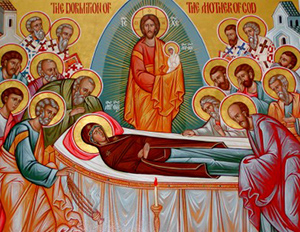 Today is the Feast of the Dormition (the “falling asleep”) of the Mother of God. It is the analogue in the Eastern Orthodox Church of the Assumption of the Virgin in Roman Catholicism, and on balance, the similarities between the two commemorations are greater than their differences: The Dormition is one of the twelve Great Feasts in the Orthodox year. The Assumption is a holy day of obligation and, I am told, is superseded only by Easter in its importance for Catholics.
The heart of the feast remains the same for both: the end of Mary’s earthly life of faithfulness, the culmination of her own original yes in her agreement to bear the Son of God in the reception of her sanctified body into heaven. It is believed (contrary to some popular misunderstanding) by both Orthodox and Roman Catholics that Mary experienced a normal, natural death, but received upon her burial the glorified state—reunion of body and soul—that is the ultimate end for which all we faithful pray.
In their aesthetic emphasis, though, the two feasts are utterly different: In all the Roman Catholic portrayals of the event that I have seen, Mary is bright-faced and young—evoking the description of the woman “clothed with the sun” from Revelation.
On the rich, glowing portrait that backs the altar of St. Mary of the Assumption in Govans, Baltimore, where my in-laws are parishioners, she is crowned with flowing hair that echoes the undulations of her robe as she is borne heavenward.
On the apron of concrete that tops the postconciliar mega-modern (built 1968) Faith Community of St. Mary in Landover Hills, Maryland, a couple of miles from my house, the Assumption is presented in bas relief, with the Blessed Virgin’s feet treading on billowing clouds that always remind me, paradoxically, of the cover of the 1965 Herb Alpert album Whipped Cream and Other Delights.
In comparison with all that frothy lightness—and I say this as a woman married to a Catholic, with Catholic images of Mary in my house as well as Orthodox ones—the Orthodox icon of the Dormition is weighty and grave.
It is suffused with that characteristically Orthodox emotion that others have termed bright sadness, an overwhelming joy in sorrow, in the dichotomy between the Now-and-Not-Yet, the Kingdom her son ransomed, but which has not culminated in its final fulfillment.
Here the Mother of God dances not on clouds, but lies flat on a heavily-covered bed, echoing the icon of her own mother, St. Anna, when she brought forth baby Mary in childbirth. Just as Anna was, Mary is not a young woman here, but has the covered hair of a matron and a face that looks lined and resigned to me, though that just might be my misperception of certain conventions of iconography.
Lying on her deathbed, Mary is surrounded by the flock of Apostles, who according to one tradition were all made miraculously present at the event, with (for some reason) the exception of Thomas.
The tableau is thus oddly earth-centered, which seems fitting to me, given that it rests on the oblique line of the Church’s extra-biblical tradition: This is a scene I can truly and utterly believe, whether it is in the Bible or not, and I cannot look at the icon of the Dormition without thinking of, and praying for, my own mother, lying on her deathbed and gasping for breath in the pulmonary unit at Inova Fairfax Hospital.
That my mother, with her sorrows, could be mothered by the Mother, who in her own sorrow and obedience and incomprehensible vigilance can witness for all of us before the Bright Throne.
And we, both male and female, must be about the very business of witnessing for God to each other: For it is not just women who are called to be like the Virgin Mary—
It is all of us Christians.
Mary—the Theotokos, the god bearer, as Orthodox call her—is both the literal and symbolic uniting of heaven and earth, and we, too, must follow in her steps.
The tradition is that when Thomas finally made it back to Jerusalem after Mary’s death, the stone from Mary’s tomb was rolled away and the inside was revealed to be empty. She who had borne the universe inside her had been borne away to it.
Or as we sing in the Kontakion hymn of the feast:
Neither the tomb, nor death could hold the Theotokos,
Who is constant in prayer and our firm hope in her intercessions.
For being the Mother of Life,
She was translated to life by the One who dwelt in her virginal womb.
In some icons of the Dormition, Christ descends from the top of the frame amid the shining almond of a mandorla, a sign that the events depicted therein can only be spiritually perceived. In his arms, he carries a swaddling-wrapped female baby that is said to represent Mary’s soul.
I look at that tiny baby, and think of my own little daughter when she was born, and Christ lifting up my mother’s soul, and I think that little icon baby is the ultimate objective correlative for all the thinking and psychoanalysis I’ve done in my years on this earth, the end goal to which all of us should aspire. That we might, like our model Mary, be gathered, lifted, and transformed.
Next Post

August 18, 2014 Rules for Celebrating: An Observation from the Way of Saint James, Part 2
Browse Our Archives
Select a Category A. G. Harmon Alissa Wilkinson Allison Backous Art Authors Brad Fruhauff Bradford Winters Bryan Bliss Caroline Langston Chad Thomas Johnston Chris Hoke Christiana N. Peterson Culture D.G. Myers D.L. Mayfield Daniel Bowman Jr. David Griffith Elizabeth Duffy Faith Film Greg Wolfe Guest Contributor Interview Jan Vallone Jeffrey Overstreet Jessica Eddings-Roeser Jessica Mesman Griffith Kelly Foster Lindsey Crittenden Morgan Meis music Natalie Vestin Nick Olson Peggy Rosenthal Personal Reflection Poetry Friday Reflection Relationships Review Richard Chess Richard Cole Sara Zarr Shannon Huffman Polson Sonya Bilocerkowycz Tania Runyan Tony Woodlief Topical Categories Uncategorized Vic Sizemore Writing
Select a Month October 2018 September 2018 August 2018 July 2018 June 2018 May 2018 April 2018 March 2018 February 2018 January 2018 December 2017 November 2017 October 2017 September 2017 August 2017 July 2017 June 2017 May 2017 April 2017 March 2017 February 2017 January 2017 December 2016 November 2016 October 2016 September 2016 August 2016 July 2016 June 2016 May 2016 April 2016 March 2016 February 2016 January 2016 December 2015 November 2015 October 2015 September 2015 August 2015 July 2015 June 2015 May 2015 April 2015 March 2015 February 2015 January 2015 December 2014 November 2014 October 2014 September 2014 August 2014 July 2014 June 2014 May 2014 April 2014 March 2014 February 2014 January 2014 December 2013 November 2013 October 2013 September 2013 August 2013 July 2013 June 2013 May 2013 April 2013 March 2013 February 2013 January 2013 December 2012 November 2012 October 2012 September 2012 August 2012 July 2012 June 2012 May 2012 February 2008
Follow Us!
TAKE THE
Religious Wisdom Quiz
According to 1 John, what three things testify on earth?
Select your answer to see how you score.
The Spirit, the water, and the blood Prayer, fasting, and almsgiving Faith, hope, and love The Father, the Son, and the Holy Spirit
Related posts from Good Letters


Leonard Cohen’s Holy and Broken Hallelujah

Ready or Not for the Days of Awe

TRENDING AT PATHEOS Catholic

Rejecting Doom: Christian Hope And Human Action
Christianity is a religion of hope. We are to have hope and...

It’s What Comes From Within Which Matters
One of the most difficult things for us to understand is why...

Why I Choose the Eucharist Over the Sermon
Choose the Eucharist, Not the Sermon What are we supposed to get...

5 Design Elements Found in Spiritually Rooted Homes
Putting Spirituality Into Home Decor Our homes are more than our living...

Credo: A Story of God Told with the...
About 10 years ago, I began to imagine a personal "Credo" that...

The Anatomy of Divine Revelation in Catholic Thought
The claim that God has made Himself known to human beings is...
view all Catholic blogs
Ad-Free & Subscriber Log-In Subscription Support
- About Us
- 2026 Calendar
- Videos
- Podcasts
- Library of World Religions
- Faith In Media Tracker
- Advertise With Us
- Write for Us
- Privacy Policy
- Terms of Service
- Do Not Sell My Data
- Contact Us
- Radiant Digital
- Manage Newsletter Subscriptions
- Unsubscribe From Notifications
- Sitemap
Copyright 2008-2026, Patheos. All rights reserved.
Subscription Support Ad-Free & Subscriber Log-In
Follow Patheos