
BuddhistCatholicContemplativeEvangelicalGeneral ChristianHinduJewishLatter-day SaintMuslimNew VisionsProgressive Christian
Beliefs
- Buddhist
- Catholic
- Contemplative
- Evangelical
- General Christian
- Hindu
- Jewish
- Latter-day Saint
- More Voices
- Muslim
- New Visions
- Pagan
- Progressive Christian
Topics
- Religion News
- Food and Religion
- Sports and Religion
- Religious Art
- Religious Music and Entertainment
- Religious Events
- History and Religion
- Style and Religion
- Politics and Religion
- Women in Religion
- Recreation Outdoors and Religion
- Business Finance and Religion
- Careers Workplace and Religion
- Education and Religion
- Family Parenting and Religion
- Health Fitness and Religion
- Home and Religion
- Relationships and Religion
- Technology and Religion
- Travel and Religion
Columnists
- Buddhist Columnists
- Business Finance and Religion Columnists
- Careers Workplace and Religion Columnists
- Catholic Columnists
- Contemplative Columnists
- Education and Religion Columnists
- Evangelists Columnists
- Family Parenting and Religion Columnists
- General Christian Columnists
- Health Fitness and Religion Columnists
- Hindu Columnists
- History and Religion Columnists
- Home and Religion Columnists
- Jewish Columnists
- More Voices Columnists
- Latter Day Columnists
- Muslim Columnists
- New Visions Columnists
- Nonreligious Columnists
- Pagan Columnists
- Politics and Religion Columnists
- Progressive Columnists
- Recreation Outdoors and Religion Columnists
- Relationships and Religion Columnists
- Religion News Columnists
- Religious Art Columnists
- Religious Events Columnists
- Religious Music and Entertainment Columnists
- Sports and Religion Columnists
- Style and Religion Columnists
- Technology and Religion Columnists
- Travel and Religion Columnists
- Women in Religion Columnists
Resource Library
- 2026 Calendar
- Library of World Religions
- The 100 Most Holy Places on Earth
- Patheos Answers
- Podcasts
- Videos
- Faith Leaders Database
- Anglican Episcopalian
- Bahai
- Baptist
- Buddhism
- Christianity
- Confucianism
- Eastern Orthodoxy
- Hinduism
- Holiness and Pentecostal
- ISKCON
- Islam
- Judaism
- Lutheran
- Methodist
- The Church of Jesus Christ of Latter-day Saints
- New Age
- Paganism
- Presbytarian and Reformed
- Protestantism
- Religion Behind the Scenes
- Roman Catholic
- Scientology
- Shia Islam
- Sikhism
- Sufism
- Sunni Islam
- Taoism
- Zen
- See all religions
Research Tools
 Ad-Free & Subscriber Log-In Subscription Support
Ad-Free & Subscriber Log-In Subscription Support
Follow Patheos 

- Trending:
- Forgiveness
- |
- Marriage
- |
- Consciousness
- |
- Death Penalty
- |
- Election
- |
- Halloween
 Good Letters
-
Contributors
- Home
- Catholic
- Fiction is Truer than Fact
Fiction is Truer than Fact
Last updated on: September 26, 2014 at 3:42 pm by Peggy Rosenthal
Fiction is Truer than Fact 2014-09-26T15:42:13-07:00 Peggy Rosenthal
Patheos Explore the world's faith through different perspectives on religion and spirituality! Patheos has the views of the prevalent religions and spiritualities of the world.
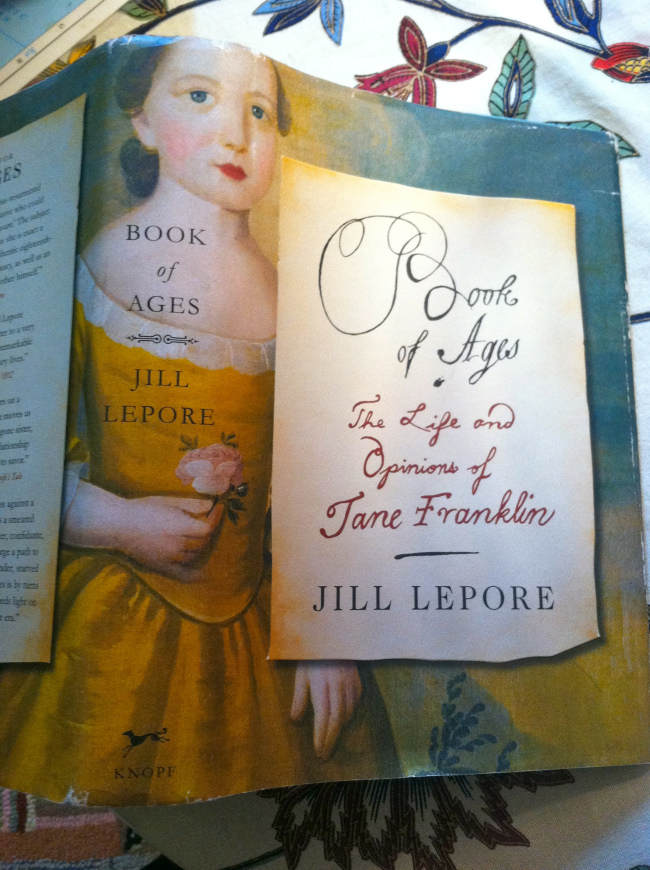 In Jill Lepore’s extraordinary biography of Ben Franklin’s sister Jane, Book of Ages, a short chapter near the end sketches the rise of the novel as a genre. Prior to the eighteenth century, “history” was the genre for telling the stories of lives, and they were always the stories of famous men. Then in the eighteenth century, novels began to be written, but at first they called themselves “histories”: Fielding’s History of Tom Jones, Sterne’s The Life and Opinions of Tristram Shandy are two that Lepore names. Richardson’s epistolary novel Pamela also purported to be real letters that Fielding had discovered.
Soon, though, novelists dropped pretense of writing history, because they were convinced that their new genre was truer than history. It was a new kind of biography—of ordinary people—and its truth was founded not in documentary evidence but in human nature.
I was reminded of this while recently reading Kent Haruf’s novels Plainsong, Eventide, and Benediction, all set in his fictional town of Holt, Colorado, on the high dusty plains east of Denver. The small events of very ordinary lives are Haruf’s subject. In a spare, understated style, Haruf creates characters who surprise themselves with a generous gesture, who suffer from depression or loss or the meanness of others, who settle into habits of sadness or of gratitude.
Reading along, I would often stop and think: “this is life as it really is.”
Lepore’s terms helped me understand why I keep reading fiction: because fiction connects me with the truth of other lives. And so with the truth of my own.
“How we spend our days is, of course, how we spend our lives,” Annie Dillard says in The Writing Life. It’s almost impossible to stand back from our own days and take account of how we’re spending them. But fiction traces in minute detail the spending of days—and so the spending of lives.
Fiction also traces the interconnections among lives. In each of Haruf’s novels, we begin with the tracing of days of separate characters. Then, unexpectedly, one character will enter another’s life. It might be in a small way, like an elderly woman chatting warmly with two young boys whose mother has left them. Or it might be in a huge way, like two aging brothers hesitantly opening their home to a pregnant high school girl, who eventually enriches their lives in ways they couldn’t have imagined.
My life has so many interconnections with others that I couldn’t begin to trace them. But in fiction I can see the reality of how lives inevitably yet surprisingly entwine.
One of my favorite Anne Tyler novels, Saint Maybe, ends with an oh-wow scene that dramatizes exactly this. The novel has followed the protagonist Ian’s ways of living out his sense of responsibility for his brother Danny’s death, soon after Danny married Lucy.
In this final scene, Ian is carrying his newborn daughter downstairs to meet family and friends who are gathered there.
He was halfway down the stairs when he felt a kind of echo effect—a memory just beyond his reach. He paused, and Danny stepped forward to present his firstborn. “Here she is!” he said. But then the moment slid sideways like a phonograph needle skipping a groove, and all at once it was Lucy he was presenting. “I’d like you to meet the woman who’s changed my life,” he said. His face was very solemn but Lucy was smiling. “Your what?”she seemed to be saying. “Your, what was that? Oh, your LIFE.” And she tipped her head and smiled. After all, she might have said, this was an ordinary occurrence. People changed other people’s lives every day of the year. There was no call to make such a fuss about it.
Yes, people do change each other’s lives every day of the year. But it takes fiction for us to see the fullness of this truth.
A few years ago, in The New York Review of Books, Colm Toibin reviewed two new books by the South African writer Nadine Gordimer. One was a collection of her essays and speeches on the politics of her country especially under apartheid; the other was a collection of her short stories. Comparing the two books (and considering as well Gordimer’s major novels), Toibin observes that in her essays and speeches “she made rhetoric of considerable and persuasive force, filled with anger and fire… But she made her fiction out of a set of more complex, mysterious, and tender arguments.”
“In her nonfiction,” Toibin goes on, “Gordimer knows who the heroes and villains are; in her best stories, she allows her characters to be puzzled, to be caught between forces. She allows her best creations a full life that can be poisoned or damaged by apartheid but not fully foretold or controlled by the system.”
What I hear Toibin saying is that Gordimer’s fiction is truer to life than her nonfiction. Surely our lives are mysterious and unpredictable; outside forces influence but do not predetermine them.
When I want to learn facts, I read history or essays. When I want to absorb truth, I reach for fiction.
Peggy Rosenthal is director of Poetry Retreats and writes widely on poetry as a spiritual resource. Her books include Praying through Poetry: Hope for Violent Times(Franciscan Media), and The Poets’ Jesus (Oxford). SeeAmazon for full list. She also teaches an online course, “Poetry as a Spiritual Practice,” through Image’s Glen Online program*.*
Previous Post

August 28, 2014
The Creationist Crisis Reprise
Browse Our Archives
Select a Category A. G. Harmon Alissa Wilkinson Allison Backous Art Authors Brad Fruhauff Bradford Winters Bryan Bliss Caroline Langston Chad Thomas Johnston Chris Hoke Christiana N. Peterson Culture D.G. Myers D.L. Mayfield Daniel Bowman Jr. David Griffith Elizabeth Duffy Faith Film Greg Wolfe Guest Contributor Interview Jan Vallone Jeffrey Overstreet Jessica Eddings-Roeser Jessica Mesman Griffith Kelly Foster Lindsey Crittenden Morgan Meis music Natalie Vestin Nick Olson Peggy Rosenthal Personal Reflection Poetry Friday Reflection Relationships Review Richard Chess Richard Cole Sara Zarr Shannon Huffman Polson Sonya Bilocerkowycz Tania Runyan Tony Woodlief Topical Categories Uncategorized Vic Sizemore Writing
Select a Month October 2018 September 2018 August 2018 July 2018 June 2018 May 2018 April 2018 March 2018 February 2018 January 2018 December 2017 November 2017 October 2017 September 2017 August 2017 July 2017 June 2017 May 2017 April 2017 March 2017 February 2017 January 2017 December 2016 November 2016 October 2016 September 2016 August 2016 July 2016 June 2016 May 2016 April 2016 March 2016 February 2016 January 2016 December 2015 November 2015 October 2015 September 2015 August 2015 July 2015 June 2015 May 2015 April 2015 March 2015 February 2015 January 2015 December 2014 November 2014 October 2014 September 2014 August 2014 July 2014 June 2014 May 2014 April 2014 March 2014 February 2014 January 2014 December 2013 November 2013 October 2013 September 2013 August 2013 July 2013 June 2013 May 2013 April 2013 March 2013 February 2013 January 2013 December 2012 November 2012 October 2012 September 2012 August 2012 July 2012 June 2012 May 2012 February 2008
Follow Us!
TAKE THE
Religious Wisdom Quiz
Who was the mother of Samuel?
Select your answer to see how you score.
Sarah Mary Rebekah Hannah
Related posts from Good Letters

On Writing Odes: Taking Time to Celebrate



TRENDING AT PATHEOS Catholic

Rejecting Doom: Christian Hope And Human Action
Christianity is a religion of hope. We are to have hope and...

It’s What Comes From Within Which Matters
One of the most difficult things for us to understand is why...

Why I Choose the Eucharist Over the Sermon
Choose the Eucharist, Not the Sermon What are we supposed to get...

5 Design Elements Found in Spiritually Rooted Homes
Putting Spirituality Into Home Decor Our homes are more than our living...

Credo: A Story of God Told with the...
About 10 years ago, I began to imagine a personal "Credo" that...

The Anatomy of Divine Revelation in Catholic Thought
The claim that God has made Himself known to human beings is...
view all Catholic blogs
Ad-Free & Subscriber Log-In Subscription Support
- About Us
- 2026 Calendar
- Videos
- Podcasts
- Library of World Religions
- Faith In Media Tracker
- Advertise With Us
- Write for Us
- Privacy Policy
- Terms of Service
- Do Not Sell My Data
- Contact Us
- Radiant Digital
- Manage Newsletter Subscriptions
- Unsubscribe From Notifications
- Sitemap
Copyright 2008-2026, Patheos. All rights reserved.
Subscription Support Ad-Free & Subscriber Log-In
Follow Patheos