
BuddhistCatholicContemplativeEvangelicalGeneral ChristianHinduJewishLatter-day SaintMuslimNew VisionsProgressive Christian
Beliefs
- Buddhist
- Catholic
- Contemplative
- Evangelical
- General Christian
- Hindu
- Jewish
- Latter-day Saint
- More Voices
- Muslim
- New Visions
- Pagan
- Progressive Christian
Topics
- Religion News
- Food and Religion
- Sports and Religion
- Religious Art
- Religious Music and Entertainment
- Religious Events
- History and Religion
- Style and Religion
- Politics and Religion
- Women in Religion
- Recreation Outdoors and Religion
- Business Finance and Religion
- Careers Workplace and Religion
- Education and Religion
- Family Parenting and Religion
- Health Fitness and Religion
- Home and Religion
- Relationships and Religion
- Technology and Religion
- Travel and Religion
Columnists
- Buddhist Columnists
- Business Finance and Religion Columnists
- Careers Workplace and Religion Columnists
- Catholic Columnists
- Contemplative Columnists
- Education and Religion Columnists
- Evangelists Columnists
- Family Parenting and Religion Columnists
- General Christian Columnists
- Health Fitness and Religion Columnists
- Hindu Columnists
- History and Religion Columnists
- Home and Religion Columnists
- Jewish Columnists
- More Voices Columnists
- Latter Day Columnists
- Muslim Columnists
- New Visions Columnists
- Nonreligious Columnists
- Pagan Columnists
- Politics and Religion Columnists
- Progressive Columnists
- Recreation Outdoors and Religion Columnists
- Relationships and Religion Columnists
- Religion News Columnists
- Religious Art Columnists
- Religious Events Columnists
- Religious Music and Entertainment Columnists
- Sports and Religion Columnists
- Style and Religion Columnists
- Technology and Religion Columnists
- Travel and Religion Columnists
- Women in Religion Columnists
Resource Library
- 2026 Calendar
- Library of World Religions
- The 100 Most Holy Places on Earth
- Patheos Answers
- Podcasts
- Videos
- Faith Leaders Database
- Anglican Episcopalian
- Bahai
- Baptist
- Buddhism
- Christianity
- Confucianism
- Eastern Orthodoxy
- Hinduism
- Holiness and Pentecostal
- ISKCON
- Islam
- Judaism
- Lutheran
- Methodist
- The Church of Jesus Christ of Latter-day Saints
- New Age
- Paganism
- Presbytarian and Reformed
- Protestantism
- Religion Behind the Scenes
- Roman Catholic
- Scientology
- Shia Islam
- Sikhism
- Sufism
- Sunni Islam
- Taoism
- Zen
- See all religions
Research Tools
 Ad-Free & Subscriber Log-In Subscription Support
Ad-Free & Subscriber Log-In Subscription Support
Follow Patheos 

- Trending:
- Forgiveness
- |
- Marriage
- |
- Consciousness
- |
- Death Penalty
- |
- Election
- |
- Halloween
 Good Letters
-
Contributors
- Home
- Catholic
- Eiseley, Darwin, and the Weird Portentous
Eiseley, Darwin, and the Weird Portentous
Last updated on: July 20, 2015 at 12:41 pm by Morgan Meis
Eiseley, Darwin, and the Weird Portentous 2015-07-20T12:41:18-07:00 Morgan Meis
Patheos Explore the world's faith through different perspectives on religion and spirituality! Patheos has the views of the prevalent religions and spiritualities of the world.
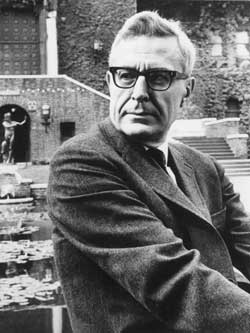 Loren Eiseley was born in 1907. He died in 1977. For many years and until his death, he was the Benjamin Franklin Professor of Anthropology and History of Science at the University of Pennsylvania. A scientist, he was particularly interested in the study of the origins of human kind.
Eiseley was also a writer and a poet. He was a dreamer and something of a philosopher, too. Some called him a freak. Ray Bradbury once said of Eiseley that he was, “every writer’s writer and every human’s human.”
The poet W. H. Auden was a great admirer of Eiseley. Auden wrote the introduction to a collection of Eiseley’s writings called The Star Thrower. In that introduction Auden, like Bradbury, brought up the fact of Eiseley’s being a “human’s human.”
“Dr. Eiseley,” Auden wrote, “happens to be an archeologist, an anthropologist, and a naturalist, but, if I have understood him rightly, the first point he wishes to make is that in order to be a scientist, an artist, a doctor, a lawyer, or what-have-you, one has first to be a human being.”
A human being must live in the world first, even as he or she tries to understand it. Scientists, for instance, do not get to do their science from outside the context of being human beings. They look at the world from within that world.
Eiseley read Charles Darwin from that perspective. He saw in Darwin a similar kind of searching mind. He saw a person attuned to the strange experience of being alive on planet earth. Eiseley wrote about this aspect of Darwin in an essay called, “Science and the Sense of the Holy.”
Eiseley notes the following passage from one of Darwin’s journals as a young man:
If we choose to let conjecture run wild, then animals, our fellow brethren in pain, disease, suffering and famine—our slaves in the most laborious works, our companions in our amusement—they may partake of our origin in one common ancestor—we may be all netted together.
Thinking about this passage, Eiseley made the following claim about Darwin:
Darwin’s…comment that we may all be netted together in one gigantic mode of experience, that we are in a mystic sense one single diffuse animal, subject to joy and suffering beyond what we endure as individuals, reveals a youth drawn to the world of nature by far more than just the curiosity to be readily satisfied by the knife or the scalpel.
The thought that we seek more in observing nature than can be readily satisfied by the knife or the scalpel brings to mind Wordsworth’s famous poem, “The Tables Turned.” That poem includes the oft-repeated line, “we murder to dissect.”
Sweet is the lore which Nature brings;
Our meddling intellect
Mis-shapes the beauteous forms of things:—
We murder to dissect.
Auden and Eiseley would agree with this sentiment. According to Eiseley, Darwin would agree as well. There is a right way to interrogate nature and there is a wrong way. You are on the wrong track when you end up murdering to dissect. You are on the wrong road when you step out of your own creatureliness, your own status as an animal, suffering with the other groping and grasping creatures mucking about in Earth’s mud.
But if you have the feeling that all animals, all living things, have a common ancestor, that we are all “netted together,” as Darwin put it, then you come to your scientific work with a much different sensibility than the person who blithely wields the knife or the scalpel. You’ll be less inclined to “murder to dissect” because you’ll feel a sense of kinship with what you’re murdering.
Another way to say this, according to Eiseley, is that everyone—singer or scientist—has a “sense of the holy.” The more you develop your sense of the holy, the more you are actually in tune with what it means to be a human being. And the more you are attuned to being human, the more you are attuned to every other living creature too.
As Eiseley saw it, Charles Darwin was very much possessed of a “sense of the holy”:
It was not the tough-minded, logical inductionists of the early nineteenth century who in a deliberate distortion of Baconian philosophy solved the problem of evolution. Rather, it was what Darwin chose to call “speculative” men, men, in other words, with just a touch of the numinous in their eye, a sense of marvel, a glimpse of what was happening behind the visible, who saw the whole of the living world as though turning in a child’s kaleidoscope.
This goes much further than the claim—bandied about rather loosely these days—that scientists like “wonder” too, or that people who study evolution also enjoy flowers. Eiseley is not claiming simply that Darwin had a sense of wonder. He is claiming that Darwin could see truths other scientists could not precisely because he had a touch of the numinous in his eye.
According to Eiseley, Darwin’s theory of evolution is potentially compatible with a religious sensibility because Darwin’s theory of evolution emerged directly from Darwin’s “sense of the holy.” “Ever since man first painted animals in the dark caves,” Eiseley wrote, “he has been responding to the holy, to the numinous, to the mystery of being and becoming, to what Goethe very aptly called ‘the weird portentous.’”
When we are attuned to the “weird portentous,” the mystery of being and becoming expresses itself. It may do so in a painting or a poem or a prayer. Or, it may do so in a flash of insight into how living beings evolve, as it did for Charles Darwin.
This post was made possible through the support of a grant from The BioLogos Foundation’s Evolution and Christian Faith program. The opinions expressed are those of the author and do not necessarily reflect the views of BioLogos.
Morgan Meis is the critic-at-large for The Smart Set (thesmartset.com). He has a PhD in Philosophy and has written for n+1, The Believer, Harper’s Magazine, and The Virginia Quarterly Review. He won the Whiting Award in 2013. Morgan is also an editor at 3 Quarks Daily, and a winner of a Creative Capital | Warhol Foundation Arts Writers grant. A book of Morgan’s selected essays can be found here. He can be reached at [email protected].
Previous Post

July 31, 2014
The Destruction of a Man
Next Post
August 4, 2014 A House Blessed
Browse Our Archives
Select a Category A. G. Harmon Alissa Wilkinson Allison Backous Art Authors Brad Fruhauff Bradford Winters Bryan Bliss Caroline Langston Chad Thomas Johnston Chris Hoke Christiana N. Peterson Culture D.G. Myers D.L. Mayfield Daniel Bowman Jr. David Griffith Elizabeth Duffy Faith Film Greg Wolfe Guest Contributor Interview Jan Vallone Jeffrey Overstreet Jessica Eddings-Roeser Jessica Mesman Griffith Kelly Foster Lindsey Crittenden Morgan Meis music Natalie Vestin Nick Olson Peggy Rosenthal Personal Reflection Poetry Friday Reflection Relationships Review Richard Chess Richard Cole Sara Zarr Shannon Huffman Polson Sonya Bilocerkowycz Tania Runyan Tony Woodlief Topical Categories Uncategorized Vic Sizemore Writing
Select a Month October 2018 September 2018 August 2018 July 2018 June 2018 May 2018 April 2018 March 2018 February 2018 January 2018 December 2017 November 2017 October 2017 September 2017 August 2017 July 2017 June 2017 May 2017 April 2017 March 2017 February 2017 January 2017 December 2016 November 2016 October 2016 September 2016 August 2016 July 2016 June 2016 May 2016 April 2016 March 2016 February 2016 January 2016 December 2015 November 2015 October 2015 September 2015 August 2015 July 2015 June 2015 May 2015 April 2015 March 2015 February 2015 January 2015 December 2014 November 2014 October 2014 September 2014 August 2014 July 2014 June 2014 May 2014 April 2014 March 2014 February 2014 January 2014 December 2013 November 2013 October 2013 September 2013 August 2013 July 2013 June 2013 May 2013 April 2013 March 2013 February 2013 January 2013 December 2012 November 2012 October 2012 September 2012 August 2012 July 2012 June 2012 May 2012 February 2008
Follow Us!
TAKE THE
Religious Wisdom Quiz
The beginning of knowledge starts with this.
Select your answer to see how you score.
Understanding Wisdom Fear of the Lord Instruction
Related posts from Good Letters

Morning in a Forgotten Neighborhood


Monasticism in Lockdown America: Part 8: Psalms In...
An Italian Journey with Auden, Goethe, Sex, and...
TRENDING AT PATHEOS Catholic

Rejecting Doom: Christian Hope And Human Action
Christianity is a religion of hope. We are to have hope and...

It’s What Comes From Within Which Matters
One of the most difficult things for us to understand is why...

Why I Choose the Eucharist Over the Sermon
Choose the Eucharist, Not the Sermon What are we supposed to get...

5 Design Elements Found in Spiritually Rooted Homes
Putting Spirituality Into Home Decor Our homes are more than our living...

Credo: A Story of God Told with the...
About 10 years ago, I began to imagine a personal "Credo" that...

The Anatomy of Divine Revelation in Catholic Thought
The claim that God has made Himself known to human beings is...
view all Catholic blogs
Ad-Free & Subscriber Log-In Subscription Support
- About Us
- 2026 Calendar
- Videos
- Podcasts
- Library of World Religions
- Faith In Media Tracker
- Advertise With Us
- Write for Us
- Privacy Policy
- Terms of Service
- Do Not Sell My Data
- Contact Us
- Radiant Digital
- Manage Newsletter Subscriptions
- Unsubscribe From Notifications
- Sitemap
Copyright 2008-2026, Patheos. All rights reserved.
Subscription Support Ad-Free & Subscriber Log-In
Follow Patheos