
BuddhistCatholicContemplativeEvangelicalGeneral ChristianHinduJewishLatter-day SaintMuslimNew VisionsProgressive Christian
Beliefs
- Buddhist
- Catholic
- Contemplative
- Evangelical
- General Christian
- Hindu
- Jewish
- Latter-day Saint
- More Voices
- Muslim
- New Visions
- Pagan
- Progressive Christian
Topics
- Religion News
- Food and Religion
- Sports and Religion
- Religious Art
- Religious Music and Entertainment
- Religious Events
- History and Religion
- Style and Religion
- Politics and Religion
- Women in Religion
- Recreation Outdoors and Religion
- Business Finance and Religion
- Careers Workplace and Religion
- Education and Religion
- Family Parenting and Religion
- Health Fitness and Religion
- Home and Religion
- Relationships and Religion
- Technology and Religion
- Travel and Religion
Columnists
- Buddhist Columnists
- Business Finance and Religion Columnists
- Careers Workplace and Religion Columnists
- Catholic Columnists
- Contemplative Columnists
- Education and Religion Columnists
- Evangelists Columnists
- Family Parenting and Religion Columnists
- General Christian Columnists
- Health Fitness and Religion Columnists
- Hindu Columnists
- History and Religion Columnists
- Home and Religion Columnists
- Jewish Columnists
- More Voices Columnists
- Latter Day Columnists
- Muslim Columnists
- New Visions Columnists
- Nonreligious Columnists
- Pagan Columnists
- Politics and Religion Columnists
- Progressive Columnists
- Recreation Outdoors and Religion Columnists
- Relationships and Religion Columnists
- Religion News Columnists
- Religious Art Columnists
- Religious Events Columnists
- Religious Music and Entertainment Columnists
- Sports and Religion Columnists
- Style and Religion Columnists
- Technology and Religion Columnists
- Travel and Religion Columnists
- Women in Religion Columnists
Resource Library
- 2026 Calendar
- Library of World Religions
- The 100 Most Holy Places on Earth
- Patheos Answers
- Podcasts
- Videos
- Faith Leaders Database
- Anglican Episcopalian
- Bahai
- Baptist
- Buddhism
- Christianity
- Confucianism
- Eastern Orthodoxy
- Hinduism
- Holiness and Pentecostal
- ISKCON
- Islam
- Judaism
- Lutheran
- Methodist
- The Church of Jesus Christ of Latter-day Saints
- New Age
- Paganism
- Presbytarian and Reformed
- Protestantism
- Religion Behind the Scenes
- Roman Catholic
- Scientology
- Shia Islam
- Sikhism
- Sufism
- Sunni Islam
- Taoism
- Zen
- See all religions
Research Tools
 Ad-Free & Subscriber Log-In Subscription Support
Ad-Free & Subscriber Log-In Subscription Support
Follow Patheos 

- Trending:
- Forgiveness
- |
- Marriage
- |
- Consciousness
- |
- Death Penalty
- |
- Election
- |
- Halloween
 Good Letters
-
Contributors
- Home
- Catholic
- The Destruction of a Man
The Destruction of a Man
Last updated on: August 3, 2014 at 9:35 pm by D. G. Myers
The Destruction of a Man 2014-08-03T21:35:56-07:00 D. G. Myers
Patheos Explore the world's faith through different perspectives on religion and spirituality! Patheos has the views of the prevalent religions and spiritualities of the world.
 This year 233,000 American men will be diagnosed with prostate cancer, while almost the same number of American women will be diagnosed with invasive breast cancer.
What breast cancer is for women prostate cancer is for men. And yet the funding of prostate cancer research is less than half that for breast cancer. In 2012, the National Cancer Institute spent $602.7 million on breast cancer, but only $256.3 million on prostate cancer. This amounts to $2,590 per new case of invasive breast cancer as opposed to $1,100 for every prostate case.
Feminists who complain about gender discrepancies in every other corner of American life are oddly silent about the discrepancy in cancer funding. But they do no more than mimic the silence of American men.
The National Football League, for example, promotes “A Crucial Catch,” a month-long campaign “to support the fight against breast cancer.” During October, NFL players wear pink game apparel, which is later auctioned off to raise money for breast cancer research.
And prostate cancer? The league does nothing whatever, even though—if the rates in the general population hold for them—242 of the men on the NFL’s active rosters this season will eventually come down with the cancer and forty-seven of them will die of it.
What accounts for the discrepancy? It sure isn’t the patriarchy, which seems to have abandoned men on this issue.
Women are better organized—Susan G. Komen for the Cure, the country’s most successful breast cancer organization, raised $325.2 million in fiscal year 2013, while the Prostate Cancer Foundation raised 15.5% of that total—but to take notice of this disparity is merely to ask the question in different words. Why are men such lousy advocates for themselves?
I can’t speak for other prostate cancer patients, but if they are anything like me (and I suspect a good many are) the answer can be given in two words: sexual shame.
For more than seventy years, or ever since Charles B. Huggins discovered that tumors would shrink if deprived of testosterone, the treatment of metastatic prostate cancer has varied little. The treatment is castration.
Most men react as New York Times book critic Anatole Broyard did when apprised of the treatment:
My urologist, who is quite famous, wanted to cut off my testicles…. Speaking as a surgeon, he said that it was the surest, quickest, neatest solution. Too neat, I said, picturing myself with no balls. I knew that such a solution would depress me, and I was sure that depression is bad medicine.
Since the 1980s, luteinizing hormone-releasing hormone (LH-RH) agonists have gradually replaced surgery—that is, chemical castration now achieves a similar medical effect to cutting off a man’s balls. The psychological effect is only slightly better.
It has taken me six-and-a-half years to talk about being castrated. Only this past weekend did I confess to two of my closest friends that hormone treatments have left me impotent. And not merely impotent: I have been entirely drained of any sexual feeling whatever.
The effects of castration have a comical side. My pre-adolescent sons are not the only ones to groan “Yuck!” now when a man and woman start necking on screen. A sex scene in a contemporary novel transforms me into a thin-lipped censorious prude, flipping pages to escape the humidity. Feminine beauty is an abstraction: a Playboy Playmate arouses about as much physical response in me as the election results in Nauru.
Comical or not, castration is an impoverishment of personality. What I have learned is that eros is hormone-based. A latter-day Dr. Johnson would undergo castration and announce: “Thus I refute Gilbert Ryle’s ‘Ghost in the Machine.’”
My sexual passion for my wife is a happy memory, like nostalgia for staying out till after dark playing pick-up baseball with friends. Our marriage really is between true minds; my body stays outside the door.
There is no cancer that does not impoverish the patient in some way. A mastectomy is just as damaging an assault upon a woman’s sexuality and self-image as castration upon a man’s, but women seem to be more fearless, less ashamed to contemplate the worst that might happen, more open to taking preparations for it.
But even with their head start in research spending and fundraising, women who endure breast cancer are largely invisible to the culture. From James L. Brooks’s Terms of Endearment (1983), in which Debra Winger bobbed her hair to signify the effects of chemotherapy, to Mike Nichols’s Wit (2001), for which Emma Thompson shaved her head, Hollywood only grudgingly acknowledged the physical stigmata of cancer. There is yet to be a major studio film, or even a good independent one, about a woman living with the emotional consequences of a mastectomy.
My wife Naomi, who is a physician, distinguishes between life-threatening disease and life-limiting disease. Advances in research, genetic mapping, and drug treatments have made even terminal cancer, for more and more patients, a chronic condition in which they may loiter, suspended between diagnosis and death, for several years.
To live with cancer’s physical limitations and yet not to permit them also to become mental limitations demands the summoning of an inner power—what Primo Levi calls “the power to refuse our consent.” In Auschwitz, Levi says:
We have learnt that our personality is fragile, that it is much more in danger than our life; and the old wise ones, instead of warning us “remember that you must die,” would have done much better to remind us of this great danger that threatens us.
To live with cancer is nothing like the struggle of all against all in a death camp, and yet perhaps cancer patients might learn something from Holocaust survivors. “To destroy a man is difficult,” as Levi writes, “almost as difficult as to create one”: and his destruction may precede his death. But only if he consents to it.
D. G. Myers is a critic and literary historian who taught for nearly a quarter of a century at Texas A&M and Ohio State universities. He is the author of The Elephants Teach and ex-fiction critic for Commentary. He has also written for the New York Times Book Review, the Weekly Standard, Philosophy and Literature, the Sewanee Review, First Things, Jewish Ideas Daily, the Daily Beast, the Barnes & Noble Review, the Journal of the History of Ideas, American Literary History, and other journals.
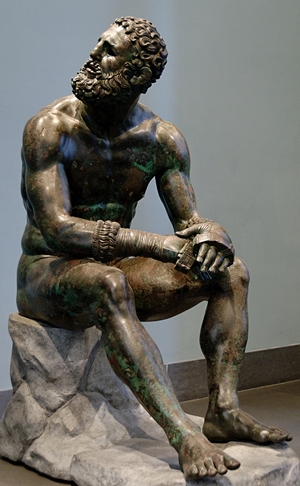
Image Used: Boxer of Quirinal (330 B.C.E.), Hellenistic Period, artist unknown, bronze
Previous Post

July 30, 2014
Losing the Thread
Next Post
August 1, 2014 Eiseley, Darwin, and the Weird Portentous
Browse Our Archives
Select a Category A. G. Harmon Alissa Wilkinson Allison Backous Art Authors Brad Fruhauff Bradford Winters Bryan Bliss Caroline Langston Chad Thomas Johnston Chris Hoke Christiana N. Peterson Culture D.G. Myers D.L. Mayfield Daniel Bowman Jr. David Griffith Elizabeth Duffy Faith Film Greg Wolfe Guest Contributor Interview Jan Vallone Jeffrey Overstreet Jessica Eddings-Roeser Jessica Mesman Griffith Kelly Foster Lindsey Crittenden Morgan Meis music Natalie Vestin Nick Olson Peggy Rosenthal Personal Reflection Poetry Friday Reflection Relationships Review Richard Chess Richard Cole Sara Zarr Shannon Huffman Polson Sonya Bilocerkowycz Tania Runyan Tony Woodlief Topical Categories Uncategorized Vic Sizemore Writing
Select a Month October 2018 September 2018 August 2018 July 2018 June 2018 May 2018 April 2018 March 2018 February 2018 January 2018 December 2017 November 2017 October 2017 September 2017 August 2017 July 2017 June 2017 May 2017 April 2017 March 2017 February 2017 January 2017 December 2016 November 2016 October 2016 September 2016 August 2016 July 2016 June 2016 May 2016 April 2016 March 2016 February 2016 January 2016 December 2015 November 2015 October 2015 September 2015 August 2015 July 2015 June 2015 May 2015 April 2015 March 2015 February 2015 January 2015 December 2014 November 2014 October 2014 September 2014 August 2014 July 2014 June 2014 May 2014 April 2014 March 2014 February 2014 January 2014 December 2013 November 2013 October 2013 September 2013 August 2013 July 2013 June 2013 May 2013 April 2013 March 2013 February 2013 January 2013 December 2012 November 2012 October 2012 September 2012 August 2012 July 2012 June 2012 May 2012 February 2008
Follow Us!
TAKE THE
Religious Wisdom Quiz
What did Solomon ask God for when he became king?
Select your answer to see how you score.
Wisdom Long life Victory Riches
Related posts from Good Letters

Reynolds Price and Me: The Tale of Two...


Poison Ivy and the Path of Grief

TRENDING AT PATHEOS Catholic

Creation, Preservation, and Teleology in Catholic Theology
As I write this, it is very early Monday morning. Like millions...

The Parable Of The Sower And The Word...
One of Christ’s most famous parables is that of the sower who...

Rejecting Doom: Christian Hope And Human Action
Christianity is a religion of hope. We are to have hope and...

Why I Choose the Eucharist Over the Sermon
Choose the Eucharist, Not the Sermon What are we supposed to get...

5 Design Elements Found in Spiritually Rooted Homes
Putting Spirituality Into Home Decor Our homes are more than our living...

Credo: A Story of God Told with the...
About 10 years ago, I began to imagine a personal "Credo" that...
view all Catholic blogs
Ad-Free & Subscriber Log-In Subscription Support
- About Us
- 2026 Calendar
- Videos
- Podcasts
- Library of World Religions
- Faith In Media Tracker
- Advertise With Us
- Write for Us
- Privacy Policy
- Terms of Service
- Do Not Sell My Data
- Contact Us
- Radiant Digital
- Manage Newsletter Subscriptions
- Unsubscribe From Notifications
- Sitemap
Copyright 2008-2026, Patheos. All rights reserved.
Subscription Support Ad-Free & Subscriber Log-In
Follow Patheos