
BuddhistCatholicContemplativeEvangelicalGeneral ChristianHinduJewishLatter-day SaintMuslimNew VisionsProgressive Christian
Beliefs
- Buddhist
- Catholic
- Contemplative
- Evangelical
- General Christian
- Hindu
- Jewish
- Latter-day Saint
- More Voices
- Muslim
- New Visions
- Pagan
- Progressive Christian
Topics
- Religion News
- Food and Religion
- Sports and Religion
- Religious Art
- Religious Music and Entertainment
- Religious Events
- History and Religion
- Style and Religion
- Politics and Religion
- Women in Religion
- Recreation Outdoors and Religion
- Business Finance and Religion
- Careers Workplace and Religion
- Education and Religion
- Family Parenting and Religion
- Health Fitness and Religion
- Home and Religion
- Relationships and Religion
- Technology and Religion
- Travel and Religion
Columnists
- Buddhist Columnists
- Business Finance and Religion Columnists
- Careers Workplace and Religion Columnists
- Catholic Columnists
- Contemplative Columnists
- Education and Religion Columnists
- Evangelists Columnists
- Family Parenting and Religion Columnists
- General Christian Columnists
- Health Fitness and Religion Columnists
- Hindu Columnists
- History and Religion Columnists
- Home and Religion Columnists
- Jewish Columnists
- More Voices Columnists
- Latter Day Columnists
- Muslim Columnists
- New Visions Columnists
- Nonreligious Columnists
- Pagan Columnists
- Politics and Religion Columnists
- Progressive Columnists
- Recreation Outdoors and Religion Columnists
- Relationships and Religion Columnists
- Religion News Columnists
- Religious Art Columnists
- Religious Events Columnists
- Religious Music and Entertainment Columnists
- Sports and Religion Columnists
- Style and Religion Columnists
- Technology and Religion Columnists
- Travel and Religion Columnists
- Women in Religion Columnists
Resource Library
- 2026 Calendar
- Library of World Religions
- The 100 Most Holy Places on Earth
- Patheos Answers
- Podcasts
- Videos
- Faith Leaders Database
- Anglican Episcopalian
- Bahai
- Baptist
- Buddhism
- Christianity
- Confucianism
- Eastern Orthodoxy
- Hinduism
- Holiness and Pentecostal
- ISKCON
- Islam
- Judaism
- Lutheran
- Methodist
- The Church of Jesus Christ of Latter-day Saints
- New Age
- Paganism
- Presbytarian and Reformed
- Protestantism
- Religion Behind the Scenes
- Roman Catholic
- Scientology
- Shia Islam
- Sikhism
- Sufism
- Sunni Islam
- Taoism
- Zen
- See all religions
Research Tools
 Ad-Free & Subscriber Log-In Subscription Support
Follow Patheos 

- Trending:
- Advent
- |
- Forgiveness
- |
- Thanksgiving
- |
- Election
- |
- Seasonal Holidays
- |
- Marriage
 Good Letters
-
Contributors
- Home
- Catholic
- Sitting with Pain in Gaza and Israel
Sitting with Pain in Gaza and Israel
Last updated on: July 29, 2014 at 9:26 am by Richard Chess
Sitting with Pain in Gaza and Israel 2014-07-29T09:26:08-07:00 Richard Chess
Patheos Explore the world's faith through different perspectives on religion and spirituality! Patheos has the views of the prevalent religions and spiritualities of the world.
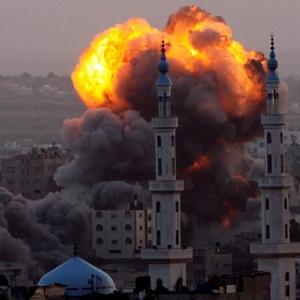 This morning, as I tried to awaken from a fitful night’s sleep, I turned to “Darkness Falls on Gaza,” an opinion piece by Mohammed Omer in the New York Times.
The piece begins,
“Ramadan, when night descends, is usually a joyous time. Friends and family gather to break their fast at the iftar meal. Not this year.”
“Nights are the worst. That is when the bombing escalates. Nowhere is safe. Not a mosque. Not a church. Not a school, or even a hospital. All are potential targets.”
I was hooked. Even if I hadn’t been anxiously following the news out of Israel and Gaza the last few weeks, I would have been hooked by the simple, clear, dramatic yet restrained writing.
You think the day’s long fast is challenging? Think again. You think there’s a feast with family and friends to look forward to at the end of the day? Think again.
We know, those of us who have been obsessively following the news, why this year is different.
I hunger for the stories, the lived experience, the telling details. Enough with the rationales, the justifications, the opinions, the politics-spin-politics-spin. Give me the story of one mother. Give me the story of a daughter, a son.
Because I’m a Jew, and because I lived in Israel for three years in the late seventies, and because there, in my twenties, I discovered the richness of Judaism and Jewish civilization, and my life was pointed in a direction in which it has continued to this day, I feel it’s my obligation to hear the stories of Palestinians.
So, I’m grateful for Omer’s piece.
Yet, I remind myself, no story about one family’s grief, another family’s rage, told in the midst of this war, is just a story, free of political purposes.
The opening of Omer’s opinion piece uses familiar narrative conventions to gain his reader’s interest and sympathy: trouble has come to town, and not just at any time but, for the victims, during the holy month of Ramadan.
Ramadan: maybe you don’t know much about Ramadan. But how much do you need to know to appreciate values cultivated by its observance? Believe in self-discipline? It takes self-discipline to observe a day-long fast, day after day after day for twenty-nine or thirty days. How about family and community? Observing Ramadan strengthens bonds among family and friends who join together at the end of each day’s fast to share a meal.
But maybe you prefer fierce independence, what America stands for. But can America stand as “one nation” if it’s a nation of 318,502,581 (the population according to the U. S. and World Population Clock when I checked just now) fiercely independent citizens?
If you, dear American reader, cannot relate to Ramadan, maybe your sympathies are aroused by this: the victims of this story have no place to hide, not even places conventionally considered off limits to military attacks: a mosque, a hospital, a school.
Omer transports you to the scene:
“On Monday the Israeli military fired artillery rounds at Al Aqsa hospital in Deir al-Balah, central Gaza…Dr. Khalil Khattab, a surgeon, was operating on a patient when the first shell struck. He ran to the floors below to discover at least four dead and dozens of colleagues—doctors, nurses, orderlies and administrators—injured. The medical staff had become patients.”
(Yes, but. Yes, but. I know. I know. I know. They hide _____ there. They live among _____. They this, they that, they the other, which is why we must this, that, and the other, heroically trying to minimize harm to uninvolved people.)
But I omitted a few words from the descriptive passage I just quoted. Here’s the complete first sentence: “the Israeli military fired artillery rounds at Al Aqsa hospital in Deir al-Balah, central Gaza, claiming [my emphasis] to target a cache of anti-tank missiles”. A doubtful nod to the Israeli position.
Now meet the al-Baba family, a family of fifteen. A “corrugated tin roof,” Omer tells us, was all that stood between them and the bombs.” Because other families have been killed in their homes, when a drone is heard overhead, “for safety, [Mr. al-Baba] split [his] family into different rooms—a scene played out in nearly every home in Gaza, a grim shell game of family members.”
I know this story! It’s the story of Jacob, on the eve of his reunion with Esau, dividing his family, herds, and camels into several camps, so that if Esau and the 400 men accompanying him were to attack, Jacob wouldn’t lose everyone and everything dear to him.
The authors or Author of the Bible knew something about conflict, violence, revenge. The Bible: it’s my story. It’s Omer’s story, too.
In the end, Omer doesn’t use a human shield, hiding his argument behind a few civilians of Gaza.
“A cease-fire agreement is possible, but all parties need to be at the table…. Even peace might be possible—if the international community has the courage to engage in dialogue with Hamas.”
Here’s another act of courage. What if, for a moment, in a safe place—no bombs, no blockade—we could suspend the urge to assign blame and the urge to find solutions? What if, for that moment, we could just sit with each other’s suffering, each other’s pain—historical, existential, communal, familial, personal? What might happen then?
I am saddened by the loss of life and suffering in Gaza. I am saddened by the suffering and loss of life in Israel. Saddened, too, that conditions resulted in Israel’s current actions. There I go: I couldn’t even make it for more than a few sentences before seeking a cause to explain if not justify Israel’s actions.
Maybe it’s impossible. We are our stories, the stories into which we are born, the stories in which we’ll one day die. But maybe there’s another story we can’t hear, maybe it would become known if, just for a moment, we could sit together, brothers and sisters, in pain, just pain.
Richard Chess is the author of three books of poetry, Tekiah, Chair in the Desert, and Third Temple. Poems of his have appeared in Telling and Remembering: A Century of American Jewish Poetry, Bearing the Mystery: Twenty Years of IMAGE, and Best Spiritual Writing 2005. He is the Roy Carroll Professor of Honors Arts and Sciences at the University of North Carolina at Asheville. He is also the director of UNC Asheville’s Center for Jewish Studies.
Previous Post

July 28, 2014
Everyone Deserves Clean Grout and Starched Linen
Next Post
July 30, 2014 Losing the Thread
Browse Our Archives
Select a Category A. G. Harmon Alissa Wilkinson Allison Backous Art Authors Brad Fruhauff Bradford Winters Bryan Bliss Caroline Langston Chad Thomas Johnston Chris Hoke Christiana N. Peterson Culture D.G. Myers D.L. Mayfield Daniel Bowman Jr. David Griffith Elizabeth Duffy Faith Film Greg Wolfe Guest Contributor Interview Jan Vallone Jeffrey Overstreet Jessica Eddings-Roeser Jessica Mesman Griffith Kelly Foster Lindsey Crittenden Morgan Meis music Natalie Vestin Nick Olson Peggy Rosenthal Personal Reflection Poetry Friday Reflection Relationships Review Richard Chess Richard Cole Sara Zarr Shannon Huffman Polson Sonya Bilocerkowycz Tania Runyan Tony Woodlief Topical Categories Uncategorized Vic Sizemore Writing
Select a Month October 2018 September 2018 August 2018 July 2018 June 2018 May 2018 April 2018 March 2018 February 2018 January 2018 December 2017 November 2017 October 2017 September 2017 August 2017 July 2017 June 2017 May 2017 April 2017 March 2017 February 2017 January 2017 December 2016 November 2016 October 2016 September 2016 August 2016 July 2016 June 2016 May 2016 April 2016 March 2016 February 2016 January 2016 December 2015 November 2015 October 2015 September 2015 August 2015 July 2015 June 2015 May 2015 April 2015 March 2015 February 2015 January 2015 December 2014 November 2014 October 2014 September 2014 August 2014 July 2014 June 2014 May 2014 April 2014 March 2014 February 2014 January 2014 December 2013 November 2013 October 2013 September 2013 August 2013 July 2013 June 2013 May 2013 April 2013 March 2013 February 2013 January 2013 December 2012 November 2012 October 2012 September 2012 August 2012 July 2012 June 2012 May 2012 February 2008
Follow Us!
TAKE THE
Religious Wisdom Quiz
How many years between David's reign and the Babylonian exile?
Select your answer to see how you score.
400 years 450 years 500 years 300 years
Related posts from Good Letters

Ready or Not for the Days of Awe



TRENDING AT PATHEOS Catholic

The Kingdom Of God In Ordinary Life And...
The kingdom of God is all around us; it is in us...

How Discretion Guides Us Away From Extremes
Prudence is an important virtue for all of us. While we should...

If Baptism Washes Away Sin, Why Do Catholics...
The seven sacraments stand as the foundation of Catholic ecclesial life. The...

The Power of Setting a Good Example
Remember last August when the Chicago White Sox hosted a "Pope Hat...

A Catholic Critique of Biblical Unitarianism
If the statistics are to be believed, Unitarianism is rising worldwide. Although...

How Grandma Tourism Helps Grandparents Live Their Vocation
Grandma, The New Travel Influencer What started as a nostalgia-inspired social media...
view all Catholic blogs
Ad-Free & Subscriber Log-In Subscription Support
- About Us
- 2026 Calendar
- Videos
- Podcasts
- Library of World Religions
- Faith In Media Tracker
- Advertise With Us
- Write for Us
- Privacy Policy
- Terms of Service
- Do Not Sell My Data
- Contact Us
- Radiant Digital
- Manage Newsletter Subscriptions
- Unsubscribe From Notifications
- Sitemap
Copyright 2008-2026, Patheos, part of the Radiant Digital network of media brands. All rights reserved.
Subscription Support Ad-Free & Subscriber Log-In
Follow Patheos