
BuddhistCatholicContemplativeEvangelicalGeneral ChristianHinduJewishLatter-day SaintMuslimNew VisionsProgressive Christian
Beliefs
- Buddhist
- Catholic
- Contemplative
- Evangelical
- General Christian
- Hindu
- Jewish
- Latter-day Saint
- More Voices
- Muslim
- New Visions
- Pagan
- Progressive Christian
Topics
- Religion News
- Food and Religion
- Sports and Religion
- Religious Art
- Religious Music and Entertainment
- Religious Events
- History and Religion
- Style and Religion
- Politics and Religion
- Women in Religion
- Recreation Outdoors and Religion
- Business Finance and Religion
- Careers Workplace and Religion
- Education and Religion
- Family Parenting and Religion
- Health Fitness and Religion
- Home and Religion
- Relationships and Religion
- Technology and Religion
- Travel and Religion
Columnists
- Buddhist Columnists
- Business Finance and Religion Columnists
- Careers Workplace and Religion Columnists
- Catholic Columnists
- Contemplative Columnists
- Education and Religion Columnists
- Evangelists Columnists
- Family Parenting and Religion Columnists
- General Christian Columnists
- Health Fitness and Religion Columnists
- Hindu Columnists
- History and Religion Columnists
- Home and Religion Columnists
- Jewish Columnists
- More Voices Columnists
- Latter Day Columnists
- Muslim Columnists
- New Visions Columnists
- Nonreligious Columnists
- Pagan Columnists
- Politics and Religion Columnists
- Progressive Columnists
- Recreation Outdoors and Religion Columnists
- Relationships and Religion Columnists
- Religion News Columnists
- Religious Art Columnists
- Religious Events Columnists
- Religious Music and Entertainment Columnists
- Sports and Religion Columnists
- Style and Religion Columnists
- Technology and Religion Columnists
- Travel and Religion Columnists
- Women in Religion Columnists
Resource Library
- 2026 Calendar
- Library of World Religions
- The 100 Most Holy Places on Earth
- Patheos Answers
- Podcasts
- Videos
- Faith Leaders Database
- Anglican Episcopalian
- Bahai
- Baptist
- Buddhism
- Christianity
- Confucianism
- Eastern Orthodoxy
- Hinduism
- Holiness and Pentecostal
- ISKCON
- Islam
- Judaism
- Lutheran
- Methodist
- The Church of Jesus Christ of Latter-day Saints
- New Age
- Paganism
- Presbytarian and Reformed
- Protestantism
- Religion Behind the Scenes
- Roman Catholic
- Scientology
- Shia Islam
- Sikhism
- Sufism
- Sunni Islam
- Taoism
- Zen
- See all religions
Research Tools
 Ad-Free & Subscriber Log-In Subscription Support
Ad-Free & Subscriber Log-In Subscription Support
Follow Patheos 

- Trending:
- Forgiveness
- |
- Marriage
- |
- Consciousness
- |
- Death Penalty
- |
- Election
- |
- Halloween
 Good Letters
-
Contributors
- Home
- Catholic
- Seeing The World As It Is
Seeing The World As It Is
Last updated on: July 7, 2014 at 1:00 am by Richard Chess
Seeing The World As It Is 2014-07-03T10:40:17-07:00 Richard Chess
Patheos Explore the world's faith through different perspectives on religion and spirituality! Patheos has the views of the prevalent religions and spiritualities of the world.
 “My religious commitment: to stay in conversation with Jewish stories.” That’s Nancy Fuchs Kreimer in “The Face under the Huppah: Relating to My Closest Stranger.” The essay is a meditation inspired by a drive with her husband from Philadelphia to Boston. Near the beginning of the drive, Fuchs Kreimer and her husband get stuck in a familiar conflict: a disagreement over whose proposed route is best: hers that is shortest, his that sometimes involves less traffic. They’ve been here before: on this highway, on this trip, caught in this disagreement whose stakes to them seem high.
Given the “circumstances”—their late start, the threat of snow and ice in Connecticut, and the building Friday afternoon traffic on the New Jersey Turnpike—her husband declares that “he will be determining” their route. “Alone.”
How does he get away with simply claiming the authority to choose their route? Fuchs Kreimer doesn’t openly protest her husband’s autonomous action. Rather, she devotes the rest of her illuminating essay to considering her response to him in relation to relevant rabbinic texts and others, including Freud, Levinas, and the Israeli novelist David Grossman.
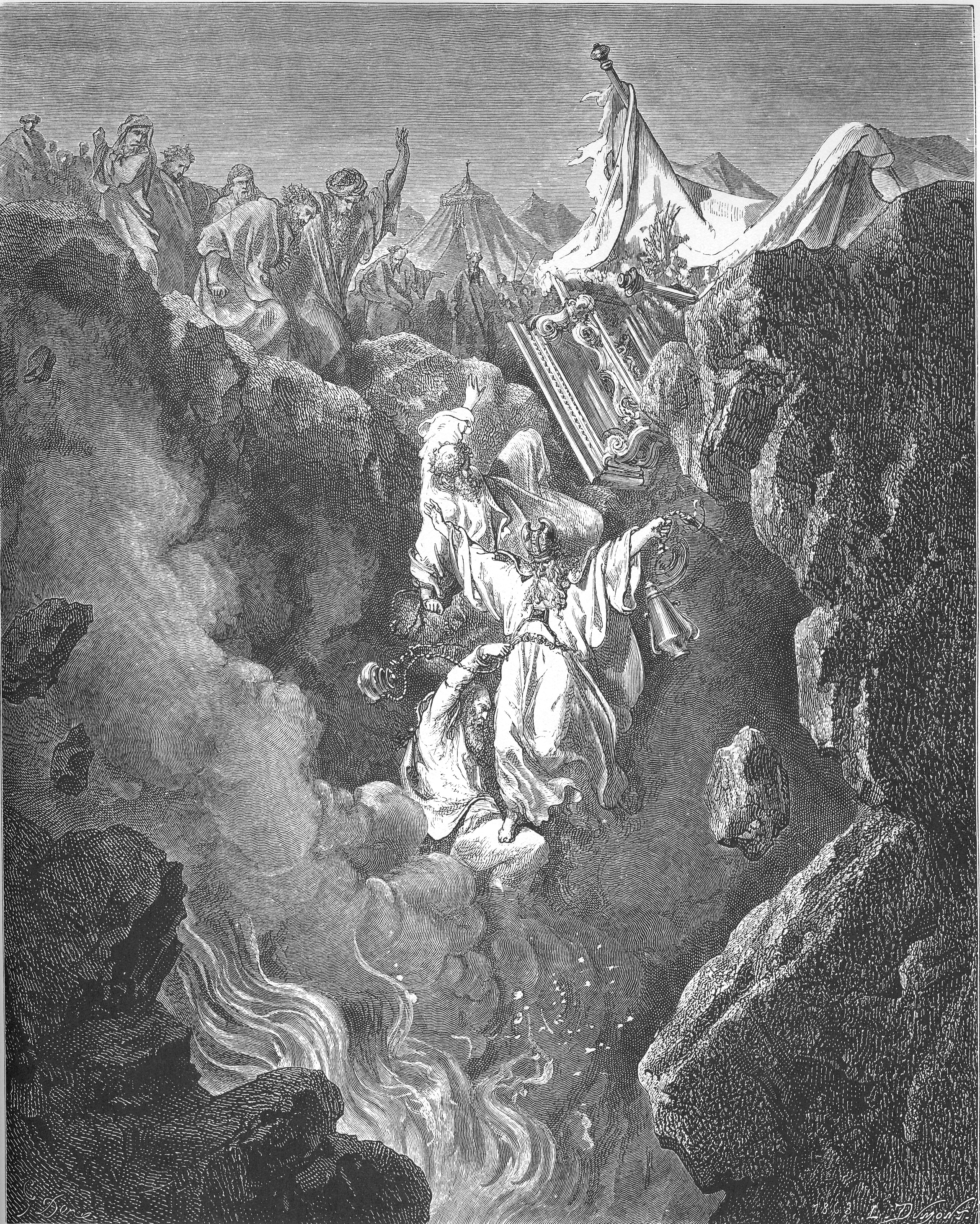
Unlike Fuchs Kreimer in this particular situation, the biblical character Korah, when he sees Moses and Aaron setting themselves above the community, speaks up. How do you get off, he asks them, “raising yourselves above the Lord’s congregation?” “All the community are holy, all of them, and the Lord is in their midst.” Challenged by Korah and his rebellious crew of 250 Israelites, Moses falls on his face. In other words, he prays for direction in responding to Korah’s challenge.
The Torah doesn’t tell us what Moses said as he lay on his face. The next verse jumps right into Moses’s reply to Korah’s challenge—“Come morning, the Lord will make known who is His and who is holy” (Numbers 16:5).
The second time Moses falls on his face is after God, appears, as promised in the morning. The whole community has come out to see who God will choose: Korah or Moses. “Stand back from this community,” God warns Moses and Aaron, “that I may annihilate them in an instant.” God’s pissed!
This time when Moses and Aaron fall on their faces to pray, they are, as it were, miked: “O God, Source of the breath of all flesh!” they begin their prayer (Numbers 16:22). Are they buttering God up, flattering the Divine before boldly questioning God’s morality?
Are they reminding God, in case God has forgotten who God’s children are, that God is the source of all life—faithful servant and rebel, humble and arrogant, powerful and weak, wise and deluded? Or do they have no rhetorical purpose other than to speak plainly and truthfully to God, beginning, respectfully, by showing they know who they are talking to and then proceeding to raise a question—“When one man sins, will You be wrathful with the whole community?”—arising from how they see the situation?
God immediately scales back his plan. “Speak to the community,” God instructs Moses in the next verse, “and say: Withdraw from about the abodes of Korah, Dathan, and Abiram” (Korah’s co-conspirators).
If anger can color God’s perception so that everywhere he looks he sees nothing but the cause of that anger—it’s you and you and you and—how much more vulnerable am I to the potentially catastrophic effects of anger?
Usually, of course, I experience anger in response to mundane matters—such as when, recently, I disagreed with Laurie on which direction to walk to catch a bus to the central train station in Rome where we would then catch a train to the Vatican. She said left; I said right. What’s at stake? Nothing more—no, nothing less—than my ability to read a map, prove that I can find my way around in a new place, and protect my ego, my story, my me me me!
What’s at stake? The opportunity to see without reacting aversely to the truth that the world (in this case, the map) is not the world I alone see. My story is one story. Laurie’s is another.
So, too, God’s is one story, and Moses’s story is another. I am going to wipe them all out (collective punishment), God says. What if your anger is affecting your perception and judgment? Moses asks.
If the world God sees isn’t the world, how much more likely is it that the world I see—when I’m angry or hungry, confident or insecure—isn’t the world? (Sorry, Wallace Stevens: “She was the single artificer of the world / In which she sang.” “The Idea of Order at Key West.”)
You can—you should!—read Fuchs Kreimer’s deeply insightful essay (included in Chapters of the Heart: Jewish Women Sharing the Torah of Their Lives, a book she co-edited) in which she admits her inability to feel the way teachings important to her say she should feel: Love your neighbor as yourself; love the stranger because we know the heart of the stranger; carry the stranger’s burden.
In my own marriage, I have often missed the opportunity to experience the world beyond my own making. While the normal conflicts and tensions that come up between us, Laurie and me—you want to spend money on what? You didn’t notice that leak?—are of little consequence to others, I sometimes feel as if my entire life depends on their resolution in the way I think they should be resolved.
The beginning of life beyond the narrow experience of self is life in relation to an other—a spouse, a friend, a colleague, a dog, an ocean, God. Every relationship presents the opportunity to see the world as it is, which is always more than one thinks it is. Seeing the world as it is, one stands a better chance of acting wisely, justly, lovingly. That’s worth aspiring to.
Richard Chess is the author of three books of poetry, Tekiah, Chair in the Desert, and Third Temple. Poems of his have appeared in Telling and Remembering: A Century of American Jewish Poetry, Bearing the Mystery: Twenty Years of IMAGE, and Best Spiritual Writing 2005. He is the Roy Carroll Professor of Honors Arts and Sciences at the University of North Carolina at Asheville. He is also the director of UNC Asheville’s Center for Jewish Studies.
Image used: The Death of Korah, Dathan, and Abiram (1866), Gustave Doré, from Doré‘s English Bible
Previous Post

July 3, 2014
Hymn to the Fourth of July
Next Post
July 8, 2014 Quitting the Cancer Battle
Browse Our Archives
Select a Category A. G. Harmon Alissa Wilkinson Allison Backous Art Authors Brad Fruhauff Bradford Winters Bryan Bliss Caroline Langston Chad Thomas Johnston Chris Hoke Christiana N. Peterson Culture D.G. Myers D.L. Mayfield Daniel Bowman Jr. David Griffith Elizabeth Duffy Faith Film Greg Wolfe Guest Contributor Interview Jan Vallone Jeffrey Overstreet Jessica Eddings-Roeser Jessica Mesman Griffith Kelly Foster Lindsey Crittenden Morgan Meis music Natalie Vestin Nick Olson Peggy Rosenthal Personal Reflection Poetry Friday Reflection Relationships Review Richard Chess Richard Cole Sara Zarr Shannon Huffman Polson Sonya Bilocerkowycz Tania Runyan Tony Woodlief Topical Categories Uncategorized Vic Sizemore Writing
Select a Month October 2018 September 2018 August 2018 July 2018 June 2018 May 2018 April 2018 March 2018 February 2018 January 2018 December 2017 November 2017 October 2017 September 2017 August 2017 July 2017 June 2017 May 2017 April 2017 March 2017 February 2017 January 2017 December 2016 November 2016 October 2016 September 2016 August 2016 July 2016 June 2016 May 2016 April 2016 March 2016 February 2016 January 2016 December 2015 November 2015 October 2015 September 2015 August 2015 July 2015 June 2015 May 2015 April 2015 March 2015 February 2015 January 2015 December 2014 November 2014 October 2014 September 2014 August 2014 July 2014 June 2014 May 2014 April 2014 March 2014 February 2014 January 2014 December 2013 November 2013 October 2013 September 2013 August 2013 July 2013 June 2013 May 2013 April 2013 March 2013 February 2013 January 2013 December 2012 November 2012 October 2012 September 2012 August 2012 July 2012 June 2012 May 2012 February 2008
Follow Us!
TAKE THE
Religious Wisdom Quiz
Who was Paul's hometown companion?
Select your answer to see how you score.
Timothy Barnabas Silas Luke
Related posts from Good Letters

Ready or Not for the Days of Awe


Marital Anger and Icelandic Rock Spirits

TRENDING AT PATHEOS Catholic

Rejecting Doom: Christian Hope And Human Action
Christianity is a religion of hope. We are to have hope and...

It’s What Comes From Within Which Matters
One of the most difficult things for us to understand is why...

Why I Choose the Eucharist Over the Sermon
Choose the Eucharist, Not the Sermon What are we supposed to get...

5 Design Elements Found in Spiritually Rooted Homes
Putting Spirituality Into Home Decor Our homes are more than our living...

Credo: A Story of God Told with the...
About 10 years ago, I began to imagine a personal "Credo" that...

The Anatomy of Divine Revelation in Catholic Thought
The claim that God has made Himself known to human beings is...
view all Catholic blogs
Ad-Free & Subscriber Log-In Subscription Support
- About Us
- 2026 Calendar
- Videos
- Podcasts
- Library of World Religions
- Faith In Media Tracker
- Advertise With Us
- Write for Us
- Privacy Policy
- Terms of Service
- Do Not Sell My Data
- Contact Us
- Radiant Digital
- Manage Newsletter Subscriptions
- Unsubscribe From Notifications
- Sitemap
Copyright 2008-2026, Patheos. All rights reserved.
Subscription Support Ad-Free & Subscriber Log-In
Follow Patheos