
BuddhistCatholicContemplativeEvangelicalGeneral ChristianHinduJewishLatter-day SaintMuslimNew VisionsProgressive Christian
Beliefs
- Buddhist
- Catholic
- Contemplative
- Evangelical
- General Christian
- Hindu
- Jewish
- Latter-day Saint
- More Voices
- Muslim
- New Visions
- Pagan
- Progressive Christian
Topics
- Religion News
- Food and Religion
- Sports and Religion
- Religious Art
- Religious Music and Entertainment
- Religious Events
- History and Religion
- Style and Religion
- Politics and Religion
- Women in Religion
- Recreation Outdoors and Religion
- Business Finance and Religion
- Careers Workplace and Religion
- Education and Religion
- Family Parenting and Religion
- Health Fitness and Religion
- Home and Religion
- Relationships and Religion
- Technology and Religion
- Travel and Religion
Columnists
- Buddhist Columnists
- Business Finance and Religion Columnists
- Careers Workplace and Religion Columnists
- Catholic Columnists
- Contemplative Columnists
- Education and Religion Columnists
- Evangelists Columnists
- Family Parenting and Religion Columnists
- General Christian Columnists
- Health Fitness and Religion Columnists
- Hindu Columnists
- History and Religion Columnists
- Home and Religion Columnists
- Jewish Columnists
- More Voices Columnists
- Latter Day Columnists
- Muslim Columnists
- New Visions Columnists
- Nonreligious Columnists
- Pagan Columnists
- Politics and Religion Columnists
- Progressive Columnists
- Recreation Outdoors and Religion Columnists
- Relationships and Religion Columnists
- Religion News Columnists
- Religious Art Columnists
- Religious Events Columnists
- Religious Music and Entertainment Columnists
- Sports and Religion Columnists
- Style and Religion Columnists
- Technology and Religion Columnists
- Travel and Religion Columnists
- Women in Religion Columnists
Resource Library
- 2026 Calendar
- Library of World Religions
- The 100 Most Holy Places on Earth
- Patheos Answers
- Podcasts
- Videos
- Faith Leaders Database
- Anglican Episcopalian
- Bahai
- Baptist
- Buddhism
- Christianity
- Confucianism
- Eastern Orthodoxy
- Hinduism
- Holiness and Pentecostal
- ISKCON
- Islam
- Judaism
- Lutheran
- Methodist
- The Church of Jesus Christ of Latter-day Saints
- New Age
- Paganism
- Presbytarian and Reformed
- Protestantism
- Religion Behind the Scenes
- Roman Catholic
- Scientology
- Shia Islam
- Sikhism
- Sufism
- Sunni Islam
- Taoism
- Zen
- See all religions
Research Tools
 Ad-Free & Subscriber Log-In Subscription Support
Ad-Free & Subscriber Log-In Subscription Support
Follow Patheos 

- Trending:
- Forgiveness
- |
- Marriage
- |
- Consciousness
- |
- Death Penalty
- |
- Election
- |
- Halloween
 Good Letters
-
Contributors
- Home
- Catholic
- Quitting the Cancer Battle
Quitting the Cancer Battle
Last updated on: July 8, 2014 at 1:00 am by D. G. Myers
Quitting the Cancer Battle 2014-07-03T12:10:37-07:00 D. G. Myers
Patheos Explore the world's faith through different perspectives on religion and spirituality! Patheos has the views of the prevalent religions and spiritualities of the world.
 I am not a hero. After my last post, some readers wanted to know how I arrived at my attitude toward cancer, which is to be found somewhere between a religious person’s submission and the cordial host’s welcome. A better question—one my oncologist and I wrestle with at every appointment—is why most cancer patients tumble into a bottomless slough of despond.
My intention is not to criticize other cancer patients. To be told that you have a disease which is going to kill you in the next few months or years is to be slammed by a violent and remorseless truth that nothing in experience prepares you for. At first you can’t even process what your doctor is telling you, because there is nothing to which you can compare the news in order to make sense of it—it is a monster from beyond your imagination. Denial, self-pity, panic, despair: these are the natural reactions.
I was diagnosed with metastatic prostate cancer in the fall of 2007. Just before Sukkot my doctor phoned to warn that an “opacity” had shown up on my chest X-ray during a routine physical examination. To the Jews, Sukkot is zeman simhatenu, the “season of our rejoicing,” but there was little joy in our sukkah that year. Our season was one of dread.
Average survival time of men diagnosed with metastatic prostate cancer is one to three years. Maybe ten percent live ten years. When you are first diagnosed, you obsess over the numbers. You vow, “I will be one of the ten percent!” Your vow, though, has no effect whatever on the outcome of your disease.
No matter how often you swear that you will fight the cancer, you are helpless against it. The journalistic convention in obituaries to praise the dead for their “courageous battle” against cancer is a lie designed to comfort the living and healthy. At best the cancer patient consents to treatment, although he must withdraw consent at some point and permit the disease to run its course. Or, as L. E. Sissman sang of the foreign country known as Hodgkin’s lymphoma where he lingered for a decade,
I
Reside on the sufferance of authorities
Until my visas wither, and I die.
Cancer patients are betrayed by our culture’s dishonesty. Those who recover from the disease are hailed as “survivors”—a term appropriated from the Holocaust—but while they are struggling with cancer and undergoing sometimes painful treatments for it, they are barely acknowledged. They are consigned to what Ralph Ellison calls a “hole of invisibility.”
“There’s a possibility,” Ellison goes on to say, “that even an invisible man has a socially responsible role to play.” Not, however, as long as the servitude of cancer is described by the platitudes our culture favors—“fight,” “battle,” “survive,” or “succumb.” Is it any wonder the cancer patient, who suspects the truth even if he dare not utter it to himself, ends in inconsolable resignation?
A friend of mine who has recovered from breast cancer points out that being a patient with a life-threatening illness is a release from daily, clock-managed, to-do-list responsibility. Cancer patients should embrace their freedom, she argues. That most fail to do so is a testament to their mortal terror of freedom.
My own view is somewhat different. Cancer permanently disfigures a person’s self-image, and neither the culture nor his curriculum vitae includes the materials for a reconstruction.
For half a century now, American culture has been a culture of self-fulfillment. Interests must be pursued, talents developed, desires expressed, needs met: the self is conceived as a string of imperatives. But cancer exposes these as arbitrary and extravagant. The staples of selfhood, it turns out, have been neglected.
A diagnosis of cancer might be the “rift or revelation” which, as the Romanian philosopher E. M. Cioran says, dries up illusion and begins the true self. And yet the exact opposite is what usually happens:
When you no longer believe in yourself, you stop producing or struggling…whereas it is the contrary which should have occurred, since it is precisely at this moment that, being free of all bonds, you are likely to grasp the truth, discern what is real and what is not.
If cancer patients are to be helped out of their despondency—if they are to face the reality of their condition, which to my mind is the only possible way to go on living with cancer—they must be helped to believe in themselves again.
But how? The literature, divided between breathless guides to “alternative” healing and triumphalist accounts of “survival,” is of small assistance. Perhaps my own history, though, might suggest a tentative first step.
My wife was pregnant with our fourth child during the initial months of my cancer. Watching her deal with morning sickness and a husband laid low by chemotherapy, I realized that I had the easier job. All I had to do was die. She would be left alone with her grief and the emptiness where I once held her and we laughed together. As Dora Carrington cried to her dead husband Lytton Strachey in her diary, “Every day for the rest of my life you will be away.”
The self that lived for fulfillment may have collapsed like a pretense at the first word of cancer. This is not a loss, however, but a refinement. You are no longer defined by the interests you pursued or the desires you expressed: you are no more or less than the person whom your wife (or husband) and children love.
Your capacities may be diminished—you may not be able to dance with your wife, play catch with your sons, pick up your daughter—but they do not love your capacities; they love the person. And whether you accept the responsibility of being that person, or acquiesce as the cancer proves itself to be stronger than love, is a decision entirely within your command.
D. G. Myers is a critic and literary historian who taught for nearly a quarter of a century at Texas A&M and Ohio State universities. He is the author of The Elephants Teach and ex-fiction critic for Commentary. He has also written for the New York Times Book Review, the Weekly Standard, Philosophy and Literature, the Sewanee Review, First Things, Jewish Ideas Daily, the Daily Beast, the Barnes & Noble Review, the Journal of the History of Ideas, American Literary History, and other journals.
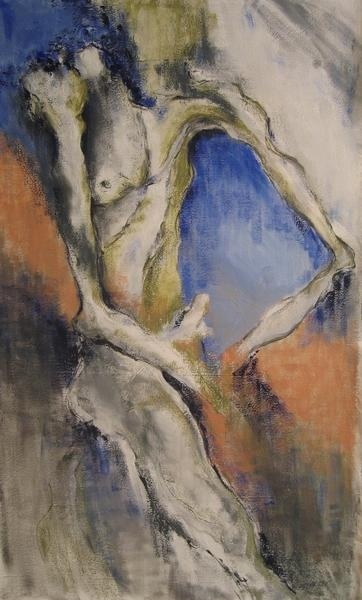
Image Used: Dessicated Seated Nude, by Bill Claps, oil and oil pastel on canvas, 36 x 56 in.
Previous Post

July 7, 2014
Seeing The World As It Is
Next Post
July 9, 2014 A Christian Writer Drops the F-Bomb: 25 Years of Image
Browse Our Archives
Select a Category A. G. Harmon Alissa Wilkinson Allison Backous Art Authors Brad Fruhauff Bradford Winters Bryan Bliss Caroline Langston Chad Thomas Johnston Chris Hoke Christiana N. Peterson Culture D.G. Myers D.L. Mayfield Daniel Bowman Jr. David Griffith Elizabeth Duffy Faith Film Greg Wolfe Guest Contributor Interview Jan Vallone Jeffrey Overstreet Jessica Eddings-Roeser Jessica Mesman Griffith Kelly Foster Lindsey Crittenden Morgan Meis music Natalie Vestin Nick Olson Peggy Rosenthal Personal Reflection Poetry Friday Reflection Relationships Review Richard Chess Richard Cole Sara Zarr Shannon Huffman Polson Sonya Bilocerkowycz Tania Runyan Tony Woodlief Topical Categories Uncategorized Vic Sizemore Writing
Select a Month October 2018 September 2018 August 2018 July 2018 June 2018 May 2018 April 2018 March 2018 February 2018 January 2018 December 2017 November 2017 October 2017 September 2017 August 2017 July 2017 June 2017 May 2017 April 2017 March 2017 February 2017 January 2017 December 2016 November 2016 October 2016 September 2016 August 2016 July 2016 June 2016 May 2016 April 2016 March 2016 February 2016 January 2016 December 2015 November 2015 October 2015 September 2015 August 2015 July 2015 June 2015 May 2015 April 2015 March 2015 February 2015 January 2015 December 2014 November 2014 October 2014 September 2014 August 2014 July 2014 June 2014 May 2014 April 2014 March 2014 February 2014 January 2014 December 2013 November 2013 October 2013 September 2013 August 2013 July 2013 June 2013 May 2013 April 2013 March 2013 February 2013 January 2013 December 2012 November 2012 October 2012 September 2012 August 2012 July 2012 June 2012 May 2012 February 2008
Follow Us!
TAKE THE
Religious Wisdom Quiz
What does the Pale Horse in Revelations symbolize?
Select your answer to see how you score.
Death War The Kingdom of God Prosperity
Related posts from Good Letters




TRENDING AT PATHEOS Catholic

Rejecting Doom: Christian Hope And Human Action
Christianity is a religion of hope. We are to have hope and...

It’s What Comes From Within Which Matters
One of the most difficult things for us to understand is why...

Why I Choose the Eucharist Over the Sermon
Choose the Eucharist, Not the Sermon What are we supposed to get...

5 Design Elements Found in Spiritually Rooted Homes
Putting Spirituality Into Home Decor Our homes are more than our living...

Credo: A Story of God Told with the...
About 10 years ago, I began to imagine a personal "Credo" that...

The Anatomy of Divine Revelation in Catholic Thought
The claim that God has made Himself known to human beings is...
view all Catholic blogs
Ad-Free & Subscriber Log-In Subscription Support
- About Us
- 2026 Calendar
- Videos
- Podcasts
- Library of World Religions
- Faith In Media Tracker
- Advertise With Us
- Write for Us
- Privacy Policy
- Terms of Service
- Do Not Sell My Data
- Contact Us
- Radiant Digital
- Manage Newsletter Subscriptions
- Unsubscribe From Notifications
- Sitemap
Copyright 2008-2026, Patheos. All rights reserved.
Subscription Support Ad-Free & Subscriber Log-In
Follow Patheos