
BuddhistCatholicContemplativeEvangelicalGeneral ChristianHinduJewishLatter-day SaintMuslimNew VisionsProgressive Christian
Beliefs
- Buddhist
- Catholic
- Contemplative
- Evangelical
- General Christian
- Hindu
- Jewish
- Latter-day Saint
- More Voices
- Muslim
- New Visions
- Pagan
- Progressive Christian
Topics
- Religion News
- Food and Religion
- Sports and Religion
- Religious Art
- Religious Music and Entertainment
- Religious Events
- History and Religion
- Style and Religion
- Politics and Religion
- Women in Religion
- Recreation Outdoors and Religion
- Business Finance and Religion
- Careers Workplace and Religion
- Education and Religion
- Family Parenting and Religion
- Health Fitness and Religion
- Home and Religion
- Relationships and Religion
- Technology and Religion
- Travel and Religion
Columnists
- Buddhist Columnists
- Business Finance and Religion Columnists
- Careers Workplace and Religion Columnists
- Catholic Columnists
- Contemplative Columnists
- Education and Religion Columnists
- Evangelists Columnists
- Family Parenting and Religion Columnists
- General Christian Columnists
- Health Fitness and Religion Columnists
- Hindu Columnists
- History and Religion Columnists
- Home and Religion Columnists
- Jewish Columnists
- More Voices Columnists
- Latter Day Columnists
- Muslim Columnists
- New Visions Columnists
- Nonreligious Columnists
- Pagan Columnists
- Politics and Religion Columnists
- Progressive Columnists
- Recreation Outdoors and Religion Columnists
- Relationships and Religion Columnists
- Religion News Columnists
- Religious Art Columnists
- Religious Events Columnists
- Religious Music and Entertainment Columnists
- Sports and Religion Columnists
- Style and Religion Columnists
- Technology and Religion Columnists
- Travel and Religion Columnists
- Women in Religion Columnists
Resource Library
- 2026 Calendar
- Library of World Religions
- The 100 Most Holy Places on Earth
- Patheos Answers
- Podcasts
- Videos
- Faith Leaders Database
- Anglican Episcopalian
- Bahai
- Baptist
- Buddhism
- Christianity
- Confucianism
- Eastern Orthodoxy
- Hinduism
- Holiness and Pentecostal
- ISKCON
- Islam
- Judaism
- Lutheran
- Methodist
- The Church of Jesus Christ of Latter-day Saints
- New Age
- Paganism
- Presbytarian and Reformed
- Protestantism
- Religion Behind the Scenes
- Roman Catholic
- Scientology
- Shia Islam
- Sikhism
- Sufism
- Sunni Islam
- Taoism
- Zen
- See all religions
Research Tools
 Ad-Free & Subscriber Log-In Subscription Support
Ad-Free & Subscriber Log-In Subscription Support
Follow Patheos 

- Trending:
- Forgiveness
- |
- Marriage
- |
- Consciousness
- |
- Death Penalty
- |
- Election
- |
- Halloween
 Good Letters
-
Contributors
- Home
- Catholic
- Moving to Stillness
Moving to Stillness
Last updated on: July 10, 2014 at 1:00 am by Caroline Langston
Moving to Stillness 2014-07-08T12:33:21-07:00 Caroline Langston
Patheos Explore the world's faith through different perspectives on religion and spirituality! Patheos has the views of the prevalent religions and spiritualities of the world.
 Last Thursday morning I got up, made my son’s lunch, made sure that both children were dressed and fed. My husband had left for work at his news job hours before. I pulled back my long hair, graying at the roots—time for a touch-up—grabbed the keys and the steel mug of coffee, and piled my son and daughter into the car.
At seven forty-five we were rounding the Beltway, the sun an arc in the sky behind us, the radio tuned on Pharrell and Imagine Dragons. I drove twenty-three miles to drop my son off at his camp, dropped off my daughter at Greek Orthodox Vacation Bible School, and then threaded my way through traffic from the Quicken Loans National Golf Championship to the nearest Starbucks, where I wrote a grant proposal asking for $300,000. I was under the gun, because I had to pick up my daughter at noon.
By late afternoon, though, I was miles away and all alone, at least as alone as one can get on the 4:06 p.m. Metroliner to New York Penn Station. I resigned myself to the spotty Wi-Fi. The train bore forward along its rusted, hundred-year-old tracks, curving through the row-house blocks and abandoned factories of Baltimore, Wilmington, and Philadelphia, along the Atlantic seaboard and then into New Jersey.
Along the way, I began to feel an odd expansion of spirit. For this journey—the train from Washington, New York, and Boston—has been a constant in my life, a marker that has intermittently measured my days since I first rode it alone at fourteen, blinking and unwilling to admit I was terrified.
It was good now to be forty-five, with not a lot of money but enough to get a cup of coffee and not to be bereft of sufficient change to make a pay phone call—which happened sometimes, back in the day, when payphones were all that there was. (Oh, the number of collect calls I made from random phones!)
Good as well, at Penn, to know what I was going to do: Pay a quick obeisance in the direction of the men’s room where legendary architect Louis I. Khan had a heart attack in 1979. Then head, on foot, down Seventh Avenue to Twenty-Third Street and The Leo House, the hundred-year-old Catholic guest house where I was staying.
Founded as a boarding house for German Catholic immigrants—and just down the block from the now-gentrified Chelsea Hotel (Thomas Wolfe! Patti Smith! Sid Vicious!)—The Leo House has for decades been something between a retreat house and a hostel, filled with both European tourists and florid religious statuary. Of the order of nuns running the place, most seemed to be Jamaican, indulgent in voice but firm in rectitude. I got my heavy key and took the old elevator to my room on the fourth floor.
And then there I was: in this tiny room as bare as my dorm room for boarding school, a tidy white double bed, box air conditioner, and crucifix on the wall.
What I felt then was something I can only describe by analogy: It was as though the water of my soul had run to the bottom of the hill.
As you can see, everything I have written up to this point has been about moving, perpetually restless in my own animal-adult ADHD compulsions about Things to Accomplish. (A critic once told me that one of the big problems with my writing was that I spent so much time talking about driving that my work never actually got anyplace.)
I felt like I was returning, somehow, to my essential self. I put down my bag and went back downstairs and turned in my key, stopping to check out the high-ceilinged lounge and dim chapel whose vigil candle glowed red against terra-cotta-tinted walls, and which smelled fragrantly of lilies. I needed to venture out for something to eat. I could have treated myself to an elaborate meal with my working-woman’s salary, but it seemed more appropriate to find something small and satisfying.
Down Twenty-third Street I discovered the source for both food and the lilies: A combination all-night Korean florist and market, its façade arrayed with buckets of brilliant blooms, hot coffee on offer. I poured a cup and stood outside holding it like a junkie, drawing in the riot of fragrant smells.
As dusk descended, the street seemed a bit ratty: a subsidized apartment building across the street, lingering figures on the pavement. I was surprised and delighted to see, through the green leaves of a pocket park, the mosaic façade of St. Eleftherios Greek Orthodox Church, which I hadn’t known was nearby.
I walked back into The Leo House, picked up my key, went back to the room. I was, it seemed, in the middle of my own apocalyptic vision. Entry alone into hotel rooms is often code for the life self-abandoned—like the protagonist in Doris Lessing’s “To Room Nineteen,” and the aborted suicide of the mother in Michael Cunningham’s The Hours—both mothers, it should be noted, also worn down by the demands of children and custom and expectation.
And yet I wasn’t unhappy or suicidal in the least: I felt with a slap of recognition that my encounter with this room, this street, was a foreshadowing of the ultimate telescoping inward that we all must face, and that I believe we must all be prepared to face. It is our own Passion that we cannot, should not, circumvent.
As the dying Ann thinks in Susan Minot’s 1998 novel Evening: “She had known other rooms and lived in other houses and been in other countries but this was the last room, she knew what was coming to her.”
Let me be ready, I thought. And made my own cross to mirror that of the crucifix on the wall. Then I lay down on the white sheets with their riot of pillows, and fell asleep.
A native of Yazoo City, Mississippi, Caroline Langston is a convert to the Eastern Orthodox Church. She is a widely published writer and essayist, a winner of the Pushcart Prize, and a commentator for NPR’s “All Things Considered.”
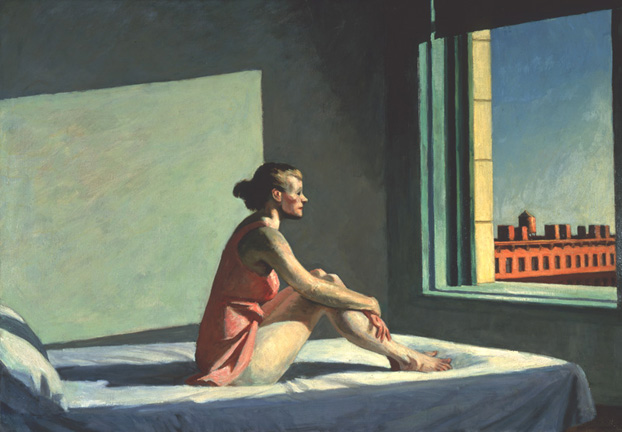
Image used: Morning Sun (1952), Edward Hopper, oil on canvas, 28 x 40 in.
Previous Post

July 9, 2014
A Christian Writer Drops the F-Bomb: 25 Years of Image
Next Post
July 11, 2014 Cheers to the World Cup
Browse Our Archives
Select a Category A. G. Harmon Alissa Wilkinson Allison Backous Art Authors Brad Fruhauff Bradford Winters Bryan Bliss Caroline Langston Chad Thomas Johnston Chris Hoke Christiana N. Peterson Culture D.G. Myers D.L. Mayfield Daniel Bowman Jr. David Griffith Elizabeth Duffy Faith Film Greg Wolfe Guest Contributor Interview Jan Vallone Jeffrey Overstreet Jessica Eddings-Roeser Jessica Mesman Griffith Kelly Foster Lindsey Crittenden Morgan Meis music Natalie Vestin Nick Olson Peggy Rosenthal Personal Reflection Poetry Friday Reflection Relationships Review Richard Chess Richard Cole Sara Zarr Shannon Huffman Polson Sonya Bilocerkowycz Tania Runyan Tony Woodlief Topical Categories Uncategorized Vic Sizemore Writing
Select a Month October 2018 September 2018 August 2018 July 2018 June 2018 May 2018 April 2018 March 2018 February 2018 January 2018 December 2017 November 2017 October 2017 September 2017 August 2017 July 2017 June 2017 May 2017 April 2017 March 2017 February 2017 January 2017 December 2016 November 2016 October 2016 September 2016 August 2016 July 2016 June 2016 May 2016 April 2016 March 2016 February 2016 January 2016 December 2015 November 2015 October 2015 September 2015 August 2015 July 2015 June 2015 May 2015 April 2015 March 2015 February 2015 January 2015 December 2014 November 2014 October 2014 September 2014 August 2014 July 2014 June 2014 May 2014 April 2014 March 2014 February 2014 January 2014 December 2013 November 2013 October 2013 September 2013 August 2013 July 2013 June 2013 May 2013 April 2013 March 2013 February 2013 January 2013 December 2012 November 2012 October 2012 September 2012 August 2012 July 2012 June 2012 May 2012 February 2008
Follow Us!
TAKE THE
Religious Wisdom Quiz
Which book of the Bible has a talking tree?
Select your answer to see how you score.
Proverbs Judges Ezekiel Genesis
Related posts from Good Letters




TRENDING AT PATHEOS Catholic

Rejecting Doom: Christian Hope And Human Action
Christianity is a religion of hope. We are to have hope and...

It’s What Comes From Within Which Matters
One of the most difficult things for us to understand is why...

Why I Choose the Eucharist Over the Sermon
Choose the Eucharist, Not the Sermon What are we supposed to get...

5 Design Elements Found in Spiritually Rooted Homes
Putting Spirituality Into Home Decor Our homes are more than our living...

Credo: A Story of God Told with the...
About 10 years ago, I began to imagine a personal "Credo" that...

The Anatomy of Divine Revelation in Catholic Thought
The claim that God has made Himself known to human beings is...
view all Catholic blogs
Ad-Free & Subscriber Log-In Subscription Support
- About Us
- 2026 Calendar
- Videos
- Podcasts
- Library of World Religions
- Faith In Media Tracker
- Advertise With Us
- Write for Us
- Privacy Policy
- Terms of Service
- Do Not Sell My Data
- Contact Us
- Radiant Digital
- Manage Newsletter Subscriptions
- Unsubscribe From Notifications
- Sitemap
Copyright 2008-2026, Patheos. All rights reserved.
Subscription Support Ad-Free & Subscriber Log-In
Follow Patheos