
BuddhistCatholicContemplativeEvangelicalGeneral ChristianHinduJewishLatter-day SaintMuslimNew VisionsProgressive Christian
Beliefs
- Buddhist
- Catholic
- Contemplative
- Evangelical
- General Christian
- Hindu
- Jewish
- Latter-day Saint
- More Voices
- Muslim
- New Visions
- Pagan
- Progressive Christian
Topics
- Religion News
- Food and Religion
- Sports and Religion
- Religious Art
- Religious Music and Entertainment
- Religious Events
- History and Religion
- Style and Religion
- Politics and Religion
- Women in Religion
- Recreation Outdoors and Religion
- Business Finance and Religion
- Careers Workplace and Religion
- Education and Religion
- Family Parenting and Religion
- Health Fitness and Religion
- Home and Religion
- Relationships and Religion
- Technology and Religion
- Travel and Religion
Columnists
- Buddhist Columnists
- Business Finance and Religion Columnists
- Careers Workplace and Religion Columnists
- Catholic Columnists
- Contemplative Columnists
- Education and Religion Columnists
- Evangelists Columnists
- Family Parenting and Religion Columnists
- General Christian Columnists
- Health Fitness and Religion Columnists
- Hindu Columnists
- History and Religion Columnists
- Home and Religion Columnists
- Jewish Columnists
- More Voices Columnists
- Latter Day Columnists
- Muslim Columnists
- New Visions Columnists
- Nonreligious Columnists
- Pagan Columnists
- Politics and Religion Columnists
- Progressive Columnists
- Recreation Outdoors and Religion Columnists
- Relationships and Religion Columnists
- Religion News Columnists
- Religious Art Columnists
- Religious Events Columnists
- Religious Music and Entertainment Columnists
- Sports and Religion Columnists
- Style and Religion Columnists
- Technology and Religion Columnists
- Travel and Religion Columnists
- Women in Religion Columnists
Resource Library
- 2026 Calendar
- Library of World Religions
- The 100 Most Holy Places on Earth
- Patheos Answers
- Podcasts
- Videos
- Faith Leaders Database
- Anglican Episcopalian
- Bahai
- Baptist
- Buddhism
- Christianity
- Confucianism
- Eastern Orthodoxy
- Hinduism
- Holiness and Pentecostal
- ISKCON
- Islam
- Judaism
- Lutheran
- Methodist
- The Church of Jesus Christ of Latter-day Saints
- New Age
- Paganism
- Presbytarian and Reformed
- Protestantism
- Religion Behind the Scenes
- Roman Catholic
- Scientology
- Shia Islam
- Sikhism
- Sufism
- Sunni Islam
- Taoism
- Zen
- See all religions
Research Tools
 Ad-Free & Subscriber Log-In Subscription Support
Ad-Free & Subscriber Log-In Subscription Support
Follow Patheos 

- Trending:
- Forgiveness
- |
- Marriage
- |
- Consciousness
- |
- Death Penalty
- |
- Election
- |
- Halloween
 Good Letters
-
Contributors
- Home
- Catholic
- Made Whole Again: 25 Years of Image
Made Whole Again: 25 Years of Image
Last updated on: July 16, 2014 at 1:00 am by Guest Contributor
Made Whole Again: 25 Years of Image 2014-07-15T09:50:50-07:00 Guest Contributor
Patheos Explore the world's faith through different perspectives on religion and spirituality! Patheos has the views of the prevalent religions and spiritualities of the world.
 To celebrate Image*’s twenty-fifth anniversary we are posting a series of essays by people who have encountered our programs over the years.*
Guest post by Paige Eve Chant
I am not the kind of Christian my parents wanted me to be. Case in point: I rarely call myself a Christian in public. These days it seems more of a political statement than I’d like it to be—and often not one I’d care to make.
I just don’t want the ordeal.
Any faith I could be said to have is troubled by doubt, such that most days I do not know where one ends and the other begins. This is not a new problem for me and hardly unique. It is not even, when you come down to it, a problem. It is simply the way of things.
Most days I feel I am a terrible Christian. And most days that’s exactly what I am.
You will protest. You mean well, of course, but you don’t know me like I know me. The human heart is not an easy organ to live with. “Our ticker,” writes poet Lisa Ampleman in the twenty-fifth anniversary issue of Image, “is not meat / and mainspring but measure and limit.”
I go to church sporadically, sometimes because I’m feeling philosophical about the whole affair, but most times because I’m lazy. I’ve broken nearly all of the Ten Commandments, in thought if not in deed. I frequently use God’s name in vain because, to be frank, it hits the tongue just right in a moment of need and because, when I don’t want to take the blame myself, or when I don’t know how else to account for the mysterious forces of life that lead to the myriad pedestrian tragedies of everyday life, God makes the perfect scapegoat.
Christ said: Do not judge. Go in peace. Give love freely.
I habitually fail at all three.
So.
Any qualms I have with calling myself a Christian are paralleled by the qualms I have in calling myself a writer. Once I make the declaration, people want to know what it means.
What kind of writer are you? people ask me.
A terrible writer, I want to say.
It takes me hours to compose a single status update, months to complete a blog post, years to finish a novel draft that is languishing with three final chapters to go. I’ll empty the crumb tray in the toaster or scrub the toilet or watch marathon back-to-back episodes of 90s sitcoms before I will sit in the chair and write.
And even then, once I finally manage to produce something, I regularly get the most basic kind of feedback: Your ideas are vague and abstract; your sentences too long and unwieldy; your word choice awkward, imprecise.
I am a beginner still.
“There is deep gladness,” writes Francisco X. Stork, “in the acceptance that what I do, poor as it is, will be my best” (Image #79).
I do not disbelieve this, but it is hard to keep faith in the gladness when mostly what one feels, day in and day out, is the abiding poverty of it all.
I am reminded of Annie Dillard’s telling of the Hasidic rabbi who left his house every morning convinced that he would die in fits of prayer. Or, similarly, the ritual slaughterer who every day left his home and his family in tears: Who knows what will become of me after I call on the Lord’s power and before I can summon the words for mercy?
All I know to say of the writing life, and of the life of faith—which for me are one and the same—is that to attempt to write, to attempt to believe, is to suspend myself, willingly and perpetually, in that split second of time wherein I might be saved or I might be damned.
And what compels me to this life of radical suspension is the very thing that continues to steel and sustain me for it: the devoutly artistic and doggedly interfaith work of Image.
For writers and artists whose creative work is deeply, perhaps stubbornly, informed by a religious or spiritual worldview, reading the pages of Image is like coming home. In Image we encounter a rigorous yet inclusive artistic community that strikes down the myth of a heart divided between a life of art and a life of faith (or doubt, as the case might be).
The work of Image, when all is said and done, restores us to ourselves. In its pages, we are made whole again.
“Artists need communities,” writes Greg Wolfe (Image #79). “The writers need to just keep writing—and, remarkably, they’ve continued to do so.”
He’s right, of course, but I reckon many of us might not be writing today if it weren’t for the community of Image. I certainly count myself among that number.
If I can call myself any kind of Christian, if I can call myself any kind of writer—let alone (on those rarest of days) both at once—it is because of Image.
I hope I can prove myself worthy of the call.
After earning her Master of Fine Arts in Creative Writing at the University of Washington, Paige Eve Chant was awarded the 2010-2011 Milton Center Postgraduate Fellowship. She is currently at work on her first novel. Read more of her work online at www.paigeevechant.com.
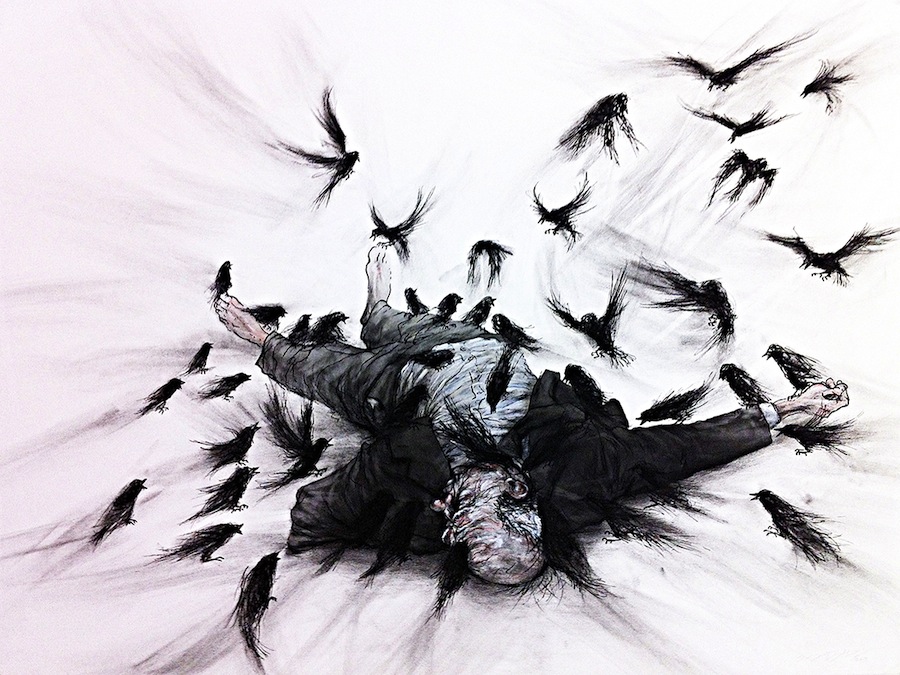
Image used: Jeremiah (2012), Scott Kolbo, archival ink jet, ink, and charcoal, 22 x 30 in.
Previous Post

July 15, 2014
Everybody Should Write Poetry
Next Post
July 17, 2014 Ovarian Cancer and a Circumcised Heart
Browse Our Archives
Select a Category A. G. Harmon Alissa Wilkinson Allison Backous Art Authors Brad Fruhauff Bradford Winters Bryan Bliss Caroline Langston Chad Thomas Johnston Chris Hoke Christiana N. Peterson Culture D.G. Myers D.L. Mayfield Daniel Bowman Jr. David Griffith Elizabeth Duffy Faith Film Greg Wolfe Guest Contributor Interview Jan Vallone Jeffrey Overstreet Jessica Eddings-Roeser Jessica Mesman Griffith Kelly Foster Lindsey Crittenden Morgan Meis music Natalie Vestin Nick Olson Peggy Rosenthal Personal Reflection Poetry Friday Reflection Relationships Review Richard Chess Richard Cole Sara Zarr Shannon Huffman Polson Sonya Bilocerkowycz Tania Runyan Tony Woodlief Topical Categories Uncategorized Vic Sizemore Writing
Select a Month October 2018 September 2018 August 2018 July 2018 June 2018 May 2018 April 2018 March 2018 February 2018 January 2018 December 2017 November 2017 October 2017 September 2017 August 2017 July 2017 June 2017 May 2017 April 2017 March 2017 February 2017 January 2017 December 2016 November 2016 October 2016 September 2016 August 2016 July 2016 June 2016 May 2016 April 2016 March 2016 February 2016 January 2016 December 2015 November 2015 October 2015 September 2015 August 2015 July 2015 June 2015 May 2015 April 2015 March 2015 February 2015 January 2015 December 2014 November 2014 October 2014 September 2014 August 2014 July 2014 June 2014 May 2014 April 2014 March 2014 February 2014 January 2014 December 2013 November 2013 October 2013 September 2013 August 2013 July 2013 June 2013 May 2013 April 2013 March 2013 February 2013 January 2013 December 2012 November 2012 October 2012 September 2012 August 2012 July 2012 June 2012 May 2012 February 2008
Follow Us!
TAKE THE
Religious Wisdom Quiz
Who spoke to the burning bush?
Select your answer to see how you score.
Moses Aaron Miriam Joseph
Related posts from Good Letters

The Stars of the Earth Cry Out


Poetry Friday: “The Ordinary Time”
TRENDING AT PATHEOS Catholic

Rejecting Doom: Christian Hope And Human Action
Christianity is a religion of hope. We are to have hope and...

It’s What Comes From Within Which Matters
One of the most difficult things for us to understand is why...

Why I Choose the Eucharist Over the Sermon
Choose the Eucharist, Not the Sermon What are we supposed to get...

5 Design Elements Found in Spiritually Rooted Homes
Putting Spirituality Into Home Decor Our homes are more than our living...

Credo: A Story of God Told with the...
About 10 years ago, I began to imagine a personal "Credo" that...

The Anatomy of Divine Revelation in Catholic Thought
The claim that God has made Himself known to human beings is...
view all Catholic blogs
Ad-Free & Subscriber Log-In Subscription Support
- About Us
- 2026 Calendar
- Videos
- Podcasts
- Library of World Religions
- Faith In Media Tracker
- Advertise With Us
- Write for Us
- Privacy Policy
- Terms of Service
- Do Not Sell My Data
- Contact Us
- Radiant Digital
- Manage Newsletter Subscriptions
- Unsubscribe From Notifications
- Sitemap
Copyright 2008-2026, Patheos. All rights reserved.
Subscription Support Ad-Free & Subscriber Log-In
Follow Patheos