
BuddhistCatholicContemplativeEvangelicalGeneral ChristianHinduJewishLatter-day SaintMuslimNew VisionsProgressive Christian
Beliefs
- Buddhist
- Catholic
- Contemplative
- Evangelical
- General Christian
- Hindu
- Jewish
- Latter-day Saint
- More Voices
- Muslim
- New Visions
- Pagan
- Progressive Christian
Topics
- Religion News
- Food and Religion
- Sports and Religion
- Religious Art
- Religious Music and Entertainment
- Religious Events
- History and Religion
- Style and Religion
- Politics and Religion
- Women in Religion
- Recreation Outdoors and Religion
- Business Finance and Religion
- Careers Workplace and Religion
- Education and Religion
- Family Parenting and Religion
- Health Fitness and Religion
- Home and Religion
- Relationships and Religion
- Technology and Religion
- Travel and Religion
Columnists
- Buddhist Columnists
- Business Finance and Religion Columnists
- Careers Workplace and Religion Columnists
- Catholic Columnists
- Contemplative Columnists
- Education and Religion Columnists
- Evangelists Columnists
- Family Parenting and Religion Columnists
- General Christian Columnists
- Health Fitness and Religion Columnists
- Hindu Columnists
- History and Religion Columnists
- Home and Religion Columnists
- Jewish Columnists
- More Voices Columnists
- Latter Day Columnists
- Muslim Columnists
- New Visions Columnists
- Nonreligious Columnists
- Pagan Columnists
- Politics and Religion Columnists
- Progressive Columnists
- Recreation Outdoors and Religion Columnists
- Relationships and Religion Columnists
- Religion News Columnists
- Religious Art Columnists
- Religious Events Columnists
- Religious Music and Entertainment Columnists
- Sports and Religion Columnists
- Style and Religion Columnists
- Technology and Religion Columnists
- Travel and Religion Columnists
- Women in Religion Columnists
Resource Library
- 2026 Calendar
- Library of World Religions
- The 100 Most Holy Places on Earth
- Patheos Answers
- Podcasts
- Videos
- Faith Leaders Database
- Anglican Episcopalian
- Bahai
- Baptist
- Buddhism
- Christianity
- Confucianism
- Eastern Orthodoxy
- Hinduism
- Holiness and Pentecostal
- ISKCON
- Islam
- Judaism
- Lutheran
- Methodist
- The Church of Jesus Christ of Latter-day Saints
- New Age
- Paganism
- Presbytarian and Reformed
- Protestantism
- Religion Behind the Scenes
- Roman Catholic
- Scientology
- Shia Islam
- Sikhism
- Sufism
- Sunni Islam
- Taoism
- Zen
- See all religions
Research Tools
 Ad-Free & Subscriber Log-In Subscription Support
Follow Patheos 

- Trending:
- Advent
- |
- Forgiveness
- |
- Thanksgiving
- |
- Election
- |
- Seasonal Holidays
- |
- Marriage
 Good Letters
-
Contributors
- Home
- Catholic
- God, Guilt, and Aronofsky’s Noah, Part 1
God, Guilt, and Aronofsky’s Noah, Part 1
Last updated on: July 23, 2014 at 1:00 am by Vic Sizemore
God, Guilt, and Aronofsky’s Noah, Part 1 2014-07-22T11:07:53-07:00 Vic Sizemore
Patheos Explore the world's faith through different perspectives on religion and spirituality! Patheos has the views of the prevalent religions and spiritualities of the world.
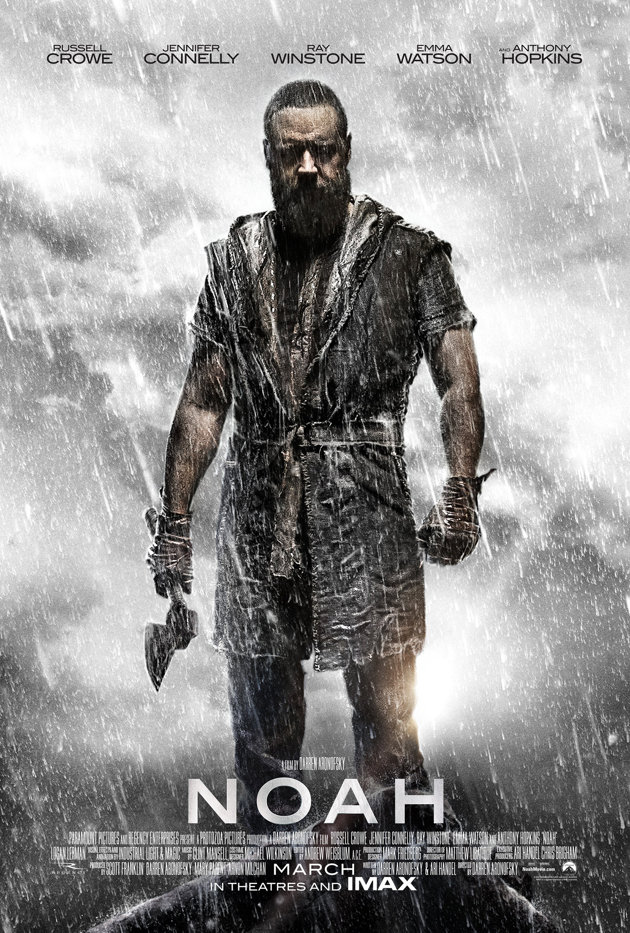 As it has become too expensive for our family of five to go to the theater together often, we usually wait to see movies until they reach the dollar theater here in town. This means that we usually do not see a movie until the flurry of reviews has passed. Not many people were still writing about Darren Aronofsky’s Noah when we saw it a couple of weeks ago. I come late to the conversation, but I still want to share some thoughts on the film.
I do not want to weigh in on the controversy surrounding it. Having grown up in a church in which every new artistic or pop-culture offering was a cause for protest—Jesus Christ Superstar, Smurfs, He Man, The Lion King, Teletubbies—I had little trouble ignoring those rants. I did join one discussion with a boycotter who countered my suggestion that he take Aronofsky at his word when he says he wanted the movie to be a midrash with a remark about “adult diaper rash.” I was reminded why I try to stay out of discussions with certain of my Facebook friends.
Since there was no worry about spoilers, I read the reviews. A concise observation by Matt Zoller Seitz gave support to what I suspected: “This is…an immense, weird, ungainly, often laughably overwrought and silly movie, an amalgamation of elements from various literary and cinematic forebears.” After seeing the movie, I disagree. Overwrought maybe. Laughable and silly? No.
I have read both that Aronofsky claims to be atheist and that he does not. From his previous movies, I think it is safe to say that whatever else he might be, he is a seeker. He is asking the big questions. As I once heard someone describe a writer, “He has his hook baited for Leviathan.”
I went into the movie assuming that he was not a believer in any dogmatic way, was not intending the movie to work on an anagogical level. There was no point worrying about claims he is making about how things actually happen in the realm of the supernatural. It seemed best to view his take on the experience of the believing soul phenomenologically.
Flood stories abound in world mythology, and the Bible’s account is strikingly similar to the story of Utnapishtim in The Epic of Gilgamesh. In Genesis, the reason God destroys humanity is that the “wickedness of man was great on the earth, and every imagination of his heart was only evil continually.” In a number of translations of the Gilgamesh version, the gods want to destroy humanity because they are making too much noise. Interestingly, this is the same reason Grendel lopes out of the moors to wreak havoc on the drunken thanes at Heorot. Excessive noise.
What is it about making too much noise that deserves supernatural retribution, whether it comes from gods or devils? You could imagine that whenever large groups of humans are making enough noise to wake up the gods, they are having either a very good time or a very bad time, a bacchanal or a war.
In his Time review, Richard Corliss mentions the 1928 version of the movie which—as Camus’s The Plague uses disease as an allegorical stand in for WWII—uses Noah’s flood (“A deluge of water drowning a world of lust”) to represent WWI (“A deluge of blood drowning a world of hate!”).
Lust and hate, sex and murder. The noisy goings on of depraved humanity. The source of the noise in Arinofsky’s Noah is mining and deforestation, the despoiling of our natural world. What is universal to these stories is that humanity stands guilty before God.
We humans stand guilty and we must pay with our lives. This is a part of understanding religion phenomenologically as well. It is not a theological statement.
In his book God, Guilt and Death, Merold Westphal claims that death and guilt are primary topics for understanding the believing soul’s religious experience, no matter what the tradition. In this scheme, guilt is the waking up to the “ontological inadequacy” of humans before the Ultimate Other. This sense of guilt, as described by Westphal, is far deeper than simply being culpable for some wrongdoing. It goes to the very “status and worth” of our being.
Before God who is Ultimate, we are less than nothing. Experiencing the world from the center of the universe as we do, we cannot help but be ambivalent in the presence of something that is “more real than I myself and the world of my immediate experience.”
We fear death, but what is worse than that is the nagging sense that, horrible as it may be, we have it coming. We feel our own “ontological inadequacy.” We sense that in an economy ruled by the Ultimate Other—which is not simply “raw power, but absolute worth”—we truly are less than worms. “You are the potter, I am the clay,” as the words of an old hymn puts it. Therefore, “representation of the holy [is] simultaneously attractive and repulsive.”
Before the Holy, I stand unworthy. It is not simply that I have misbehaved; it is even more dire than that: “What is at issue is the quality of my being and not the quantity of my (good or evil) behavior.”
Westphal explains the believer’s reaction to this realization before the Ultimate Other in terms of Rudolf Otto’s mysterium tremendum et fascinans: briefly, we experience contradictory emotions when facing God. Our response to one who is Ultimate Reality is simultaneously irresistible attraction and paralyzing terror (think of the prophet Isaiah falling down as if dead, of Arjuna dropping before Krishna, of Augustine doubting the reality of his own existence in the face of God’s profound truth). How can the believing soul help but be ambivalent?
In tomorrow’s post, I will briefly discuss some ways in which this ambivalence is depicted in Noah.
Vic Sizemore earned his MFA in fiction from Seattle Pacific University in 2009. His short stories are published or forthcoming in StoryQuarterly, Southern Humanities Review, Connecticut Review, Portland Review, Blue Mesa Review, Sou’wester, Silk Road Review, Atticus Review, PANK Magazine Fiction Fix, Vol.1 Brooklyn, Conclave, and elsewhere. Excerpts from his novel The Calling are published in Connecticut Review, Portland Review, Prick of the Spindle, Burrow Press Review, Rock & Sling, and Relief. His fiction has won the New Millennium Writings Award for Fiction, and been nominated for Best American Nonrequired Reading and a Pushcart Prize. You can find Vic at http://vicsizemore.wordpress.com/.
Previous Post

July 22, 2014
Lavender and Pennies
Next Post
July 24, 2014 God, Guilt, and Aronofsky’s Noah, Part 2
Browse Our Archives
Select a Category A. G. Harmon Alissa Wilkinson Allison Backous Art Authors Brad Fruhauff Bradford Winters Bryan Bliss Caroline Langston Chad Thomas Johnston Chris Hoke Christiana N. Peterson Culture D.G. Myers D.L. Mayfield Daniel Bowman Jr. David Griffith Elizabeth Duffy Faith Film Greg Wolfe Guest Contributor Interview Jan Vallone Jeffrey Overstreet Jessica Eddings-Roeser Jessica Mesman Griffith Kelly Foster Lindsey Crittenden Morgan Meis music Natalie Vestin Nick Olson Peggy Rosenthal Personal Reflection Poetry Friday Reflection Relationships Review Richard Chess Richard Cole Sara Zarr Shannon Huffman Polson Sonya Bilocerkowycz Tania Runyan Tony Woodlief Topical Categories Uncategorized Vic Sizemore Writing
Select a Month October 2018 September 2018 August 2018 July 2018 June 2018 May 2018 April 2018 March 2018 February 2018 January 2018 December 2017 November 2017 October 2017 September 2017 August 2017 July 2017 June 2017 May 2017 April 2017 March 2017 February 2017 January 2017 December 2016 November 2016 October 2016 September 2016 August 2016 July 2016 June 2016 May 2016 April 2016 March 2016 February 2016 January 2016 December 2015 November 2015 October 2015 September 2015 August 2015 July 2015 June 2015 May 2015 April 2015 March 2015 February 2015 January 2015 December 2014 November 2014 October 2014 September 2014 August 2014 July 2014 June 2014 May 2014 April 2014 March 2014 February 2014 January 2014 December 2013 November 2013 October 2013 September 2013 August 2013 July 2013 June 2013 May 2013 April 2013 March 2013 February 2013 January 2013 December 2012 November 2012 October 2012 September 2012 August 2012 July 2012 June 2012 May 2012 February 2008
Follow Us!
TAKE THE
Religious Wisdom Quiz
Who was visited by an angel to announce his wife would have John the Baptist?
Select your answer to see how you score.
Caiaphas Joseph Simon Zechariah
Related posts from Good Letters

Morning in a Forgotten Neighborhood



Poetry Friday: “The Name of God”
TRENDING AT PATHEOS Catholic

Bad Survey Questions Distort Eucharistic Theology
It seems to be the newest thing: someone conducts a bad survey...

If Baptism Washes Away Sin, Why Do Catholics...
The seven sacraments stand as the foundation of Catholic ecclesial life. The...

Far from promoting indifference, inaction, or quietism, Paul consistently tells us to...

The Power of Setting a Good Example
Remember last August when the Chicago White Sox hosted a "Pope Hat...

A Catholic Critique of Biblical Unitarianism
If the statistics are to be believed, Unitarianism is rising worldwide. Although...

How Grandma Tourism Helps Grandparents Live Their Vocation
Grandma, The New Travel Influencer What started as a nostalgia-inspired social media...
view all Catholic blogs
Ad-Free & Subscriber Log-In Subscription Support
- About Us
- 2026 Calendar
- Videos
- Podcasts
- Library of World Religions
- Faith In Media Tracker
- Advertise With Us
- Write for Us
- Privacy Policy
- Terms of Service
- Do Not Sell My Data
- Contact Us
- Radiant Digital
- Manage Newsletter Subscriptions
- Unsubscribe From Notifications
- Sitemap
Copyright 2008-2026, Patheos, part of the Radiant Digital network of media brands. All rights reserved.
Subscription Support Ad-Free & Subscriber Log-In
Follow Patheos