
BuddhistCatholicContemplativeEvangelicalGeneral ChristianHinduJewishLatter-day SaintMuslimNew VisionsProgressive Christian
Beliefs
- Buddhist
- Catholic
- Contemplative
- Evangelical
- General Christian
- Hindu
- Jewish
- Latter-day Saint
- More Voices
- Muslim
- New Visions
- Pagan
- Progressive Christian
Topics
- Religion News
- Food and Religion
- Sports and Religion
- Religious Art
- Religious Music and Entertainment
- Religious Events
- History and Religion
- Style and Religion
- Politics and Religion
- Women in Religion
- Recreation Outdoors and Religion
- Business Finance and Religion
- Careers Workplace and Religion
- Education and Religion
- Family Parenting and Religion
- Health Fitness and Religion
- Home and Religion
- Relationships and Religion
- Technology and Religion
- Travel and Religion
Columnists
- Buddhist Columnists
- Business Finance and Religion Columnists
- Careers Workplace and Religion Columnists
- Catholic Columnists
- Contemplative Columnists
- Education and Religion Columnists
- Evangelists Columnists
- Family Parenting and Religion Columnists
- General Christian Columnists
- Health Fitness and Religion Columnists
- Hindu Columnists
- History and Religion Columnists
- Home and Religion Columnists
- Jewish Columnists
- More Voices Columnists
- Latter Day Columnists
- Muslim Columnists
- New Visions Columnists
- Nonreligious Columnists
- Pagan Columnists
- Politics and Religion Columnists
- Progressive Columnists
- Recreation Outdoors and Religion Columnists
- Relationships and Religion Columnists
- Religion News Columnists
- Religious Art Columnists
- Religious Events Columnists
- Religious Music and Entertainment Columnists
- Sports and Religion Columnists
- Style and Religion Columnists
- Technology and Religion Columnists
- Travel and Religion Columnists
- Women in Religion Columnists
Resource Library
- 2026 Calendar
- Library of World Religions
- The 100 Most Holy Places on Earth
- Patheos Answers
- Podcasts
- Videos
- Faith Leaders Database
- Anglican Episcopalian
- Bahai
- Baptist
- Buddhism
- Christianity
- Confucianism
- Eastern Orthodoxy
- Hinduism
- Holiness and Pentecostal
- ISKCON
- Islam
- Judaism
- Lutheran
- Methodist
- The Church of Jesus Christ of Latter-day Saints
- New Age
- Paganism
- Presbytarian and Reformed
- Protestantism
- Religion Behind the Scenes
- Roman Catholic
- Scientology
- Shia Islam
- Sikhism
- Sufism
- Sunni Islam
- Taoism
- Zen
- See all religions
Research Tools
 Ad-Free & Subscriber Log-In Subscription Support
Ad-Free & Subscriber Log-In Subscription Support
Follow Patheos 

- Trending:
- Forgiveness
- |
- Marriage
- |
- Consciousness
- |
- Death Penalty
- |
- Election
- |
- Halloween
 Good Letters
-
Contributors
- Home
- Catholic
- Cheers to the World Cup
Cheers to the World Cup
Last updated on: July 11, 2014 at 1:00 am by Vic Sizemore
Cheers to the World Cup 2014-07-10T10:29:07-07:00 Vic Sizemore
Patheos Explore the world's faith through different perspectives on religion and spirituality! Patheos has the views of the prevalent religions and spiritualities of the world.
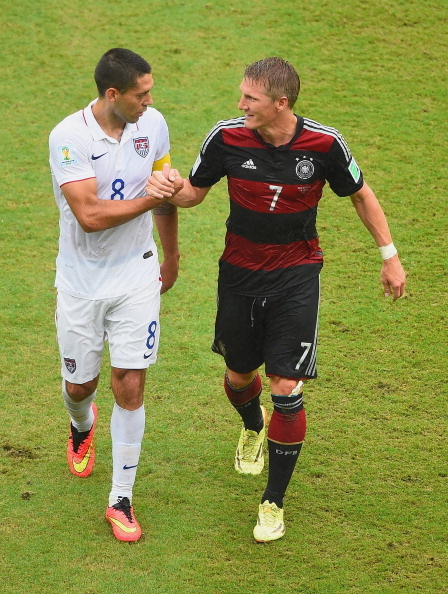 I met a friend in the local hipster bar to watch what was to be the U.S. team’s final game of the World Cup. An exciting game, we left with a loss that felt like a win. I was at the beach when the U.S. played Portugal and Germany.
I was a serious soccer player in high school, planned to play in college until a senior-year leg injury (not on the field) took me out, so I was ready to watch some soccer no matter who was playing; I didn’t know about my family. They caught the excitement. We had not cheered this way for a sports team as a family ever before—even my kids who don’t watch sports on television and don’t particularly care for soccer.
But what I felt this time around watching the World Cup most strongly is a sense of pride in being American that I haven’t felt for a long time. It appears that we are having dealings with the rest of the world on equal and friendly terms. Americans on the field are simply men on the field, just like the ones from Ghana and Portugal and Germany, and every other nation. There is competition, but it is (mostly) friendly, and filled with admiration for a well-played ball no matter who makes the play. (My wife has complained that it is still a world of men, and I can’t disagree with that.)
Years ago I read an essay, and can’t remember where, that traced our national character through sport. When baseball became our national sport, our culture was agrarian, small town. Long lazy afternoons in the heat of summer, when the crops were growing on their own, spent playing ball in a dusty field. Baseball is a pastoral sport, the essay claimed, studied and cerebral. The rise of football marks a shift from this pastoral ideal to a heroic warrior ideal. A calm evening of balls cracking on bats and glove slaps can no longer compete with the bursts of speed and violence that is smash-mouth football.
What of soccer in all of this? Does it really matter in the United States? When a British commentator said during the Belgium game, “Things are at a standstill in the United States,” the bar burst out in laughter. Yet this bar was full with an audience (much younger than my friend and me) raised in soccer leagues.
Writing for Quartz, John McDuling observed that, “while soccer will never unseat baseball as the national pastime, or football as the national sport, it is finally settling into a sustainable place in the country’s psyche.”
Does our sport really mean anything about our character, or our relationship to the rest of the world? It is nice to think maybe it does, as Galia Press-Barnathan does when he writes, “The World Cup games indeed reflect and symbolize a sense of global fraternity and rejoicing in this popular and beautiful sport, and provide a stage for states to compete with each other and empower themselves by peaceful means.”
On the evening of the Portugal game, I stood on the deck enjoying the warm ocean breeze and a garbage truck rumbled up to dump the trash from the previous cottage residents. Two Latino men jumped out in blue coveralls and bounded around the truck. The dirty green garbage bin came up to his shoulders, stuffed to overflowing with white bags.
When one of the men pulled on the bin, an empty milk jug fell out into the road. In smooth, graceful movements, he rainbow kicked the jug and juggled it: one, two, three, four, five times, caught it in his hands and threw it into the truck. When he glanced up at me, I gave him a thumbs-up and he responded with a grin and a nod. The men jumped in the truck and drove on, but in that momentary exchange, a feeling of good will passed between us—it was the World Cup, we both knew, that had created it.
Sports fans in the United States generally get their sense of community by gathering in a stadium with people they don’t know for the most part to cheer for kids who are from somewhere else. The World Cup is different at least in that we can have this sense of national pride in our boys who played their hearts out and, as more than one commentator wrote, “left it all out there on the field.” It felt good to cheer for our boys.
However, as Laurent Dubois points out, “John Brooks, Jermaine Jones, Timothy Chandler, Fabian Johnson, and Julian Green.… All five are the sons of African-American servicemen and German mothers, and four of them were born in Germany (Green was born in Florida but moved to Germany when he was 2). They grew up in Germany and, crucially, learned to play in the excellent football academies that have made that country the global football power that it is.”
The United States is recruiting from its diaspora, which is “part of the massive and unequaled U.S. military presence abroad.”
After the Portugal game, my sister laughed and read aloud a comedian’s Tweet that the game almost made him want to learn the rules of soccer and find out where Portugal is. This made me think of another bit of humor I saw posted somewhere on social media a few years ago: “War is how the United States teaches its children geography.”
Fleeting and insubstantial as it might be, it still felt good to be the United States on the international stage, dealing with other countries big and small, “without,” as a man sitting at the bar beside me said, “feeling like we have to have our heels on everyone else’s throat.”
Vic Sizemore earned his MFA in fiction from Seattle Pacific University in 2009. His short stories are published or forthcoming in StoryQuarterly, Southern Humanities Review, Connecticut Review, Portland Review, Blue Mesa Review, Sou’wester, Silk Road Review, Atticus Review, PANK Magazine Fiction Fix, Vol.1 Brooklyn, Conclave, and elsewhere. Excerpts from his novel The Calling are published in Connecticut Review, Portland Review, Prick of the Spindle, Burrow Press Review, Rock & Sling, and Relief. His fiction has won the New Millennium Writings Award for Fiction, and been nominated for Best American Nonrequired Reading and a Pushcart Prize. You can find Vic at http://vicsizemore.wordpress.com/.
Previous Post

July 10, 2014
Moving to Stillness
Next Post
July 14, 2014 The Gay Science and Nietzsche’s Prayer Rant
Browse Our Archives
Select a Category A. G. Harmon Alissa Wilkinson Allison Backous Art Authors Brad Fruhauff Bradford Winters Bryan Bliss Caroline Langston Chad Thomas Johnston Chris Hoke Christiana N. Peterson Culture D.G. Myers D.L. Mayfield Daniel Bowman Jr. David Griffith Elizabeth Duffy Faith Film Greg Wolfe Guest Contributor Interview Jan Vallone Jeffrey Overstreet Jessica Eddings-Roeser Jessica Mesman Griffith Kelly Foster Lindsey Crittenden Morgan Meis music Natalie Vestin Nick Olson Peggy Rosenthal Personal Reflection Poetry Friday Reflection Relationships Review Richard Chess Richard Cole Sara Zarr Shannon Huffman Polson Sonya Bilocerkowycz Tania Runyan Tony Woodlief Topical Categories Uncategorized Vic Sizemore Writing
Select a Month October 2018 September 2018 August 2018 July 2018 June 2018 May 2018 April 2018 March 2018 February 2018 January 2018 December 2017 November 2017 October 2017 September 2017 August 2017 July 2017 June 2017 May 2017 April 2017 March 2017 February 2017 January 2017 December 2016 November 2016 October 2016 September 2016 August 2016 July 2016 June 2016 May 2016 April 2016 March 2016 February 2016 January 2016 December 2015 November 2015 October 2015 September 2015 August 2015 July 2015 June 2015 May 2015 April 2015 March 2015 February 2015 January 2015 December 2014 November 2014 October 2014 September 2014 August 2014 July 2014 June 2014 May 2014 April 2014 March 2014 February 2014 January 2014 December 2013 November 2013 October 2013 September 2013 August 2013 July 2013 June 2013 May 2013 April 2013 March 2013 February 2013 January 2013 December 2012 November 2012 October 2012 September 2012 August 2012 July 2012 June 2012 May 2012 February 2008
Follow Us!
TAKE THE
Religious Wisdom Quiz
How long did David reign as king?
Select your answer to see how you score.
25 years 40 years 33 years 50 years
Related posts from Good Letters


Do I Have Anything Left to Say?

TRENDING AT PATHEOS Catholic

Rejecting Doom: Christian Hope And Human Action
Christianity is a religion of hope. We are to have hope and...

It’s What Comes From Within Which Matters
One of the most difficult things for us to understand is why...

Why I Choose the Eucharist Over the Sermon
Choose the Eucharist, Not the Sermon What are we supposed to get...

5 Design Elements Found in Spiritually Rooted Homes
Putting Spirituality Into Home Decor Our homes are more than our living...

Credo: A Story of God Told with the...
About 10 years ago, I began to imagine a personal "Credo" that...

The Anatomy of Divine Revelation in Catholic Thought
The claim that God has made Himself known to human beings is...
view all Catholic blogs
Ad-Free & Subscriber Log-In Subscription Support
- About Us
- 2026 Calendar
- Videos
- Podcasts
- Library of World Religions
- Faith In Media Tracker
- Advertise With Us
- Write for Us
- Privacy Policy
- Terms of Service
- Do Not Sell My Data
- Contact Us
- Radiant Digital
- Manage Newsletter Subscriptions
- Unsubscribe From Notifications
- Sitemap
Copyright 2008-2026, Patheos. All rights reserved.
Subscription Support Ad-Free & Subscriber Log-In
Follow Patheos