
BuddhistCatholicContemplativeEvangelicalGeneral ChristianHinduJewishLatter-day SaintMuslimNew VisionsProgressive Christian
Beliefs
- Buddhist
- Catholic
- Contemplative
- Evangelical
- General Christian
- Hindu
- Jewish
- Latter-day Saint
- More Voices
- Muslim
- New Visions
- Pagan
- Progressive Christian
Topics
- Religion News
- Food and Religion
- Sports and Religion
- Religious Art
- Religious Music and Entertainment
- Religious Events
- History and Religion
- Style and Religion
- Politics and Religion
- Women in Religion
- Recreation Outdoors and Religion
- Business Finance and Religion
- Careers Workplace and Religion
- Education and Religion
- Family Parenting and Religion
- Health Fitness and Religion
- Home and Religion
- Relationships and Religion
- Technology and Religion
- Travel and Religion
Columnists
- Buddhist Columnists
- Business Finance and Religion Columnists
- Careers Workplace and Religion Columnists
- Catholic Columnists
- Contemplative Columnists
- Education and Religion Columnists
- Evangelists Columnists
- Family Parenting and Religion Columnists
- General Christian Columnists
- Health Fitness and Religion Columnists
- Hindu Columnists
- History and Religion Columnists
- Home and Religion Columnists
- Jewish Columnists
- More Voices Columnists
- Latter Day Columnists
- Muslim Columnists
- New Visions Columnists
- Nonreligious Columnists
- Pagan Columnists
- Politics and Religion Columnists
- Progressive Columnists
- Recreation Outdoors and Religion Columnists
- Relationships and Religion Columnists
- Religion News Columnists
- Religious Art Columnists
- Religious Events Columnists
- Religious Music and Entertainment Columnists
- Sports and Religion Columnists
- Style and Religion Columnists
- Technology and Religion Columnists
- Travel and Religion Columnists
- Women in Religion Columnists
Resource Library
- 2026 Calendar
- Library of World Religions
- The 100 Most Holy Places on Earth
- Patheos Answers
- Podcasts
- Videos
- Faith Leaders Database
- Anglican Episcopalian
- Bahai
- Baptist
- Buddhism
- Christianity
- Confucianism
- Eastern Orthodoxy
- Hinduism
- Holiness and Pentecostal
- ISKCON
- Islam
- Judaism
- Lutheran
- Methodist
- The Church of Jesus Christ of Latter-day Saints
- New Age
- Paganism
- Presbytarian and Reformed
- Protestantism
- Religion Behind the Scenes
- Roman Catholic
- Scientology
- Shia Islam
- Sikhism
- Sufism
- Sunni Islam
- Taoism
- Zen
- See all religions
Research Tools
 Ad-Free & Subscriber Log-In Subscription Support
Ad-Free & Subscriber Log-In Subscription Support
Follow Patheos 

- Trending:
- Forgiveness
- |
- Marriage
- |
- Consciousness
- |
- Death Penalty
- |
- Election
- |
- Halloween
 Good Letters
-
Contributors
- Home
- Catholic
- A Christian Writer Drops the F-Bomb: 25 Years of Image
A Christian Writer Drops the F-Bomb: 25 Years of Image
Last updated on: July 15, 2014 at 9:55 am by Guest Contributor
A Christian Writer Drops the F-Bomb: 25 Years of Image 2014-07-15T09:55:28-07:00 Guest Contributor
Patheos Explore the world's faith through different perspectives on religion and spirituality! Patheos has the views of the prevalent religions and spiritualities of the world.
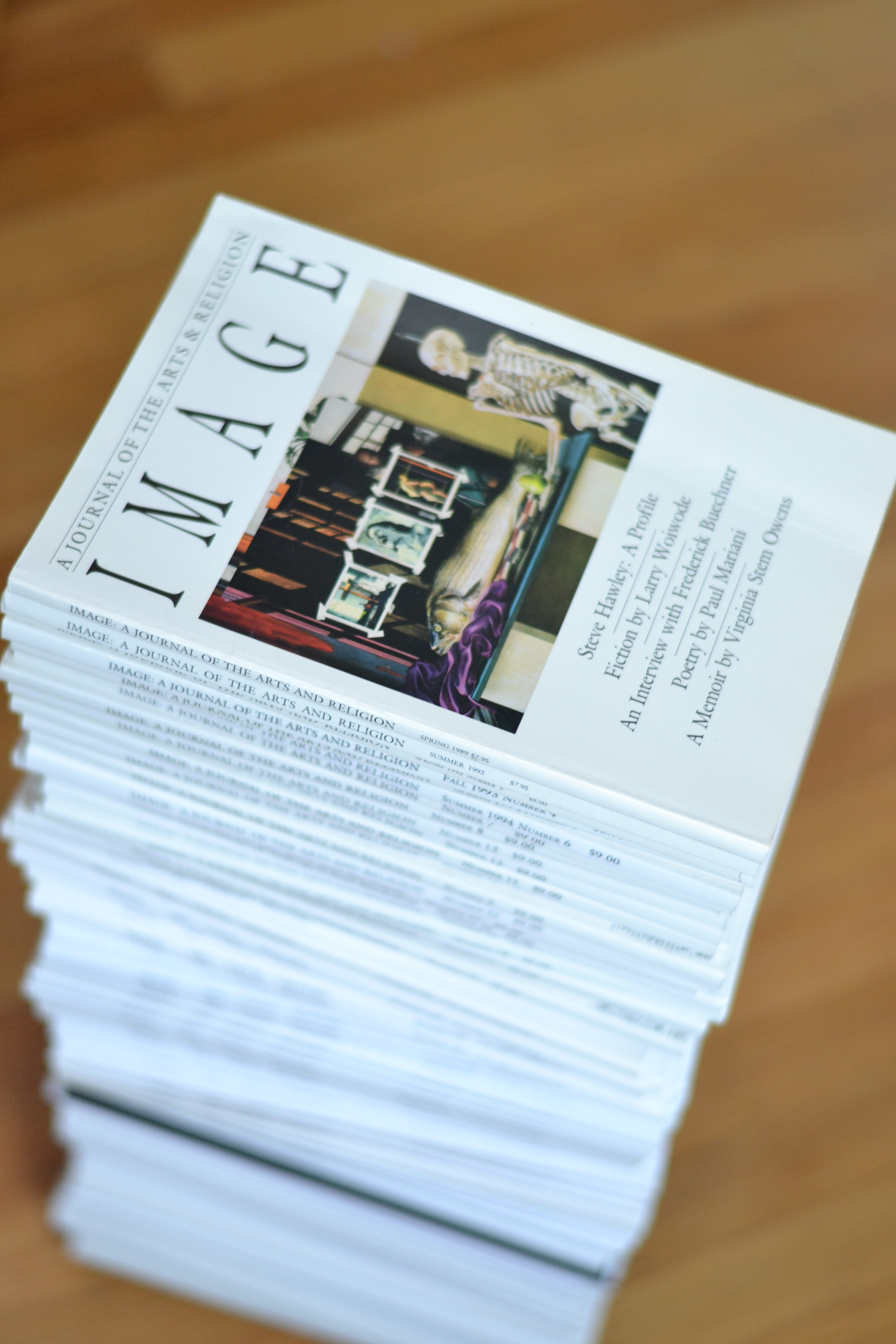 To celebrate Image*’s twenty-fifth anniversary we are posting a series of essays by people who have encountered our programs over the years.*
Guest post by Cathy Warner
It was a reading at a memorial service that got me riled.
“Death is nothing at all. It does not count. I have only slipped away into the next room.” Don’t be sad, my pastor read, “All is well. Nothing is hurt; nothing is lost.”
Watching the tearful widow, who’d now be living alone after forty years, I was unconvinced and angry the dead man’s missive denied the living their grief.
I penned an alternative letter, then another, and another, until I imagined half a dozen dead—an aged father, alcoholic wife, young solider, child molester, husband who succumbed to cancer—writing from the beyond to those they’d loved and those they’d wronged.
It was the inner-city teenage girl—innocent victim of a drive-by shooting—I conjured that got me kicked out of the Christian writer’s conference in 2002 before I arrived. Evidently I was the first participant who wrote a character that said (of getting shot): “Fuck that shit.”
More than one student complained to our instructor upon receiving my manuscript, she explained in an email. She understood what I was trying to do, but this was a Christian program, and my language was offensive. I should submit something else.
Yes my language was raw, but I’d written as true to life as my imagination and skills allowed.
I was part of a secular writing group that liked the letters, but I’d wanted to know what other people like me—Christian writers—thought. My F-bomb made it clear.
On my end, I hadn’t known what to make of their stories. In one, a sniper was reclaiming a futuristic United States overrun by Communists. As the body counted mounted the protagonist thought, “gosh darn it, they deserve it.” In another a battered wife plotted her husband’s murder as casually as folding laundry, with a quick, “forgive me God,” tossed in.
There was no grappling with conscience, no authentic emotion, no attempt to tell the truth, no desire to make art. I’d been willing to read their stories in good faith and to offer constructive feedback, until they weren’t willing to do that for me.
I withdrew from the conference, thinking that was the end of marrying writing and faith. But the next spring, I received my first issue of Image journal, #38 Bringing Home the Work: The Artist & The Community (recommended by the same person who suggested the writers conference) just as I was appointed pastor of my home church, a small shrinking congregation unable to afford ordained clergy.
I expected another stapled Christian magazine filled with 250 word feel-good essays bookended by scripture printed over watermarked stock photos. I expected to be disappointed. Instead I held a sleek white journal with bold black headings and pages of original artwork.
I bracketed and double-bracketed sections of Ginger Henry Geyer’s essay, “The Misfit” (appropriate for the way I felt), highlighting a guide for ministry: “Maintaining community is surely one of humanity’s larger challenges, because true community doesn’t always make us feel good. It’s more about shaping and changing us than making us feel cozy and warm.”
And: Do your work and do it well. Invest your competency with passion. Tell the truth, even at the price of making yourself an outsider. Be an artist where you are planted, and if that’s smack in the middle of middle-class American life, so be it. Speak to the people to whom you are given.
I was given two-dozen worshippers, and eight writers in a critique group, and I gave them my best work, feeling the gap between my ideas and execution as I explored the Bible from a preacher’s point of view, and experimented with fiction.
My second issue of Image (#39) included a review of Lauren Winner’s Girl Meets God, which I promptly ordered. Finishing Winner’s memoir, I wanted to write my own meeting God: It happened in the shower, a flood of unconditional love in my mid-twenties. I lacked the understanding, vocabulary, and nerve to speak or write about it then.
Inspired, I gave it a try. It was difficult for my writing group—atheists and non-practicing Jews—to offer feedback when they didn’t share my beliefs, so I wrote about awkward childhood moments in church and youth group, the many times I was “introduced” to God, but hadn’t seen beyond the suited men or leader’s sexy smile.
In Fall 2004, the back cover of Image #43 announced the formation of a new low-residency MFA program at Seattle Pacific University (Image’s current home) for writers who “care deeply about faith and literature.” I read more on the website: “The spiritual dimension of this program is not intended to produce didactic, sectarian, or sentimental literature. Nor is this MFA intended to produce writers of ‘Christian fiction.’ Far from it.”
They knew my plight. I wanted in.
I began studying creative nonfiction in the summer of 2008. Now it wasn’t fiction’s F-words that might single me out, but revealing my own actions. I confessed that fear to my mentor, Leslie Leyland Fields, with an essay I drafted describing the time I hit my oldest daughter. Leslie responded: “You can write about anything, absolutely anything and I will read it with compassion, understanding, and the desire to further the work.”
That was true for faculty and students. We critiqued manuscripts chocked with family secrets, suicide and adultery, sibling rivalry, and encounters with AIDS. No one complained about language or subject matter. There were no artificial standards to hurdle, simply the challenge to be faithful to the story, wherever that might lead.
Twice a year we gathered from far-flung locales—huddling against rain on Whidbey Island and watching sunsets in Santa Fe’s thin air—embracing our call as writers, molding long-distance learning into true belonging. We left buoyed by the grace and long reach of the Image community to resume daily lives where we are often, as Geyer writes, misfits.
Cathy Warner is the author of the poetry volume Burnt Offerings (eLectio 2014). She serves as “Good Letters” Literary Editor, and earned an MFA from Seattle Pacific University. Cathy and her husband renovate homes hiring veterans through their business Yellow Ribbon Homes, and she leads writing workshops in West Puget Sound. Her website is cathywarner.com.
Previous Post

July 8, 2014
Quitting the Cancer Battle
Next Post
July 10, 2014 Moving to Stillness
Browse Our Archives
Select a Category A. G. Harmon Alissa Wilkinson Allison Backous Art Authors Brad Fruhauff Bradford Winters Bryan Bliss Caroline Langston Chad Thomas Johnston Chris Hoke Christiana N. Peterson Culture D.G. Myers D.L. Mayfield Daniel Bowman Jr. David Griffith Elizabeth Duffy Faith Film Greg Wolfe Guest Contributor Interview Jan Vallone Jeffrey Overstreet Jessica Eddings-Roeser Jessica Mesman Griffith Kelly Foster Lindsey Crittenden Morgan Meis music Natalie Vestin Nick Olson Peggy Rosenthal Personal Reflection Poetry Friday Reflection Relationships Review Richard Chess Richard Cole Sara Zarr Shannon Huffman Polson Sonya Bilocerkowycz Tania Runyan Tony Woodlief Topical Categories Uncategorized Vic Sizemore Writing
Select a Month October 2018 September 2018 August 2018 July 2018 June 2018 May 2018 April 2018 March 2018 February 2018 January 2018 December 2017 November 2017 October 2017 September 2017 August 2017 July 2017 June 2017 May 2017 April 2017 March 2017 February 2017 January 2017 December 2016 November 2016 October 2016 September 2016 August 2016 July 2016 June 2016 May 2016 April 2016 March 2016 February 2016 January 2016 December 2015 November 2015 October 2015 September 2015 August 2015 July 2015 June 2015 May 2015 April 2015 March 2015 February 2015 January 2015 December 2014 November 2014 October 2014 September 2014 August 2014 July 2014 June 2014 May 2014 April 2014 March 2014 February 2014 January 2014 December 2013 November 2013 October 2013 September 2013 August 2013 July 2013 June 2013 May 2013 April 2013 March 2013 February 2013 January 2013 December 2012 November 2012 October 2012 September 2012 August 2012 July 2012 June 2012 May 2012 February 2008
Follow Us!
TAKE THE
Religious Wisdom Quiz
What was the primary occupation in ancient Israel?
Select your answer to see how you score.
Fishing Shepherding Farming Carpentry
Related posts from Good Letters

On Writing Odes: Taking Time to Celebrate

The Stars of the Earth Cry Out


TRENDING AT PATHEOS Catholic

Creation, Preservation, and Teleology in Catholic Theology
As I write this, it is very early Monday morning. Like millions...

The Parable Of The Sower And The Word...
One of Christ’s most famous parables is that of the sower who...

Rejecting Doom: Christian Hope And Human Action
Christianity is a religion of hope. We are to have hope and...

Why I Choose the Eucharist Over the Sermon
Choose the Eucharist, Not the Sermon What are we supposed to get...

5 Design Elements Found in Spiritually Rooted Homes
Putting Spirituality Into Home Decor Our homes are more than our living...

Credo: A Story of God Told with the...
About 10 years ago, I began to imagine a personal "Credo" that...
view all Catholic blogs
Ad-Free & Subscriber Log-In Subscription Support
- About Us
- 2026 Calendar
- Videos
- Podcasts
- Library of World Religions
- Faith In Media Tracker
- Advertise With Us
- Write for Us
- Privacy Policy
- Terms of Service
- Do Not Sell My Data
- Contact Us
- Radiant Digital
- Manage Newsletter Subscriptions
- Unsubscribe From Notifications
- Sitemap
Copyright 2008-2026, Patheos. All rights reserved.
Subscription Support Ad-Free & Subscriber Log-In
Follow Patheos