
BuddhistCatholicContemplativeEvangelicalGeneral ChristianHinduJewishLatter-day SaintMuslimNew VisionsProgressive Christian
Beliefs
- Buddhist
- Catholic
- Contemplative
- Evangelical
- General Christian
- Hindu
- Jewish
- Latter-day Saint
- More Voices
- Muslim
- New Visions
- Pagan
- Progressive Christian
Topics
- Religion News
- Food and Religion
- Sports and Religion
- Religious Art
- Religious Music and Entertainment
- Religious Events
- History and Religion
- Style and Religion
- Politics and Religion
- Women in Religion
- Recreation Outdoors and Religion
- Business Finance and Religion
- Careers Workplace and Religion
- Education and Religion
- Family Parenting and Religion
- Health Fitness and Religion
- Home and Religion
- Relationships and Religion
- Technology and Religion
- Travel and Religion
Columnists
- Buddhist Columnists
- Business Finance and Religion Columnists
- Careers Workplace and Religion Columnists
- Catholic Columnists
- Contemplative Columnists
- Education and Religion Columnists
- Evangelists Columnists
- Family Parenting and Religion Columnists
- General Christian Columnists
- Health Fitness and Religion Columnists
- Hindu Columnists
- History and Religion Columnists
- Home and Religion Columnists
- Jewish Columnists
- More Voices Columnists
- Latter Day Columnists
- Muslim Columnists
- New Visions Columnists
- Nonreligious Columnists
- Pagan Columnists
- Politics and Religion Columnists
- Progressive Columnists
- Recreation Outdoors and Religion Columnists
- Relationships and Religion Columnists
- Religion News Columnists
- Religious Art Columnists
- Religious Events Columnists
- Religious Music and Entertainment Columnists
- Sports and Religion Columnists
- Style and Religion Columnists
- Technology and Religion Columnists
- Travel and Religion Columnists
- Women in Religion Columnists
Resource Library
- 2026 Calendar
- Library of World Religions
- The 100 Most Holy Places on Earth
- Patheos Answers
- Podcasts
- Videos
- Faith Leaders Database
- Anglican Episcopalian
- Bahai
- Baptist
- Buddhism
- Christianity
- Confucianism
- Eastern Orthodoxy
- Hinduism
- Holiness and Pentecostal
- ISKCON
- Islam
- Judaism
- Lutheran
- Methodist
- The Church of Jesus Christ of Latter-day Saints
- New Age
- Paganism
- Presbytarian and Reformed
- Protestantism
- Religion Behind the Scenes
- Roman Catholic
- Scientology
- Shia Islam
- Sikhism
- Sufism
- Sunni Islam
- Taoism
- Zen
- See all religions
Research Tools
 Ad-Free & Subscriber Log-In Subscription Support
Ad-Free & Subscriber Log-In Subscription Support
Follow Patheos 

- Trending:
- Forgiveness
- |
- Marriage
- |
- Consciousness
- |
- Death Penalty
- |
- Election
- |
- Halloween
 Good Letters
-
Contributors
- Home
- Catholic
- Maya Angelou’s Caged Bird and Me
Maya Angelou’s Caged Bird and Me
Last updated on: June 20, 2014 at 1:00 am by Allison Backous Troy
Maya Angelou’s Caged Bird and Me 2014-06-19T09:46:23-07:00 Allison Backous Troy
Patheos Explore the world's faith through different perspectives on religion and spirituality! Patheos has the views of the prevalent religions and spiritualities of the world.
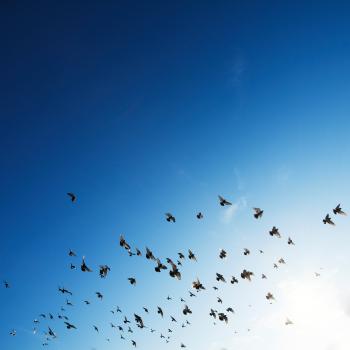
 But a plea, that upward to Heaven he flings
—Paul Lawrence Dunbar, “Sympathy”
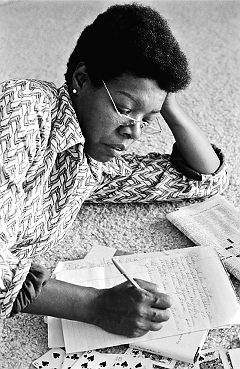
I first read Maya Angelou’s I Know Why the Caged Bird Sings when I was thirteen. I discovered the book through an interview with Fiona Apple, one of the many female singer-songwriters whose mournful lyrics poured through my boom box speakers while I slogged my way through the kickboxing routine that, according to Seventeen, would slim my hips.
Thirteen was a difficult year; I was overweight, dorky, sarcastic, and sensitive. I spent my Friday nights eating Tombstone pizza and writing Tolkien fan fiction. And it was the last year my parents, whose marriage darkened our house, would live together under the same roof.
And what Angelou’s work did in my life, in that year, was phenomenal.
I remember faking sick, as I often did, to stay home and read the book (which was a better education than what my failing middle school had to offer, anyway). It was November, and the piercing headache that had followed me for months only subsided when I was alone, listening to music or reading, away from my parents and the girls who bullied me at school.
“You are too damn smart,” they would say when I spoke in class, their hair shiny from gel and glittering butterfly clips, their breasts perky beneath the powder blue uniform shirts that my mother had to buy in men’s sizes for me. We had the same route walking home, and I often lingered in my teachers’ classrooms at the close of day, hoping that by the time I left there would be enough of a distance between us for me to walk home in peace.
At home, the only true peace was absence: my mother at work, my father asleep. I stayed home when I could and sank into my books. And what I saw in Angelou’s world, even though it was so different from mine, was a world that also felt like my own: a young woman whose surroundings sought to diminish her, but who remained distinct, alive, and beautiful.
People praise Angelou for giving voice to the personal lives of African Americans during the blight of Jim Crow. And while her work certainly provides a picture of that era, it is more portrait than documentary, the characters of her family and friends—her grandmother, her daddy, the salvific Bertha Flowers—charged with an intensity that resonated with me deeply, intuitively, despite my being white. Angelou’s memoir illumined the inner lives of the people around her, demonstrating that racism and prejudice didn’t just deny opportunity, but crushed and twisted people from the inside out.
But the book also showed me that people had incredible power to both change and remain constant, to seek beauty, to find something within themselves and the world that was not only worth loving, but worth loving rightly.
And it is through Mrs. Flowers, the elegant woman who invited Angelou over in the months after her rape and gave her cookies, tea, and poetry, that Angelou’s words became the lifeline I caught. I saw what it meant to seek beauty, to welcome others. I wished that I had my own Mrs. Flowers, who would like me for just being Allison Backous.
But I also wished for the ache in my heart, which came from my parents’ unhappiness, from our town’s poverty, and from my own self-rejection, to be heard. I wished that I could give words to what I felt, and filled notebooks with rhyming poems that contained the words “undulating” and “convalescence” (which I learned from Fiona Apple).
After reading Angelou’s memoir, I asked for her poetry for Christmas. And although it was a freer form than I was used to reading, I found in it a way to ward off the nasty girls at school, and the nastier thoughts that kept me up at night, my mother’s car mysteriously absent from the driveway. Angelou’s poetry held the power of self-assertion, affirmed the size of my hips, and told me that there was courage and strength in me that could not be silenced.
It was that courage that helped me through the next round of difficult years, my parents’ divorce, my mother’s desperate need and abandonment, her boyfriend’s secret terrors. And to this day, that courage helps me carry my history and put it on the page.
When I have talked about the abuse that fills my family life, people have asked how I faced it all. What kept me going? Those are profound questions. I don’t have full answers. Does anyone fully understand her life while she’s living it?
But I keep flinging my plea upwards, my notebooks overflowing, my heart being slowly uncaged.
Allison Backous Troy lives with her son and husband in Laramie, Wyoming. A teacher and writer with an MFA from Seattle Pacific University, Allison is a former blogger for “Good Letters.”
Previous Post

June 19, 2014
Medicating the Religious Mind
Next Post
June 23, 2014 Snapshots from the Imperial City
Browse Our Archives
Select a Category A. G. Harmon Alissa Wilkinson Allison Backous Art Authors Brad Fruhauff Bradford Winters Bryan Bliss Caroline Langston Chad Thomas Johnston Chris Hoke Christiana N. Peterson Culture D.G. Myers D.L. Mayfield Daniel Bowman Jr. David Griffith Elizabeth Duffy Faith Film Greg Wolfe Guest Contributor Interview Jan Vallone Jeffrey Overstreet Jessica Eddings-Roeser Jessica Mesman Griffith Kelly Foster Lindsey Crittenden Morgan Meis music Natalie Vestin Nick Olson Peggy Rosenthal Personal Reflection Poetry Friday Reflection Relationships Review Richard Chess Richard Cole Sara Zarr Shannon Huffman Polson Sonya Bilocerkowycz Tania Runyan Tony Woodlief Topical Categories Uncategorized Vic Sizemore Writing
Select a Month October 2018 September 2018 August 2018 July 2018 June 2018 May 2018 April 2018 March 2018 February 2018 January 2018 December 2017 November 2017 October 2017 September 2017 August 2017 July 2017 June 2017 May 2017 April 2017 March 2017 February 2017 January 2017 December 2016 November 2016 October 2016 September 2016 August 2016 July 2016 June 2016 May 2016 April 2016 March 2016 February 2016 January 2016 December 2015 November 2015 October 2015 September 2015 August 2015 July 2015 June 2015 May 2015 April 2015 March 2015 February 2015 January 2015 December 2014 November 2014 October 2014 September 2014 August 2014 July 2014 June 2014 May 2014 April 2014 March 2014 February 2014 January 2014 December 2013 November 2013 October 2013 September 2013 August 2013 July 2013 June 2013 May 2013 April 2013 March 2013 February 2013 January 2013 December 2012 November 2012 October 2012 September 2012 August 2012 July 2012 June 2012 May 2012 February 2008
Follow Us!
TAKE THE
Religious Wisdom Quiz
What does "Moses" mean?
Select your answer to see how you score.
Gifted Born Amid Trouble Rescued Drawn Out (of water)
Related posts from Good Letters
Maya Angelou’s Caged Bird and Me
TRENDING AT PATHEOS Catholic

The Parable Of The Sower And The Word...
One of Christ’s most famous parables is that of the sower who...

Rejecting Doom: Christian Hope And Human Action
Christianity is a religion of hope. We are to have hope and...

Why I Choose the Eucharist Over the Sermon
Choose the Eucharist, Not the Sermon What are we supposed to get...

5 Design Elements Found in Spiritually Rooted Homes
Putting Spirituality Into Home Decor Our homes are more than our living...

Credo: A Story of God Told with the...
About 10 years ago, I began to imagine a personal "Credo" that...

The Anatomy of Divine Revelation in Catholic Thought
The claim that God has made Himself known to human beings is...
view all Catholic blogs
Ad-Free & Subscriber Log-In Subscription Support
- About Us
- 2026 Calendar
- Videos
- Podcasts
- Library of World Religions
- Faith In Media Tracker
- Advertise With Us
- Write for Us
- Privacy Policy
- Terms of Service
- Do Not Sell My Data
- Contact Us
- Radiant Digital
- Manage Newsletter Subscriptions
- Unsubscribe From Notifications
- Sitemap
Copyright 2008-2026, Patheos. All rights reserved.
Subscription Support Ad-Free & Subscriber Log-In
Follow Patheos